With Friends Like These - A response to Rabbi Pini Dunner's letter to Prime Minister Netanyahu
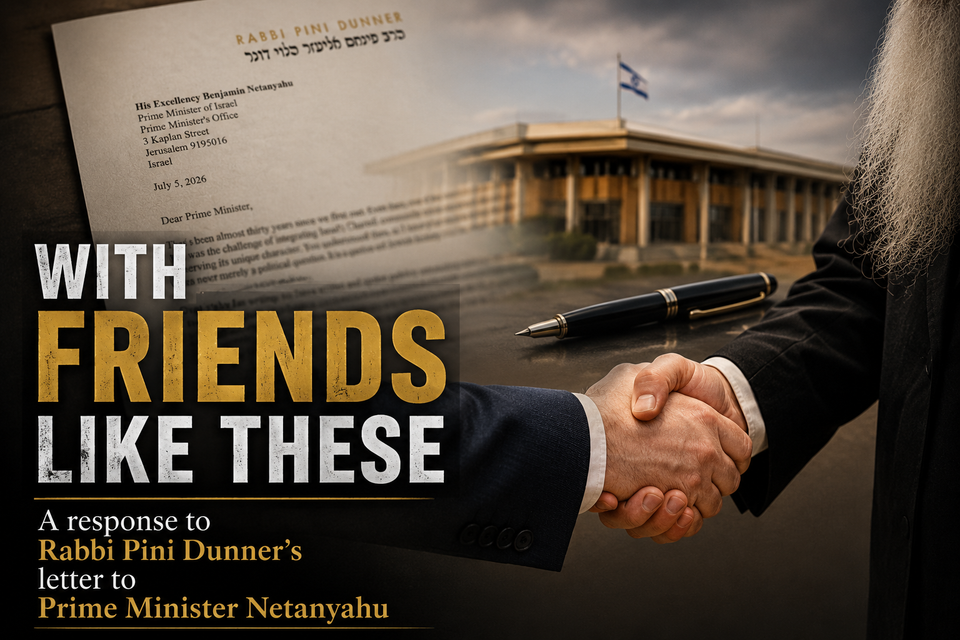
Rabbi Pini Dunner has published an open letter to Prime Minister Netanyahu about the Charedi draft crisis, and has invited public comment. He writes as a friend — warmly, sincerely, and with real distress over the arrests of bnei yeshiva. And that is precisely why his letter demands a careful answer. Because beneath the warmth, Rabbi Dunner asks the Prime Minister to stop handcuffing our sons — and to aim the state's pressure at our gedolim instead. With respect, and with full appreciation for his tone: thanks, but no thanks.
(Note: We have tried to keep our response brief and directed at the specifics of Rabbi Dunner's letter. There is much more depth to this topic and we invite you to read other articles in this series. We have listed a few of these links at the very bottom of this article)
I. What Rabbi Dunner Wrote
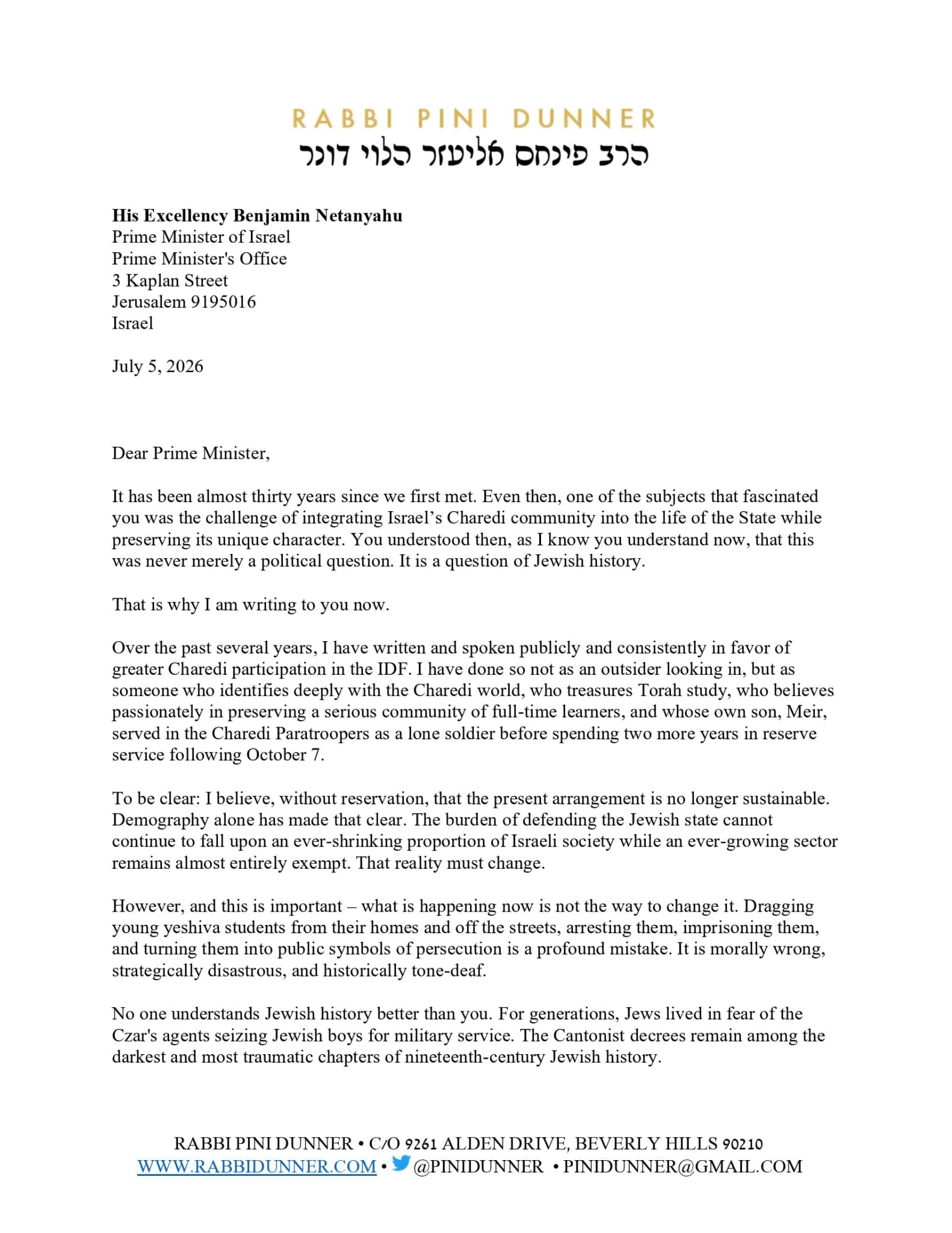
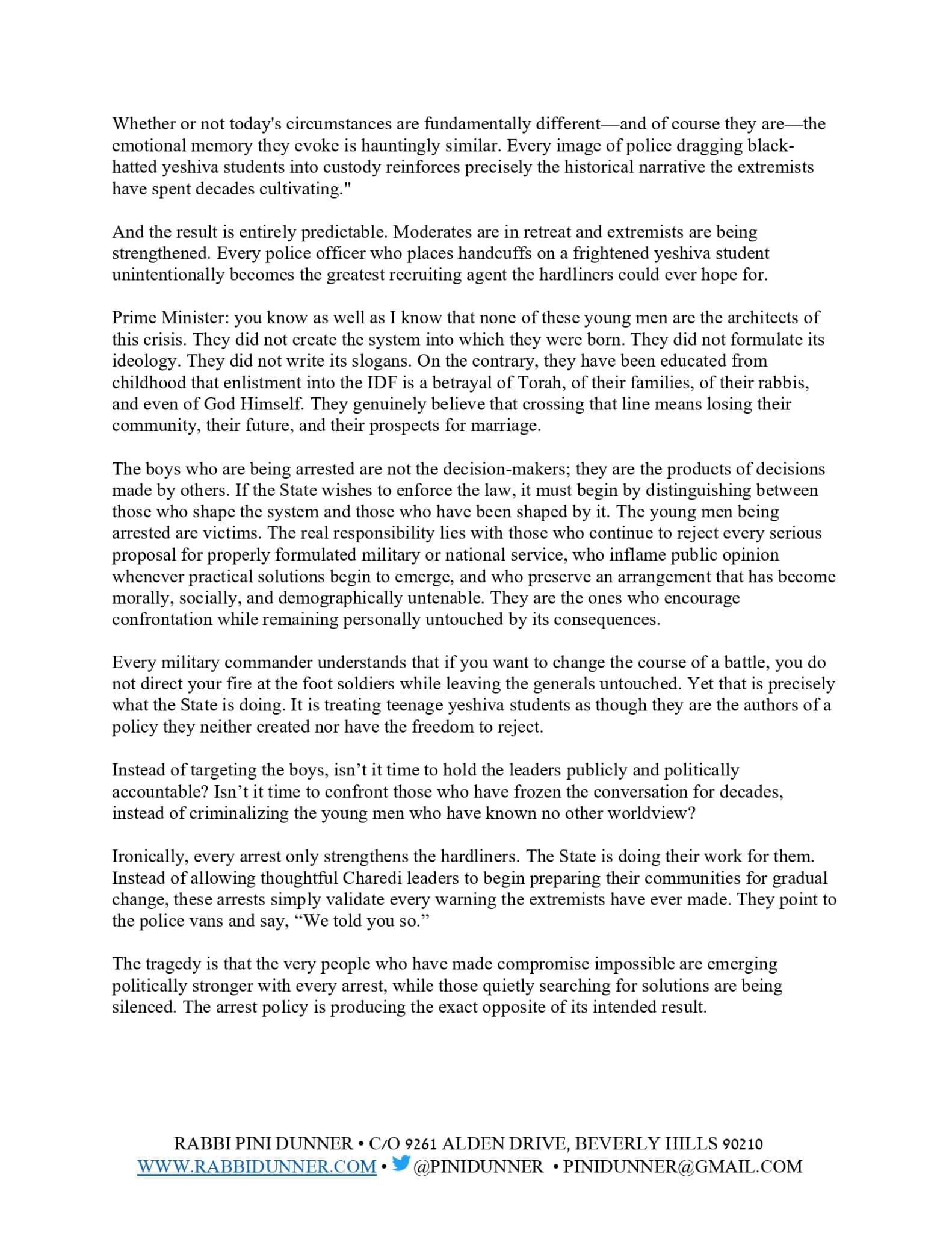
So that readers can judge for themselves, here is his argument, stated fairly. (The letter itself is posted above and is worth reading in full alongside this response.)
Rabbi Dunner opens by presenting himself as anything but an outsider: a man who identifies deeply with the Charedi world, treasures Torah study, believes passionately in preserving a serious community of full-time learners — and whose own son served in the Charedi paratroopers as a lone soldier, followed by two further years of reserve duty after October 7. He then states his position without hedging: the present arrangement, he believes, is no longer sustainable. Demography alone has settled the question; the burden of defense cannot keep falling on a shrinking share of society while a growing sector remains, in his words, almost entirely exempt. That reality, he tells the Prime Minister, must change.
But — and here is the heart of his letter — the arrests are not the way to change it. Dragging yeshiva students from their homes, imprisoning them, and turning them into public symbols of persecution is, he argues, morally wrong, strategically disastrous, and historically tone-deaf. He invokes the Cantonist decrees and the generations of Jewish dread of the Czar's snatchers, granting that today's circumstances are of course fundamentally different while insisting the emotional memory is hauntingly similar. Every image of police leading away a black-hatted bochur, he warns, validates the very narrative the "extremists" have cultivated; the moderates retreat, the hardliners grow stronger, and every arrest becomes their best recruiting tool.
And then he arrives at his central claim. These young men, he writes, are not the architects of the crisis. They did not build the system, author its ideology, or write its slogans; they were educated from childhood to believe that enlistment betrays the Torah, their families, their rabbis, and God Himself, and they genuinely believe that crossing that line means losing their community, their future, and their shidduch prospects. In his words: "the young men being arrested are victims." The real responsibility, he argues, lies with the leaders — those who reject every serious proposal for properly formulated military or national service, inflame public opinion whenever solutions emerge, and preserve an untenable arrangement while remaining personally untouched by its consequences. His prescription follows: stop targeting the boys, and hold the leaders publicly and politically accountable instead — while allowing "thoughtful Charedi leaders" to begin preparing their communities for gradual change.
That is the letter. Now let us answer it.
II. Credit Where It Is Due
First, what deserves acknowledgment. Rabbi Dunner opposes the arrests, and he said so directly to the Prime Minister — plainly, publicly, and at some cost to himself in the circles that cheer the arrests on. He honors the memory of the Cantonist trauma rather than mocking it, as so many commentators now do. And regarding his son: a father's pride is his own, the young man's sincerity is not ours to question, and we bear him nothing but goodwill. None of what follows is directed at either of them personally.
But warmth is not the same as truth, and it is precisely because this letter is warm that its errors are dangerous. Hostile op-eds refute themselves. This one arrives gift-wrapped — and inside the wrapping is a set of claims that no Torah Jew can let pass.
III. The Core Offense: Our Sons Are Not "Victims" of Their Own Torah
Consider carefully what Rabbi Dunner is actually saying when he calls the arrested bochurim victims — not victims of the state that handcuffs them, but victims of the community that raised them. They were "educated from childhood," he writes, to believe that enlistment betrays the Torah. They are the "products" of decisions made by others. In this telling, a bochur's deepest convictions are not convictions at all. They are conditioning. His emunah is indoctrination; his loyalty to his rebbeim is captivity; his readiness to sit in a military prison rather than betray the mesorah is not courage but helplessness.
We must say this as clearly as it can be said: this is the deepest possible insult, dressed in the language of compassion.
Because what Rabbi Dunner calls a "system" that "shaped" these boys, the Torah calls the mesorah — and transmitting it to our children is not some sociological accident we should apologize for. It is the mitzvah itself. "V'shinantam l'vanecha" — you shall teach them diligently to your children (Devarim 6:7). "V'hodatam l'vanecha v'livnei vanecha" — make them known to your children and your children's children (Devarim 4:9). The entire structure of Torah Judaism is a chain of exactly this: Moshe received the Torah from Sinai and handed it on (Avos 1:1), and every generation since has "educated its children from childhood" in its convictions — which is precisely why there are still Jews in the world. By Rabbi Dunner's logic, every generation of Jews who held fast under pressure — under Rome, under the Church, under the Czar, under the Soviets — were not heroes of emunah but victims of their chinuch. Does he believe that? We hope not. But it is where his argument goes.
And listening to the chachamim is not a malfunction in that system — it is its beating heart. "Al pi haTorah asher yorucha... lo sasur min hadavar asher yagidu lecha yamin u'smol" — according to the Torah that they teach you shall you act; do not deviate from what they tell you, right or left (Devarim 17:11), upon which Rashi teaches: even if they tell you that right is left. Emunas chachamim is not a Charedi eccentricity to be gently re-educated out of the next generation. It is the very basis on which the Torah has survived at all. A bochur who follows his rebbeim and the gedolim is not exhibiting a symptom. He is doing exactly what the Torah commands every Jew to do — and what Rabbi Dunner's own ancestors did, or he would not be here to write letters about it.
Nor are these boys the passive "products" he imagines. Any one of them could walk out the door tomorrow; the state would receive him with a stipend and a photo opportunity. They stay. Some go to prison rather than budge. One of them — the Mir bochur whose arrest set off a storm — was detained when he went, on his own two feet, to the recruitment office to put his status in order. These are not hostages of a worldview. They are heirs of one, and they hold it with both hands. To "rescue" them from their own convictions is not kindness. It is contempt wearing kindness's coat.
IV. "Hold the Leaders Accountable" — Read Carefully What This Means
Now to the letter's practical proposal, which deserves to be stated in the starkest terms, because its warmth conceals its edge. Rabbi Dunner reaches for a military metaphor: no commander directs his fire at the foot soldiers while leaving the generals untouched. Stop arresting the boys, he tells the Prime Minister — and hold the leaders publicly and politically accountable.
Understand who "the leaders" are. They are the Gedolei Yisrael. The Roshei Yeshiva. The rabbanim of the communities. Rabbi Dunner is asking the head of the secular state to redirect its coercive attention away from the students and toward the gedolim of the generation — to treat the Torah leadership of Klal Yisrael as the guilty party to be confronted, pressured, and politically broken. And this is offered as the friendly alternative. With friends like these, who needs the enforcement division?
His indictment of these leaders does not survive inspection either. They "reject every serious proposal," he says, and preserve the arrangement "while remaining personally untouched by its consequences." Personally untouched? The funding cuts fall on their yeshivos. The Roshei Yeshiva gathered at the home of Rav Dov Landau carry every arrested bochur on their shoulders — yeshivos convene tefillah gatherings for a single detained talmid, and senior Roshei Yeshiva have asked to sit with imprisoned bochurim in their cells. These are not distant executives insulated from the fallout. They are shepherds who feel every blow that lands on the flock.
And their "rejectionism" is nothing of the sort. It is fidelity to a principle Rabbi Dunner's letter never once engages: that the army, as it actually exists, is an environment in which a yarei Shamayim cannot remain what he is — and that the gedolim's role, precisely as leaders, is to say no when no is the truth. As for the letter's tidy division of our world into retreating "moderates" and strengthening "hardliners," with "thoughtful Charedi leaders" waiting in the wings to prepare us for "gradual change" — we have seen this frame before. It is the oldest move in the playbook: split the community from its gedolim, crown alternative leadership more amenable to the state's needs, and call it progress. We decline.
V. The Premise Underneath It All Is False
But the letter's deepest problem comes earlier, in the paragraph where Rabbi Dunner concedes the state's entire case in three sentences: unsustainable, demography, the burden must be shared. He presents this as beyond argument. It is not. It is precisely the argument.
The manpower story does not survive contact with the facts. The shortage the state now brandishes was manufactured in its own defense ministry: for over a decade, under the "small but smart" doctrine — the conceptzia — the IDF deliberately cut its own combat units and released tens of thousands of reservists from duty. When October 7 came and the country was supposedly desperate for every soldier, at least four thousand Charedim who volunteered to enlist were turned away; Charedi veterans who volunteered for reserves were never called; tens of thousands of reservists across the population have not been summoned once. And at this very moment, the government is pouring hundreds of billions of shekels into a drone-and-AI military — the Prime Minister's own "Super Sparta" — designed expressly to need fewer soldiers, not more. Even Rabbi Yigal Levinstein, a Religious Zionist rosh mechina with no brief for our position, said it flatly this month: the soldier shortage is not because of the Charedim, who were never part of the army's manpower base to begin with.
As for "almost entirely exempt" — the phrase gets the Charedi community exactly backwards. Our sons are not exempt from national service. They are bound to a different one, the oldest one: the limud haTorah that the mesorah has always understood to be the true shield of the Jewish people — Torah magna umatzla, the Torah protects and rescues (Sotah 21a). One may reject that belief; Rabbi Dunner, who says he treasures Torah study, presumably does not. But then let him not describe the beis medrash as a sector carrying nothing. And if it is truly bodies the state lacks, there are oceans of non-service to draw from before it reaches the yeshivos — the secular evaders, the surging exemptions, the entire sectors the draft has never touched. The insistence on looking only at the one community whose refusal is principled tells you what this campaign is actually about.
VI. "Properly Formulated Service" — Against the Evidence of This Very Month
Rabbi Dunner faults our leaders for rejecting "serious proposals for properly formulated military or national service." Very well: let us test the phrase against what the army is doing, right now, to the religious soldiers it already has.
The Chief of Staff stood before Religious Zionist rabbis this month and told them women's integration into combat will expand "without compromise." The Rosh Yeshiva of the Eli hesder yeshiva — whose students fight and bleed for this army — answered publicly that he does not believe a single word of the army's assurances about the Joint Service Ordinance, because the IDF drafted that ordinance and then spent years deliberately not implementing it. More than twenty-five hesder yeshivos are boycotting the Armored Corps. Wives of soldiers in Lebanon published a photograph of a female soldier bedded down among their husbands. Rabbi Levinstein ruled that his students may no longer join the army's most elite unit because the promised "separate teams" dissolve after training — and for saying so, the Chief of Staff had him removed from the dialogue meeting, while hundreds of female officers wrote demanding the rabbis' intervention be shut down entirely.
This is how the army keeps faith with the religious soldiers who serve it most devotedly. On what conceivable basis, then, does Rabbi Dunner ask the gedolim to gamble tens of thousands of Charedi neshamos on the very promises being broken, in public, this very month? The gedolim are not "freezing the conversation for decades." They are reading the evidence — evidence Rabbi Dunner's letter does not mention once.
VII. The Cantonist Memory He Invokes, Then Runs From
Finally, the history. Rabbi Dunner reaches for the Cantonist decrees — and then immediately retreats, assuring the Prime Minister that today's circumstances are of course fundamentally different, and only the emotional memory is similar. But he has it inverted. The trauma of the Cantonist era was never merely that boys were taken. It was what they were taken for: a state seizing Jewish children for an army with the purpose of remaking them — of returning them, if they returned at all, as something other than the Jews their parents raised. And that purpose has been stated openly about the Charedi draft by the state's own voices for nearly a century, from the founding generation's declared ambitions for the "new Jew" to the op-eds of this very year that speak of the army as the tool that will finally integrate, modernize, and dissolve the Charedi world into the general one. The uniforms changed. The aim of unmaking the Torah Jew did not. Rabbi Dunner feels the memory — his letter proves it. He simply refuses to accept what the memory is telling him.
VIII. Thanks, But No Thanks
So here is our answer to a man who calls himself our friend, and who, we are prepared to believe, sincerely means to be one.
We do not need friends who would defend our children by indicting our Torah. We do not need advocates whose mercy for the bochur consists of transferring the handcuffs to his rosh yeshiva. And we certainly do not need the state's help selecting "thoughtful leaders" to prepare our communities for a "gradual change" our gedolim have ruled out — because a friendship whose end point is the dissolution of everything we are is not friendship at all, however warmly it is worded.
We have seen, this very season, what a real bridge looks like. Rabbi Yigal Levinstein — a man who disagrees with us on the deepest questions of hashkafah — stood up and told the truth about the manufactured shortage, refused to scapegoat the Charedim, and demanded that this community be respected as it is, not re-engineered into something the state finds more convenient. That is friendship across a divide: truth plus respect, with no demand that we stop being ourselves as the price of his goodwill.
To Rabbi Dunner we say, with genuine respect: your love of Torah study, we take at your word. Extend the same courtesy to the gedolim whose Torah it is. Our sons do not need to be rescued from their rebbeim. They need friends who will defend their right to listen to them — for that right is nothing less than the mesorah itself, the unbroken chain by which the Torah has come down from Sinai into their hands. Defend that, and you will find no warmer allies than us. Ask us to trade it for the state's approval, and our answer will be the one we have given every empire that made us the same offer: thank you, but no.
May Hashem protect every ben Torah, strengthen the hands of our gedolim, and turn the hearts of all who love His Torah — even our critics — to stand beside it without condition.
Sources
The letter under discussion
- The open letter of Rabbi Pini Dunner to Prime Minister Netanyahu (July 2026), circulated publicly by its author with an invitation for comment, summarized in Section I above
The Torah foundations
- Devarim 6:7 — v'shinantam l'vanecha — and Devarim 4:9 — v'hodatam l'vanecha v'livnei vanecha — the mitzvah of transmitting the Torah and its convictions to one's children; Avos 1:1 — the chain of the mesorah from Sinai; Devarim 17:11 with Rashi — lo sasur, the obligation to follow the guidance of the chachamim, even if they say right is left; Sotah 21a — Torah magna umatzla, the Torah as the shield of Klal Yisrael
The facts of the manpower question
- The pre-crisis "small but smart" doctrine (the conceptzia) under which the IDF cut combat units and released tens of thousands of reservists; the 4,000+ Charedim turned away after October 7 and the Charedi reserve volunteers never called; the tens of thousands of reservists not summoned since the war began; the multi-hundred-billion-shekel "Super Sparta" technology program; and the statement of Rabbi Yigal Levinstein that the shortage is unrelated to the Charedim (Galei Yisrael, July 2026)
The army and its religious soldiers
- Chief of Staff Zamir's "without compromise" on women's combat integration; Rabbi Ohad Tirosh's statement that he does not believe a word of the army's Joint Service Ordinance assurances; the boycott of the Armored Corps by 25+ hesder yeshivos; the Lebanon mixed-sleeping-quarters photograph; the removal of Rabbi Levinstein from the dialogue meeting; and the letter of hundreds of female officers demanding an end to the rabbis' intervention — as reported across Israeli media and Yeshiva World News
The structural relationship to other articles in this series
- "Why don't Chareidim serve in the IDF" - a must read to fully understand why we don't, won't and can't be forced
- "Why Do Charedim Listen to Their Rabbanim?" — emunas chachamim, the foundation his letter mistakes for indoctrination
- "Yashar Koach, Rabbi Levinstein" — what friendship across the divide actually looks like
- "The Secular Establishment Wants to Assimilate the Charedim Through the Draft" — the aim the Cantonist memory should have taught him to see
- "The Yevsektsiya: When Jews Wage War on Torah" — A Pattern We Have Seen Before
- Maran Rabbi Yitzchak Yosef shlit”a on Drafting the Yeshivah students - Just one response from one of our Gedolim that Rabbi Dunner wants you to disregard
- Is there a halachic precedent for avoiding military service in Jewish history? - This is not our first rodeo
- Can the State of Israel Really Force Charedim to Serve in the Army? - The answer is obvious
- Their Most Devoted Soldiers Just Found Out the Truth - A wake up call to religious zionists
 Levi Schwartz