
Is It True That the Secular Establishment Wants to Assimilate Charedim Through the Draft into the IDF?
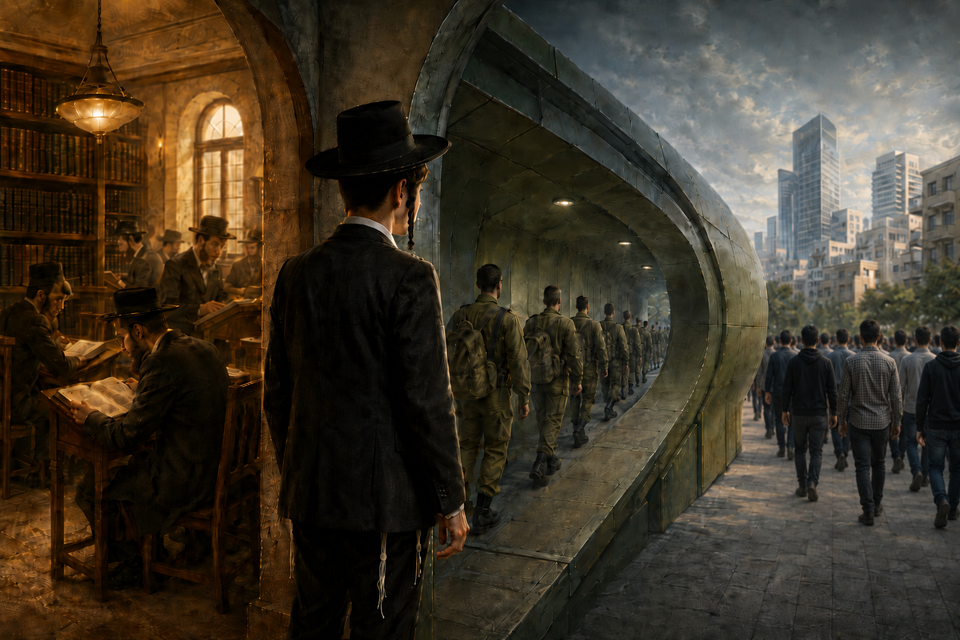
The honest answer is that the Charedi concern is grounded in documented reality, not paranoia. From Ben-Gurion onward, integrating Charedim into mainstream Israeli society has been stated openly — by prime ministers, generals, economists, and government committees — and the army's role as the nation's "melting pot" is celebrated by its own champions. Beneath it all sits a demographic anxiety: that a rapidly growing Charedi community, left un-integrated, will reshape the character of the secular state itself. Whether "integration" can be separated from "assimilation" is the real question — and the Charedi answer, grounded in how the establishment describes its own goal, is that it cannot.
Is it true that the secular establishment wants to assimilate Charedim into the secular mainstream through the IDF draft — or is this a paranoid fear that Gedolim invented to justify resistance?
The honest answer is that the concern is grounded in openly documented reality. This is not a conspiracy theory whispered in the beis medrash. The integration of Charedim into mainstream Israeli society has been an openly declared goal — stated by name, in public, by the most senior figures in the country, for as long as the state has existed. Where there is room for honest debate is in the words chosen — proponents say "integration," "equality," "sharing the burden," and "joining the workforce," not "assimilation" — and the real question is whether those gentler words can be pried apart from the harder one. The Charedi position is that they cannot — and the establishment's own statements, as we will see, give that position remarkable weight.
I. The "Melting Pot" Is Not a Secret — It Is a Founding Doctrine
The single most important fact in this discussion is that the integrationist function of the army is not something the Charedi world has to uncover. It is something the state has proclaimed with pride since its founding.
The doctrine begins with David Ben-Gurion himself. The army he built was conceived not only as a fighting force but as the nation's great kur hituch — its "melting pot," the engine of mizug galuyot, the blending of Jews from a hundred different countries and cultures into a single new Israeli identity. Military service was designed, from the start, to take the disparate tribes of the ingathered people and forge them into one secular-national whole. As scholars of Israeli society observe, military service in Israel has served, by deliberate design, to integrate the various groups into one — and Ben-Gurion's founding vision of the army-as-integrator carries weight to this day.
But a melting pot does one thing by definition: it dissolves what is placed into it. That is the entire point — to take distinct ingredients and blend them into a uniform mass. And what is a triumph from the secular-national standpoint is, from the Charedi standpoint, precisely the danger. The very feature the army's admirers boast about — its power to dissolve separate identities into a shared secular one — is exactly what the Torah world fears, because the survival of the Charedi community depends on not being dissolved into the surrounding culture. As a candid recent analysis put it, the army has long been seen as Israeli society's great equalizer and melting pot, and in the non-Charedi world that has been counted a strength — but it is also precisely what Charedi leaders fear most: they do not want that integration; they want insulation. When both sides agree on what the institution does, and disagree only on whether it is good, the Charedi fear is not a fantasy. It is a sober reading of the institution's openly advertised purpose.
II. Integration Into Society — Stated Openly, by Name
Far from being hidden, the goal of integrating Charedim into mainstream Israeli society has been stated, in plain words, by a long line of the country's most prominent figures. A sampling from the last three decades:
Yair Golan — former Deputy Chief of Staff of the IDF and, as of this writing, leader of The Democrats party — declared in 2026 that his camp would not compromise on drafting the Charedim and "ensuring their full integration into Israeli society." He has framed the entire issue as one of Israeli "tribalism," warning that the state cannot endure as separate tribes and that since 1977 the government wrongly "supported the building of barriers between the Haredim and others" — barriers he means to dismantle.
Yedidia Stern — a senior scholar at the Israel Democracy Institute who served on the government's draft committee — co-authored a prominent 2012 argument presenting an approach designed, in his words, to "facilitate the Haredi integration into Israel's army and society."
The Plesner Committee, the official government body convened in 2012 to resolve the draft question, bore the formal name the Committee for the Advancement of Equality in the Burden, and set as its goal the enlistment of roughly 80% of Charedi men — explicitly as a vehicle for bringing the community into the shared national framework, not merely to fill a manpower quota.
Haim Zicherman, who managed that committee's work, is himself a committed advocate of Charedi integration into Israeli society — though, tellingly, he warns that it must not become re-education, and that the patronizing impulse to "correct" the Charedi way of life must be abandoned. That a leading proponent of integration feels compelled to warn against its sliding into cultural erasure is itself an admission of how thin the line between the two really is.
Even the IDF's own commanders now speak the language of integration openly. The commander of the Charedi Hasmonean Brigade declared at a 2026 ceremony that "the integration of the Haredi public is genuine, and we are committed to seeing it through" — adding, in a phrase we will return to, "Not a melting pot, but integration while preserving the uniqueness of the Haredi community."
And the entire modern political project of confronting Charedi separateness traces back to Tommy Lapid and his Shinui party, which in the early 2000s built itself precisely around ending the Charedim's separate, subsidized, autonomous existence and folding the community into the secular mainstream. Across all these voices — a general, a think-tank, a government committee, an army brigade, a political movement — the word that recurs is the same: integration. It is not a Charedi invention. It is the establishment's own stated objective.
III. The Demographic Engine — Why Integration Became an Existential Obsession
To understand why this goal is pursued with such intensity, one must see the anxiety beneath it — and here the establishment is, again, entirely open: the driving fear is demographic.
The Charedi community is the fastest-growing population in Israel, with a birthrate far above the national average. On current projections, Charedim are expected to make up roughly a quarter of Israel's population by 2050, and their share of the working-age population is projected to climb from around 10% today to some 30% by 2060. And the secular establishment looks at these numbers and sees a threat to the character and viability of the state as it has known it. The logic is openly stated: a rapidly growing community that does not serve in the army, does not enter the workforce in full, and does not absorb the state's secular-national culture will, as its share of the population rises, reshape the country itself — its economy, its military capacity, and its very identity.
This is not hyperbole on the Charedi side; it is the explicit framing of the establishment itself. Israel's economic authorities — the Bank of Israel, the OECD, and the country's leading economists — have for years cast Charedi integration as a matter of national survival. The OECD calls integrating Charedim into the workforce a "crucial policy challenge… in light of the demographic trends," and, revealingly, names its own preferred high-integration economic scenario the "Melting pot" scenario. A landmark study found that the continued "limited social, economic and military integration of Haredim will lead to a substantial deterioration in Israel's economy and national resilience." In 2024, more than a hundred of Israel's most prominent economists issued a collective warning that, without a change in the current trajectory, "these processes endanger the country's very existence." Mainstream headlines put it more bluntly still: failure to integrate the Charedim, experts warn, could eventually threaten the country's very existence.
Read this plainly, because it is the key to the entire matter. The establishment is not merely asking the Charedim to share a military burden. It is declaring that the growth of the Torah community, absent its integration into secular Israeli society, is an existential threat to the state as a secular entity — and that integration is the remedy. This is precisely the Charedi claim, stated by the other side: that the goal is not to recruit some soldiers, but to absorb a growing community before it can change the character of the country. The Charedi world did not have to invent this fear. It has only to read the reports, the op-eds, and the economists' warnings, in which the integration of the Charedim is openly framed as essential to preserving the secular state against the implications of Torah-faithful demographic growth.
IV. The Politicians Pressing Hardest Are No Neutral Reformers
It is worth being honest about the leading political champions of the draft, because they are routinely presented as dispassionate advocates of fairness — and their own records tell a different story. These are not neutral actors reluctantly insisting on equality; they are figures with a long, documented record of hostility and contempt toward the Torah community.
Consider Avigdor Lieberman. The Charedim have been, in the words of one report, a "favourite target" of his campaigns. In 2019 his Yisrael Beiteinu ran a slogan that openly likened the Charedim to Hamas — "whether you surrender to those who raise weapons or those who refuse to raise them, surrender is surrender" — placing Torah Jews and a genocidal terror organization in the same frame. His campaign clips featured Border Police marching black-hatted Jews wrapped in tallisos to army recruitment centers, trading in a stereotype of the "black-clad," money-grubbing Charedi that observers across the spectrum recognized as incitement. And tellingly, analysts noted that Lieberman spoke in different voices to different audiences — soft and conciliatory in Hebrew ("we are only asking you to participate"), crude and threatening in Russian, where the Charedim were a target of open contempt. A man who shows one face to the community he is pressuring and another to his base has revealed which face is real.
Or consider Yair Lapid. He inherited the cause from his father, Tommy Lapid, who built the Shinui party around bringing the Charedim "to heel" and who openly branded them "parasites," "primitives," and "enemies of progress." The son's rhetoric has been only modestly gentler: he has called Charedi education budgets "loot," denounced subsidies as "endless extortion," declared that the system tells working Israelis "the suckers will pay for you," slashed Charedi funding when he held the purse, moved to abolish most Charedi exemptions, and, by one sympathetic account, "gleefully sparred" with Charedi lawmakers. This is not the vocabulary of a neutral reformer balancing competing goods; it is the vocabulary of an adversary.
It is true — and honesty requires saying it — that neither man has stood up and proclaimed, in those words, "our goal is to end Charedi Yiddishkeit." Lapid has at times offered reassuring lines, even telling the Charedim "we need you" and disclaiming any wish to force secularism upon them. But weigh those reassurances against the record. A politician who calls your Torah institutions "loot," who compares your community to Hamas, who campaigns on images of police dragging Jews in tallisos to induction centers — and who then, in a softer moment, promises he means you no harm — has not earned the benefit of the doubt. The honeyed word and the hostile deed come from the same mouth, and a community would be foolish to credit the word over the deed.
And here is the decisive point. Even setting aside what is in any individual's heart, the question is what they are pushing for and what it would do. These are the men working hardest to force the Charedi tzibbur into the institution openly built as the nation's melting pot — and a melting pot does not ask the intentions of the one who lights it. When figures with a documented record of contempt for the Torah world labor to drive its sons into the very furnace designed to dissolve them, the Charedi world is under no obligation to accept "but it's only about sharing the burden" at face value. The framing of "fairness" is the gentlest possible name for what the record shows to be something far less gentle.
V. Even the Reassurances Concede the Fear
Perhaps the clearest proof that the Charedi concern is grounded comes from an unexpected direction: the very efforts now being made to reassure the Charedi world concede that the fear is real and well-founded.
As the pressure to draft Charedim has intensified, the IDF has begun issuing protocols and statements aimed at calming exactly this anxiety — and in doing so, it has effectively admitted what the anxiety is about. A recent analysis described the army as trying to neutralize what has become the central Charedi argument against enlistment, voiced not only by rabbinic leaders but by ordinary Charedi parents: that conscripts who enter the IDF as Charedi will emerge as something else. The IDF's new message, the analysis noted, amounts to a novel claim: that "integration need not mean assimilation," that walls can be erected inside the army if that is what it takes. And recall the Hasmonean Brigade commander's careful phrasing — "Not a melting pot, but integration."
Read those reassurances carefully, because they are admissions. One does not labor to promise "not a melting pot" and "integration need not mean assimilation" unless the worry that integration does mean assimilation is real, widespread, and grounded enough to require answering. The very vocabulary concedes the point: the institution acknowledges that the natural, expected result of putting a Charedi young man through the system has been that he emerges changed — and is now scrambling to claim that this time, with the right protocols, it will be different. The Charedi world is entitled to be skeptical of that promise — particularly given the documented record of broken promises we have detailed elsewhere — but the very need to make it confirms that the fear was never paranoid. The melting pot is real; the only new claim is that this time someone will be held out of it.
VI. Why the Torah World Does Not Believe the Two Can Be Separated
This is the heart of the matter. The proponents say integration; the Charedi world hears assimilation; and the disagreement comes down to a single question: can a Charedi young man be put through an institution explicitly designed to forge a common secular-national identity, and emerge with his Charedi identity intact?
The Charedi answer is no, and the reasons are not mysterious. An institution does what it is built to do. The army is not a neutral container; it is, by the open admission of its own founders and admirers, a powerful engine of acculturation — total in its environment, immersive, designed precisely to override prior identities in favor of a shared one. To place a young man, at the most formative age, into such an environment for an extended period — surrounded by a culture whose values are not Torah values, under an authority that is not Torah authority — is, the Charedi world holds, to subject his Charedi identity to exactly the dissolving pressure the institution was created to apply. The melting pot does not melt everyone except the Charedim. That is not how melting pots work.
This is why the Charedi world treats "integration" and "assimilation" as, in practice, the same trajectory under different names — and why it is unmoved by assurances to the contrary. It is not that every official harbors a malicious secret plan to destroy Charedi Yiddishkeit; it is that the openly stated goal (integration into mainstream Israeli society and culture), pursued through the openly celebrated mechanism (the army as melting pot), driven by the openly stated motive (defusing the demographic "threat" of a growing Torah community), produces the feared result (the dissolution of Charedi identity) whether or not every individual names that result as his aim. The intention of any one politician is almost beside the point. A community is not reassured that the fire was lit for warmth rather than for burning, when it is the community itself that has been placed in the flames.
VII. The Closing Position
So — is it true that the secular establishment wants to assimilate Charedim through the draft?
The careful answer is this. No major secular politician has stood up and declared, in those exact words, a goal of erasing Charedi identity; the dominant framing is "equality" and "sharing the burden," and fairness requires saying so. But the Charedi concern is in no way a paranoid fantasy. The integration of Charedim into mainstream Israeli society has been an openly stated goal from Ben-Gurion's founding melting-pot doctrine to Yair Golan's pledge of their "full integration into Israeli society"; the army's function as the nation's great cultural dissolver is celebrated, not hidden; government committees, generals, and brigade commanders speak the language of integration without embarrassment; and the entire project is driven by an openly declared demographic anxiety — the fear that a fast-growing Torah community, left un-integrated, will reshape the secular state itself. The establishment has told us, in its own words, what it is trying to do.
The disagreement, in the end, is not about the facts but about whether two words can be pried apart. The proponents insist that Charedim can be integrated without being assimilated. The Torah world, looking at the openly advertised nature of the institution and the openly stated motive behind it, answers that an engine built to dissolve separate identities will dissolve the identity placed into it — and that "integration" through such an engine, for such a purpose, simply is assimilation, whatever it is called. That is not a conspiracy theory. It is the community's sober reading of what its own opponents say the army is for, and why they want the Charedim inside it.
The deeper truth is the one this entire series returns to: the survival of the Torah community has always depended on its refusal to be dissolved into the surrounding culture — and a Jew who understands that will understand why the Charedi world hears, in the warmest language of "integration," the oldest danger of all.
Sources
The "melting pot" — a founding doctrine, openly celebrated
- The founding doctrine of David Ben-Gurion that the IDF would serve as the nation's kur hituch (melting pot) for mizug galuyot — forging the ingathered tribes into a single Israeli identity through military service; the documented scholarly observation that military service in Israel was designed to "integrate the various groups into one"
- The candid recent analysis (Jerusalem Post, February 2026) that the IDF has long been seen as Israeli society's "great equalizer" and "melting pot," and that "they do not want that integration; they want insulation" — the army's melting-pot function being "precisely what haredi leaders fear most"
Integration into society — stated openly, by name
- Yair Golan (former IDF Deputy Chief of Staff; leader of The Democrats), 2026 — the pledge to ensure the Charedim's "full integration into Israeli society," and his framing of the issue as one of Israeli "tribalism" and the dismantling of "barriers between the Haredim and others" (Times of Israel; Moment, 2024)
- Yedidia Stern (Israel Democracy Institute; Plesner Committee), 2012 — an approach to "facilitate the Haredi integration into Israel's army and society" (Jerusalem Post op-ed)
- The Committee for the Advancement of Equality in the Burden (the Plesner Committee, chaired by Yohanan Plesner), 2012 — the goal of roughly 80% Charedi male enlistment as integration into the national framework
- Haim Zicherman (Israel Democracy Institute; Plesner Committee) — a proponent of integration who nonetheless warns it must not become re-education or the "correction" of the Charedi lifestyle — a proponent's concession that the line to cultural erasure is real and easily crossed
- Col. Shemer Raviv, commander of the Charedi Hasmonean Brigade, 2026 — "the integration of the Haredi public is genuine… Not a melting pot, but integration while preserving the uniqueness of the Haredi community" (Times of Israel)
- Tommy Lapid and the Shinui party (early 2000s) — the modern political project built around ending the Charedim's separate, subsidized, autonomous existence
The demographic engine
- The demographic projections that Charedim will constitute roughly a quarter of Israel's population by 2050, and roughly 30% of the working-age population by 2060 (Central Bureau of Statistics; OECD; Israel Democracy Institute, 2026)
- The OECD's framing of Charedi workforce integration as a "crucial policy challenge… in light of the demographic trends," and its naming of its own high-integration economic scenario the "Melting pot" scenario
- The Israel Democracy Institute's 2026 study warning that "limited social, economic and military integration of Haredim will lead to a substantial deterioration in Israel's economy and national resilience"
- The 2024 warning of more than one hundred leading Israeli economists that, on the current trajectory, "these processes endanger the country's very existence"; and mainstream reporting that failure to integrate the Charedim "could eventually threaten the country's very existence" (Haaretz)
The politicians pressing hardest
- Avigdor Lieberman and Yisrael Beiteinu — the Charedim a "favourite target" of his campaigns; the 2019 slogan likening the Charedim to Hamas ("surrender is surrender"); campaign clips of Border Police marching Charedi Jews to recruitment centers; the documented pattern of speaking conciliatorily in Hebrew while trafficking in open contempt in Russian (Middle East Monitor, 2019; Israel Hayom, 2019)
- Yair Lapid and Yesh Atid — inheriting the cause from his father Tommy Lapid, founder of Shinui, who branded the Charedim "parasites," "primitives," and "enemies of progress"; the son's characterization of Charedi education funds as "loot," subsidies as "endless extortion," and the system as making "suckers" pay (Times of Israel, 2023–2026; Tablet, 2013) — and the gap between such rhetoric and his occasional reassurances ("we need you")
- The article does not claim these figures have declared a goal of ending Charedi observance in those words; it documents their record of hostility and contempt, and argues that, from such figures, the framing of the draft as mere "fairness" does not warrant the benefit of the doubt — particularly as what they press for is the entry of the Torah community into the institution openly built as the melting pot
The reassurances that concede the fear
- The IDF's recent protocols and messaging aimed at the central Charedi argument — "that conscripts who enter the IDF as haredi will emerge as something else" — and its novel claims that "integration need not mean assimilation" and that "walls can be erected inside the army" (Jerusalem Post, 2026), the very making of which concedes that the fear is real and widespread
The Charedi reading
- The argument that an institution built and openly celebrated to dissolve separate identities into a shared one will dissolve the Charedi identity placed into it — so that "integration" through such a mechanism, for the stated purpose of defusing Charedi demographic growth, is in practice assimilation regardless of any individual's intent
- The documented concern of the Gedolim that conscription aims at reshaping Charedi identity, not merely recruiting soldiers — presented as their documented concern rather than as a verbatim quotation
The structural relationship to other articles in this series
- "Why Does the Charedi World Frown on 'Charedi' IDF Programs?" — the broader case against the frameworks, the broken promises, and the spiritual and physical dangers
- "Why Is Torah Learning the Top Priority?" — the identity the melting pot would dissolve
- "Do Charedim Believe They Are the Only Ones With This Task?" — survival through fidelity to the pure mesorah, free of the surrounding culture's "isms"