
This Is How You Build a Bridge - Yashar Koach, Rabbi Levinstein
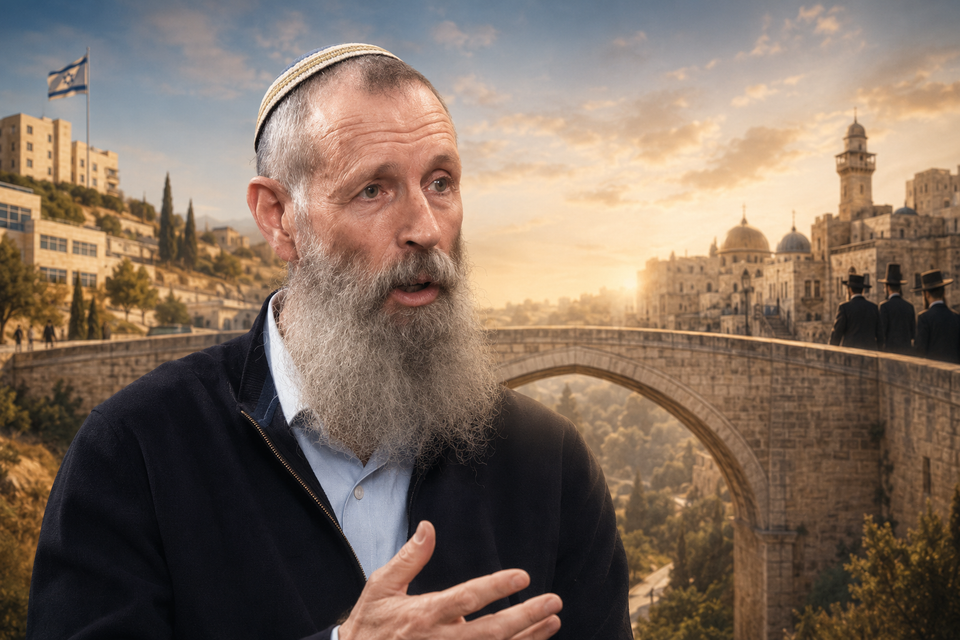
Every so often, in the middle of a bitter and exhausting fight, a voice rises from an unexpected place and simply tells the truth. This week that voice belonged to a Religious Zionist rosh mechina — and the Charedi world owes him a debt of gratitude and a loud, unembarrassed yashar koach.
Rabbi Yigal Levinstein is the Rosh Mechina of the Bnei David mechina in Eli, one of the most influential institutions in the entire Religious Zionist world — a place whose talmidim serve, fight, and lead in the IDF. He owed the Charedi community nothing. He is not of our camp. And in the middle of a national pile-on, he stood up and said, plainly and publicly, exactly what our own critics refuse to hear: the army's shortage of soldiers has nothing to do with the Charedim.
I. What He Actually Said
Speaking in an interview on Galei Yisrael, Rabbi Levinstein took the entire "blame the Charedim" narrative apart in a few unhurried sentences. It is a mistake, he said, to claim that there is a shortage of soldiers because of the Charedi public. The Charedim never enlisted in the first place — they were never part of the army's manpower base — and so the manpower problem, wherever it came from, plainly began somewhere else entirely.
That is a simple point, and a devastating one. You cannot blame a shortfall on a group that was never counted in the total to begin with. Nothing about the Charedi community changed to create this crisis; the Charedim are today exactly what they have always been. So whatever broke, they did not break it.
II. The Real Cause: The "Conceptzia"
And Rabbi Levinstein did not leave it there. He pointed directly to where the problem was actually born. Long before the October 7 massacre, the IDF had embraced a doctrine it proudly called the "small but smart" army — the now-infamous conceptzia — the theory that Israel could lean on technology and firepower and get by with dramatically fewer combat soldiers. Acting on that theory, the army cut its own forces, year after year.
That decision — made in the halls of the defense establishment, not in the batei medrash — is the true origin of today's shortage. For years, the very people who set that doctrine cut the army's own ranks by design. And now those same halls stand before the nation demanding to know where the soldiers went — and pointing, of all directions, at the yeshivos, at the one community that neither made the decision nor was ever counted in the ranks it reduced.
III. The Reduction the Army Chose
To make the point concrete, Rabbi Levinstein reached back into his own life. He enlisted after the Yom Kippur War, when the State had roughly half the Jewish population it has today — and in those years, he recalled, the army fielded fourteen reserve divisions. Today, with double the population, it fields six.
One can debate how divisions are counted and sized from one era to the next. But the truth beneath the figure does not rest on the arithmetic of divisions at all, because the shrinking of the army was never an accident — it was a deliberate policy, pursued in the open for more than a decade. In the name of the "small but smart" doctrine, the IDF's own commanders steadily trimmed infantry and armored units and released tens of thousands of relatively young reservists from duty. The force did not shrink on its own. It was made smaller, on purpose, by the very people who built it — and that, not the yeshivos, is the origin of the shortfall the country is now scrambling to fill.
And here is what makes the blame campaign so hard to accept. In all those years of cutting, there were no Charedim in the army to cut — and, as Rabbi Levinstein pointed out, even the Religious Zionists were barely serving back then. The community now being blamed for the shortage was never part of the force that was reduced in the first place. You cannot lose soldiers you never had, and you cannot pin a self-inflicted reduction on the one group that stood entirely outside it.
IV. He Is Not Alone — and the Facts Are on His Side
This is not one man's contrarian opinion. The facts have been accumulating for a long time, and other honest voices — including from deep inside the army itself — have been saying the very same thing.
Consider what actually happened after October 7, when the country was supposedly desperate for every last soldier. At least four thousand Charedim who came forward wanting to enlist were turned away and sent home. Charedim who had already served, and who volunteered for reserve duty in the days after the massacre, were never called up at all. Tens of thousands of reservists from across the population — by some accounts, hundreds of thousands — have not been summoned even once since the war began, even as the army insists it needs additional combat brigades. A decorated combat officer, a man who has served hundreds of days since October 7, said it in his own interview without flinching: the Charedi conscription story is political nonsense, and the army is not, in truth, short of manpower.
When the same institution that declares itself desperate for soldiers turns thousands of willing volunteers away at the door, the word "shortage" begins to describe something other than a shortage. Rabbi Levinstein simply had the honesty to say so out loud.
V. The Wedge — and the Man Who Refused to Drive It
But the part of his message that deserves the loudest applause of all was not the statistics. It was his grief.
Rabbi Levinstein spoke with open, pained regret about the tensions that have been deliberately inflamed between the Religious Zionist and Charedi communities — and he named it for exactly what it is: someone has succeeded in driving a wedge between us. And then he said something that a smaller man would never have brought himself to say. The burden on the reserves, he insisted, will not be eased by so much as a single millimeter until a process begins that respects a population that is ideologically disconnected from the state.
Read that again, slowly, and appreciate who is saying it. A Religious Zionist rosh mechina — whose own beloved students carry the very heaviest weight of this war — stood up and asked not that the Charedim be coerced, not that they be punished, not that they be dragged into line, but that they be respected. He looked at a community he disagrees with on the deepest questions, and he refused to let it be turned into the scapegoat for a failure that was never its own.
VI. This Is How a Bridge Is Built
And here is the lesson — a genuinely hopeful one, in a season with too few of them. For all the real and profound differences between the Charedi world and the Religious Zionist world — differences of hashkafah that we have never hidden and will not paper over — what Rabbi Levinstein modeled this week is precisely what achdus looks like when it is real.
Real unity was never about agreeing on everything. It was never about one side quietly surrendering its convictions. It is about a Jew who is willing to tell the truth even when the truth does not serve his own side. A Jew who refuses to let cynical hands set brother against brother for someone else's political gain. A Jew who insists that a community he argues with be treated, all the same, with dignity and respect. If the people shaping this entire debate carried themselves the way this rosh mechina carried himself this week, the wedge would not survive a single day — and the bridge between our communities, which so many are working so hard to burn, could be rebuilt stone by patient stone.
VII. Yashar Koach
So let us say the thing that is said far too rarely across these lines, and let us say it without a trace of reservation.
Yashar koach, Rabbi Levinstein. Thank you. You owed us nothing, and you told the truth anyway. You had every reason in the world to join the chorus, and you chose instead to defend Jews who are not your own and to plead for peace between us. That is the voice of a true ohev Yisrael — and it is exactly the voice that will bring us all closer, both to one another and to the day when we finally stand together, undivided, to greet Moshiach Tzidkeinu.
May the Ribbono Shel Olam grant that more of our leaders, on every side of every divide, find that same courage and that same love — and may He unite all of His children in truth and in peace, bimheirah b'yameinu, amen.
Sources
The statement at the center of this piece
- The interview of Rabbi Yigal Levinstein, Rosh Mechina of the Bnei David mechina in Eli, on Galei Yisrael — that the soldier shortage is not caused by the Charedi community, that its true origin lies in the pre-crisis "small but smart" army doctrine (the conceptzia), and that the burden will not ease until a process begins that respects a population ideologically disconnected from the state; his recollection that the reserve army fielded fourteen divisions after the Yom Kippur War (when the population was half its current size and no Charedim served) versus six today — as reported by Yeshiva World News
The facts that confirm it
- The documented reduction of IDF combat forces over the past decade under the "small but smart" doctrine — the trimming of infantry and armored units and the release of tens of thousands of relatively young reservists from duty; the at least 4,000 Charedim who sought to enlist after October 7 and were turned away; the Charedi veterans who volunteered for reserve duty and were never called up; the tens of thousands of reservists not summoned since October 7 despite the army's stated need for more brigades; and the public testimony of a decorated reserve combat officer that the Charedi conscription narrative is political and that the army is not truly short of manpower
The structural relationship to other articles in this series
- "Side by Side, Not Apart: What the Chief of Staff Just Told Us About the Draft" — the manufactured shortage examined in full
- "To Our Dati Leumi Brothers: Stand With Us" — the unity this piece celebrates
- "The Secular Establishment Wants to Assimilate the Charedim Through the Draft" — why the blame is aimed where it is