Rav Asher Weiss's Home Pulls His Name From HaTzibbur HaCharedi, the Party of His Own Talmid, Rabbi Yehoshua Pfeffer
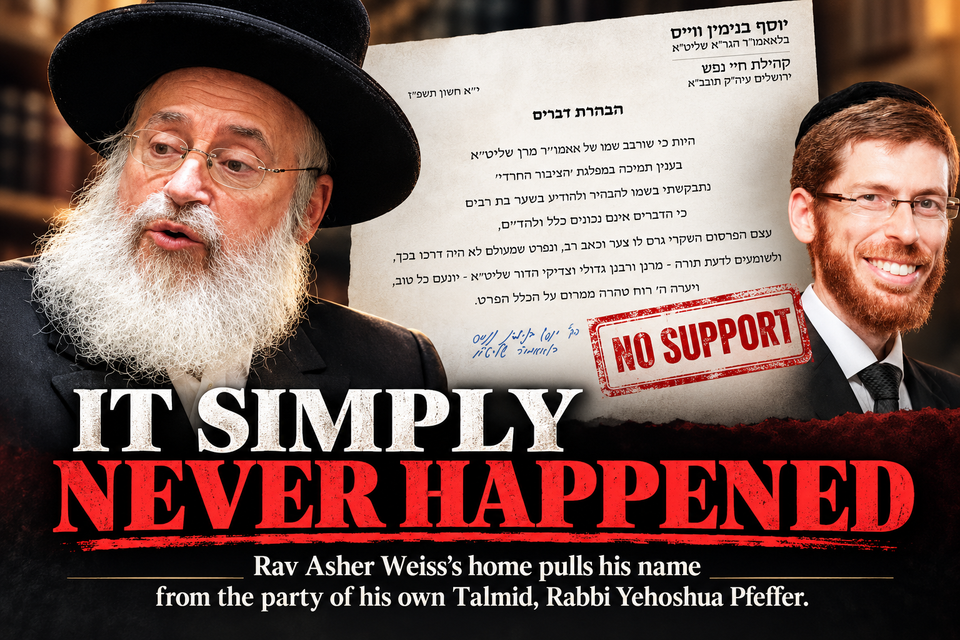
"It Simply Never Happened"
Three days before the election, a letter has been published from the home of HaGaon Rav Asher Weiss, shlita — the Minchas Asher, among the most revered poskim alive. Written by his son, Rav Yosef Binyamin Weiss, explicitly at his father's request and in his father's name, it addresses the rumor that the Minchas Asher supports the "HaTzibbur HaCharedi" party. The answer is delivered in the sharpest term the halachic vocabulary possesses for a falsehood: lahadam — lo hayu devarim me'olam, the things simply never happened. The rumor is false in its entirety, the letter states; the false publication itself caused the Rav "pain and great hurt"; such involvement "was never his way"; and good awaits "those who heed daas Torah — Maranan v'Rabbanan, the gedolim and tzaddikim of the generation." Why is this a bombshell? Because the head of the party's rabbinical board — Rabbi Yehoshua Pfeffer — is Rav Asher Weiss's own famous talmid, and the whisper that the rebbe stood somewhere behind the talmid was the deepest foundation the party had. The rebbe's house has now put the answer in writing.
I. The Letter
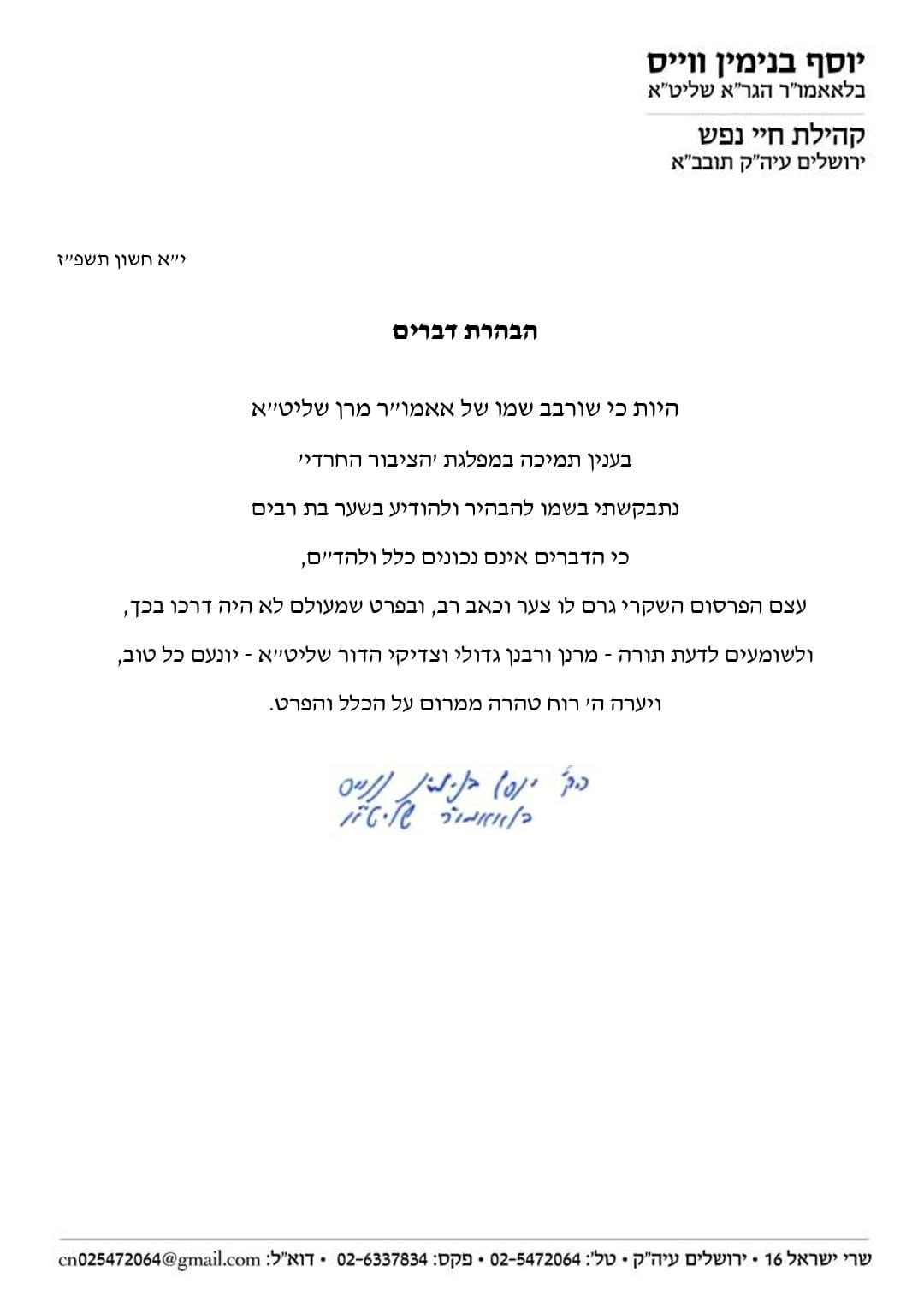
Here is the letter in full, in English:
Clarification of Matters
Whereas the name of my father, my teacher, Maran shlit"a, has been dragged into the matter of support for the "HaTzibbur HaCharedi" party —
I have been asked in his name to clarify and to announce publicly that the claims are not correct at all, and lo hayu devarim me'olam — they simply never happened.
The false publication itself caused him pain and great hurt — particularly as this was never his way.
And for those who heed daas Torah — Maranan v'Rabbanan, the gedolim and tzaddikim of the generation, shlit"a — may all good be pleasant for them; and may Hashem pour forth a spirit of purity from on high upon the community and upon each individual.
Hakatan Yosef Binyamin Weiss, son of my father, my teacher, shlit"a
Note the craft of the opening word. The letter does not say the Rav's name was "mentioned" or "cited." It says shurbav — dragged in, smuggled in, inserted where it did not belong. That single word is the whole story: a name taken, not given.
II. Why This Name, of All Names
To understand why this letter detonates, one must understand whose name was taken. Rav Asher Weiss is not a politician's rav and not a sector's rav. The Minchas Asher is among the most universally revered poskim of this generation — rosh kollel and av beis din, author of the teshuvos and Torah works learned in Bnei Brak, Lakewood, and the hesder yeshivos alike, the posek to whom hospitals, institutions, and talmidei chachamim across every community turn. His standing crosses every border in the Torah world — which is precisely what made his name the most valuable rumor this party could possess.
And here is the connection that turns a valuable rumor into a devastating one. The head of the rabbinical board of "HaTzibbur HaCharedi" — the figure who gives the party its entire claim to Torah legitimacy — is Rabbi Yehoshua Pfeffer, long known as a close talmid of Rav Asher Weiss. This is not our characterization; it is simply public knowledge. When the Charedi press interviewed Rabbi Pfeffer this very week, the interviewer referred to Rav Asher Weiss as his teacher as a matter of course — and asked the obvious question: where does the rebbe stand? Rabbi Pfeffer's answer, on the record, days before this letter: "No comment," adding that he does not drag in rabbanim who do not wish to be involved.
The son's letter, dated the very next day, answers the question the talmid declined to answer. And the answer is lahadam.
III. The Whisper Architecture — and Its Collapse
Follow the method, because it is the party's entire rabbinic platform. "HaTzibbur HaCharedi" has produced almost no public Torah authority standing behind it. What it has produced, in interview after interview, is whispers. In that same interview, Rabbi Pfeffer claimed that rabbanim in Bnei Brak privately agree with him — one, he said, told him he could not say so publicly because "they would chase me from Bnei Brak." The one rav who did publicly back the party assured listeners that rabbis greater than himself support it — privately. Always privately. The party's case to the Charedi voter has never been "here are the gedolim who stand with us." It has been "the gedolim secretly agree with us and are afraid to say so" — an argument that, by design, can never be checked.
Except that this week, the biggest implied whisper of all was checked. The unnamed "greater rabbis" whispered about had one obvious address in every listener's mind: the world-renowned posek whose own talmid sits atop the party. And from that address has now come a signed letter stating that the claim is false in its entirety, that it never happened, that it was never his way — and that the mere circulation of the rumor caused the Rav pain. Mark that last detail well: the Minchas Asher was not neutral about his name being whispered into this party. He was pained by it. The whisper architecture did not merely fail to gain his support; it wounded him. And a campaign method that wounds the very gadol it invokes has told you everything about its relationship to daas Torah.
The letter does one more thing, quietly and precisely. It does not end with the denial. It ends with a blessing — on "those who heed daas Torah, Maranan v'Rabbanan, the gedolim and tzaddikim of the generation." In the week of Rav Finkel's letter and Rav Nebenzahl's letter, no reader needs a map. The home of the Minchas Asher has pointed in exactly the direction the party exists to point away from.
IV. "We Feel Responsibility" — The Test They Set and Failed
And now to the conduct of the party itself in these final days, because it completes the picture.
In that same pre-election interview, Rabbi Pfeffer was asked the question that every right-leaning voter is asking: with the polls where they are, would the party show responsibility and withdraw before election day rather than burn right-wing votes below the threshold? His answer invoked the very standard by which the party now stands condemned: "We feel responsibility. We are truly people of the right." A commitment to withdraw, however, he declined to give — that decision, he said, belongs to the chairman.
The chairman has since decided. With an i24NEWS/Direct Polls survey showing the party below one percent — not near the threshold, not within reach of it, but at a fraction of it — and with the Prime Minister personally working to secure its withdrawal for the sake of the bloc, Moti Leitner announced: "We are not withdrawing. We are running with all our strength forward... we will be the surprise of the election." Even sympathetic voices in the Charedi press are pleading in print that the party must withdraw — now. It will not.
So let the arithmetic be said plainly, in the party's own vocabulary. At under one percent, every single vote cast for "HaTzibbur HaCharedi" on Tuesday is a vote extracted from the Charedi public, denied to the parties standing under the Gedolei Yisrael, and discarded below the threshold — in the tightest bloc arithmetic in memory. "We feel responsibility; we are truly people of the right" was the standard they announced for themselves when the question was theoretical. Now the question is real, the polls are unambiguous, the Prime Minister himself has asked — and the responsibility has evaporated. A party built on the accusation that the Charedi leadership cannot be trusted has, in its final week, demonstrated exactly what its own word is worth.
V. The Arc — and What the Gedolim Always Understood
It remains to say a word about Rabbi Pfeffer himself, and we will say it with the care our readers expect, because he remains our brother and we do not presume to read any man's neshamah — that ledger belongs to Shamayim alone.
But the documented arc deserves sober attention, because it is not incidental to this story. Rabbi Pfeffer's own published biography records the road: law degrees from the Hebrew University, a clerkship at the Israeli Supreme Court, teaching posts at Hebrew University and the Herzliya Interdisciplinary Center, leadership of a foreign foundation's "Haredi Israel" division. These are, each of them, legal and respectable stations. They are also, each of them, precisely the corridors about which the gedolim of every generation warned — not out of fear of knowledge, but out of a foresight our critics have always mocked as paranoia: that institutions carry worldviews, that worldviews reshape allegiances, and that a Torah Jew who makes his intellectual home in the academy and the court of the secular state will, with time and with all sincerity, begin to measure the Torah world by the state's yardstick rather than the reverse. The entire platform of "HaTzibbur HaCharedi" — the insistence that the Charedi public must be remade to the state's specifications, against the ruling of its own gedolim — is that yardstick, held by a frum hand.
We do not need to speculate about where the journey has led. We have a written measurement, from the hand best positioned in the world to take it. The rebbe to whom Rabbi Pfeffer owes his Torah has, through his son, stated in writing that the enterprise flying his talmid's flag was built on a claim about him that never happened, was never his way, and caused him pain — and has directed the public, in the same breath, to Maranan v'Rabbanan gedolei hador. When a talmid's project is measured by his own rebbe's pen and found this far from home, no further commentary from us is required. We will say only what our mesorah obligates us to say: the road back is never closed, the beis medrash of his rebbe stands where it always stood, and no one — least of all the household that wrote this letter with visible sorrow rather than anger — would receive his return with anything but joy.
May Hashem guard the honor of the Minchas Asher and of all the gedolim whose names are taken in vain in this hour, return every wandering talmid to his rebbe's table in joy, pour forth — in the words of this week's letter — a spirit of purity from on high upon the community and upon each individual, and bring us speedily to the day when all Israel stands united behind its Chachamim to greet Moshiach Tzidkeinu — bimheirah b'yameinu, amen.
Sources
The letter
- The "Clarification of Matters" letter of Rav Yosef Binyamin Weiss, son of HaGaon Rav Asher Weiss, shlita (Kehillas Chayei Nefesh, Yerushalayim), dated 11 Marcheshvan 5787 — written, as it states, at his father's request and in his father's name: that the claims of support for the "HaTzibbur HaCharedi" party "are not correct at all, v'lahadam"; that the false publication caused him "pain and great hurt"; that "this was never his way"; and its closing blessing upon those who heed daas Torah, Maranan v'Rabbanan gedolei v'tzaddikei hador — reproduced in facsimile above with full translation
The party and its rabbinic claims
- The Kikar HaShabbat interview with Rabbi Yehoshua Pfeffer (October 21, 2026) — the party's senior rabbinic authority; the interviewer's identification of Rav Asher Weiss as his teacher and Pfeffer's "No comment"; the claims of private rabbinic agreement in Bnei Brak ("they would chase me from Bnei Brak") and of greater rabbis supporting "privately"; and his response, when asked to commit to pre-election withdrawal below the threshold: "We feel responsibility. We are truly people of the right" — without a commitment
- Kikar HaShabbat's report on Moti Leitner's refusal to withdraw (October 21, 2026) — the i24NEWS/Direct Polls survey placing the party below one percent, the Prime Minister's personal request, and "We are not withdrawing... we will be the surprise of the election"; Mako's report on Netanyahu's efforts to secure the party's withdrawal; the Kikar HaShabbat opinion column calling on the party to withdraw immediately
The biography
- Rabbi Yehoshua Pfeffer's published biography at the Tikvah Fund — law degrees from the Hebrew University, clerkship at the Supreme Court of Israel, teaching at Hebrew University and the Herzliya Interdisciplinary Center, and leadership of its Haredi Israel division; Rav Asher Weiss's standing as the Minchas Asher
The structural relationship to other articles in this series
- "'Do Not Support Parties That Do Not Follow the Chachamim': The Rosh Yeshiva of Mir, Five Days Before the Election" — the first letter of the week
- "'Their Portion With Me in This World and the World to Come': Rav Nebenzahl Stakes His Own Olam Haba on Tuesday's Vote" — the second
- "The Useful Idiots of HaTzibbur HaCharedi" — our full examination of the party, its funders, and its program