"Their Portion With Me in This World and the World to Come": Rav Nebenzahl Stakes His Own Olam Haba on Tuesday's Vote

Four days before the election, a handwritten letter has emerged from the Old City of Yerushalayim. Its author is the Zakein HaPoskim, HaGaon Rav Avigdor Nebenzahl, shlita — the Rav of the Old City, chavrusa of Rav Shlomo Zalman Auerbach for more than forty years, and a rebbi to generations of Religious Zionist students at the yeshivos overlooking the Kosel. In it, he describes the persecution of bnei Torah by the authorities, instructs every Jew with yiras Shamayim to vote this Tuesday solely for the list the Gedolei HaDor have endorsed — and then does something a Torah leader does only in the gravest of hours: he pledges that all who assist will have their portion with him, in this world and in the World to Come. A tzaddik of ninety-one has put his own chelek in Olam Haba on the table. It is worth understanding exactly who is speaking, and why.
I. Who Is Writing — the Rav Who Belongs to Everyone
Rav Avigdor Nebenzahl is not a party figure, and no one in Israel could mistake him for one. Born in 1935, he has served for decades as the Rav of the Old City of Yerushalayim — the Jewish Quarter rebuilt around the Churva and the Ramban shul, whose rabbanus he carried until passing it to his son — and he remains its zakein, davening and teaching within sight of the place of the Mikdash. For more than forty years he was the chavrusa of Rav Shlomo Zalman Auerbach zt"l — the posek of the generation, revered in every camp without exception — and he taught in Yeshivas Mir in Yerushalayim. His sefarim, listed on the very letterhead of this letter — Yitzchak Yikra, Mitzion Michlal Yofi, the sichos on Chumash — sit on shelves in Bnei Brak and in hesder yeshivos alike.
And here is what makes this voice unlike any other in this election: for decades, Rav Nebenzahl has been a senior rosh yeshiva at Yeshivat Netiv Aryeh and a maggid shiur at Yeshivat HaKotel — the flagship yeshivos of the Religious Zionist world, standing at the Kosel plaza itself. The students who fill his shiurim wear knitted kippot and serve in the army. He is, in the fullest sense, a rav who belongs to all of Klal Yisrael — which is precisely why no honest reader can wave this letter away as sectoral politics.
One more biographical fact, and it is not a detail. Rav Nebenzahl's father, Dr. Yitzhak Nebenzahl, served as the State Comptroller of Israel for thirty-three years — from the state's founding generation until 1981 — one of the most trusted public servants the country has ever had. The Rav of the Old City is not an outsider to the State of Israel's institutions; he is the son of the man who audited them. When this man opens his letter with the words "the bnei Torah are persecuted by the authorities" — the authorities his own family served with distinction — it is not polemic. It is testimony, from a witness no court could dismiss.
II. The Letter
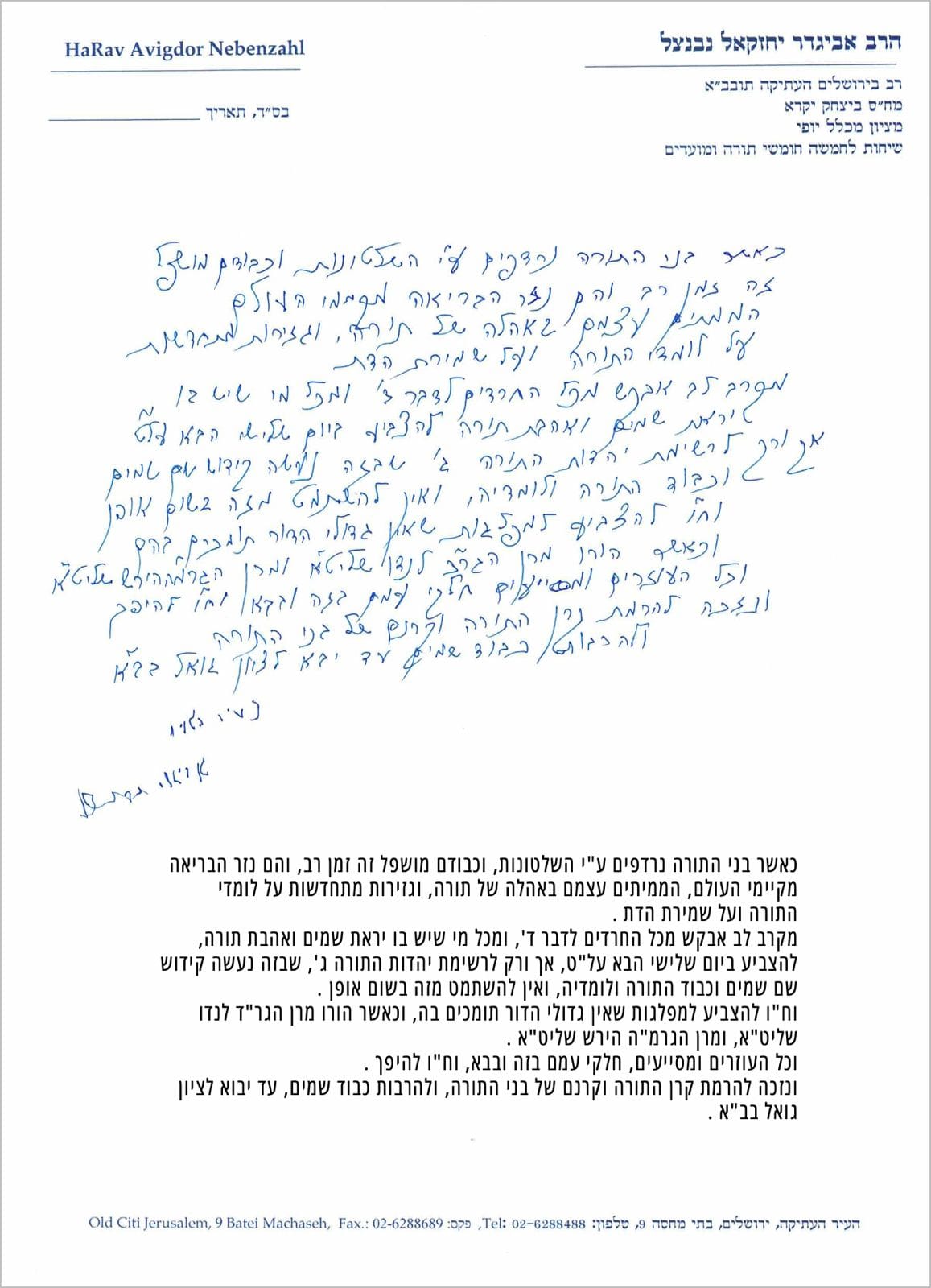
Caption: The handwritten letter of HaGaon Rav Avigdor Nebenzahl, shlita, Rav of the Old City of Yerushalayim, on his personal letterhead, with transcription.
Here is the letter in full, in English:
When the bnei Torah are persecuted by the authorities, and their honor has been humiliated for a long time — they who are the crown of creation and the sustainers of the world, who dedicate themselves entirely in the tent of Torah — and new decrees are constantly enacted against those who study Torah and against the preservation of religion:
From the depths of my heart, I appeal to all those who are charedim l'dvar Hashem, and to anyone who possesses fear of Heaven and love of Torah, to vote this coming Tuesday solely for the United Torah Judaism list (Gimmel).
By doing so, a great sanctification of Hashem's Name will be achieved, along with honoring the Torah and its scholars — and no one should evade this obligation under any circumstances.
And chas v'shalom to vote for parties that are not supported by the Gedolei HaDor, as instructed by Maran HaGaon Rav Dov Landau, shlita, and Maran HaGaon Rav Moshe Hillel Hirsch, shlita.
May all those who assist and support have their portion with me in this world and in the World to Come — and chas v'shalom the opposite.
And may we merit the elevation of the glory of Torah and the pride of the bnei Torah, and to increase the honor of Heaven, until the coming of Moshiach, speedily in our days, Amen.
III. "Charedim L'Dvar Hashem" — He Addressed Us by Our Name's Own Pasuk
Before the instruction, notice the address — because the Rav chose it with a posek's precision. He appeals to "all those who are charedim l'dvar Hashem" — those who tremble at the word of Hashem. That is not a party label. It is the pasuk from which our community's very name descends: "Shim'u dvar Hashem, ha'charedim el devaro" — hear the word of Hashem, you who tremble at His word (Yeshayahu 66:5); and two pesukim earlier, Hashem declares the one to whom He looks: the humble and broken of spirit, "v'chared al devari" — who trembles at My word (Yeshayahu 66:2).
To be a Charedi, in other words, was never a matter of dress or district. It is a definition: the Jew who trembles before the dvar Hashem — and therefore bends his own will to those who carry it, the Chachamim. The Rav's letter does not merely use the name; it enacts the definition. He summons those who tremble at the word, and then tells them what trembling at the word looks like this Tuesday: standing where the Gedolei HaDor stand. The address and the instruction are one thought.
And his preamble's description of the bnei Torah — "the crown of creation and the sustainers of the world" — is likewise not flourish but citation: "Im lo brisi yomam valaylah, chukos shamayim va'aretz lo samti" — were it not for My covenant studied day and night, I would not have set the laws of heaven and earth (Yirmiyahu 33:25, as Chazal expound it). The ones the state calls a burden, the navi calls the reason the world stands. The Rav is simply writing the navi's accounting instead of the Treasury's.
IV. The Pesak Behind the Ballot
Readers of this publication have met Rav Nebenzahl's pen before, and the two letters must be read together. Months ago, we published the Zakein HaPoskim's ruling on the draft itself — that even a bochur who is not learning must not enlist. While the state's entire campaign rests on sorting Jews into "genuine learners" worth protecting and everyone else fit for the taking, the Rav of the Old City refused the sorting at its root: the army, as it stands, is no place for any yarei Shamayim, and a Jew's neshamah is not forfeited because his shteiging is weak.
Now comes this letter, and it is the same pesak carried to its next station. The rav who would not surrender a single bochur to the recruiters now instructs the vote that shields them — because the hour demands it. His opening lines are a one-paragraph summary of the file this publication has documented all year: bnei Torah "persecuted by the authorities" — the arrests at recruitment offices, the airport detentions, the forty-six taken in a single Shabbos, the tefillin denied behind prison gates; their honor "humiliated for a long time" — the "parasite" rhetoric, the gallery outbursts, the certified statistical libels; "new decrees constantly enacted" — the funding cuts, the daycare sanctions, the Section 46 revocations, the student registries. Every phrase in his preamble has a date and a source in our archive. The Zakein HaPoskim is not writing politics. He is writing a to'eles pesak for an hour of persecution: this is what the defense of Torah requires of every Jew who can hold a ballot.
V. The Deference — Even Poskim Have Poskim
Now notice what may be the letter's most instructive sentence, hiding in plain sight. Rav Nebenzahl — a posek of world standing, with every right to speak in his own name — does not rest the instruction on his own authority. He anchors it explicitly: chas v'shalom to vote for parties not supported by the Gedolei HaDor, "as instructed by Maran HaGaon Rav Dov Landau, shlita, and Maran HaGaon Rav Moshe Hillel Hirsch, shlita."
Our critics have spent months insisting that "daas Torah" is a slogan wielded by askanim and party men who invoke distant gedolim for their own purposes. Here is the answer, in a tzaddik's own handwriting. A ninety-one-year-old rav of the Old City — outside every party apparatus, employed by no machinery, revered in the very communities that vote differently — sits down with a pen and points, unprompted, to the same two names: Rav Dov Landau and Rav Moshe Hillel Hirsch. This is how the mesorah actually works, and has always worked: even gedolim have gedolim; even poskim bow to the Gedolei HaDor. The hierarchy our critics call manufactured is simply the chain of Sinai, operating exactly as it did in every generation — and here it is operating in blue ink, on letterhead, before our eyes.
VI. The Guarantee — and the Word "Evade," Returned to Its Owners
And then the sentence that should stop every reader cold: "May all those who assist and support have their portion with me in this world and in the World to Come — and chas v'shalom the opposite."
Understand what is being offered. A tzaddik's chelek in Olam Haba is the yield of ninety-one years — of a lifetime of Torah in the Old City, of four decades of chavrusashaft with Rav Shlomo Zalman, of shiurim beyond counting at the foot of Har HaBayis. It is the one possession no government can revoke, no court can suspend, and no Tax Authority can strip. And the Rav has placed it on the table as surety, binding himself in partnership with every Jew who stands with the Torah this Tuesday. Gedolim do not spend this currency on ordinary asks. That he judged this hour worthy of it tells you, more than any analysis we could write, how the Zakein HaPoskim weighs what is at stake.
And one phrase more, because the Rav has quietly turned the state's own vocabulary on its head. For a year, the enforcement machine has branded our sons "mishtamtim" — evaders. Comes the Rav of the Old City and rules: the voting booth is an obligation — a kiddush Hashem — "and no one should evade this obligation under any circumstances." There, says the zakein, is the only evasion available to a Jew this week: evading the duty to stand up, quietly and lawfully, for the Torah's honor. The boys in the batei medrash are not evading; they are at their posts. The Jew who stays home on Tuesday is the one abandoning his.
VII. Two Letterheads, One Instruction
Set this letter beside the one we published yesterday, because together they form the week's complete picture. From the heart of the yeshiva world: the Rosh Yeshiva of Mir, head of the largest yeshiva on earth, writing of an hour of persecution and warning against any party that does not follow the Chachamim. And now from the Old City: the Zakein HaPoskim — the bridge figure of the generation, rebbi to Charedi and Religious Zionist alike, son of the state's own comptroller — writing the same hour, the same instruction, the same two names, and sealing it with his own Olam Haba. The Moetzes and the Kosel yeshivos' elder; Mir and the Ramban shul; the handwriting of two men in their tenth decades who have nothing to gain and nothing to fear. No askan arranged this convergence. The hour did.
Our own position our readers know, and we restate it as the gedolim have given it: on Tuesday, the 16th of Marcheshvan, the instruction of the Gedolei Yisrael — Rav Dov Landau and Rav Moshe Hillel Hirsch at their head — is to vote for the parties that stand under the authority of the Chachamim, Gimmel and Shas, each community per its gedolim's direction. Rav Nebenzahl has now told us what that ballot is in Shamayim's ledger: a kiddush Hashem, a defense of the persecuted bnei Torah, and a partnership — his word, his guarantee — with the Rav of the Old City himself, in this world and in the next.
Shim'u dvar Hashem, ha'charedim el devaro. He called us by our name. May we answer to it — and may Hashem raise the glory of His Torah and the pride of its bearers, silence every decree, and bring us, trembling and rejoicing, to greet Moshiach Tzidkeinu — bimheirah b'yameinu, amen.
Sources
The letter
- The handwritten letter of HaGaon Rav Avigdor Nebenzahl, shlita, Rav of the Old City of Yerushalayim, on his personal letterhead, with Hebrew transcription — reproduced in facsimile above with full English translation: the persecution of the bnei Torah, the appeal to vote this Tuesday solely for the Gimmel list, the warning against parties not supported by the Gedolei HaDor "as instructed by Maran HaGaon Rav Dov Landau, shlita, and Maran HaGaon Rav Moshe Hillel Hirsch, shlita," and the pledge of a portion with him in this world and the World to Come
The author's standing
- Rav Nebenzahl's biography: born 1935; Rav of the Old City of Yerushalayim (succeeded in the rabbanus by his son, Rav Chizkiyahu Nebenzahl); chavrusa of Rav Shlomo Zalman Auerbach zt"l for more than forty years; maggid shiur in Yeshivas Mir Yerushalayim; senior rosh yeshiva at Yeshivat Netiv Aryeh and faculty at Yeshivat HaKotel; rav of the Ramban shul; author of Yitzchak Yikra, Mitzion Michlal Yofi, and sichos on Chumash (as listed on the letterhead); son of Dr. Yitzhak Nebenzahl, State Comptroller of Israel, 1948–1981
The pesukim and Chazal
- Yeshayahu 66:2, 66:5 — v'chared al devari; shim'u dvar Hashem ha'charedim el devaro — the source of the name "Charedim"; Yirmiyahu 33:25 as expounded by Chazal — the covenant of Torah as that which sustains heaven and earth
The structural relationship to other articles in this series
- "Zakein HaPoskim Rav Avigdor Nebenzahl: Even a Bochur Who Isn't Learning Must Not Enlist" — the pesak of which this letter is the continuation
- "'Do Not Support Parties That Do Not Follow the Chachamim': The Rosh Yeshiva of Mir, Five Days Before the Election" — the companion letter, from the heart of the yeshiva world