"Do Not Support Parties That Do Not Follow the Chachamim": The Rosh Yeshiva of Mir, Five Days Before the Election
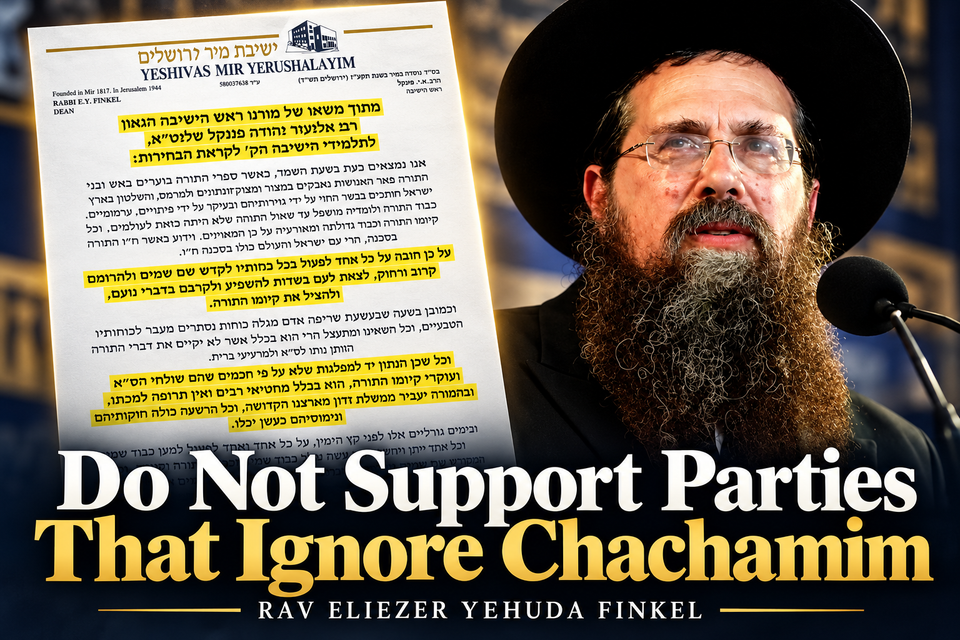
Five days before Israel votes, a letter has gone up on the letterhead of the largest yeshiva in the world. In it, the Rosh Yeshiva of Mir Yerushalayim, HaGaon Rav Eliezer Yehuda Finkel, shlita, describes this moment as an hour of persecution of the Torah — and issues one of the most severe warnings a Torah leader can issue: that one who lends his support to parties that do not follow the guidance of the Chachamim joins the ranks of those who cause the masses to sin, for whom there is no remedy. We present the letter in full, explain the Torah sources behind its strongest phrases, and set it into the hour it addresses.
I. Who Is Speaking — and Why His Words Carry the Weight They Do
Begin with the author, because the letter's weight is the weight of the man and the institution behind it. Rav Eliezer Yehuda Finkel is the Rosh Yeshiva of Mir Yerushalayim — the largest yeshiva in Eretz Yisrael and, together with Lakewood, one of the two largest in the world, with many thousands of talmidim and avreichim filling its halls. He is a member of the Moetzes Gedolei HaTorah. When he speaks, he speaks as the head of the single greatest concentration of Torah learning on the planet.
And he is not describing a siege he has read about. He has lived it, this very year, inside his own walls. It was a Mir talmid who was arrested at the Be'er Sheva recruitment office — a bochur who came, on his own feet, to put his status in order — and it was the heichalos of Mir that filled with thousands for the atzeres tefillah until his release, after which the Rosh Yeshiva sent everyone back to their Gemaras. It was Rav Finkel who sat beside HaGaon Rav Dov Landau in the now-famous conversation that the Prime Minister himself saw fit to attack on social media. And it was Rav Finkel who, in the depths of the war, extended the yeshiva's zman for its avreichim — announcing, after consultation with gedolei Yisrael, that in the face of both the war and the harsh decrees upon the Torah world, the answer of Mir would be more Torah, not less. So when this letter speaks of bnei Torah "groaning under siege and distress," understand: the man writing it has watched the military police come for his own talmidim. This is testimony, not rhetoric.
II. The Letter Itself
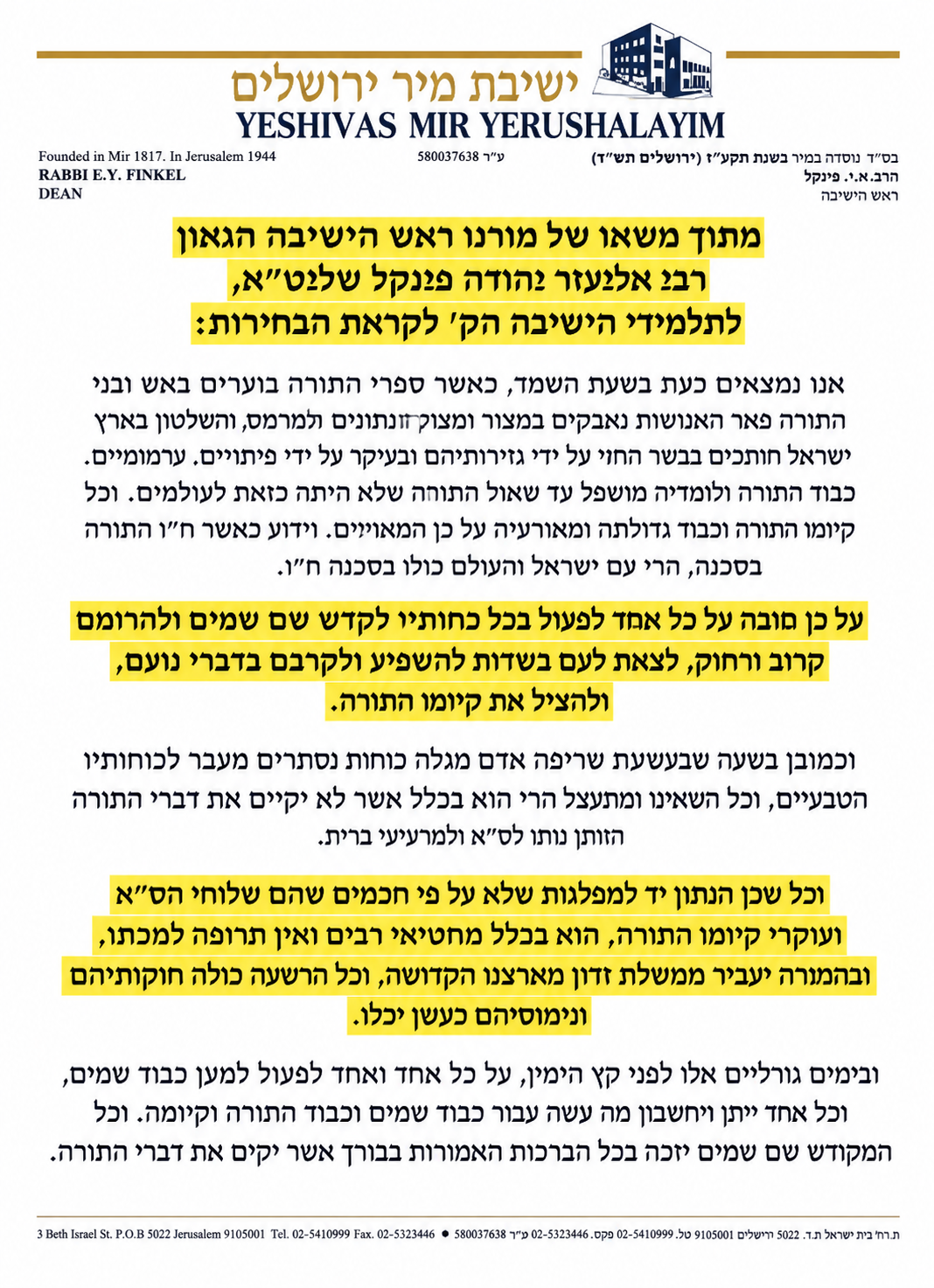
Here is the full English translation:
Yeshivas Mir Yerushalayim
From the address of our teacher, the Rosh Yeshiva, the Gaon Rabbi Eliezer Yehuda Finkel, shlita, to the students of the holy yeshiva regarding the upcoming elections:
We find ourselves at this time in an hour of persecution, when the Torah scrolls are burning in fire, and the sons of Torah, the glory of humanity, are groaning under siege and distress and are being trampled upon.
The government in Eretz Yisrael is cutting into living flesh through its decrees, and especially through its cunning enticements.
The honor of Torah and those who study it has been lowered to the very depths, in a manner unprecedented in history.
The entire continued existence of Torah, and the honor of its great leaders and luminaries, hang in the balance.
And it is known that when the Torah is in danger, Heaven forbid, the Jewish people and the entire world are in danger, Heaven forbid.
Therefore, it is incumbent upon each and every individual to do everything within his power to sanctify the Name of Heaven and elevate the honor of Torah, and to influence those near and far.
One must go out to the people in the fields, influence them, and bring them closer with pleasant words, in order to save the continued existence of Torah.
And as is well known, when a person who possesses great powers becomes entangled and follows his own natural inclinations, and all his possessions and efforts are devoted to things through which he will not uphold the words of this Torah, he places his strength in support of the evildoers.
And all the more so, one who lends support to parties that do not act according to the guidance of the Chachamim, who are emissaries of the Sitra Achra [the forces of evil] and undermine the continued existence of Torah, is included among those who cause the masses to sin, and there is no remedy for his wrongdoing.
And may [Hashem] speedily remove the wicked government from our Holy Land, and may all wickedness perish like smoke, and may their laws and customs vanish like smoke.
And in these fateful days, before the End of Days, each and every individual must act for the honor of Heaven.
And every person should make an accounting of what he has done for the honor of Heaven, for the honor of Torah, and for its continued existence.
And may all who sanctify the Name of Heaven merit all the blessings promised to those who uphold the words of the Torah.
III. "An Hour of Persecution" — The Receipts
A reader encountering this letter cold might wonder whether its opening is hyperbole. Readers of this publication know better, because we have spent the entire year compiling, item by documented item, exactly the file the Rosh Yeshiva is summarizing.
An hour of persecution: bochurim handcuffed at recruitment offices they entered voluntarily; forty-six detained over a single Shabbos; military police at family doors; stay-of-exit orders turning Ben Gurion Airport into a trap, with avreichim arrested in front of their children. Siege and distress: hundreds of millions stripped from the yeshivos; daycare subsidies cut from kollel mothers by the Attorney General's order; Section 46 tax status revoked from dozens of Torah institutions while terror-solidarity organizations keep theirs; a demand that yeshivos hand over registries of their students' identity numbers; some sixty-six thousand avreichim suspended in a limbo of revoked exemptions, no orders, and halted stipends. Trampled upon: a Jew in a military prison denied his tefillin for three days while his father stood at the gate; and when the head of training of the army's own Charedi brigade came to the High Court carrying data, the deputy president told him he would not receive so much as a minute. Every clause of the Rosh Yeshiva's opening paragraph has a date, a name, and a source in our archive. He is not painting. He is reporting.
And note his most precise phrase: the government cuts into living flesh "through its decrees, and especially through its cunning enticements." The decrees we all see. The enticements are the subtler blade — the brochures, the stipends, the "tailored tracks" and glossy promises of frameworks where a bochur can supposedly serve and remain what he is. Our readers have just watched what those promises are worth: the Tomer Company's soldiers, who gave up family and shidduchim on the strength of exactly such assurances, folded by memo into a mixed company in Gaza and told that refusing kitchen duty with female soldiers means discipline. The Rosh Yeshiva calls the enticements more dangerous than the decrees — because a decree hardens a community, while an enticement hollows it. The man has read the battlefield exactly.
IV. The Severity Is Not Rhetoric — It Is Chazal
Now to the sentence that will be quoted, attacked, and screenshotted: that supporting parties which do not follow the Chachamim places one "among those who cause the masses to sin, and there is no remedy for his wrongdoing."
To ears unfamiliar with the sources, this sounds like invective. It is not. It is a citation. The Mishnah in Avos (5:18) teaches: kol ha'machti es ha'rabbim, ein maspikin b'yado la'asos teshuvah — whoever causes the masses to sin is not granted the means to repent — and the Rambam codifies the machti'ei ha'rabbim among those gravest categories for whom the ordinary gates of remedy do not stand open (Hilchos Teshuvah, ch. 3). The logic is as old as the Mishnah: a private sin can be privately repaired, but one who moves the rabbim — who lends his hand to turning a community off its course — has set in motion consequences that no private teshuvah can chase down and recall. The Rosh Yeshiva is not inventing a punishment for his political moment. He is applying a two-thousand-year-old category to a choice he believes falls within it: that a ballot, in this hour, is not a private act but an act upon the rabbim — upon the continued existence of Torah itself.
And the letter's thunderous closing — that Hashem speedily remove the wicked government, that all wickedness perish like smoke — is not a new curse either. It is the siddur. Every Jew who stood in shul this past Rosh Hashanah and Yom Kippur davened these very words in the Amidah: v'chol ha'rish'ah kulah k'ashan tichleh, ki sa'avir memsheles zadon min ha'aretz — may all wickedness vanish like smoke, when You remove the reign of arrogance from the earth. As we demonstrated at length in "Do We Pray for the End of the Secular State?", the Rosh Yeshiva of Mir is not coining radical slogans. He is praying the tefillos of Klal Yisrael, with their plain meaning intact — and waiting, as we all claim to, for them to be answered.
V. And Inside the Thunder — Pleasant Words
Having given the warning its full weight, do not miss the other command in this letter, because it is just as binding and it is pure Mir. The Rosh Yeshiva does not instruct his talmidim to denounce anyone. He instructs them to go out to the people in the fields, influence them, and bring them closer with pleasant words — b'darchei noam — in order to save the continued existence of Torah.
That is the derech of this house, and of ours. The severest warning in the letter is aimed at a choice; toward the people, the letter commands only closeness, influence, and pleasantness. It is the same pairing we have documented in every gadol this year — Rav Dov Landau directing the community away from street confrontation and toward the beis medrash; the Sanzer Rebbe forbidding a negative word about fellow Jews even outside a prison holding his chassidim. And it is the standing derech of Mir itself: on the night of the last elections, while the country refreshed exit polls, hundreds of Mir bochurim sat in the heichal for a special seder named "U'vacharta BaChaim" — choosing life while the nation chose parties. Thunder toward Heaven, pleasantness toward every Jew. That is what Torah leadership sounds like.
VI. The Hour It Lands In
What we can report, separately and on the record, is the hour into which this letter arrives. Israel votes on Monday, the 27th of October — Tes-Zayin Marcheshvan — five days from now. And for the first time in a generation, this election features a party campaigning explicitly for Charedi votes against the parties that operate under the Gedolei Yisrael: a party that has literally taken the name "HaTzibbur HaCharedi," whose chairman launched his campaign by declaring that a ballot for United Torah Judaism and Shas is a ballot for "the bullies of the Yerushalmi Faction," and by pronouncing the community's Torah leadership "disconnected." Its pitch, in other words, is precisely the proposition the Rosh Yeshiva's letter addresses in principle: that a Charedi public can be represented apart from — and against — the guidance of its Chachamim.
Every reader can now set the two documents side by side and weigh them: a campaign built on the premise that the Chachamim can be bypassed, and a letter from the Rosh Yeshiva of the largest yeshiva on earth stating what the Torah holds of that premise. As for this publication, our position has been stated plainly and we restate it without apology: the Gedolei Yisrael — Rav Dov Landau and Rav Moshe Hillel Hirsch at their head, and the Moetzos Gedolei HaTorah with them — have instructed the community to vote for the parties that stand under their authority, Gimmel and Shas. In this house, that instruction is not one consideration among many. It is the consideration. Al pi haTorah asher yorucha.
VII. Daas Torah, in the Present Tense
One final observation, for those who have followed this year's debates in these pages. Our critics — thoughtful ones among them — have argued that invoking the Gedolim of the past begs the question of what they would say about today's reality. Our answer, given at length in "The Central Question, Answered," was that we need not speculate, because the mesorah did not end in 1953: we have Gedolim today, confronting today's metzius, and they have ruled.
Here is that answer made flesh, on letterhead. A Rosh Yeshiva whose own talmidim have sat in military prison this year, who has watched every decree and every enticement of this campaign from the inside, surveys the full landscape of 5787 — and writes that the obligation of the hour is to stand with the Chachamim, to strengthen the Torah's existence, and to draw every Jew closer with pleasant words. Daas Torah is not an archive. It is alive, it is watching, and five days before this election, it has put its position in writing.
The letter ends with a charge that belongs to each of us, whatever our camp: every person should make an accounting of what he has done for the honor of Heaven, for the honor of Torah, and for its continued existence. Five days remain to settle that account.
May Hashem grant Klal Yisrael the wisdom to stand where its Chachamim stand, guard the bnei Torah in this hour of persecution, turn every heart closer with pleasant words, and speedily bring the day when the honor of Torah is raised to its full height before the eyes of all — bimheirah b'yameinu, amen.
Also About the Elections:
The Rabbis of Hatzibur Hacharedi
The Gedolim Have Spoken
The Useful Idiots of Hatzibur Hacharedi
Sources
The letter and its author
- The letter on the letterhead of Yeshivas Mir Yerushalayim, presenting the address of the Rosh Yeshiva, HaGaon Rav Eliezer Yehuda Finkel, shlita, to the talmidim regarding the upcoming elections — reproduced in facsimile above with full English translation (the date and original publication context of the photographed document to be confirmed against the source)
- The standing of the author: Rosh Yeshiva of Mir Yerushalayim, the largest yeshiva in Eretz Yisrael, and member of the Moetzes Gedolei HaTorah; his wartime directive, issued after consultation with Gedolei Yisrael, extending the yeshiva's zman for avreichim in the face of the war and the decrees upon the Torah world (JDN); the atzeres tefillah in the heichalos of Mir for the yeshiva's arrested talmid; the Mir election-night "U'vacharta BaChaim" seder (B'Chadrei Charedim)
The Torah sources of the letter's strongest phrases
- Avos 5:18 — kol ha'machti es ha'rabbim, ein maspikin b'yado la'asos teshuvah; Rambam, Hilchos Teshuvah ch. 3 — the machti'ei ha'rabbim; the Yamim Noraim Amidah — v'chol ha'rish'ah kulah k'ashan tichleh, ki sa'avir memsheles zadon min ha'aretz; Devarim 17:11 — al pi haTorah asher yorucha
The hour
- The Knesset elections of October 27, 2026; the launch of the party styling itself "HaTzibbur HaCharedi," its chairman's declaration that a vote for United Torah Judaism and Shas is a vote for "the bullies" of the Yerushalmi Faction, and his characterization of the community's leadership as "disconnected" (i24NEWS); the documented enforcement record of this year — the arrests, the funding and Section 46 revocations, the student registries, the subsidy cuts, the tefillin denials, and the rest — compiled across this series