
Our response to Rabbi Pini Dunner's critique of our article "Why Don't Charedi Rabbanim Come Out Publicly Against Extremists?"
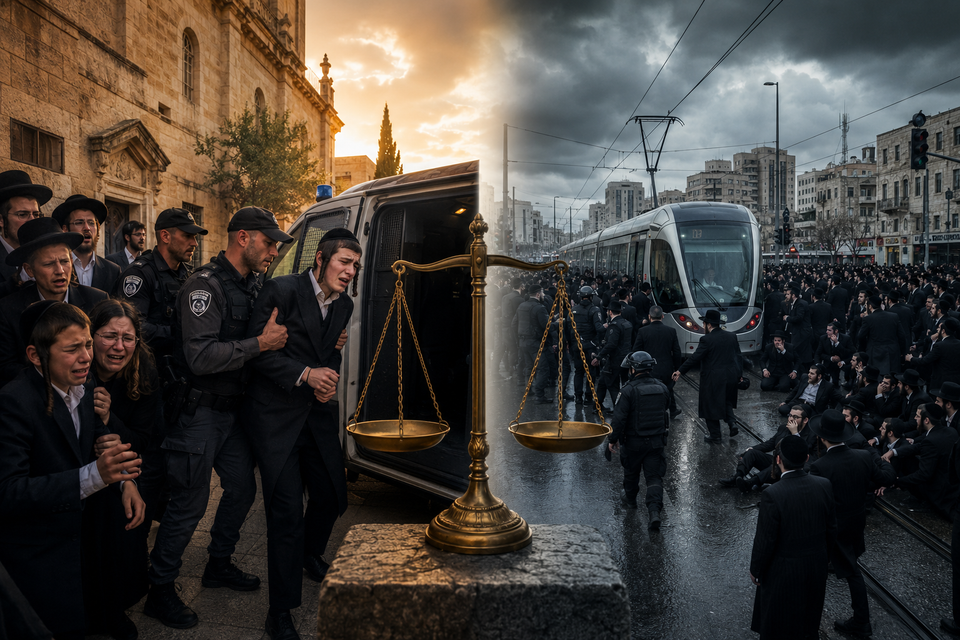
Rabbi Pini Dunner has written a sharp and serious response to our article on why Charedi Gedolim do not hold press-conference condemnations of extremists. We thank him for it — this is exactly the kind of honest exchange the Torah world needs more of. But his critique, for all its force, answers a question we did not ask, overlooks warnings that were in fact issued, and — most importantly — judges a reaction while saying almost nothing about what provoked it.
But first read Rabbi Dunner's original post on X.com:
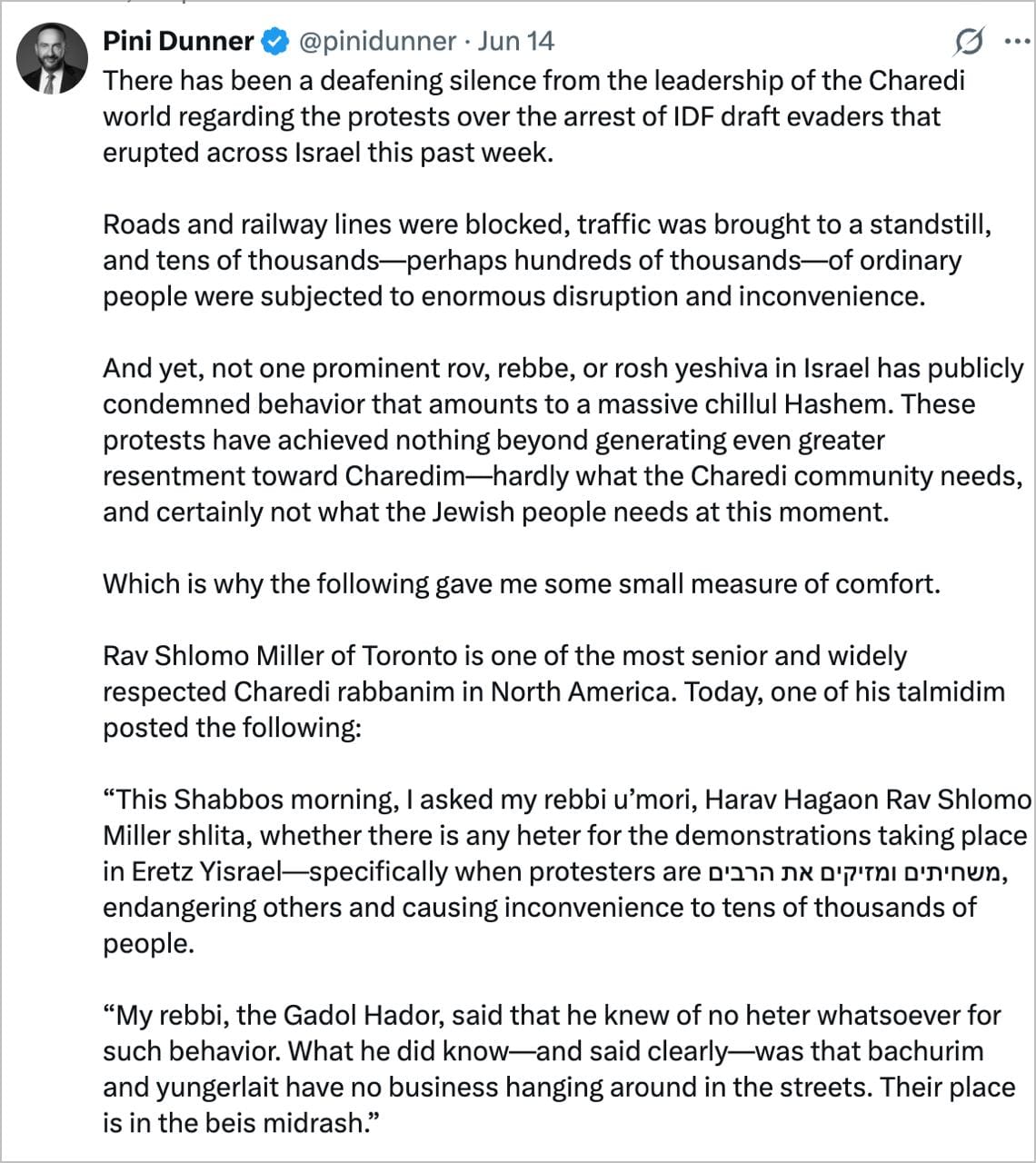
To witch I commented and sent him a link to this post: https://www.charedim.com/why-dont-charedi-rabbanim-come-out-publicly-against-extremists/ explaining generally why Gedolim don't come out publicly against extremists.
To which Rabbi Dunner wrote a full detailed response to that post here: https://rabbidunner.com/silence-is-the-wrong-answer/
Below is our response to his article on his blog.
We want to begin not with a rebuttal but with a thank-you. Rabbi Dunner engaged our article seriously, point by point, and made several arguments that deserve a serious reply rather than a dismissive one. Disagreement conducted this way — machlokes l'shem shamayim, for the sake of Heaven (Avos 5:17) — is not a problem to be managed; it is how a thinking community sharpens its own understanding. We are genuinely grateful for the dialogue, and we hope what follows is received in the same spirit in which his piece was plainly intended: a shared desire for the honor of Torah and the welfare of Klal Yisrael. With that said, we think his response misses the mark in three ways, the last of which is the most important.
I. Two Different Articles, Two Different Questions
The first point is a clarification that turns out to matter a great deal. Our article was a general one. It addressed a standing, recurring demand — the one that surfaces every time any individual in Charedi dress does something disgraceful anywhere: "Where are the Gedolim? Why no press conference?" It was written about the category of demand, not about any single event, and it made a set of general arguments about how Torah leadership communicates and why media-style condemnations are usually neither required nor effective.
Rabbi Dunner's response, by contrast, is about a specific event — the mass road-and-rail protests of the past two weeks. That is a fair subject to raise, and we will address it directly below. But it is worth being clear that he is, in large part, answering a question our article was not asking. When he writes that we "avoid the real question" by speaking about solitary fringe individuals and Neturei Karta rather than organized protests, the explanation is simpler than evasion: our article was the general treatment, and the organized protests are a particular case. So let us turn to the particular case, where, as it happens, our general argument holds up better than he allows.
II. Who Actually Called These Protests
Here the facts are not in our favor or his — they simply are what they are, and they are publicly documented. The road and rail blockages of June 1st and June 11th were not a spontaneous welling-up of the mainstream Charedi street, and they were not called by the mainstream Gedolim. They were called and organized by the Jerusalem Faction — the Peleg Yerushalmi.
This is the single most relevant fact in the entire discussion, and Rabbi Dunner does not mention it. The Peleg is not a synonym for "the Charedi community." It is the breakaway movement that split from Rav Aharon Leib Shteinman in 2012 — and it split from him precisely over his moderation, precisely because he opposed exactly this style of confrontation. It has operated ever since as an independent faction that does not take its direction from the mainstream Degel HaTorah leadership now headed by Rav Dov Landau and Rav Moshe Hillel Hirsch; a senior figure of that leadership once charged Peleg, in so many words, with having "declared war against the discipline to adhere to the words of Gedolei Torah." So when Rabbi Dunner calls our "they don't listen to the Gedolim" argument a "cop-out," we would gently point out that, in this case, it is not an argument at all — it is a description: the group that called these protests is, by its own founding act, outside the authority of the mainstream Gedolim. A condemnation from those Gedolim would carry over the Peleg exactly the authority the Peleg has spent over a decade rejecting — and in fact, mainstream Degel leaders have publicly criticized precisely this kind of protest, asking aloud where Torah Jews ever had a tradition of sending teenage bochurim to face off against police. It changed nothing the faction did.
Now, Rabbi Dunner has a real answer to this, and we will not pretend he doesn't. He argues that a public statement is not aimed only at the hardened activist — that it also tells mainstream bachurim to stay away, tells parents not to romanticize it, and draws a moral line for the watching public. That is a fair and weighty point, and we concede it has force. Which brings us to his second mistaken assumption.
III. The Warnings That Did Go Out
Rabbi Dunner's central factual claim is that the mainstream leadership has been silent — that "the absence of an unambiguous message" is the real scandal. But this is not accurate, and the record does not support it. The mainstream Gedolim did not call these protests; the mainstream yeshivos did not send their talmidim to lie down on train tracks. And contrary to the impression of total silence, calls and notices were issued against the dangerous methods themselves — against blocking trains, against endangering life, against the conduct that turns a grievance into a chillul Hashem.
We will say plainly: if Rabbi Dunner's complaint is that he wishes those messages had been louder, more public, more frequent, and more unmistakable, that is a position a person can hold in good faith, and reasonable people in our own world hold it too. But that is a very different claim from "the leadership said nothing." It did not say nothing. The community that listens to the mainstream Gedolim was not, in the main, the community on the tracks — and that is not a coincidence. It is the whole point.
IV. The Question Rabbi Dunner Does Not Ask
And now to the heart of it — because there is something missing from Rabbi Dunner's article so large that its absence reshapes everything else in it.
He has written a detailed, passionate, twelve-point indictment of how the Charedi community reacted over the past two weeks — and he has done so without a single word about what the community was reacting to. Not one mention of the arrests of yeshiva students. Not one mention of bnei Torah being pulled into custody and handed to military police. Not one mention of the economic sanctions, the frozen funds, the criminalization of an entire community's way of life. Not one mention of the police commissioner's declared crackdown, or of the fact that the Forum of Haredi mayors felt compelled to declare that the police had become "an enemy of the sector." Not one mention of the relentless, years-long media campaign that treats the most devoted Jews in the country as parasites and traitors. He describes the smoke in exhaustive detail and says nothing whatsoever about the fire.
Consider an analogy. Imagine an article that spent two thousand words condemning Israel for striking targets in Beirut — the destruction, the disruption, the suffering — without once mentioning the Hezbollah rockets that had rained down on northern Israel first. Every honest reader would recognize that piece, instantly, as a distortion. Not because the strikes raise no hard questions — they may well — but because you cannot fairly judge a response while erasing the thing it was responding to. To frame the reaction as if it floated free of any cause is not analysis. It is, to use the plain word, disingenuous.
That is precisely what has been done here. A community watched its sons arrested for the "crime" of sitting and learning Torah; watched its institutions squeezed and its identity branded as treason; watched, day after day, a campaign it experiences — with reason — as a war on its very existence. And out of that anguish, some among it crossed lines it should not have crossed. We have said clearly, in our original article and we say it again here, that the dangerous conduct is wrong — that blocking an ambulance, endangering a life, attacking a person, or desecrating Hashem's Name is forbidden by the Torah, full stop, no matter how just the grievance. Understanding a reaction is not the same as endorsing it, and we endorse none of the lawbreaking. But a critique that thunders against the reaction and stays utterly silent about the provocation has not told the truth about the situation. It has told half of it — and the half it left out is the half that explains the rest.
The Torah's own standard of judgment demands both halves. "B'tzedek tishpot amitecha" — "judge your fellow with righteousness" (Vayikra 19:15) — and "judge every person favorably" (Avos 1:6). One cannot render a just verdict on a defendant while refusing to hear what was done to him.
V. A Word About How We Speak of Our Gedolim
There is one more matter, and we raise it with genuine care, because it touches something close to the heart of how the Charedi world understands itself.
Running through the critique is not only a disagreement about tactics, but a verdict about the Gedolim themselves. It states that their silence "can also be fear, political convenience, moral confusion, or unwillingness to confront one's own extremists" — and makes plain that it takes this to be such a case. That is a remarkable thing to commit to print. And it is worth pausing on the difference between two very different acts that are easy to blur together. To wish the Gedolim had spoken more loudly, to ask why they chose the path they did, even to disagree with that path — all of this is legitimate. But to publicly pronounce that the Gedolei Yisrael of our generation are very likely acting out of fear, political convenience, and moral confusion is something else entirely. It does not merely question a decision. It assigns unworthy motives to the Torah leadership of the generation — and quietly seats one reader's view of a fast-moving crisis above the considered judgment of men who have given their whole lives to the Torah and who carry the weight of all of Klal Yisrael on their shoulders.
And let no one blur the two, because they are not remotely the same act. Our disagreeing with the article on this page is one writer differing with another — ordinary, healthy discourse, which we have conducted respectfully. The article, by contrast, publicly declares that the Torah leaders of the generation are gripped by fear and moral confusion. There is no comparison between the two. Defending and explaining the judgment of the Gedolim is precisely what kavod for them looks like; to indict them instead — to diagnose them rather than plead with them, from a distance, in public, in the heat of the moment, with the confidence that one sees the matter more clearly than they do — is its reverse.
The Charedi world extends its Gedolim a presumption it does not extend lightly: that when their handling of a crisis differs from what we ourselves would have done, the gap is far more likely to lie in the narrowness of our own vantage than in some failure of their nerve. This is not because we imagine them incapable of error. It is because we have learned, generation after generation, that the wide and patient judgment of those steeped in Torah and answerable for an entire people tends, in the fullness of time, to prove wiser than the hot certainties of any given week. "Let the reverence of your teacher be as the reverence of Heaven" (Avos 4:12) — not because a teacher cannot be wrong, but because humility before Torah greatness is itself part of how a Jew is meant to stand.
The certainty with which the article assigns motives to the Gedolei HaDor sits a good distance outside how these matters are approached — even for a rav. One may press the Gedolim, beg them, ask them the hardest questions. But to announce publicly that they are wrong, and that one has seen what they have missed, is a posture that should give any of us pause.
VI. Where the Real Conversation Is
So let us be clear about where we actually agree, because it is more than Rabbi Dunner's piece suggests. We agree that dangerous, life-endangering conduct is forbidden — we said so first. We agree that conduct carried out in the name of Torah, which brings the Torah into disrepute, is a grievous chillul Hashem. We agree that leadership drawing clear moral lines has genuine value, and that those lines should be drawn. None of that is in dispute between us.
What we dispute is the framing. The real and worthy question is not "Why won't the Charedi world grovel for the cameras?" It is something harder and more honest: how does a community under unprecedented assault channel its very real anguish in a way that is both effective and a kiddush Hashem, rather than the reverse? That is a question the mainstream Charedi leadership has in fact been wrestling with — against the Peleg, against the street, against the temptation of rage — for years. It is a conversation worth having seriously. But it can only be had honestly if both sides of the ledger are on the table: the conduct and the campaign that provoked it. Rabbi Dunner put only one side on the table. We are simply asking that the other side be placed there too.
VII. In Closing — and in Gratitude
We thank Rabbi Dunner again, sincerely, for taking our article seriously enough to argue with it. We mean that. Too much of what passes for discourse on these matters is shouting; he wrote an argument, and an argument deserves an answer. We hope ours has been one.
But we ask him, and anyone moved by his piece, to finish the thought he started. Condemn the road-blocking and the recklessness — we will stand beside you in condemning it. And then turn the page and look, with the same unflinching honesty, at the arrests, the sanctions, and the campaign that lit the fuse. A community does not riot from contentment. The Torah asks us to judge the whole picture, b'tzedek — in righteousness, with all the facts in view. That is all we are asking of this conversation: the whole picture, not half of it.
May Hashem grant the Torah world the wisdom to respond to every trial with both strength and dignity, may He soften the hearts of those who persecute it, and may we all merit to see the day when these divisions are healed in the light of the true Geulah.
The structural relationship to other articles in this series
- "Why Don't Charedi Rabbanim Come Out Publicly Against Extremists?" — the original, general article to which this is a follow-up
- "What Is the Charedi View on Extremism?" — the underlying question of the Charedi attitude toward extremism itself
- "The State of Israel Has Intensified Its War on Bnei Torah" — the documented context of arrests, sanctions, and enforcement
- "Heres a thought, maybe stop kidnapping our children" - the other side of the story