
"Exterminate the Charedim": A Newspaper Editor Calls for Pogroms — and Then Doubles Down
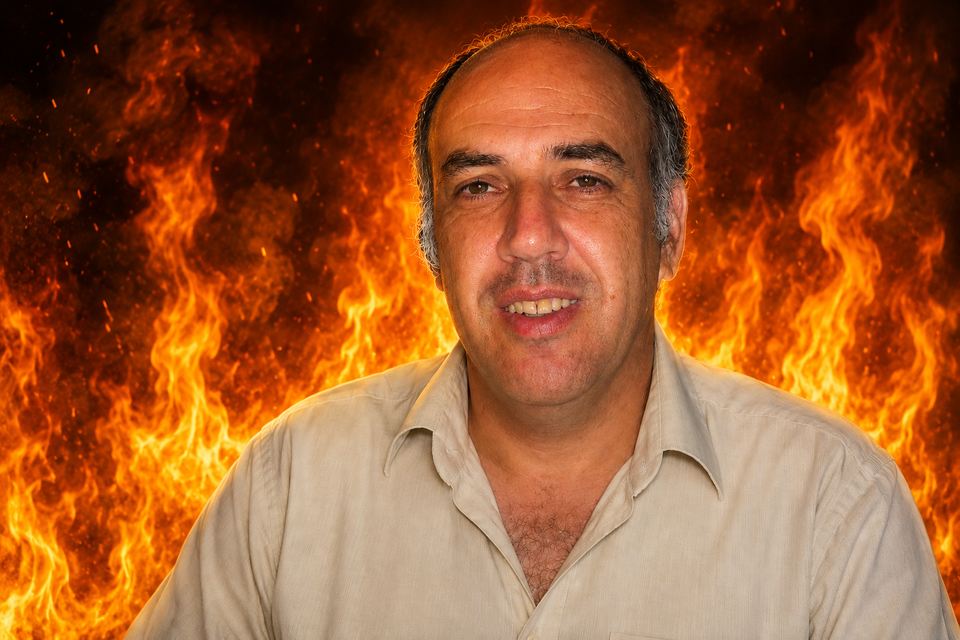
A Religious-Zionist editor wrote in a journalists' group that he has "long advocated" running over religious Jews and exterminating the Charedim. When a colleague recoiled and the public erupted, he did not retreat — he escalated, telling Channel 14 that road-blocking Charedim should be met with physical violence, broken bones, "preferably with clubs." The words are grotesque on their own. What they reveal about the climate now surrounding the draft is worse.
There are sentences that, once read, cannot be unread — because they tell you exactly what a person believes when he thinks he is among friends.
Chaggai Hoberman, the veteran journalist and editor of the Religious-Zionist weekly Matzav HaRuach, a man identified publicly with Naftali Bennett, wrote one of those sentences this week. In an internal journalists' group, against the backdrop of the Peleg Yerushalmi protests and road-blockages against the draft, Hoberman typed the words: "I have long advocated implementing 'run over every dos, exterminate the Charedi.'" The reaction inside the group was immediate. One participant wrote back, in evident shock, "What did you write here??" — and the screenshot of that exchange has since spread across Israeli social media, where the report was carried by Channel 14 and the Charedi press.
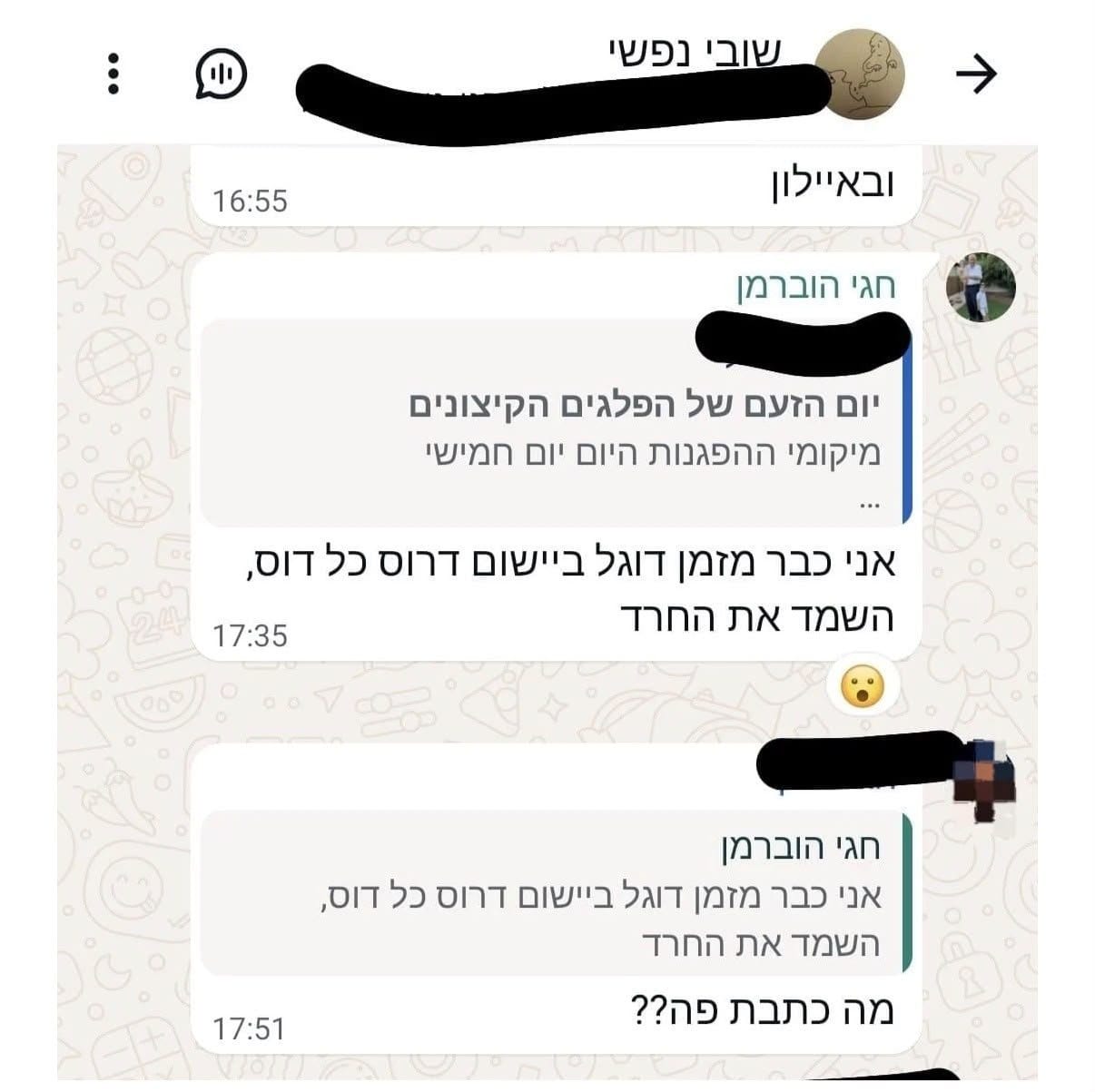
"Run over every dos. Exterminate the Charedi." Read it again, and be clear about what it is. It is not a policy argument. It is not even ordinary hatred. It is a call to kill Jews — an entire community of them — published by the editor of a newspaper.
I. The "Clarification" That Made It Worse
When incitement is exposed, the usual move is to retreat — to plead a joke, a slip, a moment of anger. Hoberman did not retreat. He escalated.
Asked about the statement by Channel 14, he first offered what he presented as a softening: that he had meant only "run over every dos who blocks roads in a protest against conscription." But then, pressed on whether such a statement could possibly be reasonable, he went further rather than back. In his view, he said, the public response to road-blockages "because of opposition to the draft" should be physical violence — including the breaking of bones, "preferably with clubs."
Take the measure of that. Given the chance to walk it back, a newspaper editor instead specified the method. Not "I spoke in anger." Not "I went too far." But a considered preference for the instrument with which Jews should have their bones broken in the street. The "clarification" did not contain the incitement; it confirmed it, and gave it detail.
II. This Is Not the First Time
It would be comforting to imagine this was an aberration — a single bad day. The record says otherwise.
In 2013, Hoberman caused a public storm with a different sentence, and it is worth quoting precisely, because it casts a long shadow over the one he wrote this week. He said: "I admit that not a single tear will fall from my eye if I see the yeshivos of Ponevezh, Mir, Slabodka, and Chevron all standing in the same condition as Yeshivat Chachmei Lublin in Poland" — the yeshiva that was destroyed in the Holocaust. And in June 2022, during the Bennett-Lapid government, he sent MK Idit Silman a message she publicly described as an attempt at coercion and intimidation, telling her what headline he would write against her if she voted the wrong way. A pattern of menace toward those he opposes is not new. What is new is that it has now arrived, in plain words, at extermination.
III. The Language of Extermination
Pay attention to the words themselves, because they were chosen.
"Dos" is not a neutral term; it is a slur, the reduction of a religious Jew to a contemptible type. "Hashmed" — exterminate — is not a word one reaches for by accident. It is the vocabulary of annihilation. And from a man who, in 2013, openly wished the great yeshivos of Klal Yisrael reduced to the ruin of a yeshiva murdered in the Shoah, the choice of "exterminate" is not loose talk. It is a Jew deploying, against other Jews, the exact grammar that was once deployed against all of us.
There is a particular horror in this. The Charedi world is made up of the children and grandchildren of those who were, in fact, exterminated — whose yeshivos in Poland and Lithuania were, in fact, left standing in ruins. To wish that fate upon Ponevezh and Mir, and to call for running Jews over in the street and breaking their bones, is to take up the language of our murderers and turn it inward. That a Jew would write such a thing is a tragedy. That a newspaper editor would write it, and then defend it, is a scandal that should shake anyone who still believes words have weight.
IV. The Test of the Double Standard
Here is the question that exposes everything, and it deserves to be asked without flinching: imagine these words aimed at any other group in Israel.
Imagine a newspaper editor writing "run over every Arab, exterminate them," and then telling a television channel that Arabs who protest should have their bones broken with clubs. There would be no "examination." There would be an arrest, a prosecution, a global headline, and a career reduced to ash by nightfall — and rightly so. The speed and force of the response would be total, and no one would call it excessive. The incitement to murder of any community is among the gravest things a public figure can do, and every decent society treats it that way.
So the Charedi community is entitled to ask why, when the target is them, the machinery moves so slowly. As of this writing, the police have opened only a preliminary examination of Hoberman's statements; we are told that if grounds for a criminal investigation are found, even summoning him would require the Attorney General's specific approval. Charedim have long argued that incitement against them is met with a shrug where incitement against others is met with handcuffs. This episode is becoming a live test of exactly that claim — and the whole country is watching to see whether "exterminate the Charedi" is treated as the call to murder that it plainly is, or quietly filed away as a strong opinion.
V. This Did Not Come From Nowhere
It would be a mistake to treat Hoberman as a lone deranged voice. He is not the disease; he is a symptom of a fever that has been rising for some time — and that the draft confrontation has brought to a boil.
For two years now, the public conversation about Charedim has curdled. The language of "equality" and "sharing the burden" has, at its edges, hardened into something uglier — a steady drumbeat in which a whole community is cast as parasites, as enemies, as a thing to be broken rather than a people to be reasoned with. When the dehumanization of a community becomes background noise, it is only a matter of time before someone says the quiet part out loud. Hoberman said it. He did not invent the sentiment; he merely stripped it of its euphemisms and printed it in the clear. And incitement, once normalized, does not stay on the page. It travels to the road, to the protest, to the lone individual who decides that an editor's words are permission. The distance between "exterminate the Charedi" and a Jew lying injured in the street is shorter than anyone should be comfortable with.
VI. How We Answer — and How We Do Not
So how does the Torah community respond to a man who calls for its extermination?
Not in kind. Let this be said plainly, because it is the whole difference between us and the words written about us: we do not answer a call for murder with a call for murder. We will not wish broken bones on Chaggai Hoberman, nor on anyone. We have buried too many Jews, across too many centuries, to ever take up the vocabulary of those who buried them. Our answer is the one our mission has always been: facts, dignity, and a demand for justice — not vengeance, but accountability.
And so we say clearly what we do ask. We ask that the law be applied to incitement against Charedim exactly as it would be applied to incitement against anyone else — no faster, but not one step slower. We ask that those who shape public opinion, across the entire spectrum, name this for what it is; and we note, without bitterness, that the decency to be appalled by "exterminate the Charedi" is not a Charedi value or a Religious-Zionist value but a human and a Jewish one, and that many in Hoberman's own world will be as sickened by his words as we are. And we ask the wider public to understand, at last, where the road of demonization leads — because it has led there before, and the ruins of Chachmei Lublin are still standing to prove it.
A Jew called for the extermination of his brothers, and a newspaper editor said it should be done with clubs. The Charedi community will not meet that with hatred. It will meet it with the truth, said plainly and without fear — and with a tefillah that the One who has guarded this people through every exile guard us still, and soften the hearts that have hardened so far against their own flesh and blood.
"He will not slumber nor sleep, the Guardian of Israel." May He watch over all His people, turn hatred to brotherhood, and bring the day when no Jew lifts a word — or a hand — against another. Bimheirah b'yameinu, amen.
Sources
- The statement in the journalists' group — "I have long advocated implementing 'run over every dos, exterminate the Charedi'" — and the immediate reply, "What did you write here??", as reported by Channel 14 and the Charedi press (Bechadrei Charedim; Charedim10), and corroborated by the screenshot circulated publicly; Hoberman identified as editor of the Religious-Zionist weekly Matzav HaRuach and associated with Naftali Bennett
- Hoberman's response to Channel 14: that he meant "run over every dos who blocks roads in a protest against conscription," followed by his escalation — that road-blockages over opposition to the draft should be met with physical violence, including breaking bones, "preferably with clubs"
- The opening of a police examination of the statements (Sunday), with the note that a criminal summons would require the approval of the Attorney General; and the public calls upon the police, Shin Bet, and State Attorney to investigate for racist incitement to murder
- Hoberman's history: the 2013 statement that "not a single tear" would fall from his eye to see the yeshivos of Ponevezh, Mir, Slabodka, and Chevron in the ruined condition of Yeshivat Chachmei Lublin in Poland (destroyed in the Holocaust); and the June 2022 message to MK Idit Silman that she publicly described as coercion and intimidation
- The broader pattern, documented across the Charedi community's complaints, of disparate enforcement — incitement against Charedim met more leniently than comparable incitement against other groups
This is a developing news story; details are drawn from the reporting available at the time of writing and may be updated as the police examination proceeds.
A note on the publication's standard
This article reports documented, on-the-record statements by a named public figure, condemns them, and calls only for lawful accountability. It does not endorse, and the Torah community does not countenance, any act of violence or any incitement in response — toward Chaggai Hoberman or anyone else.