The Gedolim Have Spoken
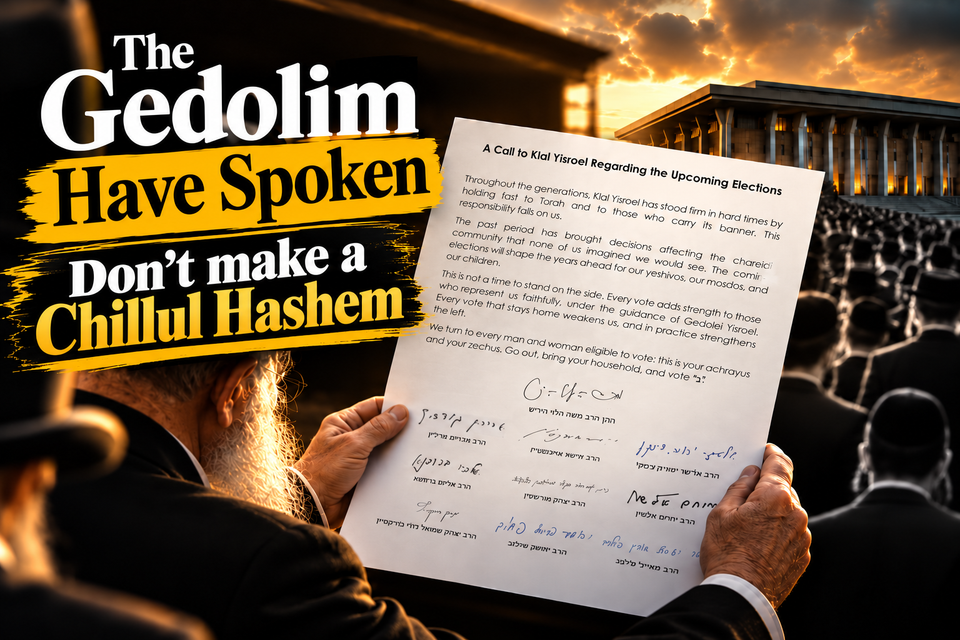
One week before Israel goes to the polls, the Gedolei Yisrael have spoken, and they have spoken in English.
This morning, October 20, a letter titled "A Call to Klal Yisroel Regarding the Upcoming Elections" was published. It is short. It is signed by ten of the greatest roshei yeshiva and rebbes of our generation, from Bnei Brak, Yerushalayim, Gateshead, Lakewood and Brooklyn. And it is addressed, deliberately, to us: the English-speaking Charedi public in Eretz Yisrael, the Americans, the British, the South Africans, the Australians, the tens of thousands of bochurim, avreichim, families and retirees who hold an Israeli teudat zehut and who, in previous elections, were the easiest votes to lose.
The letter is reproduced in full below. Read it slowly. Then read the names.
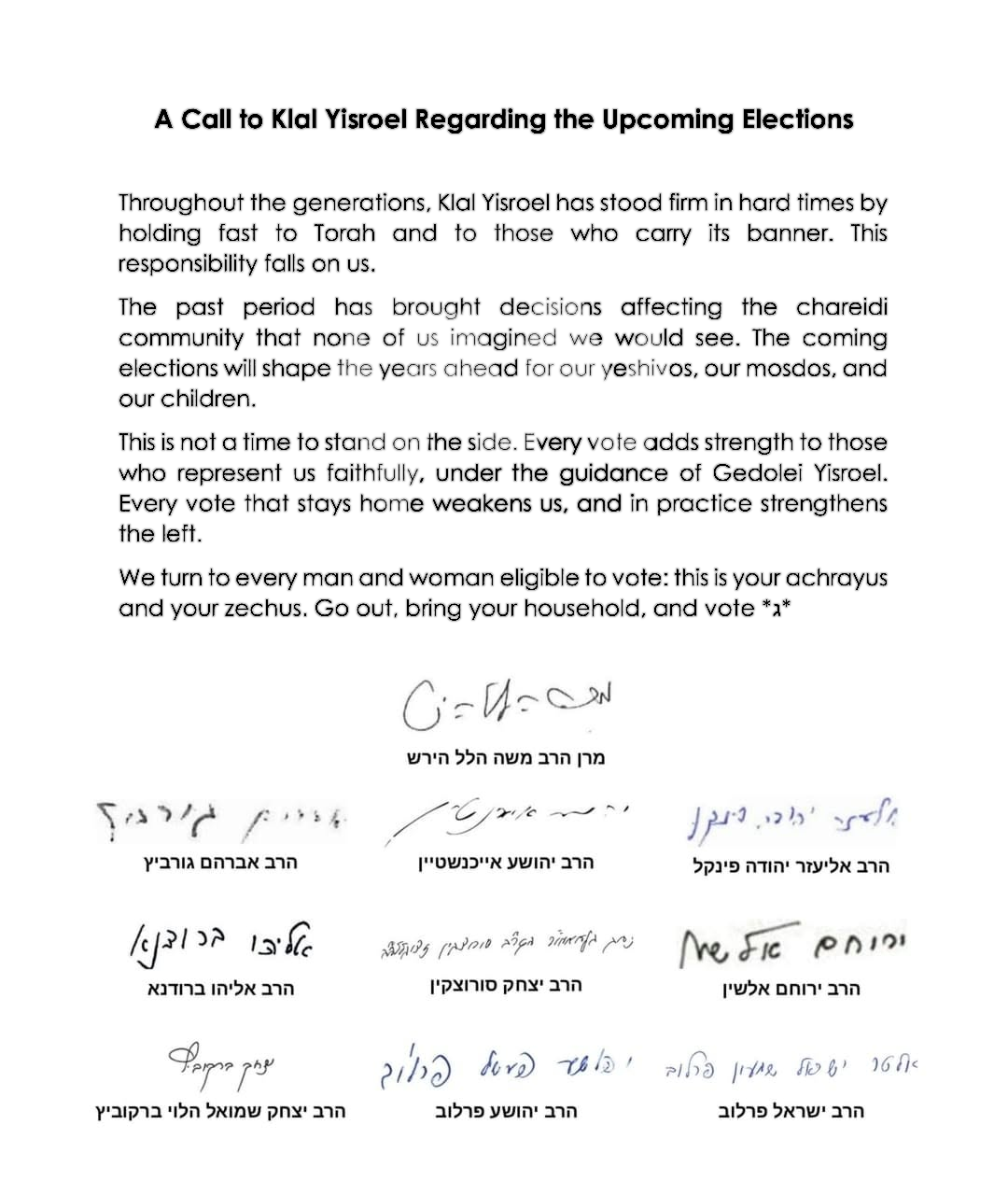
The Gedolim do not waste words, and they do not sign things lightly. When Rav Moshe Hillel Hirsch puts his name at the top of a page, and Rav Yeruchem Olshin and Rav Elya Brudny and the Gateshead Rosh Yeshiva put theirs beneath it, that page is not a suggestion. It is a psak about hishtadlus. Its message can be summarized in four sentences, in the letter's own words: the past period brought decisions affecting the Charedi community that none of us imagined we would see. The coming elections will shape the years ahead for our yeshivos, our mosdos and our children. Every vote that stays home weakens us and in practice strengthens the left. Go out, bring your household, and vote Gimmel.
That is the whole letter. Everything that follows in this post is only an attempt to explain why they wrote it, and why we must listen.
Who signed
Look at the signatures. This is not one party's rabbanim or one yeshiva's hanhala. It is the Litvishe Torah world on two continents, together with the Novominsker chassidus, on a single page.
- Maran Harav Moshe Hillel Hirsch, Rosh Yeshivas Slabodka, Bnei Brak. Together with Rav Dov Landau he leads Degel HaTorah's Moetzes Gedolei HaTorah and has been the address for the entire draft question since the petirah of Rav Gershon Edelstein zt"l. His signature heads the letter.
- Harav Avraham Gurwicz, Rosh Yeshiva of Gateshead, the largest yeshiva in Europe and the center of the English-speaking Torah world outside America.
- Harav Yehoshua Eichenstein, Rosh Yeshivas Yad Aharon, Yerushalayim, among the senior roshei yeshiva of the capital.
- Harav Eliezer Yehuda Finkel, Rosh Yeshivas Mir Yerushalayim, the largest yeshiva in the world, and a member of the Moetzes Gedolei HaTorah.
- Harav Elya Brudny, Rosh Yeshivas Mir Brooklyn and a member of the Moetzes Gedolei HaTorah of America.
- Harav Yitzchok Sorotzkin, Rosh Yeshiva of Telshe and of the Mesivta of Lakewood, one of the most widely respected roshei yeshiva in America.
- Harav Yeruchem Olshin, Rosh Yeshiva of Beth Medrash Govoha, Lakewood, the largest yeshiva in America. There is no bochur or avreich from Lakewood in Eretz Yisrael who does not know whose signature this is.
- Harav Yitzchok Shmuel Halevi Berkovits, Rosh Yeshivas Aish HaTorah and Linas HaTzedek, Yerushalayim, the rav and posek of thousands of Anglo families in Yerushalayim and the Ramat Eshkol area.
- Harav Yisroel Perlow and Harav Yehoshua Perlow, the Novominsker Rebbes, sons of the Novominsker Rebbe zt"l who led Agudas Yisroel of America for decades.
For the American oilam in Eretz Yisrael, these are not distant names. These are our own roshei yeshiva, the rebbeim whose shiurim we sat in, whose haskamos are on our seforim, whose homes we went to for a bracha before our chasunah. They did not sign a Hebrew kol koreh and leave it for someone to translate. They wrote to us in our language, because they want to be certain that no one can say he did not understand.
This letter is not alone
The English letter is the latest in a week of unprecedented, public, unanimous calls from the Gedolei Hador. In any other election cycle, the roshei yeshiva would sign a kol koreh and go back to their shiurim. This time they have left the beis medrash and gone city to city.
Rav Dov Landau, Rosh Yeshivas Slabodka and the senior member of the Moetzes Gedolei HaTorah, traveled on Friday to Tel Aviv, of all places, to meet dozens of rabbanim and community leaders. He compared the moment to a Sefer Torah that has fallen to the floor: no one stops to ask whether it is convenient to pick it up. Earlier that week he instructed shochtim not to accept shechitah assignments abroad if the trip would keep them from the ballot box, even at a loss of income.
On Motzoei Shabbos, October 17, Degel HaTorah's Moetzes Gedolei HaTorah convened an emergency gathering with roshei yeshiva and mashgichim at the Wolf Seminary in Bnei Brak. The report of that night reads like a wartime council:
- Rav Dov Landau said that participating in elections is a chiyuv of hishtadlus established by the Chazon Ish, that a drop in turnout would be a chillul Hashem, and that personal grievances are no excuse to stay home.
- Rav Moshe Hillel Hirsch addressed directly the bochurim who say voting has accomplished nothing. He rejected the argument outright, called a decline in voters a terrible chillul Hashem, and asked every rosh yeshiva to go to his talmidim personally and tell them: do not think you know everything; there are things being done that you do not see.
- Rav Boruch Dov (Berel) Povarsky, Rosh Yeshivas Ponovezh, sent a letter read aloud by Rav Hirsch. It cited the Chazon Ish's position that going to vote is a public declaration that Hashem is G-d and that we want the Torah to rule. Voting, he wrote, sanctifies Hashem's name; abstaining does the opposite. He described what is happening now as a war against lomdei Torah.
- Rav Meir Tzvi Bergman, Rosh Yeshivas Rashbi and a member of the Moetzes, called the election a fight for the survival of the Torah world and above all against the drafting of bochurim.
- Rav Eliezer Yehuda Finkel, Rosh Yeshivas Mir, said that anyone who abstains now out of frustration or personal calculation is showing that his vote in past years was never really about emunas chachamim.
- Rav Shraga Steinman, Rosh Yeshivas Orchos Torah, cited his father Rav Aharon Leib zt"l: elections are how the world sees that Torah Jewry is still standing, and a smaller number is a chillul Hashem.
- Rav Sholom Ber Sorotzkin, Rosh Yeshivas Ateres Shlomo, called the act of voting a public kiddush Hashem and a renewed kabbalah of Torah and of the Gedolei Yisrael.
- Letters from Rav Aviezer Piltz of Tifrach were read; Rav Moshe Yehuda Schlesinger of Kol Torah and Rav Daniel Wolfson of Nesivos Aviezer were there as well.
The next night, Monday October 19, Rav Hirsch was in Petach Tikvah. His words there, as reported, are the sharpest of the campaign. He warned that any alternative draft law coming from the left would make it impossible to keep the yeshivos running as they do today, and that the people behind it are aiming at Chinuch Atzmai, the chadarim and the seminaries as well. To those who are angry and considering another party, he said it is forbidden, forbidden, forbidden to go anywhere else, and that every yeshiva bochur and every Charedi man must vote Gimmel.
And a few days before all this, when Minister Smotrich attacked the Charedi public, Rav Landau called it a deliberate chillul Hashem and said the Torah world is under assault.
Why this election is not like the others
Every election, someone says this one is the most important ever. Usually it is campaign talk. This time the people saying it are the ones who have spent the last two years in the room, and they are not campaigners.
Think about what the letter means by "decisions affecting the chareidi community that none of us imagined we would see." It means a High Court ruling, in June 2024, that ended the legal protection for bnei yeshiva, ordered the army to draft them, and cut off the yeshivos' funding. It means criminal sanctions, arrest warrants and travel bans hanging over bochurim whose only crime is sitting in the beis medrash. It means ministers of a so-called right-wing government speaking about us the way the left once did. None of this was on the table a few years ago. All of it is on the table now.
And here is what the roshei yeshiva understand that the frustrated bochur in the back of the beis medrash does not: the only thing standing between the Olam HaTorah and something far worse is political strength. Not perfect representatives. Not a perfect party. Strength. Seats. The ability to say to any prime minister, of any bloc, that no coalition exists without us and no law touches a yeshiva without our consent. That is what Rav Hirsch meant in Petach Tikvah when he warned that the alternative to the current situation is a law under which the yeshivos simply cannot function. He was not describing a hypothetical. He was describing what is written and waiting in the drawer of the next government if we are not at the table at full strength.
So picture, chas v'shalom, the morning of October 28 with the Charedi parties two or three seats weaker than they are today. Not because the Charedi public shrank; it grew. Because tens of thousands of us stayed home, or threw our vote at a party that evaporated below the threshold. What does that morning look like?
It looks like a coalition that can be formed without us, and therefore is. It looks like a draft law written by people who want the yeshivos emptied, passed without a single amendment we asked for. It looks like Chinuch Atzmai, the chadarim and the seminaries next in line, exactly as Rav Hirsch warned. It looks like every secular editorialist writing the same column: the Charedim are splitting, the young are leaving, the Gedolim have lost the street. It looks like the enemies of Torah learning that it was never about equality or the burden, it was about whether the Olam HaTorah has the power to say no. And on that morning the answer would be no.
That is the chillul Hashem Rav Landau and Rav Hirsch and Rav Povarsky keep returning to. Not a vague embarrassment. A public, countable, broadcast demonstration that Torah Jewry is weaker than it was, at the exact moment its enemies are testing whether it can be broken.
There is a reason the Chazon Ish, who kept his distance from the state in every other way, told the Charedi public to vote, and told a Yid who could not afford the poll tax to sell his tefillin to pay it (the story is recorded and it is the Chazon Ish's position on voting that Rav Povarsky invoked this week). The Chazon Ish understood that in a country where the government holds the keys to the yeshivos, the ballot is not politics. It is the wall around the beis medrash. You do not take a day off from guarding the wall because you are annoyed at the guards.
The flash in the pan, and the vote that goes in the garbage
Every election season a new banner appears on the Charedi street promising to finally do what the old parties could not. It speaks to real pain: the working Charedi who feels unseen, the bochur who is tired of the same faces, the family that reads the news and wants someone to fight harder. The pain is real. The answer is not.
This year's version calls itself HaTzibur HaCharedi, "the Charedi Public," led by Moti Leitner. Its platform, by its own description, includes a different approach to enlistment and sweeping changes to Charedi education. Judge for yourself what a party that runs on Charedi enlistment and education reform will do with our children's chadarim once it is sitting across the table from the Attorney General. But set even that aside, because there is a simpler problem.
We have written about how they are being used extensively here: https://www.charedim.com/the-useful-idiots-of-hatzibur-hacharedi/
To enter the Knesset a party needs 3.25 percent of the national vote. Channel 14's poll last week gave HaTzibur HaCharedi 0.4 percent. It has not crossed the threshold in a single poll since it was founded. The prime minister himself has reportedly spent days trying to persuade its leader to withdraw, because every vote cast for a party that fails the threshold is simply thrown out. It does not transfer. It does not send a message. It is not counted for anyone. It is a slip of paper in a landfill.
So a Charedi vote for HaTzibur HaCharedi is, in practice, a vote subtracted from the Torah bloc and handed to the left, which is exactly what the letter from the Gedolim warns against in plain English. The people who built this party may believe they are fighting for the Charedi public. The arithmetic says they are weakening it at the most dangerous moment in its history. That is why Rav Hirsch, who does not use such language lightly, said three times in Petach Tikvah that it is forbidden to go anywhere else.
And notice who is cheering. The Jerusalem Post presents it as a "different path" for the Charedi voter; the Times of Israel happily relays its attacks on the "detachment" and "stupidity" of the parties the Gedolim stand behind. When the outlets that have spent years campaigning to empty the yeshivos are delighted by a new Charedi party, that is all the information you need about whom it serves.
There is nothing wrong with wanting better representation. Fight for it inside the house, after the war. Right now the house is under siege, and the only question on October 27 is whether the Olam HaTorah shows up at full strength or lets itself be counted as divided and shrinking. Protest votes are a luxury of peacetime.
Hishtadlus is a mitzvah. Rise.
We believe with complete faith that governments do not decide the fate of the Torah. Hashem does. But Hashem has told us, through the Chazon Ish, through Rav Shach, through Rav Elyashiv and Rav Shteinman and Rav Chaim Kanievsky, and now through Rav Landau and Rav Hirsch and the roshei yeshiva of two continents, exactly what our hishtadlus is. It is to go and vote. The Gedolim have taken that decision off your shoulders. The only thing left on your shoulders is whether you listen.
Understand what the state is doing. The medina, through its court, its army and now its politicians of every stripe, has declared war on the Olam HaTorah. Not on crime, not on poverty, not on a security threat. On the beis medrash. On the idea that a Jew may spend his life learning Hashem's Torah. We did not pick this fight. But we will not pretend it is not happening, and we will not lose it by default. Our vote is the one weapon they handed us themselves, and we are going to use every single one.
This is what a kiddush Hashem looks like in a democracy: the morning after the election, the whole country reads that the Charedi parties grew, that the Torah public turned out in numbers no one else can match, that the young did not drift and the frustrated did not sulk, that when the Gedolim called, Klal Yisrael answered. That headline is worth more than any speech. And it is entirely in our hands.
So here is what the letter is asking of you, in practical terms, for the next seven days:
- Vote yourself, on Tuesday, October 27, for Gimmel. Check now where your polling station is and when you will go. Do not leave it to the last hour.
- Bring your household. The letter says it explicitly: every man and every woman. Your wife's vote counts exactly as much as yours. So does your grandmother's, your married daughter's, your son in the dirah in Yerushalayim who has not registered an address in years.
- Call the Americans. Every bochur and avreich from Lakewood, Brooklyn, Gateshead or Johannesburg who holds a teudat zehut and is sitting in a yeshiva in Eretz Yisrael right now is exactly who this letter was written for. Many of them have never voted here and assume it is complicated. It is not. Tell them their own roshei yeshiva signed this. Then tell them where to go.
- Drive people. The elderly, the kimpeturin, the family without a car, the one who says he will go later. Later does not vote. Put them in the car.
- Answer the frustrated with the Gedolim, not with arguments. Rav Hirsch already told the bochur who thinks it is pointless: there are things being done that you do not see. You do not need a better argument than the Rosh Yeshiva's. Show him the letter.
- Do not waste a single vote. Not on a party that will not cross the threshold, not on a protest, not on a party that runs on reforming our chadarim. Gimmel. That is the whole instruction.
The Gedolim have spoken. They did not whisper, and they did not hedge. They wrote it in English so that no one could say he did not understand. One week from now, on October 27, we will find out who was listening.
Sources
- A Call to Klal Yisroel Regarding the Upcoming Elections, The Yeshiva World, October 20, 2026
- Rav Dov Landau in Tel Aviv, Matzav, October 18, 2026
- Emergency Bnei Brak gathering of the Moetzes Gedolei HaTorah, Matzav, October 19, 2026
- Rav Moshe Hillel Hirsch in Petach Tikvah, JFeed, October 20, 2026
- Rav Dov Landau on Smotrich's remarks, The Yeshiva World, October 2026
- HaTzibur HaCharedi and the threshold, The Yeshiva World, October 19, 2026
- HaTzibur HaCharedi platform, Jerusalem Post
- The Chazon Ish and the poll tax, Matzav