
Why is unity so important in Torah Judaism?
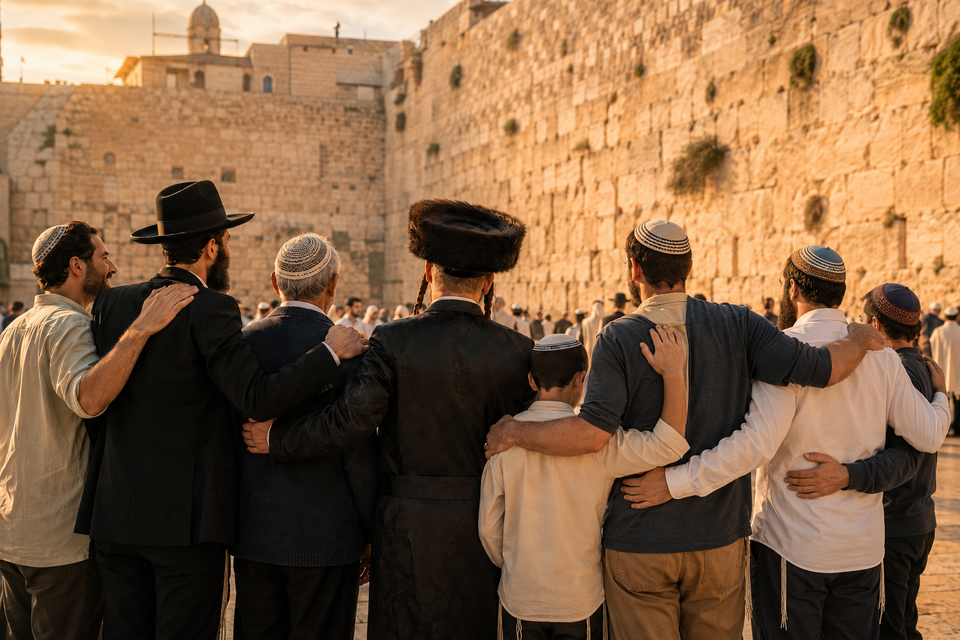
Achdus — the Unity of Klal Yisrael — Is Not a Sentimental Slogan in the Torah; It Is a Foundational Force. It Is the Vessel That Holds the Brachah, the Condition Under Which the Shechinah Rests Among Us, the State in Which the Torah Was Given and in Which It Can Be Received. It Is What Redeemed Us From Mitzrayim and What Will Redeem Us Again; It Is the Shield Against Our Enemies; and Its Absence — Baseless Hatred and the Habit of Attacking Every Jew Who Differs — Is What Destroyed the Beis HaMikdash and Keeps Us in Exile. But True Achdus Is Not Conformity. It Does Not Mean We All Look Alike or Erase Real Differences. It Means Loving Every Jew as Ourselves, Assuming the Best of One Another, and Caring for the Pain of Every Member of the One Body That Is Klal Yisrael — Because Hashem Is One, His Torah Is One, and Only a Nation That Is One Can Receive His Light
Why is unity — achdus — so central to Torah Judaism? It is tempting to treat the answer as obvious sentiment: of course unity is nice, of course we should all get along. But in the Torah, achdus is far more than a pleasant ideal. It is a foundational spiritual force — the vessel that holds blessing, the condition for the Divine Presence, the state in which the Torah was given and can be received, the shield against our enemies, and the key to the geulah. And its opposite — division and baseless hatred — is, in the Torah's accounting, among the most destructive forces in Jewish history.
I. Unity Is the Vessel That Holds Blessing
Begin with a teaching that places unity at the very foundation of how blessing reaches the Jewish people. The Mishnah, in the closing words of an entire order of the Mishnah, declares:
"Lo matza HaKadosh Baruch Hu kli machzik berachah l'Yisrael ela hashalom."
"The Holy One, blessed be He, found no vessel that holds blessing for Israel except peace." (Uktzin 3:12)
This is a startling statement. Of all the things Hashem might have designated as the container for His blessing to Israel, He chose shalom — peace, the harmony of a people at one with itself. Blessing, in other words, requires a vessel; and a divided people is a broken vessel that cannot hold what Hashem wishes to pour into it. However much blessing Heaven sends, it can only be received by a nation united enough to contain it. This is why peace is the closing brachah of so much of our avodah — the Birkas Kohanim ends in shalom, the Shemoneh Esrei ends in shalom — because peace is not merely one good thing among many; it is the precondition for every other good thing to take hold.
The same principle governs the resting of the Shechinah. Chazal teach that the Divine Presence rests amid harmony and joy and withdraws from strife and brokenness — "ein haShechinah shorah ela mitoch simchah" (Shabbos 30b) — and the entire thrust of the mesorah is that Hashem's presence dwells among a people at peace with itself and is driven off by division. Where there is achdus, the Shechinah draws near; where there is machlokes, it withdraws. A community torn by strife, however outwardly observant, has made itself a place from which the Divine Presence recoils. Unity is not decoration on the house of Torah; it is the foundation that allows the Shechinah to dwell in it at all.
II. The Torah Was Given Only in Unity
The supreme moment of Jewish history — the giving of the Torah at Har Sinai — was conditioned on achdus, and the Torah signals this in a single grammatical detail.
Describing the nation's arrival at the mountain, the pasuk says: "Vayichan sham Yisrael neged hahar" — "and Israel camped there, opposite the mountain" (Shemos 19:2). Rashi notes that the verb vayichan — "he camped" — is in the singular, though it describes an entire nation, and explains the lesson:
"K'ish echad b'lev echad."
"[They camped] as one man, with one heart." (Rashi, Shemos 19:2)
At every other encampment in the wilderness, Rashi observes, the people came with the ordinary frictions and complaints of a vast multitude. But at Sinai, to receive the Torah, they became one — a single person with a single heart. And this was not incidental to the giving of the Torah; it was a precondition of it. The Torah, which is one, given by the One God, could be received only by a people that had made itself one. A fractured nation could not have stood at Sinai; the very unity of the Torah required a corresponding unity in those who would receive it.
The lesson reaches into every generation. The Torah is received, in each age, to the degree that Klal Yisrael approaches that Sinai unity — k'ish echad b'lev echad. Division does not merely make Jewish life unpleasant; it makes the nation less able to receive the Torah that is its very life. To build a people capable of holding the Torah, one must build a people capable of unity — and the two tasks, in the Torah's understanding, are one and the same.
III. Klal Yisrael Is One Body
Beneath all of this lies a truth about what Klal Yisrael fundamentally is: not a collection of separate individuals who happen to share a religion, but a single organism — one body, one soul.
The Gemara states the principle that binds every Jew to every other: "kol Yisrael areivim zeh bazeh" — all of Israel are guarantors for one another (Shevuos 39a). We are not independent units; we are mutually responsible, mutually bound, answerable for one another — because we are, at the deepest level, parts of one whole. This is why the Torah commands, as the Rambam codifies it: "mitzvas asei min haTorah le'ehov kol echad v'echad miYisrael k'gufo" — "it is a positive mitzvah from the Torah to love each and every Jew as oneself" (Hilchos De'os 6:3), rooted in the Torah's command "v'ahavta l'reiacha kamocha" — "you shall love your fellow as yourself" (Vayikra 19:18). To love another Jew is, quite literally, to love a part of one's own body — for that is what he is.
The greatest of Chazal placed this at the very center of the Torah. Rabbi Akiva taught that "v'ahavta l'reiacha kamocha" is "klal gadol baTorah" — the great principle of the entire Torah (Yerushalmi Nedarim 9:4; Sifra). And when a prospective convert asked Hillel to teach him the whole Torah while standing on one foot, Hillel answered with the same idea in its negative form: "That which is hateful to you, do not do to your fellow — that is the whole Torah; the rest is its explanation, go and learn" (Shabbos 31a). The whole Torah, in Hillel's formulation, rests on how a Jew treats his fellow — because the fellow is part of the same single body, and the Torah is the instruction for how that one body lives.
This is the deepest reason unity matters: it is not the joining of separate things but the recognition of what was always one. When we mock, shame, or exclude another Jew, we are not striking an opponent; we are wounding our own body. When we draw another Jew close, we are healing ourselves. Achdus is simply Klal Yisrael living in accordance with what it truly is — one.
IV. Unity Redeemed Us, and Will Redeem Us Again
Unity is not only the condition for blessing and Torah; it is, in the Torah's account of history, the engine of redemption itself.
When the Jewish people went down to Mitzrayim and were forged into a nation, and when they were redeemed, Chazal emphasize that they had become k'ish echad b'lev echad — one man with one heart. The geulah from Mitzrayim came to a people that, for all its suffering, had held together. Unity was the vessel of the first redemption — and the mesorah teaches that it will be the vessel of the final one.
The inverse is equally true, and it is the great lesson of the churban. Chazal teach that the second Beis HaMikdash was destroyed because of sinas chinam — baseless hatred (Yoma 9b) — the unraveling of the very unity that had made the nation a fitting dwelling for the Shechinah. What division destroyed, only its repair can rebuild. We have developed this at length in our article on sinas chinam and ahavas Yisrael; here it is enough to draw the conclusion that follows directly: if baseless hatred kept the Beis HaMikdash from standing, then the unity that is its opposite is what will allow it to rise again. The geulah is not waiting only on our learning or our mitzvos; it is waiting, in significant part, on our willingness to become one. Achdus is not a pleasant accompaniment to the redemption — it is its vessel.
V. Unity Is a Shield Against Our Enemies
There is a further dimension, and in a time of danger it is not abstract: the unity of Klal Yisrael is, in the Torah's understanding, a source of protection against those who would harm us.
The Midrash teaches, in the name of Hashem: "K'she'atem asuyim agudah achas, ein umos ha'olam yecholin lishlot bachem" — "When you are made into a single bundle, the nations of the world cannot rule over you" (Tanchuma, Nitzavim 1). A bundle of reeds bound together cannot be broken; the same reeds, separated, snap one by one. The image is precise: the strength of Klal Yisrael against its enemies is, in significant measure, a function of its unity. A people at one with itself is shielded; a people fractured into warring camps exposes itself to those who would dominate it.
This is a protection no weapon supplies. In a time of threat, the instinct is to look only to physical defenses — and those have their place — but the Torah teaches that the deepest shield of the Jewish people is its achdus. When Jews stand together, care for one another, and bind themselves into a single bundle, they draw upon a protection that the nations cannot overcome; when they fracture, they forfeit it. The greatest national-security asset of Klal Yisrael, in the Torah's accounting, is its unity — and squandering it through internal hatred is not only a spiritual failure but a strategic one.
VI. What Division Destroyed — the Warning of the Netziv
It is worth dwelling on precisely how the unity of the second Beis HaMikdash unraveled, because the Netziv's analysis is among the most penetrating — and most uncomfortable — in all of our literature, and it speaks directly to our own generation.
In his introduction to Sefer Bereishis, the Netziv (Rav Naftali Tzvi Yehuda Berlin) explains why the Avos are called "yesharim" — upright — and why that quality, specifically, was what the generation of the churban lacked. The people of the second Beis HaMikdash, he writes, were not wicked — they were tzaddikim and chassidim, righteous and devout, immersed in Torah and mitzvos. But they were not yesharim in their dealings with one another. Because of the distortions of baseless hatred in their hearts, whenever they saw a Jew who conducted his avodas Hashem differently than they did, they suspected him of being a heretic — and from that suspicion came strife, division, and bloodshed that destroyed the Beis HaMikdash and the nation.
Let the precision of this land. The Netziv is not describing irreligious Jews who hated the observant. He is describing deeply observant Jews — tzaddikim — whose religiosity itself became the instrument of division, because they made their own way of serving Hashem the measure of every other Jew's legitimacy, and condemned as a heretic anyone who differed. Their fault was not too little religion but a religion turned into a weapon against fellow Jews. And it was this — not laxity, not heresy, but the self-righteous fracturing of Klal Yisrael by the devout — that brought the churban. There is no sharper warning for a Torah community in any generation: that one can be a tzaddik and still be guilty of the sin that destroys the Beis HaMikdash, if one's avodas Hashem becomes a reason to despise other Jews.
VII. True Achdus Is Not Conformity
All of this raises an essential clarification, without which "unity" can be badly misunderstood: achdus does not mean uniformity, and it does not mean pretending real differences do not exist.
Unity does not require that all Jews look alike, daven alike, or hold identical hashkafos. Klal Yisrael has always contained a vast range — different communities, customs, approaches, and emphases — and the Torah never demanded that this richness be flattened into sameness. To confuse achdus with conformity is to misunderstand it entirely. The twelve tribes were one nation precisely as twelve distinct tribes, each with its own character and its own banner, united not by erasing their differences but by their common service of the one Hashem.
What achdus does require is something deeper and harder than uniformity. It means respecting other Torah-observant Jews even where we differ from them; refusing to traffic in cynical generalizations about whole groups; assuming the best of another Jew rather than the worst, unless proven otherwise; and caring genuinely about the pain of every Jew — including those with whom we disagree. It means recognizing that another Jew who serves Hashem differently than we do is not, for that reason, an enemy or a heretic — the very error the Netziv identified as the cause of the churban. As the Torah leadership of our own generation taught, true achdus means caring for another Jew even when he is not like you — not despite the differences, but across them.
This is the achdus the Torah demands: not a gray sameness, but a love and respect strong enough to hold real differences within a single, caring whole. It is harder than conformity, because conformity asks only that everyone become the same, while true achdus asks that we love those who are not the same as ourselves — and recognize them, still, as part of our own one body.
VIII. The Closing Position — Unity Is the Vessel for Geulah
Why is unity so important in Torah Judaism?
Because, in the Torah's understanding, achdus is the vessel that holds everything else. It is the only container that holds blessing (Uktzin 3:12); the condition under which the Shechinah rests among us; the state in which the Torah was given at Sinai and in which it continues to be received; the recognition of what Klal Yisrael truly is — one body, every Jew a guarantor for every other; the engine of the redemption from Mitzrayim and of the final geulah; and the deepest shield of the Jewish people against those who would harm it. And its absence — the baseless hatred that turns even the devout into accusers of their fellow Jews — is what destroyed the Beis HaMikdash and keeps us, to this day, in exile.
True achdus is not conformity. It does not erase the rich diversity of Klal Yisrael or paper over real disagreements. It means loving every Jew as a part of one's own self, assuming the best of one another, refusing to make one's own avodas Hashem the measure by which to condemn another Jew, and caring for the pain of every member of the one body we together comprise. It is harder than uniformity, and infinitely more precious.
In the end, the reason runs as deep as anything in the Torah. Hashem is One. His Torah is One. And only a nation that is one can be a vessel fit to receive His light. When Klal Yisrael becomes k'ish echad b'lev echad — one man with one heart — it becomes, once again, what it was at Sinai and what it must be for the geulah: a single, whole, unbroken vessel, ready to hold the blessing and the presence of the One who is waiting to dwell among us.
May we merit to become one — and through that oneness, to greet the geulah, bimheirah b'yameinu, amen.
Sources
Unity as the vessel for blessing and the Shechinah
- Mishnah, Uktzin 3:12 (the closing Mishnah of Seder Taharos) — "lo matza HaKadosh Baruch Hu kli machzik berachah l'Yisrael ela hashalom" — Hashem found no vessel holding blessing for Israel except peace; the closing of Birkas Kohanim and Shemoneh Esrei in shalom
- Talmud Bavli, Shabbos 30b — "ein haShechinah shorah ela mitoch simchah" — the Divine Presence rests amid joy and harmony and withdraws from strife and brokenness; (the "Shechinah does not rest amidst machlokes" teaching cited in the original draft to Rashi on Bamidbar 7:89 could not be confirmed to that source as worded; the principle is presented here on the basis of the established Chazal sources on the Shechinah and peace/joy)
The Torah given only in unity
- Shemos 19:2 with Rashi — "vayichan sham Yisrael" in the singular: "k'ish echad b'lev echad" — the nation became one man with one heart to receive the Torah at Sinai
Klal Yisrael as one body
- Talmud Bavli, Shevuos 39a — "kol Yisrael areivim zeh bazeh" — all of Israel are guarantors for one another
- Vayikra 19:18 — "v'ahavta l'reiacha kamocha" — love your fellow as yourself; and Rambam, Hilchos De'os 6:3 — the positive mitzvah from the Torah to love every Jew as oneself
- Yerushalmi Nedarim 9:4; Sifra (Kedoshim) — Rabbi Akiva: "v'ahavta l'reiacha kamocha — zeh klal gadol baTorah" — the great principle of the Torah
- Talmud Bavli, Shabbos 31a — Hillel to the prospective convert: "that which is hateful to you, do not do to your fellow — that is the whole Torah, the rest is its explanation"
Unity and redemption
- The teaching that Israel was redeemed from Mitzrayim and stood as a nation k'ish echad b'lev echad (the theme developed by Rav Chaim Shmuelevitz zt"l, Sichos Mussar — presented as a documented theme)
- Talmud Bavli, Yoma 9b — the second Beis HaMikdash destroyed through sinas chinam (developed in "Sinas Chinam and Ahavas Yisrael"); the corollary that its repair is the unity that will allow the Mikdash to rise again
Unity as a shield against enemies
- Midrash Tanchuma, Nitzavim 1 — "k'she'atem asuyim agudah achas, ein umos ha'olam yecholin lishlot bachem" — when Israel is made into a single bundle, the nations cannot rule over it
- The historical example of Rav Eliezer Silver zt"l, who during the Second World War united disparate Jewish factions in the work of rescue, finding common ground in pikuach nefesh and Yiddishkeit — presented as a documented historical example
The warning of the Netziv
- The Netziv (Rav Naftali Tzvi Yehuda Berlin), introduction to Sefer Bereishis (Ha'amek Davar) — the people of the second Beis HaMikdash were tzaddikim and chassidim, but, lacking yashrus, they suspected those who served Hashem differently of heresy, and that baseless hatred among the devout destroyed the Mikdash
True achdus is not conformity
- The principle that unity does not mean uniformity — the twelve tribes as one nation precisely in their distinctness; achdus as respect for other Torah-observant Jews, assuming the best of one another, and caring for the pain of every Jew, including those with whom one disagrees
- The teaching transmitted in the name of Rav Aharon Leib Shteinman zt"l (Ayeles HaShachar) — that true achdus means caring for another Jew even when he is not like you — presented as a transmitted teaching
- The teaching of Rav Yisrael Salanter zt"l that another Jew's physical needs are one's own spiritual obligation — presented as a documented theme
The structural relationship to other articles in this series
- "Sinas Chinam and Ahavas Yisrael" — the closely related subject of baseless hatred and the love of every Jew, and the ahavas chinam that repairs it
- "Do Charedim Believe They Are the Only Ones With This Task?" — the inclusive vision of every Jew faithful to the mesorah as a full partner
- "What Is the Charedi Approach to Those Who Go Off the Derech?" — the application of ahavas Yisrael to every Jew without exception