
Does Unity Mean We Must Compromise on Truth?
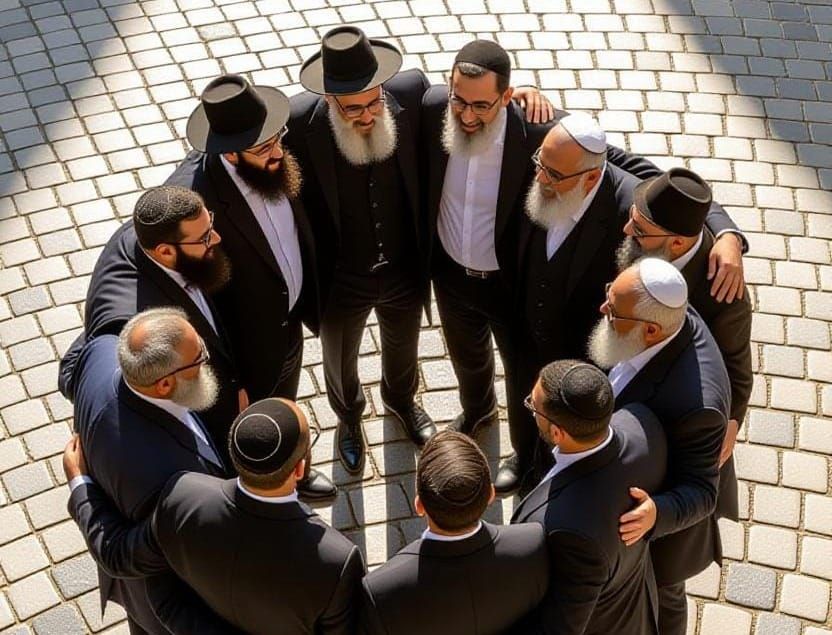
The answer is two words that must be held together: love, and truth. We are obligated to love every Jew without exception — including those far from Torah, who remain our brothers and Hashem's children no matter how distant. But love was never meant to require calling falsehood truth or sanctioning what the Torah forbids. The deepest love walks with emes, not against it — and a unity built by blurring the Torah's lines is not unity at all.
Does unity mean we must compromise on truth? And are we obligated to love even those who are secular, or who have strayed far from the mesorah?
The answer to the second question is an unconditional yes. The answer to the first is an equally firm no. These two answers are not in tension; they are two halves of a single Torah truth. We are commanded to love every Jew — genuinely, warmly, without reservation, including those most distant from Torah. And precisely because that love is real, it can never express itself by affirming falsehood, because telling a person you love that wrong is right is not love at all. Love and truth are not rivals in the Torah. They walk together — and this article is about how.
I. The Bond That Cannot Be Broken
Begin with the foundation, because everything else rests on it: the bond between one Jew and another, and between every Jew and Hashem, cannot be severed — not by distance, not by sin, not by rebellion.
The Torah declares: "Banim atem laHashem Elokeichem" — "You are children to Hashem your God" (Devarim 14:1). And Chazal teach that this status is unconditional. In the words of Rabbi Meir, "in either case you are called children" — whether the Jewish people behave as faithful children or not, they remain Hashem's children always (Kiddushin 36a). The relationship is one of birth, not of behavior; a child who rebels against his father is still his father's child. So too the Gemara's principle: "Yisrael, af al pi shechata, Yisrael hu" — a Jew, even when he has sinned, remains a Jew (Sanhedrin 44a). No sin, however grave, writes a Jew out of Klal Yisrael.
This is the bedrock of ahavas Yisrael. We love the secular Jew, the distant Jew, even the Jew who fights against Torah, because he is our brother — not metaphorically, but literally — a child of the same Father, a limb of the same body. The love we owe him is not contingent on his agreement with us or his observance; it flows from what he is, which nothing he does can change. He is one of us, and he always will be — and that is the unshakable starting point from which everything in this article proceeds.
II. The Love Is Real, Warm, and Without Reservation
Lest the "but" that is coming be misheard, let it be said as plainly and warmly as possible: the love the Torah commands for every Jew is not a grudging tolerance or a strategic posture. It is real, deep, aching love — and the Charedi world's firmness on truth must never be allowed to obscure it.
This is especially so regarding the secular Jew of our time, and here the mesorah gives us a framework of profound compassion: tinok shenishba — the "captured child." Chazal and the Rishonim teach (Shabbos 68a–b; Rambam, Hilchos Mamrim 3:3) that a Jew who was raised without Torah, who never knew it, who was shaped by a world that kept it from him, is not a rebel who chose to abandon his heritage — he is like a child taken captive among the nations, who never had the chance to know what he was missing. The overwhelming majority of secular Jews today are precisely this: not enemies of Torah who knew it and spurned it, but beloved children who were never given it, raised in good faith in a world that had already drifted. They are not to be judged or resented; they are to be loved, ached over, and welcomed — exactly as one would ache over a sibling separated from the family at birth and raised never knowing he had a home.
So the Charedi posture toward the distant Jew is — or must be — one of open arms and a broken heart: kindness, warmth, welcome, and humility; tears for those who are far; and a longing for the day they come home. As we have written in our articles on kiruv and on how the Charedi world views secular Jews, this love is not a tactic but the truth of who they are to us. Whatever follows about truth, it follows from within this love, never against it.
III. The Model of Aharon — Love That Walks With Truth
How, then, do love and truth fit together? The Torah gives us a model in the person of Aharon HaKohen, and it resolves the whole question.
Aharon is remembered as the great lover and pursuer of peace. Hillel taught: "Be of the disciples of Aharon — loving peace and pursuing peace, loving the creations and drawing them close to the Torah" (Avos 1:12). Notice the precise formulation: Aharon drew people close — but he drew them close to the Torah. His love was not a love that met people where they were and left them there; it was a love that embraced them and brought them toward the truth. He did not abandon Torah to reach people; he used his boundless love to bring people to Torah.
And the navi describes how he did it, in words that are the very definition of love walking with truth: "Toras emes haysa b'fihu… b'shalom u'vmishor halach iti, v'rabim heishiv mei'avon" — "The Torah of truth was in his mouth… he walked with Me in peace and in uprightness, and he turned many away from sin" (Malachi 2:6). Read that verse closely, for it holds the entire answer. The Torah of truth was in his mouth — he did not soften it or compromise it. And with that truth he walked in peace and turned multitudes from sin. Aharon did not choose between truth and peace; he carried both at once, and it was precisely his uncompromised truth, delivered with boundless love, that brought people back. Had he flattered their sins in the name of peace, he would have turned no one from anything. It was because he held the truth firmly and loved them deeply that "he turned many away from sin."
This is the resolution of the supposed tension. Love and truth are not opposed; they are partners, and the deepest love is the one that loves a person enough to tell him the truth. The model is not "compromise the Torah to keep the peace," nor "wield the truth without love" — it is Aharon's: uncompromised truth carried by overflowing love, which is the only thing that ever actually brings a Jew home.
IV. Why Affirming Falsehood Is Not Love
From this it follows that the one thing love may never do is the very thing a misapplied "unity" often demands: to affirm as true what the Torah calls false, or to sanction as acceptable what the Torah forbids.
Consider what such "love" actually does. If a Jew is about to eat something harmful believing it safe, the loving act is to tell him — not to smile and call the poison food. To call treif "kosher," to call rebellion against Torah "just another valid path," to assure a Jew that the falsehood he has embraced is really truth — this is not kindness. It is the opposite of kindness, because it confirms him in an error that costs him his most precious inheritance. The Torah warns: "v'lo sasuru acharei levavchem v'acharei eineichem" — do not stray after your hearts and your eyes (Bamidbar 15:39) — recognizing how readily the human heart relabels what it wants as what is right. A love that helps a fellow Jew relabel falsehood as truth is not serving him; it is abandoning him with a smile.
And the truth-telling the Torah asks of us is itself an act of love, not its opposite. The mitzvah of "hochei'ach tochiach es amisecha" — "you shall surely rebuke your fellow" (Vayikra 19:17) — appears in the Torah in the very same passage as "v'ahavta l'reiacha kamocha," because honest, loving correction is a form of love. (It must be offered, Chazal teach, with wisdom and with care — rebuke that can be heard rather than rebuke that shames; Arachin 16b — but its absence, the silent watching of a brother walk into harm, is not love.) To love a Jew is to want for him what is truly good — which means wanting him in the truth, not comfortable in a falsehood.
This is why the Charedi world cannot, in the name of "achdus," do certain things — and the boundary is principled, not personal. It cannot lend the Torah's legitimacy to movements or platforms built on the rejection of Torah she'baal peh and the foundations of emunah. It cannot co-sign declarations that present rebellion against halacha as a valid form of Judaism, or join religious frameworks that erase the very lines the Torah draws — not out of contempt for any individual, but because to do so would be to use its own affirmation to tell Klal Yisrael that falsehood is truth. The boundary is never around the Jew — every Jew is embraced — it is around the truth, which we have no authority to surrender. (The specific halachic rulings here — for instance, the teshuvos of Rav Moshe Feinstein regarding participation in services that deny the foundations of Torah — flow from this principle.)
V. The Deepest Compassion Tells the Truth
It is worth lingering on the point that the firmness is itself the compassion, because this is so easily inverted in our age.
The instinct of a soft sentimentality says: the kind thing is to affirm whatever a person has chosen, to celebrate every path as equally valid, to never suggest anyone is mistaken. But this is a shallow imitation of love, and at its heart it is a kind of indifference — for it costs nothing and risks nothing, and it leaves the other person exactly where he is, even if where he is will harm him. Real love is willing to bear the discomfort of telling a hard truth, because it cares more about the person's actual good than about the warm feeling of agreement.
The Torah leadership embodied this. The Gedolim of our generations wept for Jews who were distant — davened for their return, ached for them as a parent aches for a lost child — and that very love is what made them unwilling to flatter the falsehoods drawing those Jews away. As the matter is sometimes put in the name of the Torah leadership: a Jew who lashes out at Torah is like a child in pain striking his own father — we do not hate him, we long to heal him; but precisely because we love him, we do not place the stick in his hand. The image is exact. To love the distant Jew and to refuse to validate what is harming him are not two competing impulses; they are one. The parent who loves his child does not call the child's self-destruction a valid lifestyle choice. He loves him too much to lie to him.
This is the answer to "but aren't they also doing good?" Of course — and we acknowledge and honor every good act, every kindness, every mitzvah, wherever it is found, and we judge no one's heart, which belongs to Hashem alone. But acknowledging a person's goodness is different from affirming an ideology's truth. We can love the Jew, honor his good deeds, ache for his return, and still decline to call the falsehoods he has absorbed by the name of truth. The two are not in conflict — they are both required by the same love.
VI. The Closing Position
So — does unity mean we must compromise on truth?
No. And the reason is that real unity and real truth are not enemies. We are commanded to love every Jew without exception — the secular, the distant, even the one who fights against Torah — because he is our brother and Hashem's child, and nothing he does can sever that bond. That love is not a slogan or a strategy; it is deep, warm, and aching, and it reaches especially toward the tinok shenishba, the beloved child raised without his inheritance, whom we long to welcome home. None of the firmness in this article diminishes that love by a hair.
But love, to be love, must walk with truth — as Aharon's did, the toras emes in his mouth and shalom in his every step, drawing multitudes back to Hashem precisely because he never softened the truth he loved them enough to tell. A "unity" purchased by calling falsehood truth, by sanctioning what the Torah forbids, by lending Torah's name to movements that reject it, is not unity at all — it is the dissolution of the very thing that makes us one people, for we are one only through the one Torah. To blur its lines in the name of togetherness is to saw through the beam that holds the house together.
And so we hold both, because the Torah holds both. We love every Jew, and we stand in the truth. We welcome with open arms, and we do not call the treif kosher. We cry for those who are far, and we refuse to tell them that far is near. We yearn for unity — but for the true unity of Klal Yisrael standing together in Torah, in emunah, and in emes — and until that day, we love every one of our brothers without reservation, and we pray, with all our hearts, for their return to the eternal truth that binds us into one.
Sources
The unbreakable bond
- Devarim 14:1 — "banim atem laHashem Elokeichem" — you are children to Hashem your God; with Talmud Bavli, Kiddushin 36a — Rabbi Meir: in either case you are called children, whether faithful or not
- Talmud Bavli, Sanhedrin 44a — "Yisrael, af al pi shechata, Yisrael hu" — a Jew, even when he has sinned, remains a Jew (from the episode of Achan)
The love is real — tinok shenishba
- Talmud Bavli, Shabbos 68a–b; Rambam, Hilchos Mamrim 3:3 — the framework of tinok shenishba (the "captured child"): one raised without Torah, who never knew it, is not a rebel but like a child taken captive, to be loved and drawn close rather than judged (developed in "How Does the Charedi World View Secular Jewish Leaders?" and "What Is the Charedi Approach to Kiruv?")
- The theme (transmitted in the name of Rav Chaim Shmuelevitz zt"l, Sichos Mussar) that we love a fellow Jew not because he agrees with us but because he is part of us, a limb of one body — presented as a documented theme
The model of Aharon — love that walks with truth
- Pirkei Avos 1:12 — "hevei mitalmidav shel Aharon, oheiv shalom v'rodeif shalom, oheiv es habrios u'mekarvan laTorah" — loving peace and drawing the creations close to the Torah
- Malachi 2:6 — "Toras emes haysa b'fihu… b'shalom u'vmishor halach iti, v'rabim heishiv mei'avon" — the Torah of truth in his mouth; he walked in peace and uprightness and turned many from sin — love and truth carried together
- Vayikra 19:18 — "v'ahavta l'reiacha kamocha"; Sifra, Kedoshim — Rabbi Akiva: the great principle of the Torah
Why affirming falsehood is not love
- Bamidbar 15:39 — "v'lo sasuru acharei levavchem v'acharei eineichem" — do not stray after your hearts and eyes
- Vayikra 19:17 — "hochei'ach tochiach es amisecha" — the mitzvah of loving rebuke, set beside v'ahavta l'reiacha kamocha; with Talmud Bavli, Arachin 16b — rebuke offered with wisdom, in a way that can be heard
- The principle that the Torah's affirmation may not be lent to movements built on the rejection of Torah she'baal peh and the foundations of emunah; the documented teshuvos of Rav Moshe Feinstein zt"l regarding participation in services that deny the foundations of Torah (Igros Moshe — presented as his documented halachic position); and the documented positions of Rav Yosef Shalom Elyashiv zt"l on lending legitimacy to such movements
The deepest compassion tells the truth
- The theme (transmitted in the name of Rav Elchonon Wasserman zt"l, Kovetz Maamarim) that the greatest compassion for a distant Jew is to help him see the truth, not to applaud his departure from it — presented as a documented theme
- The documented conduct of the Torah leadership — including Rav Aharon Leib Shteinman zt"l, who wept and davened for the teshuvah of secular Jews while never permitting the dilution of Torah standards (presented as a documented theme; the citation of "Orchos Yosher" in the original draft is corrected — that sefer is the work of Rav Chaim Kanievsky zt"l, not Rav Shteinman)
- The teaching transmitted in the name of the Steipler Gaon zt"l — the distant Jew as a child in pain striking his father, whom we seek to heal but whose hand we do not arm — and the teachings of Rav Yaakov Emden and Rav Shimon Schwab zt"l that love without truth, and unity without emes, undermine themselves — all presented as documented themes
The structural relationship to other articles in this series
- "Sinas Chinam and Ahavas Yisrael" — baseless hatred and the love of every Jew
- "Why Is Unity So Important in Torah Judaism?" — unity as a force, and that unity does not mean conformity
- "How Does the Charedi World View Secular Jewish Leaders?" — the tinok shenishba framework
- "What Is the Charedi Approach to Kiruv?" — drawing every Jew close, in the model of Aharon