
What is the Torah’s view on democracy?
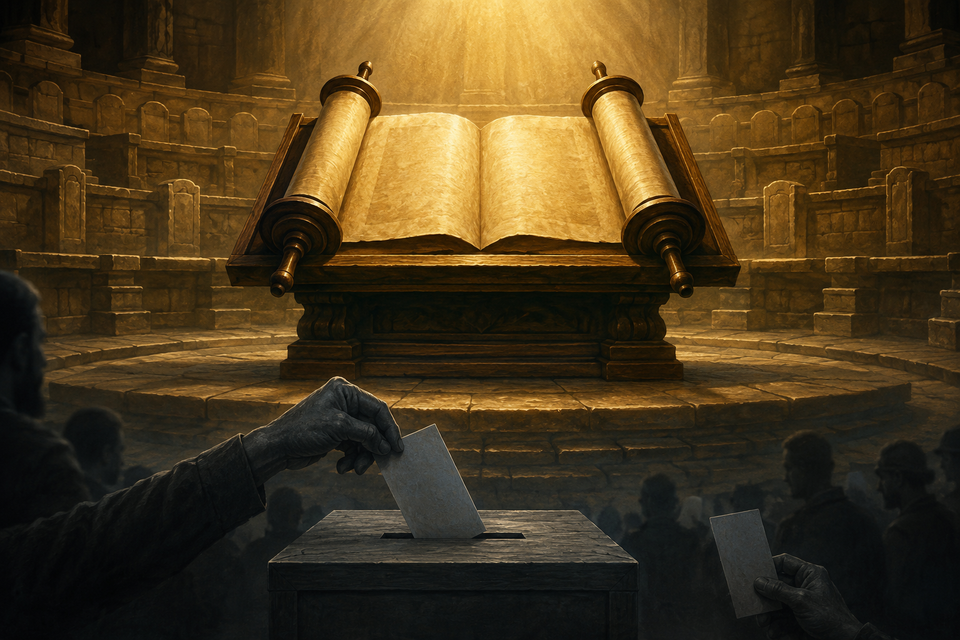
Democracy as We Know It — Government Chosen by the People, Decided by Majority Rule — Is Not a Torah Concept; the Torah's Model of Authority Flows From Hashem, Not From the Will of the Majority. But "Not a Torah Concept" Is Not the Same as "Forbidden," and the Honest Answer Requires Separating Three Very Different Questions. As a Practical System for Ordering Society and Protecting People, the Torah Does Not Oppose Democracy, and Charedim Live Under It and Participate in It. As a Philosophy of Truth — the Claim That What Is Right and True Is Determined by Counting Votes — the Torah Rejects It Entirely, Because Truth Comes From Hashem and Is Not Subject to a Show of Hands. And When Democracy Is Idolized — Made an Ultimate Value That Overrides the Torah Itself — It Crosses From a Tool Into a Danger. The Torah Even Has Its Own Principle of Majority Rule — but It Is the Majority of Qualified Torah Authorities, Not the Headcount of the Masses
Democracy as we know it today — a government chosen by the people, based on majority rule — is not a concept the Torah presents as its model of governance. The Torah's vision of authority flows from a different source entirely: not from the will of the people, but from the will of Hashem. But it would be a serious mistake to conclude from this that the Torah is simply "against democracy," and an equally serious mistake to conclude that it endorses it. The honest answer is more careful, and it requires separating three questions that are almost always run together.
There is democracy as a practical system of administering a society. There is democracy as a philosophy of truth — a claim about where right and wrong come from. And there is democracy as an idol — an ultimate value that overrides everything, including the Torah. The Torah relates very differently to each of these, and most of the confusion in this debate comes from collapsing them into one. (The specific question of the legitimacy of the State of Israel's government we have addressed in its own article; here the focus is democracy as a concept.) We take the three in turn.
I. The Torah's Source of Authority — From Above, Not Below
The first and most basic point is that, in the Torah's model, legitimate authority flows downward from Hashem, not upward from the people.
The Torah's own model of national governance is built on this. When it provides for a Jewish king, the king is "asher yivchar Hashem Elokecha bo" — the one whom Hashem chooses (Devarim 17:15) — appointed, as the Rambam codifies, through the Sanhedrin and a navi, and bound to write himself a Sefer Torah and rule in fidelity to it. Alongside the king stood the Sanhedrin, the supreme Torah court, whose members held their authority not by winning a popularity contest but by their mastery of Torah, their yiras Shamayim, and their wisdom. Authority, in the Torah's design, is conferred by Torah and answers to Torah — it does not originate in, and is not ultimately accountable to, the shifting preferences of the majority.
This is the structural difference between the Torah's model and the democratic one, and it is worth stating precisely. In a democracy, sovereignty rests, in theory, with the people: the government derives its authority from the consent of the governed, and what the people will, through their majority, becomes the law. In the Torah's model, sovereignty rests with Hashem: the Torah is the constitution, given from above, and human authority is legitimate insofar as it serves and submits to that constitution. The midrash teaches that Hashem "looked into the Torah and created the world" (Bereishis Rabbah 1:1) — the Torah is the blueprint of reality itself. A system in which the people's will is the highest authority and a system in which Hashem's Torah is the highest authority are built on opposite foundations — and this difference, not any quarrel with ballots or parliaments as such, is the root of everything the Torah has to say on the subject.
II. Truth Is Not Decided by a Show of Hands
The deepest point of divergence is not about who administers the government. It is about something more fundamental: the democratic intuition that what is right and true is determined by the will of the majority.
This intuition runs deep in modern culture — the sense that if enough people come to believe something, or vote for it, it becomes legitimate; that morality itself evolves with the consensus of the age. The Torah rejects this at the root. Truth, in the Torah's understanding, is not a matter of how many people hold it. "Lo sihyeh acharei rabim l'ra'os" — do not follow a majority to do evil (Shemos 23:2): a majority, however large, that inclines toward what is wrong does not thereby make it right. A thousand people, or a million, may agree on something; if it contradicts the Torah, it is false, because truth is anchored in Hashem and His Torah, not in the count of those who happen to affirm it. Morality is not a referendum.
Here, though, lies a subtlety that is usually missed, and getting it right is essential — because the Torah does in fact have a principle of majority rule. The very same verse continues: "acharei rabim l'hatos" — incline after the majority (Shemos 23:2) — which Chazal establish (Sanhedrin 2a; Chullin 11a) as the basis for deciding halachic and judicial questions by majority within a beis din. So the Torah is not opposed to majority decision as such. The question is: a majority of whom?
And this is the decisive distinction. The Torah's majority is the majority of a qualified body — of dayanim, of the Sanhedrin, of those who have mastered the Torah and submitted themselves to it. It is a majority among those competent to discern the truth of the Torah, deciding questions within the framework of the Torah. It is emphatically not a majority of the general population voting on what they would like the truth to be. In the Torah's system, legitimacy comes from qualification — knowledge of Torah, fidelity to it — not from headcount. Democracy counts every vote equally regardless of knowledge, and treats the resulting majority as authoritative over the very content of right and wrong. The Torah weights authority by Torah competence, and confines even its qualified majority to deciding within a truth it did not invent and cannot overturn. The difference is not "majority versus no majority." It is "the majority of the learned, deciding under the Torah" versus "the majority of all, deciding over the Torah." The first is the Torah's own method; the second is what the Torah cannot accept.
This is why, once the Torah was given, even its own interpretation was placed in the hands of the qualified Torah authorities deciding by its rules — "lo bashamayim hi," it is not in heaven (Devarim 30:12; Bava Metzia 59b) — and not in the hands of popular acclamation. The truth is fixed; the authority to apply it belongs to those who have devoted themselves to mastering it.
III. The Torah Does Recognize Communal Self-Governance
Lest this be misread as a claim that the Torah wants the people silent and passive, the opposite is true: the Torah recognizes and provides for communal self-governance. The critique of democracy-as-philosophy is not a rejection of public participation in the ordering of communal life.
Halacha gives real authority to the community to manage its own affairs. The Gemara recognizes the institution of the shiv'a tuvei ha'ir — the seven elders, or "good men," of the city — who act on behalf of the town (Megillah 26a), and establishes the broad authority of the townspeople and their representatives to enact ordinances, set prices and measures, and compel participation in communal obligations such as tzedakah (Bava Basra 8b–9a). Communities throughout Jewish history governed themselves through such bodies — appointing leaders, levying taxes, building institutions, making binding takkanos — all as a recognized part of halachic life. The Torah is entirely comfortable with people organizing their communal affairs through representatives and collective decision.
But notice the frame: all of this operates in service of the Torah, not in place of it. The community's authority to govern its own affairs is real, and it is exercised within the bounds of halacha — the tuvei ha'ir cannot enact what the Torah forbids, and communal decision does not override Torah law. This is the model the Torah offers: robust self-governance and communal participation, exercised under the authority of the Torah rather than as a sovereign power above it. Participation in the ordering of society is welcome; what is excluded is the claim that such participation is the source of truth and stands above the Torah.
IV. Living Under Democracy — and Participating in It
From all of this follows the practical Charedi posture, which is frequently misunderstood. The Charedi world does not regard living under a democracy as a problem, and it participates actively in the democratic process — without thereby endorsing democracy as the source of truth.
Throughout the long exile, Jews have lived under every kind of regime — empires, monarchies, republics, and modern democracies — and the halachic principle has been consistent: we live as faithful and law-abiding residents under whatever system governs us, so long as we are free to live by the Torah. A democracy that protects that freedom is, in practical terms, a system under which Torah life can flourish, and in that respect it may be a better and safer system than many that came before it. The Charedi world has no quarrel with the ballot box as a mechanism of administration.
This is precisely why Charedim vote and engage in democratic politics — not out of a belief in the supremacy of the popular will, but as hishtadlus to protect Torah, Torah institutions, and the Torah community within the system in which they live (a posture we have developed in our article on political participation). The guidance of the Torah leadership before elections has consistently carried this dual message: participate fully in the process, but understand what you are doing it for — not in homage to democracy as an ideal, but in defense of Torah within it. One can use the tools of a democratic system wholeheartedly while declining to worship the system itself.
V. The Danger — When Democracy Becomes an Idol
The line the Torah will not cross is reached when democracy stops being a tool and becomes an idol — when it is elevated from a method of governance into an ultimate value, a substitute religion, the final arbiter of right and wrong.
In much of modern thought, democracy has quietly assumed exactly this role. Rights are spoken of as though they originate in the will of the people or the grant of the government; morality is treated as something the majority defines and redefines; and the democratic process is invoked not merely to administer society but to legitimize whatever it produces — as though a thing becomes right by being voted for. To this, the Torah says no. Rights and duties alike originate with Hashem, not with any legislature; and no majority, however large, can make true what the Torah calls false, or permitted what the Torah forbids. When a democratic majority legislates against the Torah — on matters of Shabbos, of kashrus, of who is a Jew, of the most basic definitions the Torah establishes — the legislation may carry the force of law, but it carries no power to change the truth. The vote is real; its authority over reality is not.
This is the sense in which an unbounded democracy can become not neutral but corrosive. A system that acknowledges no authority above the majority's will has no defense against the majority willing what is wrong. The Torah's insistence that there is a truth above the vote — that some things are not ours to legislate, because they were established by the One who created the world by looking into His Torah — is not a quarrel with people governing themselves. It is a refusal to let the show of hands be mistaken for the voice of truth. As the Torah leadership has consistently warned, a state or a society that sets the majority's will above the Torah cannot, by that very act, be called a Torah society — however it labels itself.
VI. The Closing Position — The Torah's Ideal
So what is the Torah's view on democracy?
It is not the crude opposition its critics imagine, nor the endorsement its apologists sometimes seek. As a practical system for ordering society and protecting its members, democracy is something the Torah neither commands nor forbids — a system under which Torah life can flourish where it guarantees the freedom to live by the Torah, and one the Charedi world inhabits and participates in fully. The Torah even shares the principle of majority decision — but among the qualified, deciding under the Torah, never among the masses deciding over it. What the Torah rejects is the philosophy that makes the majority the source of truth, and the idolatry that makes democracy an ultimate value above the Torah itself.
The Torah's own ideal is neither mob rule nor tyranny. It is a society ordered under Hashem: a king who fears Heaven and submits to the Torah, a Sanhedrin of sages who have mastered it, dayanim who plumb the depths of halacha, communal self-governance exercised within the bounds of the Torah — and a people who find their dignity and freedom not in the power to legislate morality, but in the privilege of living by a truth higher than themselves. Democracy may grant a society temporary rights and a workable peace, and for those the Torah is not ungrateful. But only the Torah grants eternal truth — and the deepest freedom a person can know is not the freedom to vote on what is right, but the freedom to live by what truly is.
The fullest realization of this awaits the restoration of a society wholly under Hashem, with the Torah as its constitution in fact and not only in aspiration — bimheirah b'yameinu, amen.
Sources
The Torah's source of authority
- Devarim 17:15 — "asher yivchar Hashem Elokecha bo" — the king whom Hashem chooses, appointed (per the Rambam, Hilchos Melachim 1:3) through the Sanhedrin and a navi, and bound to the Torah; authority conferred by Torah, not by popular vote (developed in "What Is the Charedi View of the State of Israel's Government — Is It a Legitimate Authority?")
- Bereishis Rabbah 1:1 — "istakel b'Oraisa u'bara alma" — Hashem looked into the Torah and created the world; the Torah as the blueprint and constitution of reality
Truth is not decided by a show of hands — and the Torah's own majority principle
- Shemos 23:2 — "lo sihyeh acharei rabim l'ra'os" (do not follow a majority to do evil) and "acharei rabim l'hatos" (incline after the majority) — the rejection of a majority for evil, and the Torah's own principle of majority decision
- Talmud Bavli, Sanhedrin 2a; Chullin 11a — the establishment of majority rule as the basis of halachic and judicial decision within a qualified beis din — the majority of those competent in Torah, deciding under the Torah, as distinct from a popular majority deciding over it
- Devarim 30:12; Talmud Bavli, Bava Metzia 59b — "lo bashamayim hi" — the interpretation of the given Torah placed in the hands of the qualified Torah authorities by its own rules, not popular acclamation
- The Chazon Ish (Emunah u'Bitachon) — the documented theme that where morality is decided by consensus, the voice of the Torah is easily drowned, and that the Torah demands allegiance to truth rather than to trends — presented as a documented theme
Communal self-governance under the Torah
- Talmud Bavli, Megillah 26a — the shiv'a tuvei ha'ir (the seven elders/good men of the city) acting on behalf of the town
- Talmud Bavli, Bava Basra 8b–9a — the authority of the townspeople and their representatives to enact ordinances, set prices and measures, and compel for tzedakah — robust communal self-governance, exercised within the bounds of halacha
Living under democracy and participating in it
- The halachic posture of living as faithful residents under whatever regime governs, so long as one is free to live by the Torah; participation in democratic politics as hishtadlus to protect Torah and the Torah community, not as endorsement of the supremacy of popular will (developed in "What Is the Charedi Approach to Political Participation?" and "What Is the Torah View on Dina D'malchusa Dina?")
- The pre-election guidance of the Torah leadership (including Rav Chaim Kanievsky zt"l) to vote in defense of Torah rather than in homage to democracy — presented as transmitted guidance
The danger of idolizing democracy
- The distinction between democracy as a tool of administration and democracy as an ultimate value; rights and morality as originating with Hashem rather than with the majority's will; the limits of legislation against the Torah (a vote carries the force of law but no power to change the truth)
- The documented warning of the Torah leadership (including Rav Shach zt"l, Michtavim u'Maamarim) that a society setting the majority's will above the Torah cannot, by that act, be a Torah society — presented as a documented theme
- Note on sourcing: the quotations attributed in the original draft to Rav Moshe Feinstein (cited to Igros Moshe Choshen Mishpat 2:29) and to the Netziv (cited to Ha'amek Davar, Devarim 17, on "the mob legislating morality") could not be verified to those sources as worded; the documented frameworks are presented here on the basis of the primary Torah sources rather than unverified quotations
The structural relationship to other articles in this series
- "What Is the Charedi View of the State of Israel's Government — Is It a Legitimate Authority?" — the application of these principles to the State specifically
- "What Is the Charedi Approach to Political Participation?" — the practical posture of voting and engagement
- "What Is the Torah View on Dina D'malchusa Dina?" — the basis for living under and complying with non-Torah systems of governance
- "What Is the Torah View on Nationalism?" — the related question of the nation defined by Torah rather than by secular ideology