Why Is “Mesorah” Such an Integral Part of Judaism?
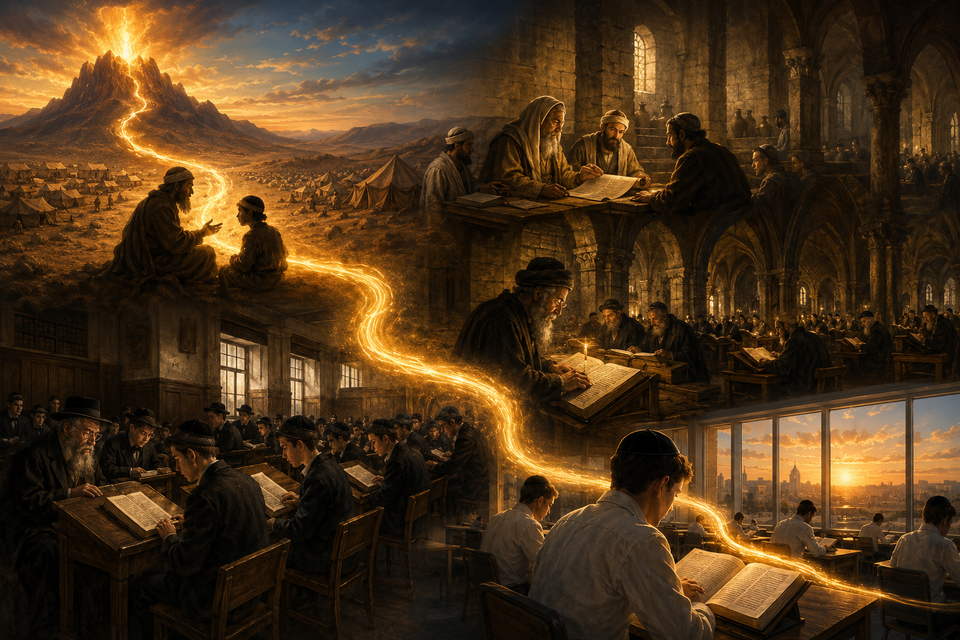
Picture a flame carried hand to hand — Sinai to this morning — never once allowed to go out. That is mesorah: not the passing of information but the transmission of Divine truth, the unbroken chain that is the whole difference between a living Torah and educated guesswork. Remove it, and Judaism does not merely weaken. It ceases to be Judaism.
There is an image worth holding onto. A single flame, lit at Har Sinai, passed from hand to hand — father to son, rebbi to talmid, generation to generation — and in three and a half thousand years, never once permitted to go dark. That flame is the mesorah, and it is not a sentimental metaphor. It is the literal mechanism by which we know anything at all about what Hashem wants from us. Strip it away, and the most learned Jew in the world is left holding a book he can only guess at. Mesorah is not one feature of Torah Judaism among many. It is the artery through which the whole of it lives.
I. What Mesorah Actually Is
The word mesorah means "transmission" — but in Torah it means something far weightier than the handing down of facts. It is the handing down of Divine truth, carried by those who received it directly or were trained by those who did. It is knowledge that comes with a chain of custody reaching back to the One who gave it.
The Torah builds this into its very instructions for how to know it. "Ask your father and he will tell you, your elders and they will inform you" (Devarim 32:7): the Torah does not say "work it out for yourself" or "consult your conscience" — it says ask the ones who received it before you. And the Mishnah opens its account of the entire Oral Torah not with a law but with a lineage: "Moshe received the Torah from Sinai and transmitted it to Yehoshua, and Yehoshua to the Elders, and the Elders to the Prophets, and the Prophets transmitted it to the Men of the Great Assembly…" (Avos 1:1). Notice that before Chazal teach us a single halacha, they first establish the credentials of the transmission — because a teaching is only as authoritative as the chain that carries it. In Torah, where something comes from is inseparable from whether it is true.
II. Why the Whole Structure Depends On It
This is not merely a nice value; it is the load-bearing wall of the entire system. The Torah deliberately did not entrust its own interpretation to each individual's private judgment. It entrusted it to a chain.
The Rambam codifies this plainly: the Great Beis Din of each generation is the authoritative bearer and interpreter of the Torah she'be'al peh, and the Jewish people are bound to its rulings (Hilchos Mamrim 1:1–2). The Torah commands "do not deviate from the word they tell you, to the right or to the left" (Devarim 17:11) — and so strong is this principle that Rashi, citing the Sifrei, explains it to mean that one follows the Sages even if it appears to you that they have called right left. The Ramban, in the same place, supplies the reason: were every Jew free to follow his own reading against the bearers of the mesorah, the one Torah would splinter into countless private Torahs, and Klal Yisrael would no longer hold a single truth at all. The Gemara had already named this danger exactly — that when students do not receive sufficiently from their teachers, "disputes multiplied in Israel and the Torah became like two Torahs" (Sanhedrin 88b).
The most striking expression of all is the famous account of the tanur shel Achnai, where a great sage, insisting on his own view, summons miracles and even a Heavenly voice to support him — and the halacha is decided against him, on the principle "lo bashamayim hi," the Torah is not in Heaven (Bava Metzia 59b; Devarim 30:12). The lesson is breathtaking in its implication: even a voice from Heaven does not override the ruling of the chain of chachamim, because Hashem Himself entrusted the Torah's interpretation to that chain and to no other channel — not to signs, not to wonders, not to inspiration, and not to each person's sense of what "makes sense to me." Once mesorah is removed, every Jew becomes his own Sanhedrin — and a Torah that means whatever each reader decides it means is a Torah that, in the end, means nothing at all.
III. Why We Honor Those Who Carry the Flame
This is why Chazal placed such weight on attaching oneself to teachers and on honoring talmidei chachamim — and the reason is precise. "Make for yourself a rav," taught the Mishnah (Avos 1:6); "let the reverence of your teacher be like the reverence of Heaven" (Avos 4:12).
That is striking language, and it is easy to misread. It does not claim that any rebbi is personally flawless or beyond error. The reverence is not for the man as a private individual; it is for what he carries. A talmid chacham of the mesorah is a living link in the chain that runs back to Sinai — and to honor him is to honor the unbroken transmission he holds in trust, and through it, the One who first lit the flame. We do not decide anew, in each generation, what the Torah means. We ask what was handed to us. That posture is not intellectual laziness or fear of thought; it is the single discipline that keeps the flame from being blown out by the fashions of the hour.
IV. The Verdict of History
If this all sounds abstract, Jewish history renders it concrete with brutal clarity. Why did the Torah survive what should have destroyed it many times over? Scattered across every empire, stripped of land and Temple and sovereignty, the Jewish people held onto one thing above all — and it was not territory or power. It was the mesorah.
In Bavel the Amoraim guarded the teachings of the Tannaim; in Sefarad the Rambam built upon the Geonim; in Ashkenaz the Baalei Tosafos argued fiercely over every sugya yet never once stepped outside the framework of Chazal; in the yeshivos of Eastern Europe, halacha and hashkafa were preserved with a devotion that defies explanation — because that is what they had received, and they would sooner die than let it drop. And the contrast is sobering. Across the centuries, movements that cut themselves loose from the mesorah did not, as a rule, endure: the Tzedukim, who rejected the Oral Torah of Chazal, faded from history within a few generations; the Karaim, who claimed the written Torah alone, survive only as a tiny remnant; and much of the Haskalah that cast off rabbinic authority watched its own grandchildren assimilate away entirely. This is not said in triumph — there is no triumph in Jewish loss — but as a pattern impossible to miss: the branch cut from the tree may stay green for a season, but it does not, in the end, live.
V. The Danger of a "New Path"
The deepest warnings, though, come not from later history but from the Torah itself, which records more than once what happens when Jews — often sincerely, often with real spiritual hunger — try to forge a fresh path around the received structure rather than through it.
Many of the Rishonim understood the Cheit ha'Egel in just this way: not as crude idol-worship in the classic sense, but as a misguided attempt to manufacture a new point of spiritual connection once the people feared Moshe — their link to Hashem — was gone. It was, in essence, religious innovation outside the channel of transmission, and it ended in catastrophe. Korach's rebellion wore an even more attractive mask: "the entire congregation is holy," he proclaimed (Bamidbar 16:3) — a slogan of equality and empowerment. But beneath it lay a rejection of Moshe and of the whole structure by which the Divine will is transmitted; and to reject the structure Hashem established, Chazal teach, is to reject its Author (Sanhedrin 110a). The Mityavnim of the Chanukah era, too, believed themselves enlightened, weaving Torah together with the brilliance of Greek thought — and we remember well where that road led. The thread joining all of them is identical: the conviction that one may reimagine Torah, or recontextualize its truths, from outside the chain rather than from within it. And once that step is taken, the safeguards are gone, and almost anything becomes possible.
VI. Mesorah and How We Read Our Own Times
All of this bears with particular force on the deepest disagreements of the present moment — including how we read history, prophecy, and the dramatic events of our own age. For mesorah does not govern only Shabbos and kashrus; it governs interpretation itself — how Klal Yisrael is permitted to understand its own story.
Here the Charedi world raises one quiet, consistent question whenever a new hashkafa appears — one that assigns redemptive significance to contemporary events, or reads current history as a confirmed stage of the geulah. The question is never aimed at anyone's sincerity, which is often profound and self-sacrificing. It is simply the question mesorah always asks: through which chain of Gedolei Yisrael did this understanding come down to us? An interpretation of prophecy and redemption that surfaces only in response to modern circumstances, and cannot point to its transmitters reaching back through the generations, is — however heartfelt — a new reading rather than a received one. It was on exactly this ground that the great bearers of the mesorah of the last century — among them the Chofetz Chaim, Rav Chaim Ozer Grodzinski, Rav Elchonon Wasserman, the Brisker Rav, Rav Aharon Kotler, and the Chazon Ish — stood wary of granting Torah-redemptive meaning to new ideologies that had not come to them through their own rebbeim. (We develop this specific question at length in "Is Zionism One of the 70 Faces of Torah?" and in our article on the hashkafic difference between Charedim and Religious Zionists.)
VII. The Safest Place in the World Is Behind Our Fathers
So why is mesorah so integral to Judaism? Because it is, quite simply, the only way we know what Hashem wants. It is why we know how to keep Shabbos, how to daven, how to marry and to mourn and to eat — and how to understand our own history and the times we live in. The Torah is not a book one opens and guesses from. It is a living inheritance, placed in our hands in trust, on the condition that we pass it on exactly as we received it.
The navi said it with perfect beauty: "Stand at the crossroads and look; ask for the ancient paths, where the good way is, and walk in it — and you will find rest for your souls" (Yirmiyahu 6:16). Those who cling to the mesorah are not afraid of thought, and they are not backward. They are afraid of one thing only — of falseness, of the flame guttering out on their watch. They are not closed-minded; they are faithful. They are not behind the times; they are timeless. And that, in the end, is the whole secret of Jewish survival: it was never our ideologies, our cleverness, or our strength. It was always the Torah, and the unbroken chain of trembling, loving hands that has carried its flame, undimmed, all the way to ours.
May we prove worthy links in that chain, holding fast to what we received and passing it onward whole.
Sources
What mesorah is
- Devarim 32:7 — "Ask your father and he will tell you, your elders and they will inform you"
- Avos 1:1 — "Moshe received the Torah from Sinai and transmitted it to Yehoshua…" — the chain established before a single law is taught
Why the structure depends on it
- Rambam, Hilchos Mamrim 1:1–2 — the Great Beis Din of each generation as the authoritative bearer of the Torah she'be'al peh
- Devarim 17:11 — "do not deviate… to the right or to the left"; Rashi there (citing the Sifrei) — one follows the Sages even where it seems to you they have "called right left"
- Ramban, Devarim 17:11 — the rationale: without binding transmission, the one Torah would fracture into many private Torahs
- Sanhedrin 88b — when students do not receive sufficiently from their teachers, "the Torah became like two Torahs"
- Bava Metzia 59b (and Devarim 30:12) — "lo bashamayim hi," the Torah is not in Heaven; the tanur shel Achnai — even a Heavenly voice does not override the chain of chachamim to whom interpretation was entrusted
Honoring the carriers
- Avos 1:6 — "make for yourself a rav"; Avos 4:12 — "let the reverence of your teacher be like the reverence of Heaven" — honor owed not to personal perfection but to the transmission a talmid chacham carries
The danger of a new path
- The Cheit ha'Egel as understood by many Rishonim (e.g., the Kuzari and the Ramban on Shemos 32) — innovation outside the channel of transmission rather than classic idolatry (presented as their interpretation)
- Bamidbar 16:3 and Sanhedrin 110a — Korach's "the entire congregation is holy" and the rejection of the transmitting structure
- The Mityavnim of the Chanukah era — Torah merged with foreign thought from outside the chain
The ancient paths
- Yirmiyahu 6:16 — "ask for the ancient paths… and you will find rest for your souls"
The structural relationship to other articles in this series
- "Is Zionism One of the 70 Faces of Torah?" — the mesorah test applied in full
- "What Is the Difference Between Charedim and Religious Zionists in Their Hashkafa?" — mesorah as the deepest root of the divide
- "The Charedi View on Recognizing Reform and Conservative Judaism" — authority and transmission as the dividing line