What Is the Difference Between Charedim and Religious Zionists in Their Hashkafa?
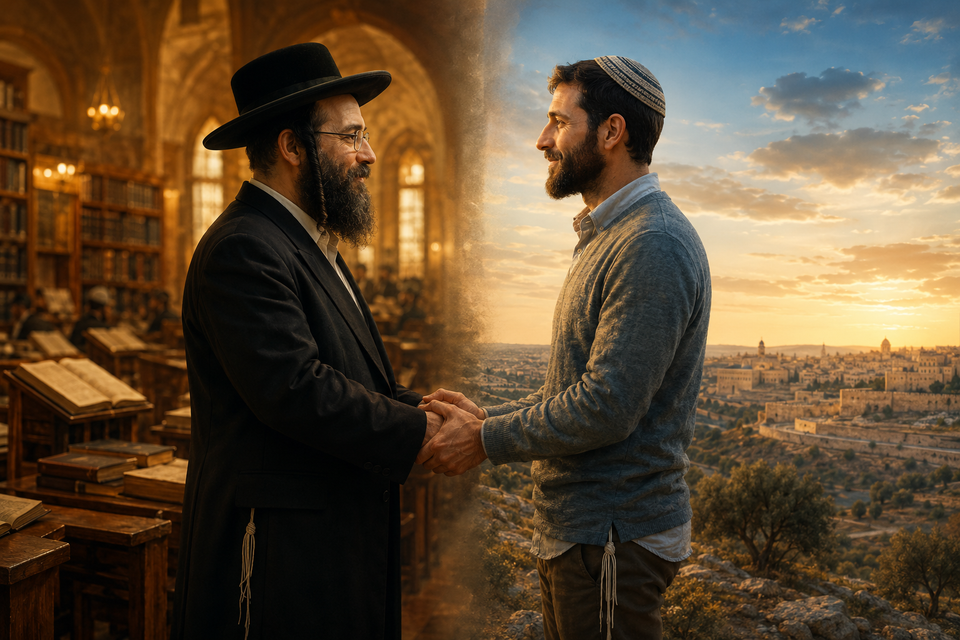
Charedim and Religious Zionists share a great deal — a love of mitzvos, a love of Eretz Yisrael, a love of Klal Yisrael — and differ, beneath all of it, on a single deep question: the lens through which we read Hashem's hand in history. Who brings the redemption? Can a state be holy? What makes us a nation at all? The disagreement is real and rooted in generations of Torah — and it can be set down honestly, with respect, and without forgetting that we are brothers.
It is worth beginning with what is not the difference. The divide between Charedim and Religious Zionists is not about clothing, custom, or sincerity. Religious Zionists are devoted, mitzvah-keeping Jews who love the Torah and have given a great deal for the Jewish people; the Charedi world knows this and honors it. The difference is something quieter and deeper than any of the externals — it is hashkafic. It is a difference in how we read the story of our own people: our exile, our return, and our redemption. Let us lay the differences out plainly, as one would explain a disagreement between brothers who still sit at the same table.
I. Who Brings the Geulah — Hashem, or Us?
The most foundational question, from which much else flows, is this: is the redemption something we wait for, or something we build?
Charedi hashkafa teaches that the Geulah is Hashem's to bring, in His time and by His hand. We have an enormous task — to learn, to keep mitzvos, to do teshuvah, to make ourselves and the world ready — but that task is one of spiritual preparation, not of pushing redemption forward by political or military means. The Gemara even hints that Moshiach comes when least expected: he is among the things that arrive b'hesech hada'as, when the mind is turned away (Sanhedrin 97a). On this view, a movement that sets out to engineer the redemption through statecraft and force — and a secular movement above all — has misread the very nature of how geulah comes. It was on exactly this ground that Gedolim such as the Brisker Rav, the Chazon Ish, and Rav Eliezer Yehuda Finkel of Mir stood wary of the entire Zionist enterprise.
Religious Zionism, by contrast, reads the last century differently — and it is a serious reading, not a careless one. It holds that we are living in the period of atchalta d'geulah, the beginning of the redemption: that the return to the Land, the ingathering of millions of exiles, and the revival of Jewish life there are signs that Hashem is at work in history, advancing His plan through natural and national events — even when the human actors carrying them out are not themselves religious. Where the Charedi reads geulah as a future, Divine, unmistakable event, the Religious Zionist reads the present as its dawning. That single difference — redemption awaited versus redemption already underway — colors everything else.
II. Can a Secular State Be Holy?
From that first divergence flows a second: does the State of Israel itself carry spiritual, even redemptive, significance?
The Charedi answer rests on a principle it holds without exception: holiness comes from Torah, and from nothing else. A political entity in Eretz Yisrael — however welcome as a refuge, however valuable as a place where millions of Jews live and where Torah can be learned in safety — is not, by virtue of being a state, holy. Kedushah does not attach to a flag, a parliament, or a declaration of independence; it attaches to Torah and the life lived by it. And so the Charedi world draws a careful line that it regards as essential: Divine kindness is not the same as Divine endorsement. That Hashem has shown the Jews of Eretz Yisrael great chesed — safety, growth, the flourishing of Torah — is cause for boundless gratitude; but chesed in galus has never been a stamp of approval on the framework through which it came. Gedolim such as Rav Shlomo Zalman Auerbach and Rav Moshe Sternbuch have stressed exactly this distinction: do not mistake the gift for an endorsement of the hands that happened to hold it.
Religious Zionist thought, here too, sees more. In its understanding, the very return of Jewish sovereignty after two millennia is itself laden with religious meaning — a stage in the unfolding of the Divine plan, such that even secular Jews building the Land may be, without knowing it, instruments of Hashem's will. The Charedi world hears this and responds, with respect but without yielding: intentions and content matter before Heaven. When a system is built to set the Torah aside — when its public life runs contrary to halacha — it is very hard, in the Charedi view, to call that system itself a vessel of kedushah, whatever good Hashem may graciously bring through it. The disagreement is not over whether Hashem is involved in our history. It is over whether His involvement sanctifies the secular instrument, or merely, mercifully, works around it.
III. What Makes Us a Nation?
Beneath both of those lies the sharpest distinction of all — a question about Jewish identity itself: what is it that makes us a people?
The Charedi answer is unambiguous, and it is ancient. "Our nation," wrote Rav Saadia Gaon over a thousand years ago, "is a nation only by virtue of its Torah" (Emunos v'Deos 3:7). We are not a people defined by a shared land, language, or culture who then happen to possess a religion; we are a people constituted by the Torah, and without it we are not, in the deepest sense, a nation at all. Even our claim to Eretz Yisrael, the Torah world insists, flows from this. Rashi opens his commentary on the Chumash with the question of why the Torah begins with creation rather than with the first mitzvah — and answers that it is to establish that the Master of the world, who created it, gave the Land to Israel as His to give (Bereishis 1:1); the Ramban, in his addition to the Sefer HaMitzvos, roots the very mitzvah of settling the Land in the Torah itself. Our bond to the Land is a Torah bond, or it is nothing.
Religious Zionism, while it cherishes Torah deeply, tends to give the people and the Land a more independent standing — to see the national project as carrying spiritual worth in its own right, so that living in the Land, serving in its defense, and reviving its language can themselves be experienced as religious achievements, even where mitzvos are not the driving force. The Charedi concern with this is not that these things are bad — many are genuinely precious — but that elevating them into independent spiritual ends risks quietly reordering the hierarchy, until Torah becomes one component of Jewish identity rather than its source. This is the danger the Beis HaLevi warned of in his drashos: that a Jewishness which lets nationhood drift loose from Torah is in peril not of redemption but of forgetting why we were chosen in the first place. For the Charedi, Torah is not part of the foundation. It is the foundation.
IV. How We Love the Land
It would be a serious error to conclude from all this that the two camps differ over whether to love Eretz Yisrael. They do not. Both love it deeply. The difference is in the texture and the source of that love.
The Charedi love of the Land is a love defined by kedushah. We cherish it because the Shechinah rests there, because it is the home of the Makom HaMikdash, because whole categories of mitzvos can be fulfilled only on its soil, because its very air, Chazal teach, makes a person wise (Bava Basra 158b). It is a love that bends the heart toward the holiness of the place rather than toward pride in it. Religious Zionists share much of this — and often add to it a register the Charedi world is warier of: a love expressed also through national pride, independence, and the dignity of Jewish self-determination. Here the difference is one of emphasis and framework more than of affection — both stand on the same beloved soil. The Charedi simply insists that the Land's worth is measured by its kedushah, realized through Torah and mitzvos, and that this — not sovereignty or pride — is what makes living there the privilege it is. The great poskim of the Torah world, from Rav Dovid Povarsky to Rav Chaim Kanievsky, taught the mitzvah of settling the Land warmly and seriously — always with Torah as its anchor and its purpose.
V. The Torah Is Perfect — So What Is Zionism Adding?
There is one more thought, and in some ways it is the most fundamental of all, because it questions the premise buried inside the very phrase "Judaism needs Zionism."
"Toras Hashem temimah" — "the Torah of Hashem is perfect" (Tehillim 19:8). Not adequate, not nearly-complete, but temimah: whole, lacking nothing. Ben Bag Bag taught of it, "turn it over and turn it over, for everything is in it" (Avos 5:22) — there is no human need, no national question, no path of avodas Hashem that is not already contained within it. And the Torah guards its own completeness with a command: "do not add to it, and do not subtract from it" (Devarim 13:1). A perfect thing cannot be improved upon; one does not append to it.
Now weigh, in that light, the claim that Judaism needs Zionism — that the Jewish people required a modern movement to supply it with something essential it did not already have: pride, safety, normalcy, a national soul. Listen to what that claim quietly says about the Torah. It says that the Torah of Hashem was missing something — that for all its perfection it left a gap, a deficiency, which only a nineteenth-century political movement could at last fill. And that, chas v'shalom, is a thought no Torah Jew can entertain, for it impugns the completeness of the Torah itself — the completeness that every Torah Jew, of every camp, affirms. The Charedi conviction here is total: the Torah lacks nothing. It already holds, within itself, everything Hashem's people will ever need — our identity, our bond to the Land, our security, our purpose, and our road to redemption. There is no hole in it for Zionism, or for any "ism," to fill — because a perfect Torah has no holes. Whatever is genuinely good in any movement was already ours, given at Sinai; and whatever a movement would add that is not already in the Torah is, by that very fact, not an enrichment of Judaism but a step outside it. To say the Torah needs completing is to have misunderstood what the Torah is.
VI. The Root of It All: Mesorah
Step back from all of it — the four differences, and the question of what Zionism could even add to a perfect Torah — and beneath everything lies one deeper root still, the principle on which this entire discussion finally turns. That root is mesorah: transmission.
Judaism does not authenticate a path by its sincerity, its beauty, or even its apparent success. It authenticates a path by where it came from. "Moshe received the Torah from Sinai and transmitted it to Yehoshua, and Yehoshua to the Elders…" (Avos 1:1) — every legitimate way of serving Hashem is something received, handed down through an unbroken chain of Gedolei Yisrael, generation after generation. A derech that a Torah giant of the past already walked, torch in hand, can be followed in confidence; a derech that appears for the first time in our own day, with no transmitters behind it, cannot claim the same authority, however heartfelt it may be. Rav Yaakov Kamenetsky is said to have put it exactly: there are indeed many ways to serve Hashem — but only ways that someone before you walked while holding a torch.
This is the true root of the Charedi answer to every question above. Those answers are not Charedi inventions; they are the received mesorah — the way the Rishonim and the Gedolim of every generation understood geulah, the Land, and Jewish nationhood, taught and transmitted long before the modern questions ever arose. And it is, with great respect and with real pain, the root of the Charedi concern about the Religious Zionist hashkafa. The sincerity of those who hold it is not in question for a single moment — they are devoted, self-sacrificing Jews who love Hashem and His people with their whole hearts. The question is not their sincerity. It is the mesorah. When a worldview assigns redemptive meaning to a secular state, reads current events as confirmed stages of the geulah, and grants the national project an independent spiritual standing, the Charedi world asks — gently, but unavoidably: through which chain of Gedolei Yisrael did this come down to us? Where are the generations of Torah leaders who taught it before there was a state that needed it taught? A hashkafa that first appears in answer to modern events, and cannot trace itself back through the mesorah, is — whatever the devotion of those who embrace it — a new path rather than a received one. And that, not good intentions or their absence, is the true heart of the matter (a question we take up directly in "Is Zionism One of the 70 Faces of Torah?").
None of this licenses an ounce of coldness toward the Jews who see it differently. We hold, with equal seriousness, to ahavas Yisrael — to the duty to daven for every Jew, to work alongside every Jew, and to let the beauty of a Torah life speak for itself rather than to wage culture wars against our own brothers. Charedi and Religious Zionist will go on disagreeing, honestly and deeply, about the lens through which to read these extraordinary times. But they will do so as members of one people, awaiting one redemption — the day, promised by the navi, when "the earth will be filled with the knowledge of Hashem as the waters cover the sea" (Yeshayahu 11:9), and the difference between us will dissolve in a light that leaves no further room for doubt.
May that day come speedily, may all of Klal Yisrael be drawn close to its Father in Heaven, and may we merit to see the true redemption together — bimheirah b'yameinu, amen.
Sources
Who brings the Geulah
- Sanhedrin 97a — Moshiach among the things that come b'hesech hada'as, when the mind is turned away — redemption as Hashem's unforced act rather than a human engineering project
- Kesubos 111a — the shalosh shevuos, the Three Oaths against forcing the end (treated in our dedicated article)
What makes us a nation
- Rav Saadia Gaon, Emunos v'Deos 3:7 — "our nation is a nation only by virtue of its Torah"
- Rashi, Bereishis 1:1 — the Torah opens with creation to establish that Hashem, Creator of the world, gave Eretz Yisrael to Israel — our claim to the Land as a Torah claim
- Ramban, Hasagos to the Sefer HaMitzvos (Asei 4) — the mitzvah of yishuv ha'aretz rooted in the Torah itself
Loving the Land through its kedushah
- Bava Basra 158b — avira d'Eretz Yisrael machkim, the air of the Land makes one wise; and the kedushah of the Shechinah, the Mikdash, and the mitzvos hateluyos ba'aretz
The Torah is perfect — it lacks nothing
- Tehillim 19:8 — "Toras Hashem temimah," the Torah of Hashem is perfect and complete; Avos 5:22 — "turn it over and turn it over, for everything is in it"; Devarim 13:1 — "do not add to it and do not subtract from it" — the basis for the claim that to say Judaism needs Zionism is to imply, chas v'shalom, a deficiency in the perfect Torah
The root: mesorah
- Avos 1:1 — "Moshe received the Torah from Sinai and transmitted it to Yehoshua…" — the chain of transmission by which an authentic path is received rather than invented
- Rav Yaakov Kamenetsky — the teaching that a genuine way of serving Hashem is one a predecessor "walked while holding a torch" (presented as his well-known principle rather than a verified quotation; developed at length in "Is Zionism One of the 70 Faces of Torah?")
The redemption we await together
- Yeshayahu 11:9 — "the earth will be filled with the knowledge of Hashem as the waters cover the sea"
The structural relationship to other articles in this series
- "Why Don't Charedim View the State as Reishit Tzmichat Geulateinu?" — the redemption question in depth
- "What Is the Torah View on Nationalism?" — Torah peoplehood versus secular nationhood
- "Is Zionism One of the 70 Faces of Torah?" — the question of mesorah developed in full
- "Do Charedim Value Living in Eretz Yisrael Even If They Are Not Zionists?" — the shared love of the Land
- "To Our Dati Leumi Brothers: Stand With Us" — the same conversation, addressed directly and warmly