
What Would Happen if No One Fought in the Wars?
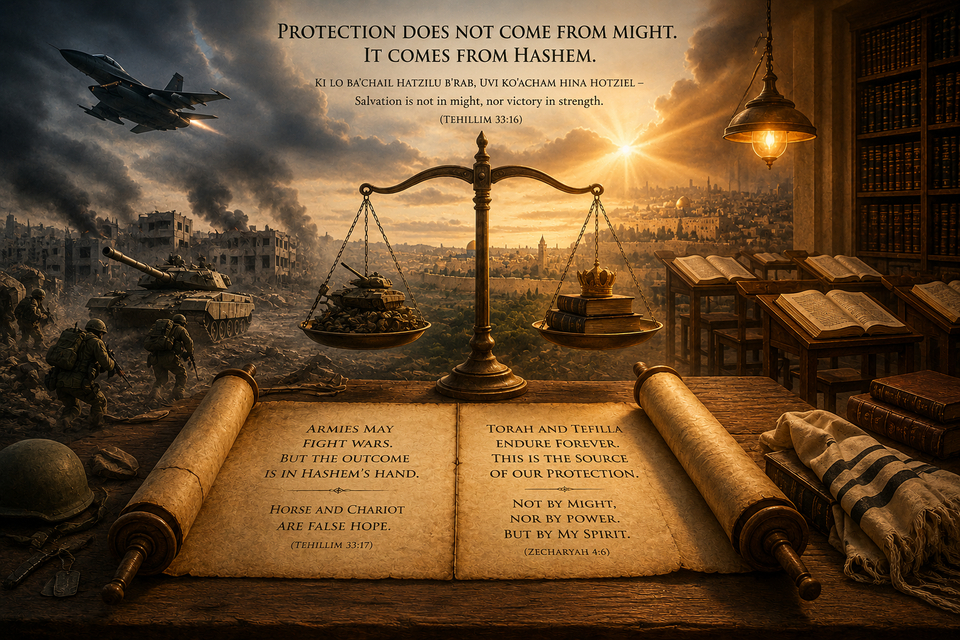
The Question Misframes the Answer. The Torah's Framework of Jewish Protection Predates the IDF by 3,000 Years — And Will Continue to Operate Whether or Not the IDF Exists.
The question is asked, sometimes with genuine concern and sometimes with sharper edge: "If Charedim don't serve in the army, and the IDF didn't exist, what would happen? Wouldn't we be destroyed?" The implication is supposed to be devastating — the secular establishment assumes that without the IDF, no protection is possible, and therefore that the Charedi refusal to enlist amounts to free-riding on the protection of others.
The question deserves a serious answer, because the answer reveals a deep theological misunderstanding embedded in the way it is asked. The question assumes that the secular military framework is the only possible vehicle of Jewish national protection. The entire Torah is the documented refutation of that assumption.
The Charedi answer is not that Jews don't need defense. The Charedi answer is that defense is what Hashem does for His people, and the human vessels through which He accomplishes it are infinitely variable. The IDF is one such vessel. It is not the only possible vessel. It is not the framework the Torah identifies as the primary mechanism of Jewish protection. And the survival of Klal Yisrael across three thousand years — most of which involved no Jewish army of any kind — is the documented proof.
Let us work through it carefully.
I. The Hidden Assumption Behind the Question
Begin by exposing what the question quietly assumes. When someone asks "What would happen if no one fought?" — what they mean is: "What would happen if no Jews participated in the IDF?" The assumption built into the question is that Jewish national protection is a function of the IDF, and that anything that reduces IDF participation reduces Jewish protection by an equivalent amount.
This is not an obvious assumption. It is, in fact, an entirely modern one — a product of the secular nationalist framework that founded the State of Israel and that has dominated Israeli public discourse for seventy-eight years. Before 1948, Jews never made this assumption. For two thousand years of galus, Jews survived in conditions of statelessness, dispersion, and routine vulnerability — and the entire Torah-faithful Jewish framework for understanding that survival did not run through "the Jewish army" because there was no Jewish army.
The framework ran through Hashem. The framework ran through Torah. The framework ran through tefillah, teshuvah, and the chain of mesorah. The framework ran through everything the Charedi world continues to emphasize today, because the Charedi world has not abandoned the framework that protected Klal Yisrael for two thousand years in favor of a seventy-eight-year-old secular alternative.
To answer the question properly, we have to set aside its hidden assumption and ask the deeper question: What actually protects Klal Yisrael, in the Torah's own framework?
II. The Torah's Default Answer: Hashem Fights for Israel
The Torah's framework for Jewish wars is anchored in a foundational declaration. Devarim 20:4:
"Ki Hashem Elokeichem haholech imachem, l'hilachem lachem im oyveichem l'hoshia eschem."
"For Hashem your God is the One who goes with you, to fight for you against your enemies, to save you."
This pasuk, recited by the kohen mashuach milchamah — the priest anointed for war — before the Jewish army went into battle, is the central Torah declaration about how Jewish wars operate. The army fights, and Hashem fights with it; but the operative force is Hashem. The army is the vessel through which Hashem's victory becomes visible in the physical world.
Devarim 20:1 makes this even more explicit: "Ki teitzei lamilchama al oyvecha v'ra'isa sus va'rechev am rav mimcha — lo sira meihem, ki Hashem Elokecha imach" — "When you go out to war against your enemy and you see horse and chariot, a people more numerous than you — do not fear them, for Hashem your God is with you." The Torah explicitly anticipates the situation in which the Jewish army is numerically and materially outmatched, and instructs the Jewish people not to fear, because Hashem's presence makes the material disparity irrelevant.
This is not a metaphor. The Torah is establishing a structural framework for understanding war: the determining factor in Jewish military outcomes is not the human balance of forces but Hashem's relationship with His people. When Klal Yisrael is faithful, the smallest force can defeat the largest. When Klal Yisrael is not faithful, the largest force can be defeated.
The most powerful articulation of this principle in Tanach is from Yonatan ben Shaul, in Shmuel I 14:6, before he and his arms-bearer attacked the entire Philistine camp single-handed:
"Ki ein lashem ma'tzor l'hoshia b'rav o b'me'at."
"For nothing prevents Hashem from saving with many or with few."
This is the foundational principle. Hashem operates with no minimum force requirement. Two people can defeat a camp of thousands, if Hashem wills it. Three hundred can defeat hundreds of thousands. The arithmetic of conventional warfare is irrelevant to the actual mechanism of Jewish victory.
III. The Documented Record: Hashem's Wars in Tanach
Tanach contains multiple documented examples of Jewish military victories that operated entirely outside conventional military logic. The Charedi mesorah treats these not as poetic exaggerations but as the normative model of how Jewish wars are supposed to be fought:
Yericho (Yehoshua 6). The first conquest of Eretz Yisrael under Yehoshua. The walls of Yericho fell not through battering rams or siege engines but through the marching of the Aron and the blowing of shofaros. The military strategy was, by every conventional standard, nonsensical. It worked.
Gideon and the 300 (Shoftim 7). Hashem explicitly reduced Gideon's force from 32,000 to 300 — telling Gideon that with too many soldiers, Israel would say "yadi hoshi'a li" ("my hand saved me") instead of recognizing the salvation as Hashem's. The 300 defeated the entire Midianite encampment with shofar blasts and torches.
David and Goliath (Shmuel I 17). A young shepherd, refusing armor, refusing a sword, declared to the giant Philistine: "Ata ba elai b'cherev u'va'chanis u'v'kidon, v'anochi va eilecha b'shem Hashem Tzevakos" — "You come to me with sword and spear and javelin, but I come to you in the Name of Hashem of hosts" (Shmuel I 17:45). The framework was explicit. David's identity was not in the weapon; it was in the Name.
Yehoshafat against Moav, Ammon, and the Meunim (Divrei HaYamim II 20). When three armies invaded Yehudah, Yehoshafat sent out the Levi'im in front of his army — singing, with no weapons — and Hashem caused the invading forces to destroy each other before the Jewish army needed to engage at all.
Chizkiyahu and Sancherev (Melachim II 19; Yeshayahu 37). The Assyrian army surrounded Yerushalayim. Chizkiyahu davened. Yeshayahu prophesied. An angel went out and struck down 185,000 Assyrian soldiers in a single night. Sancherev returned to Nineveh and was assassinated by his own sons. The Jewish army did not lift a sword.
These are not isolated stories. They are the Tanach's consistent portrayal of how Jewish wars actually work. The vessel — the Jewish army, when it exists — is the visible instrument. The Source is always Hashem, operating through whatever scale of human action He chooses. Sometimes it is a large army. Sometimes it is a small army. Sometimes it is two men. Sometimes it is no men at all — just the angel and the Name.
IV. The Ramban: Israel Operating Above Nature
The most systematic philosophical treatment of this framework in the Rishonim is in the Ramban's commentary on the brachos and klalos of Bechukosai and Ki Tavo. On Vayikra 26:7–8 — the bracha that "you will pursue your enemies, and they will fall before you by the sword; five of you will pursue a hundred, and a hundred of you will pursue ten thousand" — the Ramban writes:
"When Israel is whole and they are many, their affairs are not conducted by nature at all — not in their bodies, not in their land, not collectively, and not individually. For Hashem will bless their bread and their water, and remove illness from their midst, to the point that they will not need a doctor and will not need to take precautions through any of the natural medical arts… so too in their wars: they will not need to take cover in the natural way, but Hashem will deliver their enemies before them."
The Ramban's framework is precise. When Klal Yisrael fulfills its spiritual role, the entire conduct of their national life operates above nature. They don't need conventional medicine — Hashem heals. They don't need conventional warfare — Hashem fights. They don't need conventional agriculture — the land produces miraculously. The natural-historical framework that governs every other nation is suspended for Klal Yisrael when Klal Yisrael lives the framework the Torah prescribes.
This is the maximalist Torah position. The Charedi mesorah does not claim we are currently living in this maximalist condition — we are not all spiritually whole, we are not all faithful, and the supra-natural protection the Ramban describes is therefore operating only partially. But the direction the framework points in is the direction the Charedi mesorah teaches: the closer Klal Yisrael gets to spiritual wholeness, the more its protection comes from sources other than conventional military force.
V. Two Thousand Years Without an Army
The strongest empirical argument for the Charedi framework is the actual historical record. Klal Yisrael survived two thousand years of galus with no Jewish army of any kind. From the destruction of the Second Beis HaMikdash in 70 CE to the establishment of the State of Israel in 1948, the Jewish people had no sovereign army, no national military, no centralized defense framework. We were dispersed across hundreds of countries, under hundreds of governments, frequently subjected to violence and persecution.
And we survived. Not just survived in small numbers — survived as a continuous, organized, halachically-disciplined, Torah-learning, Mesorah-transmitting community. The Talmud was completed in galus, without an army. The Rishonim wrote their works in galus, without an army. The great Acharonim — the Beis Yosef, the Rema, the Shach, the Taz, the Vilna Gaon, the Baal Shem Tov, the Chasam Sofer, the Chazon Ish — built their schools in galus, without an army. The chain of mesorah was transmitted intact for nineteen centuries without any Jewish military infrastructure.
How? The Charedi answer is: the same way Hashem protected Klal Yisrael in every generation of Tanach — through His direct hashgacha pratis, through Torah, through tefillah, through the merit of the bnei Torah and the tzaddikim who served as the spiritual anchors of every generation. The mechanism the Gemara in Sotah 21a identifies — Torah magna u'matzla (Torah protects and saves) — was operating throughout the entire galus period, in the absence of any Jewish army.
To say therefore that "if no one fights, we'll be destroyed" is to deny two thousand years of Jewish history. The Jewish people have been "no one fighting" for far longer than they have been "Jews fighting," and the Jewish people have survived precisely because fighting was never the actual source of survival.
VI. The Chazon Ish on Bitachon
The Chazon Ish zt"l, in his foundational sefer Emunah u'Bitachon, develops this principle in detail. He addresses the question of hishtadlus — the human effort that operates alongside Hashem's hashgacha — with characteristic clarity. Hishtadlus is required. A Jew does not sit and wait for miracles. A Jew makes the appropriate human effort. But the source of the outcome is never the human effort. The source is always Hashem. The human effort is the vessel through which Hashem's will becomes visible, and the appropriate level of human effort depends on the spiritual condition of the community.
The Chazon Ish's framework illuminates the question this article addresses. The IDF is hishtadlus. The civilian defense networks of Charedi communities are hishtadlus. The bnei Torah learning in the kollelim are hishtadlus. Each is a vessel. None is the Source. Different communities, different individuals, different generations have made different choices about what kind of vessel to be. The protective outcome is determined by Hashem, not by which vessel we picked.
This is consistent with the documented exchange between the Chazon Ish and David Ben-Gurion in October 1952. Ben-Gurion pressed: "And these young men sitting at the borders, who protect you — is that not a mitzvah?" The Chazon Ish answered: "In the merit of our Torah study, they live, work, and are protected. Torah is the tree of life, the elixir of life." When Ben-Gurion pressed further — "But if these young people didn't protect you, the enemies would slaughter you!" — the Chazon Ish responded: "On the contrary. In the merit of our Torah study, they are safe."
The Chazon Ish's position is precise. The protective relationship between the bnei Torah and the soldiers runs in the opposite direction from what Ben-Gurion assumed. The soldiers are not protecting the learners; the learners are protecting the soldiers, by being the conduit through which Hashem's protection flows into the broader national life. This is not Charedi self-aggrandizement. It is the structural mechanism the Torah identifies, articulated by the gadol hador to the Prime Minister, in the central halachic-spiritual conversation of the State's founding decade.
VII. The Real Question: What Would Happen if No One Learned?
Here is where we can flip the question that was asked. The honest question, from the Torah's framework, is not "what would happen if no one fought?" The honest question is: "what would happen if no one learned?"
If every Jew enlisted in the IDF and no Jew learned full-time Torah, what would happen? The Sotah 21a framework, the Shabbos 119b framework, the Sanhedrin 98a framework, the entire Charedi understanding of how Klal Yisrael survives — all of these point in the same direction. The Torah-learning gap would be the actual catastrophe. The army might continue to exist, but the merit-mechanism that operates behind every Jewish military success would erode. The protection from above — which is the actual source of Israeli survival — would weaken.
This is what the Charedi gedolim have been saying for seventy-eight years. The Charedi position is not that no one should defend. It is that the gravest threat to Klal Yisrael's survival is the erosion of the Torah-learning infrastructure that constitutes the actual operating mechanism of national protection. The community that maintains that infrastructure is performing the most essential national function. The community that demands its dismantling — in the name of "shared burden" — is, structurally, demanding the very thing that would expose Klal Yisrael to the catastrophe its rhetoric claims to prevent.
VIII. What Charedim Actually Do
The question this article addresses presumes that "no one fighting" is the Charedi position. It is not. As we have documented across this series:
- Civilian defense networks — mishmar ezrachi, Hashomrim, and similar Charedi-organized armed community defense, operating across Charedi cities and neighborhoods, with continuous documented history from the pre-state period through October 7 and beyond
- Tefillah for soldiers — every Charedi shul davens the Mi Sheberach La'Chayalim on Shabbos, every Charedi school adds Tehillim during periods of war, every Charedi family says Acheinu and other tefillos for soldiers in danger
- The chesed infrastructure for soldiers and their families — Lev Echad, Lev L'Lev, and dozens of other Charedi-organized networks supporting reservists' families, wounded soldiers, bereaved families, and displaced communities
- The continued building of yeshivos and kollelim — the actual structural mechanism of national protection, the merit-generation that Sotah 21a identifies as the operating source of Klal Yisrael's survival
- The economic and chesed contributions to the broader national life — Hatzalah, Zaka, Yad Sarah, Ezer Mizion, Chai Lifeline, and the entire infrastructure of Charedi-organized service to all Israelis
The picture this builds is the actual answer to the question. Charedim are not free-riding on the protection of others. Charedim are operating multiple parallel vessels of national protection, including some that contribute directly to physical defense (the mishmar ezrachi networks), some that contribute indirectly (the chesed infrastructure that serves all soldiers and their families), and some that operate at the structural-spiritual level that the Torah identifies as the actual source of national survival.
What is omitted from the Charedi contribution is one specific framework — IDF enlistment as totalizing institutional commitment — for the reasons we have documented across this series. The Charedi community has, throughout, supported the alternative frameworks of defense and protection that the Torah authorizes.
IX. The Honest Answer
So what would happen if no one fought?
The honest answer, from the Torah's framework: Hashem would arrange another vessel. He has always arranged vessels for Jewish protection. He arranged the angel that struck down Sancherev's army. He arranged Gideon's 300. He arranged Yonatan's two-man assault on the Philistines. He arranged Koresh's proclamation that allowed the return from Babylonian exile. He arranged the survival of the Jewish people through two thousand years of galus without any Jewish army. He will arrange whatever He needs to arrange.
The question that imagines "no defense at all" is therefore an unreal hypothetical. The actual question is which vessel of defense Klal Yisrael is operating through. The Charedi mesorah teaches that the most important vessel — the one that has held Klal Yisrael through every generation of history — is the vessel of Torah, tefillah, and mesorah-transmission, with the community-level hishtadlus of physical defense as a supplementary vessel that adjusts to the conditions of each generation.
The current generation has the IDF. Previous generations had no army. The constant across both was Hashem's hashgacha, operating through whatever vessel each generation provided.
And the constant remains. We daven for the soldiers, who are real human beings in real physical danger, who deserve our prayers and our gratitude and our support. We honor them as the visible instruments of Hashem's protection in our current generation. And we maintain, with full halachic clarity, that the source of their protection is Hashem, and the deepest structural contribution to Israeli national survival is the Torah being learned in the batei midrash — without which no army, however well-equipped, would have the structural merit it needs to succeed.
X. The Closing Truth
Eineinu el Hashem Elokeinu — "Our eyes are to Hashem our God" (Tehillim 123:2).
That is the Jewish posture. Our eyes are to Hashem. Not to the IDF. Not to the chariots. Not to the secular state. Not to any human framework — however brave, however necessary, however much we appreciate its visible role in the protection of our brothers and sisters. Our eyes are to Hashem. He is the One who fights our battles. He is the One who protects our people. He is the One who orchestrates the unfolding of Jewish history through whatever vessels He chooses.
The dream of the Charedi world is not the dream of more soldiers. It is the dream of more Torah — and of a moment, bimheirah b'yameinu, when the framework of the geulah will arrive and the army Klal Yisrael will need will be the army of Talmidei chachamim, baalei teshuvah, bnos Yisrael lighting Shabbos candles, and a Beis HaMikdash rebuilt at the center of a nation governed by Torah.
Until then, we hold the line. We learn. We daven. We support the soldiers. We organize mishmar ezrachi where it is needed. We continue the chain of mesorah. And we trust, with the full weight of three thousand years of documented Jewish survival behind us, that Hashem will continue to protect His people through whatever vessels He arranges — including, but never reducible to, the vessel currently visible to our eyes.
That is the answer. It is anchored in the Torah, in Tanach, in the Ramban, in the Chazon Ish, and in the unbroken chain of the Charedi mesorah. It is the framework that has held Klal Yisrael for thirty centuries. It will continue to hold us until the geulah comes.
Bimheirah b'yameinu, amen.
Sources
The Torah's central declarations about war
- Devarim 20:1 — "do not fear them, for Hashem your God is with you"
- Devarim 20:4 — "Hashem your God is the One who goes with you, to fight for you"
- Devarim 20:1-9 — the laws of going to war, including the exemptions
- Bamidbar 10:35 — "vayehi binso'a ha'aron" — the Aron leading Israel into battle
Tanach examples of Hashem's wars
- Yehoshua 6 — the conquest of Yericho
- Shoftim 7 — Gideon and the 300 (the explicit reduction of force)
- Shmuel I 14:6 — Yonatan ben Shaul: "For nothing prevents Hashem from saving with many or with few"
- Shmuel I 17 — David and Goliath (David's declaration in 17:45)
- Divrei HaYamim II 20 — Yehoshafat against Moav, Ammon, and the Meunim
- Melachim II 19 / Yeshayahu 37 — the angel and Sancherev's 185,000
Tehillim sources
- Tehillim 20:8 — "Eileh ba'rechev v'eileh ba'susim, va'anachnu b'shem Hashem Elokeinu nazkir"
- Tehillim 33:16-17 — "Ein hamelech nosha b'rav chayil" — "the king is not saved by a large army"
- Tehillim 44:7 — "Lo b'kashti evtach v'charbi lo soshi'eini" — "I do not trust in my bow, and my sword does not save me"
- Tehillim 121 — "From where will my help come? My help is from Hashem"
- Tehillim 123:2 — "Eineinu el Hashem Elokeinu"
- Tehillim 127:1 — "Im Hashem lo yishmor ir, shav shakad shomer"
The Ramban on Israel above nature
- Ramban on Vayikra 26:7-8 — the foundational passage on Israel's affairs operating above nature when the nation is whole and faithful
- Ramban on Devarim 20:1 — on the Torah's framework for Jewish warfare
Talmudic and Midrashic sources on Torah as protection
- Talmud Bavli, Sotah 21a — Torah magna u'matzla — Torah protects and saves
- Talmud Bavli, Shabbos 119b — hevel pihem shel tinokos shel beis rabban — the breath of schoolchildren learning Torah sustains the world
- Talmud Bavli, Sanhedrin 98a — the signs of the End and the Land producing for its returning people
- Talmud Bavli, Berachos 64a — talmidei chachamim marbim shalom ba'olam
- Talmud Bavli, Bava Basra 7b-8a — Rabbanan lo tzrichi netiruta
The Chazon Ish on Bitachon
- Chazon Ish, Emunah u'Bitachon, Chapters 1-3 — the foundational treatment of bitachon and hishtadlus
- Kovetz Igros, Chazon Ish, Vol. 1, p. 97
The Chazon Ish – Ben-Gurion meeting (October 20, 1952)
- Yitzchak Navon's recorded account, published in his memoirs
- World Mizrachi, "The Chazon Ish, Ben-Gurion and Rav Tzvi Yehudah" (March 2023)
- Yeshiva World News, "70 Yrs Ago Today" (October 2022)
- Jewish Action (Rabbi Aharon Feldman) — citing MK Shlomo Lorincz, Digleinu Vol. 2 (110)
The Rambam's structural framework
- Rambam, Mishneh Torah, Hilchos Talmud Torah 6:10 — Talmidei chachamim exempt from anaga
- Rambam, Mishneh Torah, Hilchos Shemittah V'Yovel 13:13 — the kodesh kodashim category
The historical record of Jewish survival without an army
- The two-thousand-year period (70 CE — 1948 CE) of Jewish survival in galus, completion of Talmud, transmission of Rishonim and Acharonim, building of yeshivos, all without any Jewish military framework
Charedi documented contributions to current defense
- Mishmar ezrachi / Hashomrim civilian defense networks across Charedi cities
- Lev Echad, Lev L'Lev, and the chesed networks supporting soldiers and reservist families
- The full Charedi chesed infrastructure: Hatzalah, Zaka, Yad Sarah, Ezer Mizion, Chai Lifeline