
What is the Charedi View on Protecting Their Cities — Including Carrying Guns or Doing Guard Duty Outside the Army?
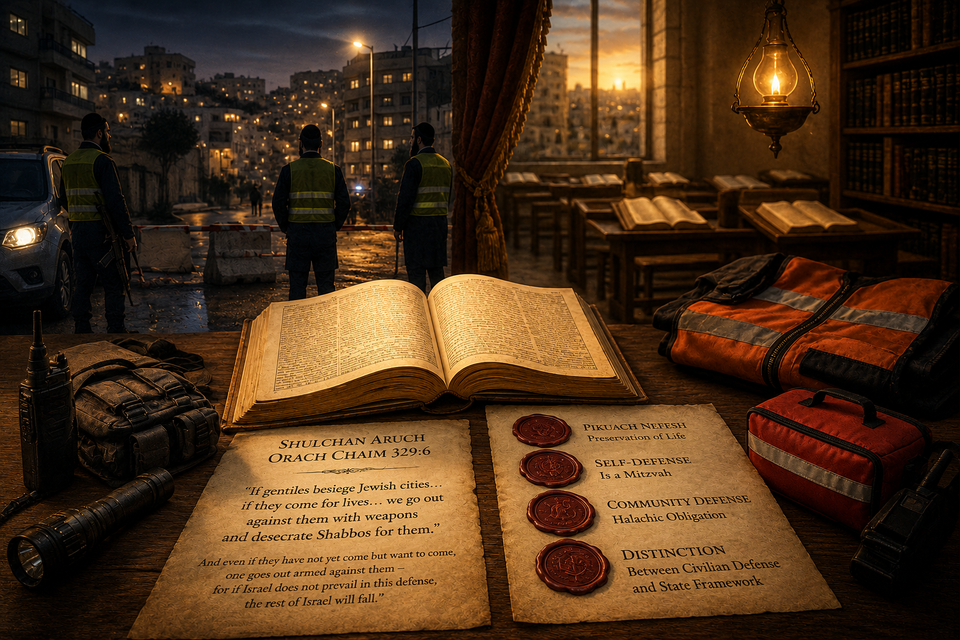
Yes to Self-Defense. Yes to Armed Civilian Protection. No to the Total Institutional Framework of the IDF. And There Is Specific Halacha to Explain Every One of These Distinctions.
The question is being asked with increasing urgency, especially since October 7. Critics ask it skeptically — as if catching the Charedi community in an inconsistency: "If you're not willing to enlist in the IDF, but you carry guns in your neighborhoods and run civilian patrols, isn't that the same thing? Why is one acceptable and the other not?"
The question deserves a serious answer, because the answer reveals one of the most important halachic and structural distinctions in the entire Charedi-State debate. The Charedi position is not that Jews shouldn't defend themselves. The Charedi position is that the framework matters as much as the action — and that targeted civilian defense governed by halacha is a categorically different thing from total institutional commitment to a secular framework. Both are common-sense conclusions of Torah-faithful Jews who take both pikuach nefesh and the protection of the soul seriously.
We work through the halacha, the documented practice, and the practical reality below.
I. Pikuach Nefesh and Self-Defense Are Mitzvos
Begin with the foundational principle. The Charedi community, like every Torah-observant Jewish community across three thousand years, treats pikuach nefesh — the preservation of Jewish life — as one of the most serious obligations in the entire halachic system.
The Gemara in Chullin 10a teaches: "Chamira sakanta me'issura" — "Danger is more severe than prohibition." This famous Talmudic principle establishes that the avoidance of physical danger overrides most ordinary halachic prohibitions. When a Jewish life is at risk, the framework changes: nearly every other halachic consideration yields to the preservation of the life.
The Rambam codifies this principle across multiple sections of Mishneh Torah — in Hilchos Shabbos 2:1, Hilchos Rotzeach 1:6–10, Hilchos Yesodei HaTorah 5:1–5. The framework is consistent: Jewish life is to be preserved with whatever halachic means the situation requires.
And self-defense — the active protection of Jewish life against threat — is not merely permitted. It is, in the Torah's own framework, a mitzvah. The Gemara in Sanhedrin 72a establishes the foundational principle: "Ha'ba l'hargecha, hashkem l'hargo" — "If someone comes to kill you, rise up and kill him first." This Talmudic dictum, codified by the Rambam in Hilchos Rotzeach U'Shemiras HaNefesh 1:6–10 and Hilchos Geneiva 9:7–12, establishes the active obligation to defend oneself and other Jews against lethal threat.
The Torah's own foundation for this is in Shemos 22:1: "Im ba'machteres yimatzei ha'ganav v'huka va'mes, ein lo damim" — "If a thief is found breaking in, and is struck and dies, there is no bloodguilt." The Torah explicitly authorizes the use of force, including lethal force, against one who comes with intent to harm.
The Charedi position on self-defense is therefore not in any doubt. When Jewish lives are at risk — from terror, from invasion, from violent attack — Torah Jews are obligated, not merely permitted, to defend themselves and their communities.
II. The Foundational Halacha: Shulchan Aruch Orach Chaim 329:6
The single most important source for understanding the Charedi position on community defense is the Shulchan Aruch's halacha on what to do when gentiles besiege a Jewish city.
Shulchan Aruch, Orach Chaim 329:6:
"Akum she'tzaru al ayarot Yisrael, im ba'u al ishei mamon — ein mechalelin aleihem es haShabbos. Ba'u al nefashos, o stam she'ba'u, o she'cheishu shema ya'vou — yotzin aleihem b'klei zayin u'mechalelin aleihem es haShabbos. U'b'ir ha'semucha l'sefar — afilu lo ba'u al ishei mamon ela al teven v'al kash, yotzin aleihem b'klei zayin u'mechalelin aleihem es haShabbos."
"If gentiles besiege Jewish cities, if they come for monetary purposes — we do not desecrate Shabbos for them. If they come for lives, or come for unclear reasons, or there is suspicion they may come — we go out against them with weapons and desecrate Shabbos for them. And in a city near the border — even if they come only for hay or straw, we go out against them with weapons and desecrate Shabbos for them."
The Rema adds:
"And even if they have not yet come but want to come, one goes out armed against them — for if Israel does not prevail in this defense, the rest of Israel will fall."
The Mishnah Berurah at 329:14 elaborates: the principle is that any threat to a Jewish city near the border is a threat to all of Klal Yisrael, because the breach of one Jewish settlement opens the door to the conquest of more. Therefore, even when the immediate threat appears small, the structural threat justifies — indeed requires — armed response.
The Talmudic source for this halacha is Eruvin 45a, where Rav Yehuda in the name of Rav teaches the same principle: Jewish communities must be defended, with weapons, against gentile aggression — even on Shabbos.
This is the foundational halacha that establishes Charedi civilian defense as a halachic obligation, not a contingent choice. Where there is a real threat to Jewish life or to a Jewish community, particularly one near a hostile border, the obligation to take up arms in defense is codified in the central halachic code of the Jewish people. The Charedi communities of Bnei Brak, Beitar Illit, Modi'in Illit, Elad, Kiryat Sefer, Beit Shemesh, and elsewhere — most of them in close proximity to Arab population centers and historical sites of attack — are precisely the kind of communities to which this halacha most directly applies.
III. The Halachic Right to Carry Weapons
Building on this foundation, the Charedi community has, for decades, organized and operated armed civilian defense networks. The halachic right to carry weapons in defensive contexts is established across multiple sources:
The basic permission. The Mishnah in Shabbos 6:4 records the dispute about whether weapons may be carried on Shabbos as "adornments" of the warrior. The mainstream halachic ruling, codified in the Shulchan Aruch OC 301:7, is that under ordinary circumstances, weapons are not carried on Shabbos as ornaments. But under defensive circumstances, where the weapons are needed for protection, the framework changes entirely.
The defensive permission. The Rambam in Hilchos Shabbos 2:23 codifies that when defending Jews against attack, all halachic considerations including Shabbos restrictions yield to the preservation of life. The same applies to the carrying of weapons necessary for that defense.
The framework of kli — tool, not object of trust. The Charedi mesorah has been consistent on the proper framing of weapons. The verse in Tehillim 20:8 — "Eileh ba'rechev v'eileh ba'susim, va'anachnu b'shem Hashem Elokeinu nazkir" — "Some trust in chariots, and some in horses, but we will mention the Name of Hashem our God" — establishes the framework. Jews use weapons. Jews do not trust in weapons. The weapon is a kli — a tool used as the situation requires — and the Source of the Jew's protection is and remains Hashem. This is the same theological structure we have explained across this series in our treatment of Source vs. vessel: the tool is real and necessary, but the religious significance belongs to the One who uses the tool through us.
The Charedi gedolim have, across the generations, consistently authorized the carrying of weapons for legitimate defensive purposes — neighborhood patrols, mishmar ezrachi civilian guard duty, personal defense in dangerous areas — while emphasizing the framework of humility and yiras Shamayim rather than the framework of national-military glory the secular establishment attaches to armed force.
IV. The Distinction That Matters: Targeted Defense vs. Total Institutional Commitment
Here is the heart of the answer to the question this article addresses. Why is civilian defense halachically appropriate, while IDF enlistment is not?
The distinction is between targeted, time-limited, community-supervised defensive action and total, multi-year, institutionally-totalizing commitment to a secular framework. These are categorically different things, and the halacha and the mesorah have always recognized the difference.
Civilian defense is targeted. A Charedi civilian patrol responds to a specific, real, immediate threat — a known terror threat, a wave of attacks, a heightened alert period, a particular night when intelligence indicates danger. The defensive action is calibrated to the threat. It is limited in time and scope. When the threat recedes, the defensive posture relaxes. This is hishtadlus, not enlistment. The Jew protects his community for the hours and days the threat requires, and returns to his ordinary life of Torah, family, and parnasa.
Civilian defense is community-supervised. A Charedi mishmar ezrachi operates under the guidance of communal rabbinic authorities, organized by community askanim, with halachic supervision over questions of tznius, kashrus, Shabbos observance, and the entire halachic framework of the community. The defensive framework operates inside the Torah framework, not outside it.
Civilian defense does not require entering a secular institutional framework. A Jew on a mishmar ezrachi shift is not under a secular chain of command. He is not subject to orders that contradict halacha. He is not removed from his family, his beis medrash, his community for months or years at a time. He is not in an environment systematically designed to integrate him into the "yehudi he'chadash" project the secular establishment has pursued for seventy-eight years.
The IDF is the opposite of all of these. IDF service is total — multi-year, institutionally encompassing, geographically removed from family and community. It places the soldier under a secular chain of command whose top legal authorities consult no halacha. It systematically requires the soldier to participate in chillul Shabbos, mixed-gender environments halacha forbids, food that is not kosher to the Charedi standard, ceremonies that no Charedi Rav would authorize a religious Jew to attend, and a cultural and ideological framework that has been, for seventy-eight years, the most powerful mechanism in the modern world for moving Jews away from full Torah observance.
These are categorically different frameworks. To compare a Charedi yungerman taking a turn on a mishmar ezrachi shift in his Bnei Brak neighborhood to a Charedi bochur enlisting in Netzach Yehuda for two and a half years is to compare two completely different halachic categories. The halacha that permits and requires the first does not require, and in fact forbids, the second.
V. The Mishmar Ezrachi Tradition
The civilian patrol — mishmar ezrachi — is not a recent Charedi innovation. It is a documented tradition with roots in the pre-state Yishuv and continuing development across the entire State period.
In the late nineteenth and early twentieth centuries, Charedi communities in Yerushalayim, Hebron, Tzfas, and Tiveriya organized their own civilian defense networks during periods of Arab violence — the 1920 riots, the 1929 Hebron massacre, the 1936–39 Arab Revolt, and subsequent periods. These were Torah-observant defenders, often organized by local rabbinic leadership, defending their own communities and the holy sites of Eretz Yisrael.
During the British Mandate period, Charedi defenders operated within the framework of community-based defense, separate from the secular Zionist Haganah and Etzel structures. The famous Neturei Karta of the period — before that name acquired its later more controversial associations — were originally simply guardians of the city, Torah Jews defending Yerushalayim's Charedi neighborhoods against Arab attack.
In the State period, the mishmar ezrachi tradition has continued. During the First Intifada (1987–1993), the Second Intifada (2000–2005), Operation Protective Edge (2014), and continuously through periods of heightened threat, Charedi communities have organized civilian patrols. The Beitar Illit mishmar ezrachi during the Second Intifada was particularly well-documented in the Israeli press — Charedi yungeleit walking the perimeter of the yishuv through the night, in shifts, with flashlights and radios and (where authorized) firearms.
After October 7, 2023, the Charedi mishmar ezrachi infrastructure expanded dramatically. With the country in crisis and the IDF's resources stretched, Charedi communities organized extensive civilian defense networks. Volunteers underwent legal firearms training (where permits were granted). Communities pooled resources to purchase equipment. The Hashomrim networks — Charedi-organized neighborhood security organizations — coordinated patrols across Charedi cities and neighborhoods.
This is the actual record. The Charedi community defends itself. The Charedi community has, for over a century, been actively involved in armed protection of its own communities. The accusation that Charedim are unwilling to bear the burden of self-defense is not supported by the documented historical record.
VI. The Documented Charedi Halachic Position
The major Charedi poskim have addressed the question of civilian defense with consistent rulings.
The Chazon Ish (Rabbi Avraham Yeshaya Karelitz zt"l), in his halachic writings on Hilchos Eiruvin (Orach Chaim 114) and across his teshuvos, treated the obligation to defend Jewish communities as a halachic given, anchored in the Shulchan Aruch O.C. 329:6 framework.
Rav Yosef Shalom Elyashiv zt"l, in the published collection of his rulings (Kovetz Teshuvos and related works), addressed the question of yeshiva students participating in mishmar ezrachi shifts. His mainstream position, transmitted through his talmid and son-in-law Rabbi Yitzchak Zilberstein in the Chashukei Chemed responsa series, has been: in times of genuine sakana, when other defenders are not available, participation in civilian defense is a mitzvah — provided that it does not become a habitual cause of bittul Torah beyond what the situation requires.
Rav Chaim Kanievsky zt"l and Rav Aharon Yehuda Leib Shteinman zt"l, in their published rulings and the recorded minhagim of their communities, supported the mishmar ezrachi framework as the appropriate Charedi form of community defense. Both consistently distinguished between this targeted hishtadlus and the totalizing framework of IDF service.
The Shu"t Minchas Yitzchak (Rabbi Yitzchak Yaakov Weiss zt"l, the Eida Charedis dayan and av beis din) addresses related questions in Vol. 10 and elsewhere, affirming the halachic legitimacy of armed civilian defense.
The position across the entire Charedi mesorah is consistent: self-defense and community protection are halachic obligations; they are properly carried out through community-controlled, halachically-supervised, time-limited defensive structures; they are not appropriately carried out through enlistment in a secular institutional framework whose structural features systematically compromise Torah observance.
VII. The State's Obstruction of Charedi Self-Defense
Here is a painful and documented friction that the secular establishment rarely acknowledges. The State of Israel, despite demanding that Charedim "share the security burden," has consistently obstructed the Charedi community's efforts to organize its own halachically appropriate defense.
Gun licensing. Israeli firearms licensing has historically been restrictive, with criteria that have disproportionately excluded Charedi applicants — non-military background, residence in certain neighborhoods, professional categories that Charedim do not occupy. Charedim with legitimate defensive needs have routinely been denied permits that secular applicants with similar profiles have received.
Training infrastructure. Israeli firearms training programs have, historically, been embedded in cultural frameworks that Charedim find inappropriate — mixed-gender environments, secular instructors, training centers without basic kashrus or Shabbos accommodations. The Charedi community has had to build its own training infrastructure largely independently.
Funding and recognition. Israeli government funding for civilian defense structures has historically flowed to secular frameworks (Bituach Beyit programs, IDF-affiliated reserve structures, etc.) while Charedi-organized mishmar ezrachi networks have struggled for equivalent recognition and resources.
The post-October 7 partial opening. Following October 7 and the broad expansion of civilian gun licensing under Minister Itamar Ben Gvir, more Charedim have been able to obtain firearms permits. Charedi communities have substantially expanded their defensive infrastructure. But the underlying framework — that the State views Charedi-organized defense with institutional suspicion, while demanding Charedi participation in its own secular institutions — has not fundamentally shifted.
The painful paradox is real. The Charedi community is willing to defend itself. The State, while criticizing the Charedim for not "sharing the burden," has obstructed the structural means by which the Charedi community would do that sharing on Torah-compatible terms. The State's preference, structurally, has been to coerce Charedim into the IDF framework — not to support Charedim in building defensive structures that serve the same protective purpose without compromising the framework of Torah.
VIII. Why Local Patrol Is Acceptable and the Army Is Not — A Final Synthesis
Now we can summarize the answer with full clarity.
The Charedi community defends itself, carries weapons in defensive contexts, organizes civilian patrols, and treats community protection as a halachic obligation. All of this is anchored in primary halachic sources — Sanhedrin 72a, Shulchan Aruch O.C. 329:6, Mishnah Berurah, Rambam — and documented across a century of Charedi practice in Eretz Yisrael.
The Charedi community does not enlist in the IDF as a totalizing institutional commitment, because that framework is structurally different from targeted civilian defense in ways the halacha takes seriously.
The distinctions, summarized:
- Targeted vs. total. Civilian defense responds to specific threats; IDF service is multi-year institutional commitment.
- Halachically supervised vs. halachically subordinated. Civilian patrols operate under community rabbinic authority; IDF service places the soldier under a secular chain of command whose legal advisors consult no halacha.
- Tznius and kashrus preserved vs. systematically violated. Civilian defense operates within Charedi community standards; IDF service systematically forces religious soldiers into compromise on tznius, kashrus, Shabbos, and other foundational halachic frameworks.
- The framework of hishtadlus vs. the framework of "yehudi he'chadash." Civilian defense is a tool for protection; IDF service was designed, from its founding, as a transformative institution intended to remake the Jewish identity of those who enter it.
A Jew may pick up a tool when the situation requires it. A Jew should not voluntarily enter a framework whose explicit institutional purpose is to remake him. This is the structural Charedi distinction, anchored in the documented halacha and the documented mesorah.
IX. The Eternal Frame
Tehillim 127:1 — "Im Hashem lo yishmor ir, shav shakad shomer" — "If Hashem does not guard the city, the watchman keeps watch in vain."
The Charedi understanding of this verse is the Charedi understanding of all national security: the protection of Jewish life flows ultimately from Hashem, with the human watchman as the necessary instrument of His protection. The watchman must still stand his watch. The civilian patrol must still walk its rounds. The community must still build its defensive infrastructure. But the watchman knows whose protection actually keeps the city, and he stands his shift with the humility of a tool, not the bravado of a source.
This is the Charedi posture on defense: practical, halachically rigorous, willing to act, willing to carry weapons, willing to organize, willing to defend — and rooted, throughout, in the recognition that the ultimate Defender is Hashem, that the watchman is His instrument, and that the framework within which the defense operates must be the framework Hashem prescribed in His Torah, not a framework that displaces it.
The Charedi community defends itself. It does so on Torah's terms. And it refuses, on principled halachic grounds, to enter a framework that — whatever its real protective functions in the broader national life — was constituted as an institutional alternative to the Torah framework that has held the Jewish people for three thousand years.
That is the answer. It is anchored in halacha. It is supported by documented practice. It is consistent with the position of every Charedi posek of the modern era.
The watchman stands his watch. The Torah remains his framework. And both, together, are the way Klal Yisrael has guarded itself since Sinai, and the way it will continue to guard itself, bimheirah b'yameinu, until the geulah comes.
Sources
Foundational halachic sources on civilian defense
- Shulchan Aruch, Orach Chaim 329:6 — gentiles besieging Jewish cities; permission to take up arms even on Shabbos; the special rule for border cities
- Mishnah Berurah on Orach Chaim 329:14 — elaboration of the structural threat principle
- Talmud Bavli, Eruvin 45a — Rav Yehuda in the name of Rav on defense of Jewish communities
- Rema, Orach Chaim 329:6 — even pre-emptive defense when attack is anticipated
The principle of pikuach nefesh and self-defense
- Talmud Bavli, Chullin 10a — "Chamira sakanta me'issura"
- Talmud Bavli, Sanhedrin 72a — "Ha'ba l'hargecha hashkem l'hargo"
- Shemos 22:1 — the law of the thief breaking in
- Rambam, Mishneh Torah, Hilchos Rotzeach U'Shemiras HaNefesh 1:6–10
- Rambam, Mishneh Torah, Hilchos Geneiva 9:7–12
- Rambam, Mishneh Torah, Hilchos Yesodei HaTorah 5:1–5
- Rambam, Mishneh Torah, Hilchos Shabbos 2:23 — desecrating Shabbos to defend Jews
The halachic framework for weapons
- Mishnah, Shabbos 6:4 — the dispute on weapons as "adornments"
- Shulchan Aruch, Orach Chaim 301:7
- Tehillim 20:8 — "Eileh ba'rechev v'eileh ba'susim, va'anachnu b'shem Hashem Elokeinu nazkir"
- Tehillim 127:1 — "Im Hashem lo yishmor ir, shav shakad shomer"
Documented Charedi halachic positions
- Chazon Ish, Orach Chaim, Hilchos Eiruvin, siman 114
- Kovetz Teshuvos, Rabbi Yosef Shalom Elyashiv zt"l
- Chashukei Chemed, Rabbi Yitzchak Zilberstein shlita (transmitting the rulings of Rav Elyashiv)
- Shu"t Minchas Yitzchak, Rabbi Yitzchak Yaakov Weiss zt"l (Eida Charedis)
Documented Charedi mishmar ezrachi tradition
- Historical record of pre-state Charedi defense in Yerushalayim, Hebron, Tzfas, and Tiveriya (1920, 1929, 1936–39 periods)
- Beitar Illit and other yishuv mishmar ezrachi networks during the Second Intifada (2000–2005)
- Post-October 7, 2023 expansion of Charedi Hashomrim and related civilian defense organizations
The structural critique of IDF as totalizing institution
- Bahad 1 incident (2011); Chief of Staff Benny Gantz directive (2012); Yeshivat Har Bracha expulsion from Hesder framework (2012)
- Brig. Gen. (res.) Oren Solomon's interview, Arutz Sheva / Israel National News (August 25, 2025) — on IDF legal advisors and operational constraints
- The November 2024 emergency gathering letter of Lithuanian Charedi Roshei Yeshiva (Israel National News) — on the structural problems of attempted accommodation tracks
Israeli civilian firearms framework
- Israeli Firearms Law (Hok Klei HaYerya) — historical restrictive licensing framework
- Post-October 7, 2023 expansion of civilian licensing under Minister Itamar Ben Gvir