What Was the Charedi View of the Founding of the State of Israel?
The Charedi Response to 1948 Was Not Hostility and Not Celebration — It Was a Complex Holding-Together of Two Things: Genuine Hakaras HaTov That Jews Who Had Survived the Holocaust Now Had Refuge and That Torah Could Be Rebuilt, Alongside Profound Theological Caution About a State Founded by a Movement Openly Hostile to Torah and Wrongly Declared by Some to Be the Beginning of Redemption. The Response Was Not One Voice — It Ranged From Agudah's Defensive Engagement to the Brisker and Satmar Separation — but It Had One Heart: Torah, Not the State, Defines the Destiny of the Jewish People
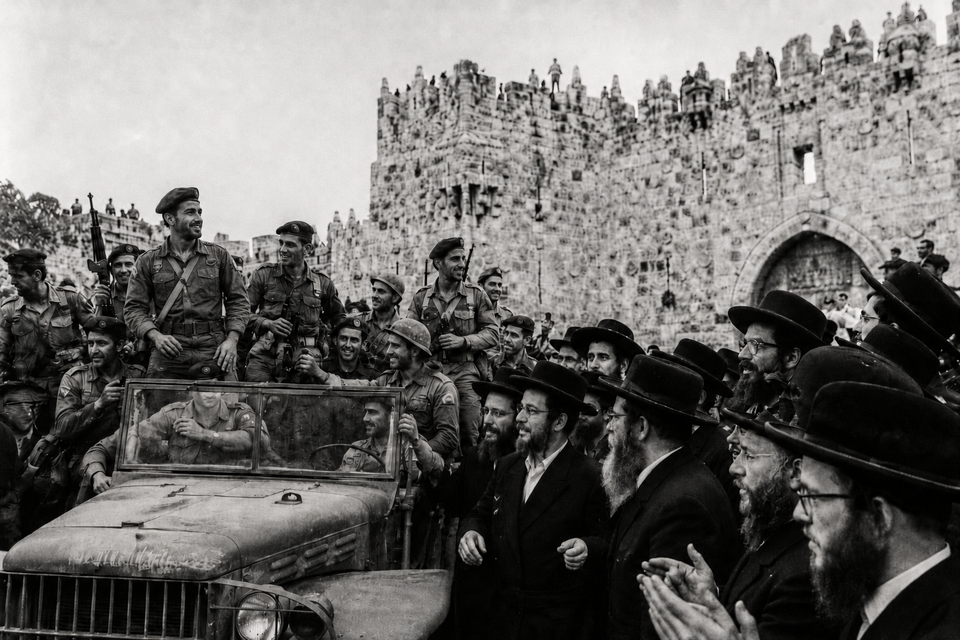
There may be no event in modern Jewish history that evokes more emotion, more confusion, and more genuine complexity than the founding of the State of Israel in 1948. For some Jews it was the long-awaited rebirth of Jewish sovereignty; for others, a political necessity and a refuge after the Holocaust. For the Charedi world, the response was neither simple celebration nor simple rejection. It was a complex holding-together of two genuine things: real gratitude, and real caution.
This article addresses the historical question — what the Charedi world actually thought and did at the founding of the State. It necessarily touches the theological frameworks we have developed at length elsewhere in this series — the Source-vs-Vessel distinction, the Three Oaths, the nature of geulah, the question of nationalism — and we will reference those rather than repeat them. The distinctive subject here is the historical moment of 1948 itself: the range of Charedi responses, the figures who shaped them, and the circumstances in which they were formed.
We work through it below.
I. The Land Was Always Ours — Not Because of 1948
The foundation of the Charedi response is a claim that long predates 1948: Eretz Yisrael belongs to the Jewish people not because of any modern political event, but because Hashem gave it to Avraham Avinu.
"L'zar'acha etein es ha'aretz hazos."
"To your offspring I will give this Land." (Bereishis 12:7)
"V'nasati lecha u'lzar'acha acharecha es eretz megurecha… la'achuzas olam."
"And I will give to you and to your offspring after you the Land of your sojourning… as an everlasting possession." (Bereishis 17:8)
The Charedi claim to Eretz Yisrael rests on these promises, not on the United Nations vote of 1947, not on Herzl's vision, and not on the events of 1948. The Land is ours because Hashem promised it to the Avos as an eternal inheritance — a promise that never expired during the long exile and was certainly not created anew by a secular political movement in the twentieth century. This is a crucial point for understanding the Charedi response to 1948: the founding of the State did not give the Jewish people Eretz Yisrael. The Land was already theirs, by Divine promise, for nearly four thousand years. What 1948 produced was a particular political arrangement governing the Land — and it is that political arrangement, not the Jewish connection to the Land, that the Charedi caution concerned.
(We have developed the affirmative Charedi relationship to the Land, and the mitzvah of yishuv Eretz Yisrael, in a dedicated article; here the point is simply that the Charedi claim to the Land is far older than, and independent of, the State.)
II. Charedim Were in Eretz Yisrael Long Before the State
The historical record refutes any notion that the Charedi presence in Eretz Yisrael depends on, or began with, the State. Charedi Jews had re-established substantial communities in the holy cities — Yerushalayim, Tzfas, Teveria, and Chevron — generations before modern Zionism existed.
In the late 1700s, talmidim of the Baal Shem Tov and the Maggid of Mezeritch made aliyah, establishing Chassidic communities in the Land. In the early 1800s, the talmidim of the Vilna Gaon — the Perushim — came to rebuild Jewish settlement in Yerushalayim and Tzfas, motivated by nothing other than the kedushah of the Land and its role in the unfolding of the geulah. These communities — the Old Yishuv — built yeshivos, mikvaos, batei knesses, and vibrant kehillos, with no government, no army, and no "state." They lived under Ottoman and later British rule, often in dire poverty, sustained by Torah and by the chalukah (the system of support from diaspora communities).
This history grounds a statement heard often in the Charedi world at the founding of the State: "We were here before the Zionists. We are not here because of them. And we will remain long after." The Charedi presence in Eretz Yisrael is not a product of Zionism; it is the continuation of an unbroken Jewish presence that the Zionist movement encountered already in place when it arrived.
III. The Genuine Gratitude — Refuge After the Catastrophe
It would be a serious distortion to portray the Charedi response to 1948 as purely negative. There was genuine gratitude, and it must be acknowledged honestly.
The State was founded three years after the Holocaust, in which European Jewry — including the heartland of the Torah world, its great yeshivos and Chassidic courts — had been destroyed. The survivors needed refuge. And the establishment of a place where Jews fleeing the ashes of Europe could find safety, where the remnant could rebuild, where Torah institutions could be re-established on a scale that would eventually exceed what had been lost — this stirred real hakaras hatov among the Charedi gedolim.
The gratitude was directed where the Charedi worldview directs all gratitude: to Hashem, who in His mercy had provided refuge for the survivors and the conditions in which Torah could be rebuilt. The Charedi world saw, in the survival of the remnant and the opportunity to rebuild, the hand of Hashem's chesed — and it was, and remains, grateful. The post-Holocaust rebuilding of the Torah world in Eretz Yisrael — the great yeshivos of Bnei Brak and Yerushalayim, the Chassidic courts reconstituted, the kollelim that now hold hundreds of thousands — happened within the framework the State provided, and the Charedi world acknowledges this with gratitude to Hashem.
This gratitude is real and is not in tension with the caution that accompanied it. One can be grateful for refuge and for the conditions of rebuilding while declining to attribute religious or redemptive significance to the political structure that provided them. The vessel sheltered the survivors; the gratitude goes to the Source who provided the shelter.
IV. The Deep Caution — The "New Jew" and the Echo of the Misyavnim
Alongside the gratitude came profound caution — and it concerned the ideology of the movement that founded the State.
Secular Zionism, in its dominant form, was not merely non-religious; it was in significant part programmatically opposed to the Torah way of life. Its leading thinkers sought to create a "new Jew" — strong, secular, modern, national — explicitly in place of the ben Torah of the exile, whom they often regarded with contempt as a relic to be overcome. They sought to normalize Jewish identity as ethnic-national rather than covenantal, to replace Torah with secular nationalism as the defining content of Jewishness, and in many documented cases to actively secularize religious immigrants, including the systematic stripping of religious observance from young immigrants in the early years of the State.
To the Charedi world, this was a recognizable historical pattern. It was the echo of the Misyavnim — the Hellenizers of the era of the Chashmonaim (Shabbos 21b; the Chanukah narrative; the Al HaNisim prayer), Jews who embraced Greek culture and sought to redefine Jewish identity without its Torah core. The Misyavnim did not, in their own understanding, seek to destroy Judaism; they sought to modernize it, to strip away what they saw as its parochial elements and align it with the sophisticated culture of the surrounding world. The Charedi world saw in secular Zionism's "new Jew" the same impulse — the attempt to redefine Jewish identity without Hashem and without Torah, dressed in modern national rather than ancient Hellenistic clothing.
The Charedi response was the same response the Torah world has always given to this pattern: Torah cannot be replaced. Jewish identity cannot be redefined without its covenantal core. A Jewish state without Torah is not Tzion, and political achievement is not redemption. This connects directly to the analysis we have developed in our articles on nationalism and on the Source-vs-Vessel framework; here the point is the historical recognition, in 1948, of a familiar danger wearing new clothing.
There was also a specific theological alarm: the declaration, by some religious supporters of the State, that its founding was atchalta d'geulah — the beginning of the redemption. This the Charedi world could not accept, for all the reasons developed across this series: the geulah comes through Moshiach, the Beis HaMikdash, the Sanhedrin, and the teshuva of Klal Yisrael (Rambam, Hilchos Melachim 11), not through a secular political-military achievement led by those who rejected Torah. To call the secular State the beginning of redemption was, in the Charedi view, a theological error of the first magnitude — and the source of much of the caution that accompanied the gratitude.
V. The Spectrum of Responses — Honestly Represented
Here honesty requires precision, because the Charedi response to 1948 was not uniform. There was a genuine spectrum, and representing it accurately matters.
It should first be noted that two of the towering figures whose names are associated with the critique of Zionism — the Chofetz Chaim (d. 1933) and Rav Elchonon Wasserman Hy"d (d. 1941) — did not live to see the founding of the State. Their warnings, including Rav Elchonon's analysis in Ikvesa D'Meshicha of secular Zionism as a counterfeit messianism that confuses Jews about the true nature of geulah, were directed at the Zionist movement in the pre-State period, not at the 1948 State per se. They shaped the framework through which the later gedolim viewed the State, but they did not themselves rule on it. Accuracy requires this distinction.
Among the gedolim who did live through and respond to the founding, the spectrum ran roughly as follows:
The Chazon Ish (Rabbi Avraham Yeshaya Karelitz zt"l), the central Lithuanian authority in Eretz Yisrael, was not confrontational in tone but was deeply concerned about the spiritual danger the secular State posed. He guided the Bnei Brak community in building Torah institutions and a self-sustaining Torah society without legitimizing secular governance — establishing the model of the parallel, self-contained Charedi community that would define Israeli Charedi life. His famous 1952 meeting with Ben-Gurion symbolized the relationship: respectful, but firm on the primacy of Torah.
Rav Aharon Kotler (zt"l), from America, was more vocal in his opposition to the atchalta d'geulah framing, insisting that redemption must come through Moshiach and the restoration of full Torah authority, and that no secular political development could be assigned redemptive significance. His writings (Mishnas Rav Aharon) develop this firmly.
Rav Reuven Grozovsky (zt"l), chairman of the Moetzes Gedolei HaTorah in America and son-in-law of Rav Baruch Ber Leibowitz, addressed the challenges of the new reality in his work Ba'ayos HaZman ("Problems of the Times"), developing the Torah framework for relating to the State and its challenges.
Rav Shlomo Zalman Auerbach (zt"l), while more reserved in tone, drew clear distinctions between the political and religious realities — recognizing the genuine value of Jewish physical safety while never assigning the State redemptive significance.
The Brisker Rav (Rabbi Yitzchak Zev Soloveitchik zt"l) took a path of near-total separation. He held that one should avoid benefiting from or legitimizing the secular state to the greatest extent possible, and went to great lengths to avoid reliance on state services and institutions (his conduct is documented in Uvdos VeHanhagos LeBeis Brisk). His was the most stringent of the mainstream Lithuanian positions — a principled refusal of engagement that we discussed in our article on political participation.
This spectrum is real and should not be flattened. From the Chazon Ish's institution-building to Rav Aharon Kotler's vocal ideological opposition to the Brisker Rav's near-total separation, the mainstream Lithuanian world held a range of postures — united on the theology (the State is not the geulah; Torah is the destiny), differing on the practical question of how much to engage or separate.
VI. The Satmar Position and the Three Oaths
At the firmest end of the spectrum stood the Satmar Rav, Rabbi Yoel Teitelbaum zt"l, who articulated the most systematic and forceful theological opposition to the Zionist enterprise in his Vayoel Moshe.
The Satmar Rav's central argument, which we have addressed in our dedicated treatment of the Three Oaths, was built on the Gemara in Kesubos 111a — the Shalosh Shevuos, the three oaths that (in this framework) bound the Jewish people not to "ascend as a wall" (reclaim sovereignty through mass human-engineered effort before the time) and not to rebel against the nations. The Satmar Rav held that the establishment of a Jewish state through human political-military initiative, before the coming of Moshiach, was not progress toward redemption but a violation of these oaths — a forcing of the end that runs against the Torah's framework for how the geulah is to come.
The Satmar position became deeply influential, particularly in the Hungarian and broader Chassidic worlds. It represents the firmest articulation of the theological objection — and, as we have noted in our articles on political participation and on the prayer for the State, it translates into the most complete practical separation: no participation, no recognition, no prayer for the State.
(We will not re-argue the Three Oaths framework here; it has its own dedicated treatment in this series. The point for this historical article is that the Satmar position represented the firmest end of the Charedi response to 1948, and shaped a major segment of the Charedi world's relationship to the State.)
VII. Agudas Yisrael, Engagement, and the Status Quo
At the same time, not all of the Charedi world advocated separation. Agudas Yisrael — the political organization of Torah Jewry, founded in 1912 on an anti-Zionist basis — chose a path of defensive engagement with the new State, not to endorse its ideology but to protect religious life within it.
This engagement produced one of the most significant documents in the religious history of the State: the "status quo" arrangement. In June 1947, in anticipation of the State's establishment, David Ben-Gurion (on behalf of the Jewish Agency) sent a letter to Agudas Yisrael committing to preserve certain basic religious standards in the future state: Shabbos as the official day of rest, kosher food in state institutions, the autonomy of religious education, and rabbinic authority over Jewish marriage and personal status. This "status quo" — the product of Agudah's willingness to engage defensively — established the baseline of religious protections that, however contested and eroded over the decades, shaped the religious character of the State.
Agudah's engagement was understood, in its own framework, exactly as we described in our article on political participation: not as an endorsement of the State's ideology, but as a shield for Torah interests — a defensive necessity undertaken to preserve Shabbos, kashrus, Torah education, and the religious framework of Jewish life within a system controlled by others. Some viewed this engagement as a necessary compromise; others as a heroic effort to build a Torah future in a spiritually dangerous environment. But across the engagement camp and the separation camp alike, the underlying conviction was identical: Torah must lead.
VIII. Not One Voice, But One Heart
The honest conclusion is that the Charedi world did not respond to 1948 with one voice. Some gedolim initially hoped the State might serve as a tool for good; others withheld judgment and watched with caution; others, like the Brisker Rav and the Satmar Rav, took firm positions of separation and opposition from the start. The tones ranged from the Chazon Ish's quiet institution-building to Rav Aharon Kotler's vocal opposition to the Satmar Rav's systematic theological critique.
But beneath the range of tones and practical postures lay a single, unified heart. Every one of these gedolim agreed on the essential points:
- The Land is ours by Divine promise, not by political achievement.
- The Charedi presence in Eretz Yisrael predates and does not depend on the State.
- There is genuine gratitude to Hashem for the refuge and the opportunity to rebuild Torah.
- The secular State is not the geulah, and to call it the "beginning of redemption" is a theological error.
- Torah, not the State, defines the destiny of the Jewish people.
- The redemption will come through Moshiach, not through a secular government.
On these points there was no disagreement — not between the Chazon Ish and the Satmar Rav, not between Agudah's engagement and Brisk's separation. They differed on the practical question of how to relate to the State; they were entirely united on what the State was and was not.
IX. The Closing Position
What was the Charedi view of the founding of the State of Israel?
It was the complex, honest holding-together of gratitude and caution. Gratitude to Hashem that the survivors of the Holocaust had refuge, that the remnant could rebuild, that Torah could flourish again in the Land after the European catastrophe. And caution — deep, principled caution — about a State founded by a movement programmatically hostile to Torah, wrongly declared by some to be the beginning of redemption, and embodying the ancient pattern of the Misyavnim in modern national dress.
The Charedi world loved Eretz Yisrael before the State and loves it still — but it has never confused survival with salvation, or sovereignty with sanctity. It was grateful for the refuge — but it never mistook the vessel for the Source. It engaged with the State where engagement could protect Torah, and separated from it where separation was the more faithful path — but across the entire spectrum, it held that Torah, not the State, is the destiny of the Jewish people.
And so the Charedi world continues, as it has since long before 1948, to build, to learn, and to raise generations in the holy Land — not because of Herzl, but because of Har Sinai. It waits — not for the next coalition, not for a national holiday, but for the sound of the shofar, the rebuilding of the Beis HaMikdash, the return of the Shechinah to Tzion, and the day when all the world will declare "Hashem Echad u'Shmo Echad."
That — not 1948 — will be the true founding the Jewish people has always awaited.
Sources
The Land as Divine inheritance, independent of 1948
- Bereishis 12:7 — "L'zar'acha etein es ha'aretz hazos" — the promise to Avraham
- Bereishis 17:8 — "la'achuzas olam" — the Land as an everlasting possession
- Bereishis 15:18, 26:3, 28:13 — the renewal of the promise to the Avos
- (The affirmative Charedi relationship to the Land developed in "Is It a Mitzvah to Live in Eretz Yisrael?")
The Old Yishuv — Charedi presence before the State
- The Chassidic aliyah of the late 1700s (talmidim of the Baal Shem Tov and the Maggid of Mezeritch)
- The aliyah of the Perushim (talmidim of the Vilna Gaon) to Yerushalayim and Tzfas in the early 1800s
- The Old Yishuv communities of Yerushalayim, Tzfas, Teveria, and Chevron; the chalukah support system
The genuine gratitude
- The post-Holocaust context: the destruction of European Jewry and its Torah heartland; the need for refuge
- The hakaras hatov to Hashem for the refuge and the opportunity to rebuild the Torah world (the great yeshivos and Chassidic courts of Bnei Brak and Yerushalayim)
- The Source vs. Vessel framework: gratitude to the Source for the shelter the vessel provided
The caution — the "new Jew" and the Misyavnim
- The secular Zionist program of the "new Jew" and the normalization of Jewish identity as national rather than covenantal
- Talmud Bavli, Shabbos 21b — the Chanukah narrative; the Al HaNisim prayer — the Misyavnim (Hellenizers) and the Chashmonaim's fight for Torah
- Yosippon (Josippon) — the medieval Hebrew history of the Second Temple period and the Hellenistic conflict
- Ramban on Vayikra 18:25 — the kedushah of Eretz Yisrael and its connection to the observance of mitzvos; the land "vomits out" those who defile it
- The theological objection to the atchalta d'geulah framing (developed in "Do Charedim Pray for the State?" and "Yes, We See the Miracles, No the State Is Not the Geulah")
The pre-State framework (figures who died before 1948)
- The Chofetz Chaim (d. 1933) — his framework on the Zionist movement
- Rav Elchonon Wasserman Hy"d (d. 1941), Ikvesa D'Meshicha — secular Zionism as counterfeit messianism; note: Rav Elchonon was killed in 1941 and did not live to see the 1948 founding; his warnings concerned the Zionist movement in the pre-State period and shaped the framework through which later gedolim viewed the State
The spectrum of gedolim who responded to the founding
- The Chazon Ish (Rabbi Avraham Yeshaya Karelitz zt"l) — institution-building in Bnei Brak without legitimizing secular governance; the 1952 meeting with Ben-Gurion (Pe'er HaDor, the Chazon Ish biography)
- Rav Aharon Kotler zt"l (Mishnas Rav Aharon) — vocal opposition to the atchalta d'geulah framing
- Rav Reuven Grozovsky zt"l (Ba'ayos HaZman) — chairman of the American Moetzes Gedolei HaTorah; the Torah framework for the new reality
- Rav Shlomo Zalman Auerbach zt"l (Halichos Shlomo) — the distinction between political and religious realities
- The Brisker Rav (Rabbi Yitzchak Zev Soloveitchik zt"l) (Uvdos VeHanhagos LeBeis Brisk) — near-total separation from state services and institutions
The Satmar position
- The Satmar Rav (Rabbi Yoel Teitelbaum zt"l), Vayoel Moshe — the Three Oaths (Kesubos 111a) argument; the establishment of a state before Moshiach as a violation of the oaths (developed in the dedicated article on the Three Oaths)
- Talmud Bavli, Kesubos 111a — the Shalosh Shevuos
Agudas Yisrael and the status quo
- Agudas Yisrael — founded 1912, Katowice, on an anti-Zionist basis; defensive engagement with the State
- The status quo letter (June 1947) — David Ben-Gurion (on behalf of the Jewish Agency) to Agudas Yisrael, committing to Shabbos as the day of rest, kosher food in state institutions, autonomy of religious education, and rabbinic authority over marriage and personal status
- Prof. Menachem Friedman's scholarship on religion and state in Israel and the history of the Charedi community
The authentic geulah
- Rambam, Mishneh Torah, Hilchos Melachim u'Milchamos 11:1 — the geulah through Moshiach, the Beis HaMikdash, and the restoration of Torah authority
- Zechariah 14:9 — "Hashem Echad u'Shmo Echad"
The structural relationship to other articles in this series
- "Yes, We See the Miracles, No the State Is Not the Geulah" — the Source vs. Vessel framework
- "Is It a Mitzvah to Live in Eretz Yisrael?" — the affirmative relationship to the Land
- "What Is the Charedi Approach to Political Participation?" — the engagement vs. separation spectrum
- "Do Charedim Pray for the State?" — the atchalta d'geulah objection
- "What Is the Torah's View on Nationalism?" — the critique of the secular national project
- "What Do Charedim Believe Will Happen to the State When Moshiach Comes?" — the temporary nature of the State