
What is the comparison between the founding of the State and the history of the Jewish people during the time of Chanukah?
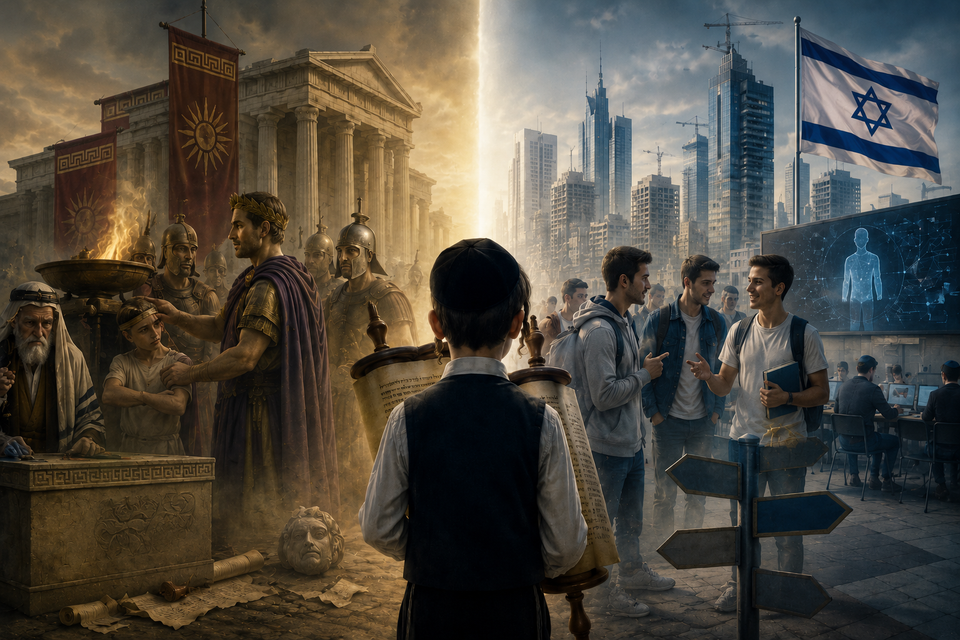
The Comparison Is Striking — and It Turns on a Single Insight: Chanukah Was Not a War Against the Physical Existence of the Jews, but Against Their Torah. The Greeks and the Hellenizers Did Not Seek to Destroy the Jewish People; They Sought to Keep the Jews as Jews While Stripping Away the Torah — to Make Them "Forget Your Torah," as We Say in Al HaNisim. The Charedi World Sees in Secular Zionism's "New Jew" the Same Structural Dynamic: a Jewish Identity Built on Land, Language, and Sovereignty in Place of Torah. The Parallel Is Real and Instructive — but It Has Limits That Honesty Requires Us to Name
The comparison between the founding of the State in 1948 and the events of Chanukah is both striking and sobering when viewed through the lens of the Charedi Torah worldview. The historical circumstances are vastly different — separated by more than two thousand years, set in entirely different political worlds. But the spiritual dynamics share a deep and specific parallel, and understanding it illuminates why much of the Charedi world saw 1948 not as the redemption but as the latest chapter in an ancient and recurring struggle.
We must be careful at the outset about what this comparison does and does not claim. It is not a claim that secular Zionists are the moral equivalent of the Greek tyrant Antiochus, or that the State is a persecution like the Hellenistic decrees. It is a claim about a recurring structural dynamic in Jewish history — the attempt to preserve Jewish identity while emptying it of its Torah core. We will develop the parallel in full, and we will also name, honestly, the points where the analogy breaks down. Because a comparison stated without its limits is propaganda; a comparison stated with its limits is analysis. We aim for analysis.
I. What Chanukah Actually Was — A Spiritual War, Not a Physical One
To understand the comparison, one must first understand what Chanukah actually commemorates — and it is frequently misunderstood.
Chanukah was not, at its core, a war against the physical existence of the Jewish people. This is the crucial point, and it distinguishes Chanukah sharply from Purim. On Purim, Haman sought the physical extermination of the Jews — "l'hashmid laharog u'l'abeid es kol haYehudim" (Esther 3:13), to destroy, kill, and annihilate every Jew. Purim was a war against Jewish bodies.
Chanukah was a war against Jewish souls. We say it explicitly, every Chanukah, in the Al HaNisim prayer:
"K'she'amda malchus Yavan ha'resha'ah al amcha Yisrael l'hashkicham Torasecha u'l'ha'aviram mei'chukei retzonecha."
"When the wicked Greek kingdom rose against Your people Israel to make them forget Your Torah and to violate the decrees of Your will."
"L'hashkicham Torasecha" — to make them forget Your Torah. This is the defining goal of the Greek persecution. The Greeks did not, in the main, seek to kill the Jews. They sought to keep the Jews alive as Jews while stripping away the Torah that made them Jews. The Rambam (Hilchos Chanukah 3:1) describes how the Greek kingdom "laid their hands on their property and their daughters, and entered the Heichal, and breached its boundaries, and defiled the pure things… and did not allow them to engage in Torah and mitzvos." The specific decrees targeted the mitzvos that define Jewish identity and the relationship with Hashem: bris milah, Shabbos, and Kiddush HaChodesh (the sanctification of the new month). The war was against the Torah, not against Jewish survival.
This is the hinge of the entire comparison. A persecution aimed at the physical destruction of Jews (Purim, the Crusades, the Holocaust) is one kind of threat. A "persecution" aimed at keeping Jews alive while severing them from Torah is a different kind entirely — and it is the kind the Charedi world sees echoed in secular Zionism.
II. The Misyavnim — The Internal Dimension
The Greek threat had an internal Jewish dimension, and this is essential to the comparison. The Greeks did not act alone. They had Jewish collaborators — the Misyavnim, the Hellenizers.
The Misyavnim were Jews — Jews by birth and ethnicity — who embraced Greek culture and sought to remake Jewish life in its image. They were drawn to the philosophy, the art, the athletics, the sophistication, and the prestige of the dominant Hellenistic civilization, and they came to regard their own Torah tradition as parochial, backward, an obstacle to full participation in the advanced culture of the age. They did not, in their own understanding, seek to stop being Jews. They sought to be a new kind of Jew — modern, cultured, integrated, free of what they saw as the constraints of Torah.
The historical record (preserved in the Books of the Maccabees, in Josephus, and in the medieval Yosippon) documents how far this went. Hellenizing High Priests — Yason (Jason) and later Menelaus — purchased the priesthood and actively Hellenized Yerushalayim, building a gymnasium in the holy city, leading young kohanim to abandon the avodah for Greek athletics, and in some cases concealing or reversing their bris milah to participate in Greek games. The Misyavnim were not a foreign enemy. They were Jews seeking to redefine Judaism without its Torah core — and they held cultural and often political power, backed by the Greek empire.
The Chashmonaim — Matisyahu ben Yochanan the Kohen Gadol and his sons, led by Yehuda HaMaccabee — rose against both the Greek decrees and the internal Hellenization. Their rebellion, beginning around 167 BCE, was sparked not by taxation or political oppression but by spiritual defilement — the banning of the mitzvos and the desecration of the Beis HaMikdash. And its climax was not a political settlement but the rededication of the Beis HaMikdash and the relighting of the Menorah (around 165 BCE) — the restoration of pure avodas Hashem, commemorated by the miracle of the oil (Shabbos 21b). The Chashmonaim did not fight for sovereignty as an end. They fought to restore the Torah.
III. The Parallel — The "New Jew" and the Hellenizer
Here is the structural parallel the Charedi world draws. Secular Zionism, in its dominant founding ideology, sought to create a "new Jew" — and the structure of that project echoes the project of the Misyavnim.
The early secular Zionist thinkers were explicit about their goal: to produce a Jew who was strong, proud, modern, national, rooted in land and language and self-defense — and emphatically not the ben Torah of the exile, whom they frequently regarded with contempt as weak, passive, and "galus-minded." They sought to normalize the Jewish people, to make them a nation like other nations, with a secular national identity in place of the covenantal Torah identity. Jewish identity was to be retained — but redefined around land, language, army, and nationhood rather than around Torah, mitzvos, and yiras Shamayim.
This is, structurally, the project of the Misyavnim in modern dress. Both movements:
- Were led by Jews, not foreign enemies
- Sought to retain Jewish identity while secularizing its content
- Were drawn to the prestige and sophistication of the dominant surrounding culture (Hellenism then, Western secular modernity now)
- Regarded the Torah Jew as a backward relic to be overcome
- Held cultural and political power and used it to shape the next generation away from Torah
The defining feature of both is the one identified in Section I: neither sought the physical destruction of the Jews. Both sought, rather, the survival of the Jewish people without the Torah — the preservation of Jewish identity emptied of its covenantal content. And this, in the Charedi understanding, is precisely the kind of threat that Chanukah was about. It is a war not against Jewish bodies but against the Jewish soul — against the Torah that is the actual content of Jewish identity.
This is why the Charedi response to secular Zionism has rhymed so closely with the response of the Chashmonaim to Hellenism: because the threat has the same structure. Not annihilation to be survived, but secularization to be resisted — through the restoration and strengthening of Torah.
IV. Majority Power vs. Faithful Minority
The comparison extends to the sociology of both eras.
In the Chanukah era, the Misyavnim and their Greek backers held the dominant position. They had the empire's power, the cultural prestige, the political control of Yerushalayim and the priesthood. The Torah-faithful — the Chashmonaim and those who rallied to them — were a small, embattled, mocked minority, written off by the sophisticated as backward zealots clinging to an obsolete past. Yet it was the small faithful minority, not the powerful Hellenizers, who proved to be the eternal ones.
In 1948 and the years that followed, the secular Zionists held the dominant position. They founded the government, established the institutions, controlled the schools, set the cultural tone, and held international recognition. The Torah-faithful were a fragile minority — many of them Holocaust survivors who had arrived with little more than their emunah and a worn Gemara, frequently mocked and marginalized by the secular establishment as a relic that would fade within a generation. Yet it was the small faithful minority, not the confident secular founders, who proved to be the enduring ones.
In both cases, the spiritually faithful were not the dominant force of their moment — but they were the ones who carried the eternal thing forward. The powerful cultures of the moment, in both eras, assumed the Torah Jew was a vanishing remnant. In both eras, they were wrong.
V. The Response — Torah, Not Just Resistance
A crucial dimension of the parallel is how the faithful responded in each era — and the answer, in both, was the same: they responded to a spiritual threat with a spiritual response.
The Chashmonaim did fight militarily — but the war was a means, and the end was the restoration of Torah and avodah. The climax was not a victory parade but the relighting of the Menorah, the rededication of the Mikdash, the resumption of the avodah. The deepest Chashmonaim response to Hellenism was the restoration of Torah, not merely the defeat of the Greek army.
The Charedi response to secular Zionism, in the 20th century, took the parallel form — minus the military dimension, which was neither available nor appropriate. The Charedi world responded to the spiritual threat by rebuilding Torah. It did not storm the Knesset; it built yeshivos. It did not wage war; it established kollelim, mikvaos, batei medrash, schools, and self-sustaining Torah communities. It responded to the danger of secularization by strengthening the one thing that has always defined and preserved the Jewish people: Torah, avodah, and chesed. This is the deepest sense in which the Charedi world are the heirs of the Chashmonaim — not in militancy, but in the response of restoring Torah in the face of a movement that sought to build a Jewish future without it.
And here the documented historical grievances belong, stated with care. The early State did exert real secularizing pressure on religious immigrants. In the ma'abarot (the immigrant absorption camps of the 1950s), religious immigrants — particularly from Yemen and other Sephardic and Mizrachi communities — faced documented pressure to abandon religious observance: the cutting of payos, the removal of religious garb, the placement of children from religious homes into secular educational frameworks. The painful chapter known as the Yemenite Children Affair — in which hundreds of children of mostly Yemenite immigrant families disappeared in the early 1950s, with families often told their children had died, amid allegations the children were given to other families — remains a genuine and unresolved grievance that has been the subject of official Israeli inquiries for decades. (The full facts remain contested, and we do not assert the contested specifics as established; but the affair, and the broader secularization pressure on religious immigrants, are part of the documented history that shaped the Charedi understanding of the period.) These grievances reinforced, for the Charedi world, the parallel to the Hellenistic decrees: a power that sought to sever Jews — especially the next generation — from their Torah heritage.
VI. Divine Victory Is Not Measured by Numbers
The deepest lesson of the comparison is theological: in both eras, the victory was Hashem's, and it was not measured by the numbers or power of the moment.
The Chashmonaim were "rabim b'yad me'atim" — the many delivered into the hands of the few, as we say in Al HaNisim. The mighty Greek empire, with all its glory and sophistication, is today a footnote — remembered, in Jewish memory, primarily as the villain of the Chanukah story. The Misyavnim are forgotten; not one of them is remembered by name with honor. The small, mocked, faithful minority — the Chashmonaim — are the ones whose victory is celebrated and whose name endures.
The parallel in our own time is, the Charedi world believes, unfolding before our eyes. The Torah world, tiny and written off at the founding of the State, has grown beyond anything the secular founders imagined or predicted. The yeshivos, the kollelim, the frum communities, the Torah institutions — the explosive growth of a Charedi population now approaching a quarter of Israel's Jews, the largest Torah-learning population in Jewish history — none of this was foreseen by the secular founders who assumed the Torah Jew would fade within a generation. It is, in the Charedi understanding, Hashem's victory — quiet, miraculous, and enduring — the same kind of victory as Chanukah: the faithful few outlasting the powerful many, not by force but by the indestructibility of Torah.
VII. The Limits of the Analogy
Honesty requires naming where the comparison breaks down, because no analogy is perfect and an analogy pressed too far becomes a distortion.
First: the secular Zionists were fellow Jews, not a foreign tyrant. Antiochus was a gentile despot wielding imperial force against the Jews. The secular Zionists, whatever the Charedi critique of their ideology, were Jews — and Jews who, in their own understanding, were acting to save the Jewish people in the wake of the Holocaust, providing refuge to survivors who had nowhere else to go. The comparison is to the ideological dynamic of secularization, not to the moral character of the actors. To equate secular Zionist leaders with Antiochus would be both inaccurate and a violation of the ahavas Yisrael this series has insisted upon.
Second: most secular Jews are not Misyavnim. The Misyavnim were, in the main, willful Hellenizers who knew the Torah and chose to abandon it. The overwhelming majority of secular Jews today are tinokos shenishbu — Jews raised without Torah, who never chose to abandon what they were never given (as we have developed at length elsewhere in this series). The comparison applies, if at all, to the ideology and its early architects — not to the millions of secular Jews who are its inheritors and who are our beloved brothers.
Third: the State provided genuine refuge. The Greek persecution offered the Jews nothing but the choice between Hellenization and death. The State, whatever its ideological character, provided real refuge to survivors and real conditions for the rebuilding of the Torah world — a genuine good for which the Charedi world is grateful to Hashem, and a significant disanalogy with the Hellenistic persecution.
The comparison, properly understood, is therefore narrow and specific: it is a comparison of the structural dynamic — the attempt to preserve Jewish identity while severing it from Torah, and the response of the faithful minority in restoring Torah. It is not a claim of moral equivalence, not a condemnation of individuals, and not a denial of the genuine good the State has done. Held within these limits, the comparison is illuminating. Pressed beyond them, it becomes a distortion that the Charedi world's own commitment to truth and ahavas Yisrael must reject.
VIII. Not Against the People — For the Torah
This brings us to the point that governs the entire comparison, in both its eras. The Chashmonaim were never against the Jewish people. The Charedi world is never against the Jewish people. In both cases, the struggle was — and is — against an ideology that sought to cut Torah out of Jewish identity, not against the Jews caught up in it.
The Chashmonaim fought to restore Torah for the Jewish people, including for the Hellenized Jews they hoped to bring back. The Charedi world resists secular ideology for the Jewish people, including — especially — for the secular Jews it loves and longs to see return. The love for Klal Yisrael was, and remains, immense in both eras. But love, to be more than sentiment, must be guided by truth. A love that affirms a Jew's secularization is not the deepest love; the deepest love is the one that wants the Jew to have the Torah that is his birthright. As we have written throughout this series: we critique the ideology and we love the person, and the two are not in tension.
IX. Conclusion — Two Eras, One Struggle
The founding of the State in 1948 and the battle of Chanukah both represented pivotal moments in which the essence of Jewish identity was contested. In both, a powerful Jewish movement arose offering nationalism without Torah, pride without halacha, identity without Hashem — seeking to preserve the Jewish people while emptying Jewishness of its Torah core. And in both, the Torah-faithful minority stood firm — not with hatred but with heartbreak, not against their fellow Jews but for the Torah, responding to a spiritual threat with the restoration of Torah.
The Chashmonaim restored the Menorah. The Charedi world restored the yeshivah. In both cases, the response to a movement that sought a Jewish future without Torah was the same: to rebuild the Torah, and to demonstrate, across the generations, that the light of Torah cannot be extinguished — not by the Greek empire and its Hellenizers, not by any movement that has risen since, and not by any that ever will.
The comparison has its limits, and we have named them honestly. But within those limits it teaches a single, enduring truth: the eternal thing in Jewish history is not the powerful movement of the moment but the Torah, and the people who hold to it. The Greeks are a footnote in Al HaNisim. The Misyavnim are forgotten. The Torah, and the Jews who carried it, endure — and they will endure until the day when the struggle ends entirely, with the coming of Moshiach and the rededication of the Beis HaMikdash, when the Menorah will be lit not for eight days but forever.
Sources
What Chanukah was — a spiritual war
- Talmud Bavli, Shabbos 21b — "Mai Chanukah" — the miracle of the oil, the eight days, the rededication of the Menorah
- Al HaNisim (the Chanukah insertion in tefillah and birkas hamazon) — "l'hashkicham Torasecha u'l'ha'aviram mei'chukei retzonecha" — the Greek goal of making Israel forget the Torah and violate the mitzvos; "rabim b'yad me'atim" — the many delivered to the few
- Rambam, Mishneh Torah, Hilchos Chanukah 3:1 — the historical summary: the Greek decrees against Torah and mitzvos, the defilement of the Mikdash
- Esther 3:13 — by contrast, Haman's decree of physical extermination ("l'hashmid laharog u'l'abeid") — distinguishing Purim (a war on Jewish bodies) from Chanukah (a war on the Jewish soul)
- The Greek decrees against bris milah, Shabbos, and Kiddush HaChodesh (Megillas Taanis and the historical record)
The Misyavnim (Hellenizers)
- The historical record in the Books of the Maccabees, in Josephus, and in the medieval Yosippon (Josippon)
- The Hellenizing High Priests Yason (Jason) and Menelaus; the gymnasium in Yerushalayim; the abandonment of the avodah for Greek culture
- The Chashmonaim — Matisyahu ben Yochanan the Kohen Gadol and his sons, led by Yehuda HaMaccabee; the revolt (c. 167 BCE) and the rededication of the Beis HaMikdash (c. 165 BCE)
The parallel to secular Zionism's "new Jew"
- The secular Zionist program of the "new Jew" — Jewish identity built on land, language, army, and nationhood in place of Torah (developed in "What Is the Torah's View on Nationalism?")
- The structural parallel: the preservation of Jewish identity while severing it from Torah; fellow Jews drawn to the prestige of the dominant surrounding culture; the regarding of the Torah Jew as a backward relic
- Vayoel Moshe, Rabbi Yoel Teitelbaum zt"l — the parallel between secular Zionism and Hellenistic assimilation
The documented grievances of the early State
- The secularization pressure on religious immigrants in the ma'abarot (1950s) — the cutting of payos, removal of religious garb, and placement of religious children in secular frameworks
- The Yemenite Children Affair (Parashat Yaldei Teiman) — the disappearance of hundreds of children of mostly Yemenite immigrant families in the early 1950s; the subject of multiple official Israeli inquiries over decades; the full facts remain contested and are not asserted here as established, but the affair and the broader secularization pressure are part of the documented history
The pre-State framework (figures who died before 1948)
- Rav Elchonon Wasserman Hy"d (d. 1941), Ikvesa D'Meshicha — secular Zionism as counterfeit messianism; note: Rav Elchonon was killed in 1941, before the founding of the State
Divine victory not measured by numbers
- The growth of the Torah world from a written-off minority at the founding to the largest Torah-learning population in Jewish history (a Charedi population approaching a quarter of Israel's Jews)
- The theological framework of rabim b'yad me'atim — the few outlasting the many through the indestructibility of Torah
The limits of the analogy (named for honesty)
- The secular Zionists as fellow Jews acting (in their own understanding) for Jewish survival after the Holocaust, not as a foreign tyrant
- The overwhelming majority of secular Jews as tinokos shenishbu, not willful Hellenizers (Rambam, Hilchos Mamrim 3:3; developed in "How Does the Charedi World View Secular Jewish Leaders?")
- The genuine refuge the State provided — a significant disanalogy with the Hellenistic persecution
Not against the people, for the Torah
- The framework of critique of ideology combined with love of the person (developed in "Sinas Chinam" and "How Does the Charedi World View Secular Jewish Leaders?")
- Ramban on Vayikra 18:25 — the kedushah of Eretz Yisrael and its connection to the observance of mitzvos
The structural relationship to other articles in this series
- "What Was the Charedi View of the Founding of the State of Israel?" — the historical companion to this comparison
- "What Is the Torah's View on Nationalism?" — the critique of the "new Jew" and secular national identity
- "How Does the Charedi World View Secular Jewish Leaders?" — the tinok shenishba framework
- "Sinas Chinam: The Illness That Destroyed the Beis HaMikdash" — critique of ideology within ahavas Yisrael