Why Don’t Charedim Celebrate Yom HaAtzmaut? (Israel Independence Day)
Beyond the Theological Question of Whether the State Is the Geulah, There Are Concrete Halachic Reasons the Charedi World Does Not Observe the 5th of Iyar as a Festival: Establishing a Binding Day of Celebration Is a Halachic Act Requiring Torah Authority That No Secular Body Possesses; the Day Falls in the Middle of Sefiras HaOmer, When Live Music and Public Celebration Are Forbidden as a Period of Mourning; and the Date Carries No Inherent Kedusha — It Is the Civil Anniversary of a Declaration Made by Secular Jews. Beyond All This, There Is Much About the State as Built That Is Not Cause for Celebration but for Pain: a Secular Court System in Place of Torah Law, the Conscription of Women, Government Sanctioning of Public Chillul Shabbos, and Pressure Against Torah Observance. A Non-Jewish Ruler Not Keeping the Torah Posed No Contradiction; a Jewish State Brought Home by Hashem and Then Defying His Torah Is a Painful One — and One Does Not Celebrate a Homecoming by Doing What the Torah Opposes
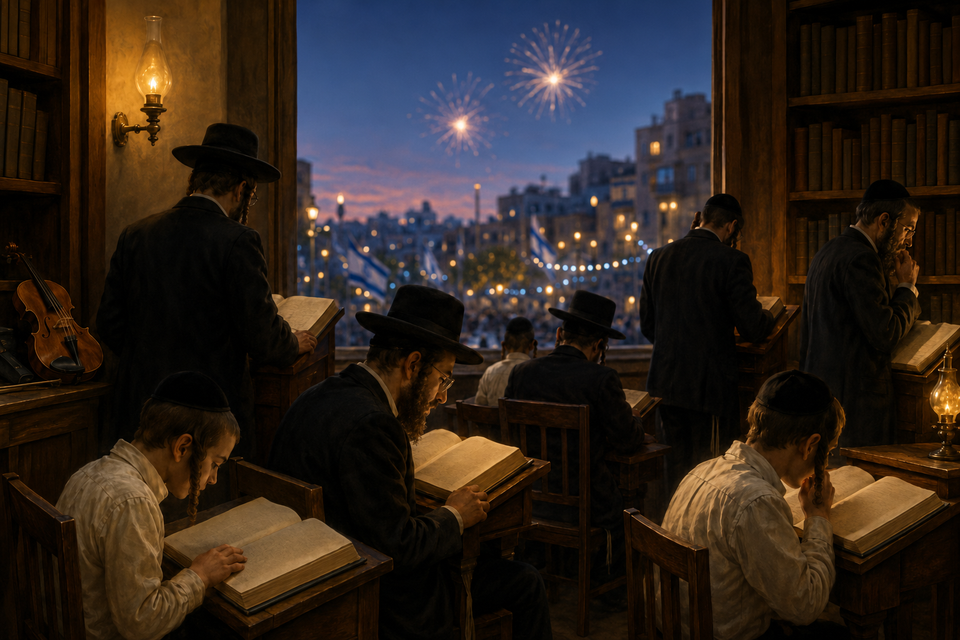
Every year on the 5th of Iyar, much of Israel bursts into celebration — blue and white in the streets, fireworks, concerts, parades, a genuine surge of national pride. In Charedi neighborhoods the day passes in quiet: no parades, no festivities, the yeshivos learning as on any ordinary day.
To the outside observer this looks like coldness, and the question is natural: why would religious Jews not celebrate the rebirth of Jewish sovereignty in the Land? We have addressed the deepest layer of the answer across this series — the theological question of whether the founding of a secular state is the geulah (it is not, for all the reasons developed in our articles on the founding of the State, on the prayer for the State, and on the Source-vs-Vessel framework). We will not repeat that theology here.
This article addresses the concrete halachic reasons — the questions of Jewish law that stand independent of the broader theological dispute. There are three, and each stands on its own: the halacha of who may create a festival; the conflict with the mourning period of Sefiras HaOmer; and the absence of any inherent kedusha in the day. Running through all three is a compounding factor: the day was designated by secular Jews, not by any Torah authority. We work through them below.
I. Who Has the Authority to Create a Chag?
The most fundamental halachic issue is this: a binding day of celebration is a halachic institution, not a civil decision — and establishing one requires a specific kind of authority that no secular body possesses.
In Jewish law, the days of obligatory celebration fall into two categories. The festivals — Pesach, Shavuos, Sukkos — are min haTorah, established by Hashem Himself, carrying kedushas hayom (the intrinsic sanctity of the day) and commemorating events of cosmic spiritual significance: the Exodus, the giving of the Torah, the Divine protection in the wilderness.
The two rabbinic festivals — Purim and Chanukah — were established not by any government or popular movement, but by the recognized Torah authorities of their generations, and only under specific conditions. Purim was established by Mordechai and Esther — Mordechai sat on the Sanhedrin, and the establishment was ratified through the authority of the beis din and accepted by all of Klal Yisrael ("kimu v'kiblu haYehudim" — Esther 9:27; the Gemara in Megillah 7a records Esther's request "kasvuni l'doros," "establish me for the generations"). Chanukah was established by the Sages of that generation — "the following year they established these as festival days" (Shabbos 21b) — by the recognized Torah leadership.
This was not a casual matter. The Gemara teaches the principle of "ein navi rashai l'chadesh davar mei'atah" — even a prophet has no authority to innovate a new mitzvah (Megillah 2b–3a; Shabbos 104a). And the Torah itself warns "lo soseif alav v'lo sigra mimenu" — do not add to the mitzvos and do not subtract (Devarim 13:1). The establishment of a new binding observance is among the most serious acts in halacha, and it requires, at minimum: recognized Torah authority (a beis din of the stature of the Sanhedrin, or the accepted Torah leadership of the generation); a recognized, genuine salvation worthy of commemoration; and acceptance by Klal Yisrael (Rambam, Hilchos Mamrim 1–2; Hilchos Chanukah 3:3).
Yom HaAtzmaut has none of this. The 5th of Iyar was designated as a national day by the secular provisional leadership of the new state — by political figures, not by a beis din; by secular Jews who did not accept the authority of the Torah, let alone possess the authority to establish a binding day of celebration for Klal Yisrael. A festival cannot be created by a vote of a secular political body. The authority to establish a chag is a Torah authority, held by the recognized Torah leadership and exercised under the strict conditions halacha requires — and a secular government possesses precisely none of it.
This is the first and most basic halachic problem: not whether the founding of the State was good, but whether anyone involved had the halachic standing to declare a new festival. They did not. The Charedi world cannot treat as a binding day of celebration something that was never — and could never have been — established as one by any authority halacha recognizes.
II. The Conflict With Sefiras HaOmer
The second halachic problem is sharp, concrete, and independent of everything else: the 5th of Iyar falls in the middle of Sefiras HaOmer — a period of mourning during which public celebration, live music, and festivity are forbidden.
The days of the Omer, between Pesach and Shavuos, are days of mourning for the 24,000 talmidim of Rabbi Akiva, who died in this period because they did not treat one another with proper respect (Yevamos 62b). In commemoration, Klal Yisrael observes the customs of mourning during these weeks, codified in the Shulchan Aruch (Orach Chaim 493): no weddings, no haircuts, and — by the well-established practice of the poskim — no live music, no dancing, and no public celebrations. The 5th of Iyar is the twentieth day of the Omer, squarely within the mourning period.
This creates a direct and unavoidable halachic collision. The standard observance of Yom HaAtzmaut — live concerts, dancing, festive gatherings, fireworks, public celebration — consists precisely of the activities that the mourning customs of Sefirah forbid. One cannot hold a day of music and dancing and festivity in the middle of a period that halacha has designated for mourning and the suspension of exactly those activities. The celebration of Yom HaAtzmaut, as it is actually conducted, runs directly against the halacha of the days in which it falls.
And here the compounding factor sharpens the problem considerably. A secular political body chose this date — and in doing so, whether through indifference or unawareness, placed a day of mandated national celebration directly into a period that halacha had designated, for nearly two thousand years, as a time of mourning. The Charedi world is asked to suspend the mourning customs of Sefirah — customs rooted in the deaths of Rabbi Akiva's talmidim and observed by all of Klal Yisrael — in order to celebrate a day chosen by secular Jews who had no authority to override those customs. This the Charedi world cannot do. The mourning of Sefirah is a halachic obligation; the celebration of a secularly-designated national day is not — and the obligation cannot yield to the non-obligation.
This objection is entirely independent of the theological dispute about the State. Even one who took a far more positive view of the State's founding would still face the simple halachic fact that the day falls during Sefirah, and that music and celebration are forbidden then. The conflict is not ideological; it is a matter of the calendar and the Shulchan Aruch.
III. The Day Has No Inherent Kedusha
The third halachic problem goes to the nature of the day itself: the 5th of Iyar carries no inherent kedusha — no kedushas hayom — and there is nothing about the date that the Torah or its authorities ever sanctified.
Every genuine day of celebration in the Jewish calendar derives its character from kedushas hayom — an intrinsic sanctity rooted either in the Torah (the festivals, with their Divine origin and their commemoration of foundational spiritual events) or in a salvation that the Torah's authorities recognized as bearing genuine spiritual significance (Purim and Chanukah, whose Al HaNisim prayer frames them explicitly as Divine deliverances of spiritual import). A real chag is not merely an anniversary; it is a day with sanctity, marking an event of spiritual meaning, established by Torah authority.
The 5th of Iyar has none of these properties. It is the civil anniversary of the date on which the secular provisional leadership declared the establishment of the state — a political and military-historical milestone. Whatever one makes of that milestone, it did not confer kedusha on the date. No spiritual sanctity attaches to the 5th of Iyar; it is not a day the Torah marked, not a day Chazal sanctified, not a day bearing kedushas hayom. It is, in halachic terms, an ordinary day of the year — and specifically an ordinary day that happens to fall within the mourning period of Sefirah.
The contrast with Purim and Chanukah is instructive. Even those rabbinic festivals, established by human (not Divine) authority, commemorate salvations that the Sages recognized as spiritually significant — the deliverance from Haman's genocidal decree, the rededication of the Beis HaMikdash and the victory over those who sought to make Israel forget the Torah. The 5th of Iyar commemorates the establishment of a secular political entity by people who, in significant part, opposed the Torah. There is no recognized spiritual salvation that Torah authority has marked as the content of the day. Without kedushas hayom and without a Torah-recognized salvation, there is simply no halachic basis on which the day could function as a chag — regardless of how it is regarded politically.
IV. The Compounding Factor — Designated by Secular Jews
Each of the three problems above is compounded by a single fact that runs through all of them: the day was created and designated by secular Jews — a secular political body — not by any Torah authority.
This is not a peripheral detail; it sharpens every one of the halachic objections:
- On the authority question: the very people who established the day were precisely those without the halachic standing to establish a binding day of celebration. A chag requires Torah authority; the 5th of Iyar was designated by a secular government that neither possessed nor claimed such authority.
- On the Sefirah question: the secular body that chose the date placed a mandated celebration into a period of halachic mourning — and the Charedi world is asked to suspend a genuine halachic obligation (the mourning of Sefirah) for the sake of a day chosen by those with no authority to override it.
- On the kedusha question: a day designated by a secular political process, commemorating a secular-political event, has no mechanism by which kedushas hayom could attach to it.
The secular origin of the day is therefore not merely a theological objection but a halachic one — it is precisely why the day fails each of the three tests that a genuine chag must pass. A festival established by Torah authority, for a Torah-recognized salvation, not in conflict with the calendar's existing obligations — that is a chag. A day established by a secular government, for a political milestone, in the middle of a mourning period, with no inherent kedusha — that is not a chag, and cannot be made into one by celebration.
V. There Is Much That Is Not Cause for Celebration
The reasons above explain why the 5th of Iyar cannot function as a halachic chag. But there is a further point, and it is sharper: even apart from the technical disqualifications, there is a great deal about the State as it was established that is not cause for celebration at all — because the State, in its public institutions, was built in ways that stand directly against the Torah.
Here a crucial distinction must be drawn, and it is the heart of the matter. When the British or the Ottomans ruled the Land and did not keep the Torah, there was no contradiction in it. They were not bound by the Torah; they were not a Jewish polity; they made no claim to represent the return of the Jewish people to their land. A non-Jewish government operating on Shabbos violates nothing, because Shabbos was never given to them — "beini u'vein bnei Yisrael os hi l'olam," "it is a sign between Me and the children of Israel forever" (Shemos 31:17). Shabbos is the os, the covenantal sign, specifically between Hashem and Klal Yisrael.
But a Jewish state — established, in the Zionist telling, as the return of the Jewish people to the land Hashem promised them — and then built in its public institutions to defy the very Torah of the One who gave them the land — that is a painful contradiction, not a cause for celebration. This is the question that sits beneath the Charedi reluctance: Hashem, in His kindness, brings Jews back to dwell in His land — and the response is to construct a polity that, in its public character, sets itself against His Torah? One does not celebrate a homecoming by defying the One who brought you home.
Consider what was built, soberly and specifically:
A secular court system in place of Torah law. The Torah commands the Jewish people to establish courts of Torah judges — "shoftim v'shotrim titen lecha" (Devarim 16:18) — and to bring their disputes before Jewish courts ruling by Torah law. The Torah opens its civil law with "v'eileh hamishpatim asher tasim lifneihem" — "these are the laws you shall place before them" — which Chazal expound (Gittin 88b; Rashi ad loc.) as "before them, and not before the courts of non-Jews" — lifneihem v'lo lifnei arka'os. To bring Jewish civil disputes before a non-Torah court is, in the words of Chazal, a profaning of the Divine Name. The State established a secular legal system as the law of the land, displacing Torah law and confining the batei din to a narrow sphere of personal status. A Jewish state whose law is secular law rather than the Torah's is not the fulfillment the Torah envisioned — it is the institutionalization of arka'os (Shulchan Aruch, Choshen Mishpat 26) as the legal order of the Jewish people in their own land.
The conscription of women into the army. The drafting of young women into military service contravenes the Torah's framework of tznius and the role of women — "darko shel ish la'asok b'milchamah, v'ein darkah shel ishah la'asok b'milchamah," "it is the way of a man to wage war and not the way of a woman" (Kiddushin 2b); "kol kevudah bas melech penimah" (Tehillim 45:14). The early State's drive to conscript women was opposed by the entire Torah leadership of every camp — one of the rare issues on which the whole spectrum of gedolim, from the most engaged to the most separatist, spoke with a single voice, in the strongest terms. A state that drafts its daughters in violation of the Torah's standards is not building something a Torah Jew can celebrate.
Government sanctioning of public chillul Shabbos. The State, as a public entity, operates in violation of Shabbos — state institutions, transportation, and infrastructure functioning on the holy day under government auspices. This is the precise point of the contrast above: the issue is not that some individuals are not observant — it is that the public, official character of the Jewish state is built to operate against the os that defines the Jewish people. The very sign of the covenant between Hashem and Israel is publicly profaned by the institutions of a state that calls itself Jewish.
Active pressure against Torah observance. As we have documented in our articles on the founding of the State and the Chanukah comparison, the early State exerted real secularizing pressure on religious immigrants — the cutting of payos, the stripping of religious garb, the placement of children from religious homes into secular frameworks in the ma'abarot — alongside a broader posture, in significant segments of the establishment, of hostility toward the Torah world and its way of life, including the ongoing effort to conscript yeshiva students away from their learning.
None of this is said in hatred, and none of it is a charge against individuals. The secular Jews who built these institutions were, in the main, tinokos shenishbu — raised without Torah, acting according to the only framework they knew, and in many cases sincerely believing they were serving the Jewish people (a framework we have developed throughout this series). The critique is of the institutions and policies, not of the people — and the love for every Jew, including every secular Jew, remains complete. But love does not require pretending that what was built against the Torah was built for it. The honest truth is that the State, in its public institutions, contains a great deal that runs against the Torah — and one does not celebrate that.
This is why, for the Charedi world, the 5th of Iyar is not merely a day that fails to qualify as a chag. It is a day on which much of what is being celebrated is precisely what the Torah opposes — a secular legal order, the conscription of women, public chillul Shabbos, pressure against Torah life. To celebrate the day is, in part, to celebrate these — and a Jew who lives by the Torah cannot. The proper response to these things is not fireworks but pain, and the hope that they will be set right when the true redemption comes.
VI. Gratitude Is Not the Same as a Festival
None of this means the Charedi world is ungrateful for the good that Hashem has done. Charedim feel genuine hakaras hatov to Hashem for the refuge the State provided to Holocaust survivors and for the conditions in which the Torah world has been rebuilt. But — as we developed in our article on the prayer for the State — gratitude and the institution of a festival are not the same thing.
A Jew expresses gratitude to Hashem for a personal salvation; he does not thereby create a new festival with binding observances. Gratitude is expressed in its appropriate measure; it does not, on its own, generate a chag — and certainly not one that overrides the mourning of Sefirah, that no Torah authority established, and that carries no kedushas hayom. The Charedi world can be — and is — grateful to Hashem for His kindnesses, while declining to mark a secularly-designated political anniversary as a day of halachic celebration. The gratitude is real; the festival is not warranted.
VII. The Ponevezh Flag — A Telling Nuance
There is one famous and instructive exception worth noting briefly. Yeshivas Ponevezh in Bnei Brak flew the Israeli flag on the 5th of Iyar — by the deliberate choice of its founder, Rav Yosef Shlomo Kahaneman zt"l (the Ponevezher Rav), who rebuilt Ponevezh after the Holocaust destroyed the original Lithuanian yeshiva and his family.
But the crucial detail is what he did not do: the Ponevezher Rav flew the flag, yet the yeshiva did not celebrate the day, did not treat it as a festival, and learned as on any ordinary day. The flag was understood by him as a statement of Torah's resilience and triumph — a declaration that Torah had risen again in the Land — not as an endorsement of secular Zionism and not as the observance of a chag. The varied understandings of his gesture all agree on this: it was about the glory of Torah, never about celebrating the secular state as a festival. Even the one yeshiva associated with the flag did not make the day into a chag — which only underscores the point that, across the Charedi world, the 5th of Iyar is not observed as a festival, for the halachic reasons above. The practice was never replicated as a normative custom and remained a point of respectful discussion.
VIII. The Closing Position
Why don't Charedim celebrate Yom HaAtzmaut?
Beneath the well-known theological dispute about whether the State is the geulah lie concrete halachic reasons, each sufficient on its own:
No one had the authority to create the chag. A binding day of celebration is a halachic institution requiring the authority of recognized Torah leadership, a Torah-recognized salvation, and acceptance by Klal Yisrael — none of which a secular political body possesses or provided.
The day falls during Sefiras HaOmer, a period of mourning in which live music, dancing, and public celebration are forbidden — so the very form of the celebration conflicts directly with the halacha of the days in which it falls.
The day carries no inherent kedusha — no kedushas hayom, no Torah-recognized spiritual salvation — being merely the civil anniversary of a secular political declaration.
And running through all three: the day was designated by secular Jews, not by any Torah authority — which is precisely why it fails each of the tests a genuine chag must pass.
Beyond all of this lies the sharpest point of all: there is a great deal about the State, as it was actually built, that is not cause for celebration but for pain — a secular court system in place of Torah law, the conscription of women against the Torah's standards, government sanctioning of public chillul Shabbos, and pressure against Torah observance. A non-Jewish ruler who did not keep the Torah posed no contradiction; he was never bound by it. But a Jewish state, brought back to the land by Hashem's kindness and then built in its institutions to defy His Torah, is a painful contradiction. One does not celebrate a homecoming by doing the very things the Giver of the home opposes.
This is not coldness, and it is not ingratitude. Charedim are grateful to Hashem for His kindnesses, love Klal Yisrael and Eretz Yisrael, and live their lives building Torah in the Land. They simply cannot treat as a halachic festival a day that no Torah authority established, that falls in a period of mourning, and that carries no sanctity — however much national feeling surrounds it.
The Charedi calendar of celebration is full — of the days the Torah and its authorities established. The 5th of Iyar is not among them, and cannot be made one by fireworks and flags. And when the true redemption comes — established not by a secular vote but by Hashem Himself, carrying a kedusha no human declaration could confer — that will be a day of celebration for all of Klal Yisrael, on the authority of the only One who can truly establish a day as holy.
Sources
The theological framework (referenced, not repeated)
- The non-redemptive status of the secular State — developed in "What Was the Charedi View of the Founding of the State?", "Do Charedim Pray for the State?", and "Yes, We See the Miracles, No the State Is Not the Geulah"
- The specific question of Hallel on Yom HaAtzmaut is addressed in its own separate article
Who has the authority to create a chag
- The Torah festivals (Pesach, Shavuos, Sukkos) — min haTorah, with intrinsic kedushas hayom (Vayikra 23; Devarim 16)
- Purim — established by Mordechai and Esther through the authority of the beis din and accepted by Klal Yisrael: "kimu v'kiblu haYehudim" (Esther 9:27); Esther's request "kasvuni l'doros" (Megillah 7a)
- Chanukah — established by the Sages of that generation: "the following year they established these as festival days" (Talmud Bavli, Shabbos 21b)
- The principle that even a prophet may not innovate a mitzvah — "ein navi rashai l'chadesh davar mei'atah" (Talmud Bavli, Megillah 2b–3a; Shabbos 104a; Yoma 80a)
- Devarim 13:1 — "lo soseif alav v'lo sigra mimenu" — the prohibition against adding to or subtracting from the mitzvos
- Rambam, Mishneh Torah, Hilchos Mamrim 1–2 — the authority of the beis din hagadol (Sanhedrin) and the conditions for binding enactments
- Rambam, Mishneh Torah, Hilchos Chanukah 3:3 — Chanukah established by "the Sages of that generation"
- The conditions for establishing a binding day of celebration: recognized Torah authority, a recognized salvation, and acceptance by Klal Yisrael — none of which a secular political body possesses
The conflict with Sefiras HaOmer
- Talmud Bavli, Yevamos 62b — the death of Rabbi Akiva's 24,000 talmidim between Pesach and Shavuos
- Shulchan Aruch, Orach Chaim 493 — the mourning customs of Sefiras HaOmer: no weddings (493:1), no haircuts (493:2); the well-established practice of the poskim prohibiting live music, dancing, and public celebration during the period
- The 5th of Iyar as the twentieth day of the Omer, within the mourning period; the direct conflict between Yom HaAtzmaut celebrations (music, dancing, festivity) and the Sefirah mourning customs
- This objection is independent of the theological dispute and rests purely on the calendar and the Shulchan Aruch
The absence of inherent kedusha
- The concept of kedushas hayom — the intrinsic sanctity of a festival, rooted in the Torah or in a Torah-recognized salvation
- The contrast with Purim and Chanukah, which commemorate salvations Chazal recognized as spiritually significant (the Al HaNisim prayer framing both as Divine deliverances)
- The 5th of Iyar as the civil anniversary of a secular political declaration (5 Iyar 5708 / May 14, 1948), carrying no kedushas hayom and marking no Torah-recognized spiritual salvation
The compounding factor — designation by secular authority
- The designation of the 5th of Iyar by the secular provisional leadership of the state, not by any Torah authority — sharpening each of the three halachic objections (authority, Sefirah, kedusha)
There is much that is not cause for celebration
- The Shabbos contrast: Shemos 31:13–17 — Shabbos as the os (covenantal sign) specifically "beini u'vein bnei Yisrael," between Hashem and the children of Israel; a non-Jewish government is not bound by it (and violates nothing by operating on it), whereas a Jewish state sanctioning public chillul Shabbos profanes the very sign of the covenant
- Secular courts in place of Torah law: Devarim 16:18 — "shoftim v'shotrim titen lecha"; Shemos 21:1 with Gittin 88b and Rashi — "lifneihem v'lo lifnei arka'os," before Jewish courts and not before non-Torah courts; Shulchan Aruch, Choshen Mishpat 26 — the issur of arka'os; the displacement of Torah law by a secular legal order as the law of the Jewish state
- The conscription of women: Kiddushin 2b — "darko shel ish la'asok b'milchamah, v'ein darkah shel ishah la'asok b'milchamah"; Tehillim 45:14 — "kol kevudah bas melech penimah"; the near-universal opposition of the gedolim of every camp to the conscription of women (giyus banos) in the early State
- Government sanctioning of public chillul Shabbos: the public, official operation of the state in violation of Shabbos
- Pressure against Torah observance: the secularization pressures on religious immigrants (developed in "What Was the Charedi View of the Founding of the State?" and the Chanukah comparison); the effort to conscript yeshiva students
- The framework of critique of institutions and policies, not of individuals — the secular Jews who built these institutions understood largely as tinokos shenishbu (Rambam, Hilchos Mamrim 3:3; developed throughout this series); the love for every Jew remaining complete
Gratitude is not a festival
- The distinction between hakaras hatov to Hashem (which Charedim express) and the institution of a binding festival (developed in "Do Charedim Pray for the State?")
The Ponevezh nuance
- Rav Yosef Shlomo Kahaneman zt"l (the Ponevezher Rav) — the documented practice of flying the flag on the yeshiva while not celebrating the day as a festival and not treating it as a chag; understood as a statement of Torah's resilience, never as an endorsement of secular Zionism or the observance of a festival; never replicated as a normative custom
- Note: specific verbatim quotations attributed to the Ponevezher Rav could not be verified to documented sources and are represented here as his documented act and attitude
The structural relationship to other articles in this series
- "What Was the Charedi View of the Founding of the State of Israel?" — the historical companion
- "Do Charedim Pray for the State?" — the parallel question of liturgical observance
- "Yes, We See the Miracles, No the State Is Not the Geulah" — the Source vs. Vessel framework
- "What Do Charedim Believe Will Happen to the State When Moshiach Comes?" — the awaited true redemption
- (A separate article addresses the specific question of Hallel on Yom HaAtzmaut)