
What Is the Charedi View of October 7th?
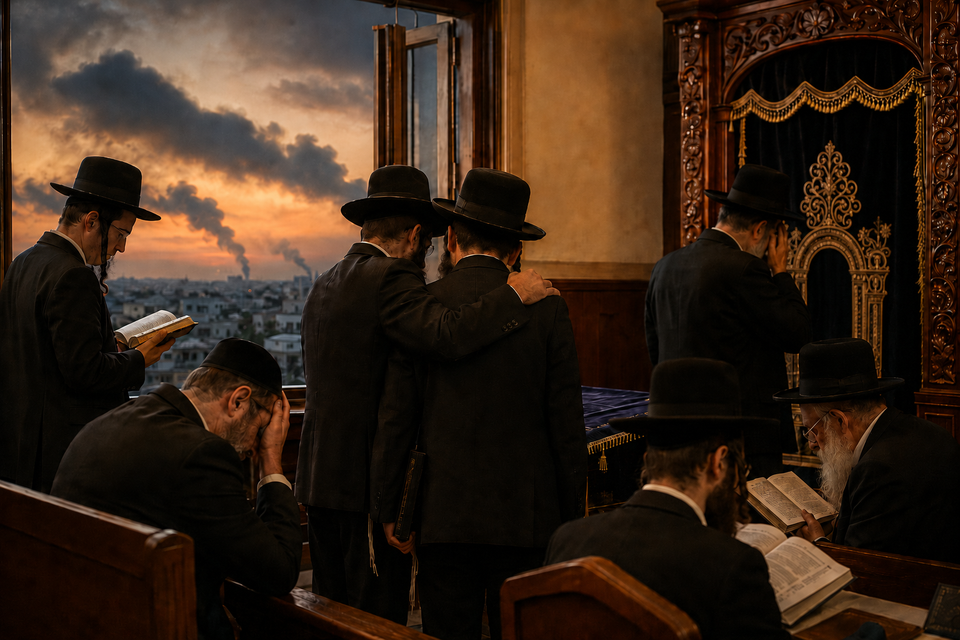
On the Shemini Atzeres that became the bloodiest day in Jewish history since the Holocaust, the Charedi world wept with all of Klal Yisrael — for the murdered, the wounded, and the captive. This is how the Torah world holds that day: in mourning, in the refusal to explain what only Hashem can, in the knowledge that no army alone can save us, and in the response of the living — to draw closer to the One who does.
On Shemini Atzeres, the 22nd of Tishrei 5784 — the 7th of October, 2023 — the Jewish people woke to a horror the modern mind could scarcely hold. Hamas terrorists tore through the Gaza border and carried out the most barbaric massacre of Jews in a single day since the Shoah. Roughly twelve hundred were murdered — men, women, children, infants, the elderly — slaughtered in their homes, hunted across the fields of the Nova festival, burned and tortured and defiled. Around two hundred and fifty were dragged into captivity. The day many now call "Black Simchas Torah" left wounds — of body, of heart, of soul — that have not begun to close. How does the Charedi world hold such a day? Let us answer with the care it demands.
I. First, and Before All Else, We Mourn
Before a single word of analysis, before any thought of meaning, there is only one response a Jewish heart can have: we weep.
We weep for the kedoshim who were murdered. We cry out for the wounded. We storm the Heavens for the hostages and their shattered families. There are no politics in a mother's tears, and no factions in the wail of a father over his child. Just as the Charedi world mourned after the crush at Meron, after the massacre in the shul at Har Nof, after Pittsburgh, after the Chabad House in Mumbai — so it mourned now, wholly and without reservation, because a Jew in pain is our pain, always. Across the Torah world — from Bnei Brak to Brooklyn, from Kiryas Yoel to Lakewood — Gedolei Yisrael led the recitation of Tehillim; every minyan added kapitlach; yeshivos cried out "Acheinu kol beis Yisrael" with trembling voices and streaming eyes. This was not a news event to the Charedi world. It was a churban, and it was mourned as one.
II. Neither a Verdict Nor a Shrug
And here, immediately, the Torah draws its lines — and there is a forbidden error waiting on more than one side.
The first is the error of laying the guilt at the victims' feet. When Iyov's friends gazed at his suffering and concluded that he must have earned it, Hashem rebuked them sharply, for they had not spoken rightly of Him. To look upon the twelve hundred and pronounce that they were the authors of their own slaughter — that the atrocity was a punishment they had brought upon themselves — is precisely that error, and it is a desecration of their memory that this publication rejects with its whole being. The twelve hundred were kedoshim, who died al kiddush Hashem; the guilt belongs wholly, entirely, and only to the murderers who chose to murder. Over the kedoshim we say Kaddish. We do not sit in judgment of them.
And yet — let this be every bit as clear — their deaths were not random, not the blind arithmetic of the wrong place at the wrong time. The Torah world does not believe in chance; there is no mikreh in the world of the Ribbono Shel Olam. Hashem chose these holy souls, by His own hand and for His own reasons — reasons that are real, and that are His alone. "The hidden things belong to Hashem our G-d" (Devarim 29:28): the cheshbon of that day is not absent but concealed — sealed with Heaven, and not handed to us to read. To say "we do not know why" is emphatically not to say "there was no why." It is to bow before a reckoning too exalted for our eyes — neither emptying the day of its meaning, chas v'shalom, nor presuming to spell out the meaning Hashem has kept to Himself.
And precisely because it was not happenstance — because the hand of Hashem was in it — a second error becomes just as forbidden: the error of the shrug. The Rambam teaches it with startling force: to meet calamity by waving it off as mikreh, to let it pass without its piercing us and moving us to examine our ways, is itself derech achzarius, a path of cruelty — and the surest way to invite the suffering to return (Hilchos Taanis 1:1–3). A Jew may not declare why his brother died; but neither may he feel nothing and change nothing. To shrug is not humility. It is a failure of its own.
So where, then, is a Jew permitted to look? Inward — never outward. Turned outward — here is why THEY were struck — every word of it is forbidden. Turned inward — what must I repair, what must we repair, so that we draw closer to Hashem — it is not merely permitted but commanded, the holiest response a broken Jewish heart can have. We do not read the ledger of the kedoshim. We read our own. Everything that follows in this article must be heard in exactly that key — never as a verdict upon the murdered, always as a summons to the living.
III. No Army Alone Can Save
There is, however, one lesson the day taught that requires no claim to Heaven's hidden reckoning — only open eyes. October 7th exposed, with terrifying clarity, the limits of human power.
The most sophisticated defensive apparatus on earth — billions of dollars of satellites, drones, sensors, and walls — was rendered useless in hours by men on paragliders and motorcycles. For the Torah world this was not a mystery but a confirmation of the oldest truth there is: "He does not desire the strength of the horse… Hashem desires those who fear Him" (Tehillim 147:10–11); "if Hashem does not guard the city, the watchman keeps watch in vain" (Tehillim 127:1). This is not, chas v'shalom, a denigration of those who labor to defend Jewish life — the Charedi world believes wholeheartedly in hishtadlus, in the human duty to protect and to guard. It is, rather, the insistence that hishtadlus is an instrument and never a guarantee — that Ein Od Milvado, there is nothing besides Him, and that the security a Jew ultimately rests upon is the One who governs history, not the hardware that serves Him. October 7th did not teach that we should not defend ourselves. It taught how fragile every defense is without the One who alone makes it stand.
IV. The Response of the Living
So what does a Jew do with such a day? He turns the ledger on himself. Not to hunt for a culprit — there is none but the murderers — but because that is precisely what the Torah asks of the living when the ground gives way beneath them: to cry out to Hashem, and to look long and honestly at our own lives. This is an act we perform upon ourselves, in the kedoshim's merit — never a verdict we pass upon them.
And so the Gedolim, in the aftermath, called Klal Yisrael not to despair and not to rage, but to return — and they were not vague about it. To strengthen our Shabbos, to guard it more jealously and draw more of its kedushah into our homes. To deepen our tznius and our kedushah, the quiet dignity of a people in whose midst the Shechinah dwells. To add to our Torah — another seder, another perek, another daf, learned in the merit of those who can no longer learn. And above all, to mend the achdus of Klal Yisrael — to root out the sinas chinam that has cost us so dearly across our history, and to put in its place a fierce and deliberate ahavas Yisrael that refuses to look at any Jew and see a stranger. None of this is a penance imposed because we have decoded a crime; there is no crime to decode but the murderers'. It is the concrete, forward-facing answer of a people that will not let twelve hundred kedoshim fall and remain unchanged.
This is the heart of it, and it is why the firewall and the call to teshuvah are not in tension but in partnership: because we refuse to read the cheshbon of the dead, we are free to read our own without limit and without flinching. Every guarded Shabbos, every perek of Tehillim, every daf of Gemara, every act of chesed, every embrace across the lines that divide us — offered upward in their memory. That is what a Jew does with a broken heart. He does not explain it away; he does not let it harden him; and he does not, chas v'shalom, let it pass as though nothing had happened. He lets it break him open — and then he lets it draw him, and all of us, closer to Hashem and to one another.
V. "But Don't Charedim Oppose the State — So Why Do They Care?"
Some have asked, with more cynicism than sense, why a community with deep reservations about the secular state should grieve so fully when that state is attacked. The answer needs no cleverness. We care because we are Jews.
The people murdered that day were our brothers and our sisters. Every Jewish neshamah is holy and infinitely precious, and "kol Yisrael areivim zeh lazeh" — all of Israel are bound up, one with another (Shevuos 39a) — a bond that does not weaken in a community's hour of agony but tightens. The Charedi world did not become Zionist on the 7th of October; its hashkafah did not change. But it cried out to Hashem as Jews always have for other Jews — with Tehillim, with tears, and with the kind of raw introspection the Torah world knows how to summon. To love your people is not a political position. It is simply what it means to be a Jew.
VI. The Response in Action
And the Charedi response was never confined to words. From the very first hours, the Torah world moved — and some of it moved straight into the fire. The volunteer medics of Hatzalah raced south toward the gunfire to reach the wounded, often arriving before the army did; three of them were killed and dozens wounded as they worked to save lives. And when the guns fell silent, the bnei Torah of ZAKA took up the most harrowing avodah of all: for weeks, hundreds of volunteers gathered every remnant of the kedoshim — from the safe rooms, the burned homes, the festival grounds — with unbearable tenderness, so that each Jew could be brought to a proper kever Yisrael. This is chesed shel emes in its purest form: the one kindness that can never be repaid, performed for those who can never say thank you. Many who did that work carry the weight of what they saw to this day.
Around that core moved the rest of a community that refused to stand still. Blood drives overwhelmed collection centers in Bnei Brak and Yerushalayim. Tens of thousands of meals streamed to families displaced from the south. Chesed organizations — Ezra L'Marpeh, Ezer Mizion, Yad Eliezer, and countless others — mobilized within hours to reach survivors, the displaced, and soldiers at the front. Bochurim across Eretz Yisrael took on new kabalos in learning and in middos. Little of it sought a camera. It was, overwhelmingly, a quiet flood of ahavas Yisrael and chesed — a kiddush Hashem performed not for an audience but for its own sake.
Beneath it all ran a conviction the Torah world has carried through every exile: that the deepest protection of the Jewish people has always been its Torah. Rav Chaim Kanievsky, of blessed memory — who left this world before that terrible day — taught throughout his life that Torah is the true shield of Klal Yisrael, the defense beneath all defenses. The crowded batei midrash, redoubled in those weeks, were the Charedi world's way of raising that shield once more.
VII. Conclusion: Through the Eyes of Emunah
To much of the world, October 7th was a catastrophic security failure. To the Charedi world it was, first, a sea of Jewish blood to be mourned without end; and then a summons — not to explain, not to accuse, but to draw closer to Hashem and to one another, and to answer an outpouring of hatred with an outpouring of holiness.
We mourn. We daven. We rebuild. We hold the kedoshim in our hearts, we begged without ceasing for the return of every captive, and we cling to the truth that has carried us through every darkness of galus: that even on the blackest day, the fire of Torah is not extinguished — and that the same Hashem who weeps with His people will, in the end, wipe the tears from every face.
May Hashem avenge the blood of the kedoshim, may He heal the wounded and comfort the bereaved among the mourners of Tzion and Yerushalayim, and may we merit the day when death is swallowed up forever — bimheirah b'yameinu, amen.
Sources
The limits of human power
- Tehillim 147:10–11 — "He does not desire the strength of the horse… Hashem desires those who fear Him"
- Tehillim 127:1 — "if Hashem does not guard the city, the watchman keeps watch in vain" — hishtadlus as instrument, never guarantee; Ein Od Milvado
What we will not say — and what we will not ignore
- Devarim 29:28 — "the hidden things belong to Hashem our G-d" — that the cheshbon of October 7th is concealed, not absent: Hashem chose the kedoshim by His own hand and for reasons that are His alone, and we neither presume to read that hidden reckoning nor cast the faintest shadow of blame upon the victims; the guilt belongs wholly to the murderers
- Rambam, Hilchos Taanis 1:1–3 — that to meet calamity as mere mikreh, unmoved and unchanged, is itself derech achzarius; the proper response is for the living to examine their own ways and return — an act performed upon ourselves, in the kedoshim's merit, never a verdict upon those who suffered. Treated in the same spirit as our articles "The Charedi View on the Holocaust" and "What Is the Charedi View on the Phrase 'Never Again'?"
Why we grieve as one
- Shevuos 39a — "kol Yisrael areivim zeh lazeh," all of Israel bound up one with another
A note on attribution and fact
- The calls of Gedolim such as Rav Don Segal and Rav Moshe Hillel Hirsch in the aftermath — to teshuvah, to chizuk in Torah and kedushah, and to a deepened reliance on Hashem — are presented here as their well-documented, forward-looking themes, and are not reproduced as causal claims about why the attack occurred. The teaching of Rav Chaim Kanievsky that Torah is the true protection of Klal Yisrael is his general, lifelong theme; he passed away in 5782 (2022), before October 7th, and nothing here is attributed to him about that day.
- The mobilization in the aftermath of ZAKA — whose volunteers performed the chesed shel emes of recovering the kedoshim for burial, for weeks, at a heavy and lasting personal cost — of United Hatzalah, whose volunteer medics raced to the wounded under fire and lost three of their own with dozens more wounded, and of chesed organizations including Ezra L'Marpeh, Ezer Mizion, and Yad Eliezer, is a matter of documented public record.
The structural relationship to other articles in this series
- "What Is the Charedi View on the Phrase 'Never Again'?" — the same refusal to explain catastrophe, and the same trust in Hashem over might
- "The Charedi View on the Holocaust" — the firewall of nistaros laHashem in its fullest form
- "Is Zionism Working?" — October 7th and the limits of military strength as a guarantor of safety