
How Is Torah Learning Seen as Benefiting Every Jew—Even Those Far from Observance?
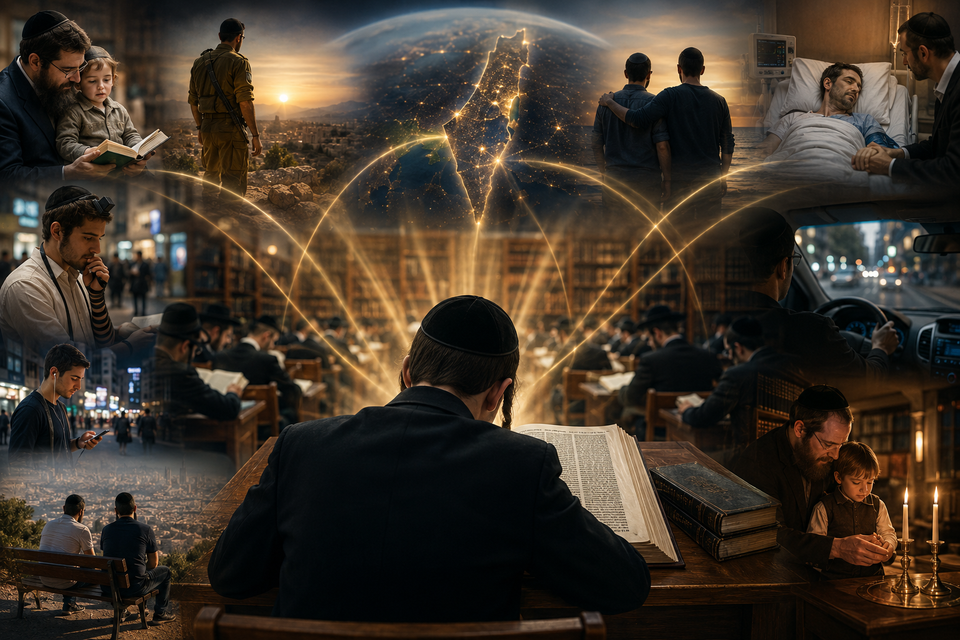
In the Torah's understanding, learning is never a private transaction between a Jew and his Gemara. It draws blessing, protection, and life into all of Klal Yisrael — including Jews who have never opened a Chumash, never lit a Shabbos candle, never set foot in a beis medrash. This is one of the deepest reasons the Charedi world gives its life to Torah: not for itself, but for every Jewish soul.
There is a quiet assumption in much of the modern conversation about Charedi life — that a yeshiva bochur bent over his Gemara is doing something purely personal, even self-interested: improving himself, securing his own portion, while the rest of the nation carries burdens he avoids. The Torah's worldview turns this picture inside out. In the eyes of Chazal, the Jew learning Torah is doing one of the most public-spirited things a human being can do — drawing down a flow of blessing and protection that reaches every member of Klal Yisrael, the close and the distant alike, the observant and the one who has never heard the word "mitzvah." To understand the Charedi devotion to learning, you have to understand this first.
I. The Tzaddik Is the Foundation Beneath the Whole House
Shlomo HaMelech states the principle in four words: "v'tzaddik yesod olam" — "the righteous one is the foundation of the world" (Mishlei 10:25). The Vilna Gaon draws out the image: a foundation is the part of a building no one living on the upper floors ever sees, and yet every floor rests upon it. The tenant on the top story, who has never once descended to look at the foundation and may not know it exists, is held up by it every moment of his life. So it is, the Gaon teaches, with the tzaddik and his Torah: they bear the weight of a world that mostly never sees them.
Chazal say this almost startlingly plainly. A heavenly voice, the Gemara records, goes out each day declaring that "the whole world is sustained for the sake of Chanina My son" (Berachos 17b) — the entire world fed and carried in the merit of a single hidden tzaddik who himself lived in utter poverty. And the principle reaches even further than sustenance. When Avraham Avinu pleaded for Sedom — a city as far from righteousness as a place can be — Hashem agreed that for the sake of even ten righteous men He would spare the whole city, the wicked along with the few (Bereishis 18:32). The righteous, in the Torah's accounting, do not earn protection only for themselves. They become the reason an entire city, an entire people, is allowed to stand.
II. Torah Is What Holds the World Together
Why should Torah specifically carry such cosmic weight? Because, in the Torah's own self-understanding, it is not a book within the world but the blueprint of it. The Midrash teaches that Hashem looked into the Torah and created the world (Bereishis Rabbah 1:1) — the world was built to the Torah's specifications, the way a builder builds from an architect's plans. And a blueprint is not consulted once and discarded; the Torah is the living design that keeps the structure standing.
So Chazal can say, without exaggeration, that "were it not for the Torah, heaven and earth would not endure" (Pesachim 68b, on Yirmiyahu 33:25), that "the world stands on three things — on Torah, on avodah, and on acts of kindness" (Avos 1:2), and — most tenderly of all — that "the world endures only for the sake of the breath of schoolchildren learning Torah" (Shabbos 119b). Rav Chaim Volozhin, in his Nefesh HaChaim, built an entire sefer around this truth: that every single word of Torah a Jew learns sends light upward and sustains and rebuilds worlds beyond our sight. There is a way of putting it that captures the idea exactly: someone has to keep paying the bill that keeps the lights of creation on — and in the Torah's understanding, the one quietly paying it is the Jew at his Gemara. Everyone lives in the lit house. Not everyone knows who is covering the cost.
III. The Light Reaches the Ones Who Are Furthest
Here is where the principle becomes most striking — and most easily misheard, so let it be said carefully. The claim is not that Torah benefits only those who keep it. It is that the light Torah generates is not fenced in; it reaches the neshamah of every Jew, including the one standing far outside the beis medrash, perhaps with no idea it is even there.
The seforim describe this in different keys. There is the image of a candle set in a window: the man across the street may never come inside, may not even turn his head — and still the light falls on him. There is the image of a great furnace in a freezing town: some Jews feed the fire and some only feel its warmth, but without the fire, every last person would freeze. The chassidic masters, and the Baal HaTanya among them, taught that the spiritual light awakened by Torah and mitzvos radiates outward and stirs even the most dormant Jewish soul. None of this is offered as a measured empirical finding; it is the mesorah's understanding of what Torah is and what it does — that "Torah protects and rescues" (Sotah 21a), and that its protection does not stop at the door of those who learn it. In this understanding, a distant Jew's mazal is quietly lifted, his soul is stirred in ways he cannot name, his children may one day be drawn toward a light he himself never consciously sought — all carried on the current of Torah being learned, somewhere, by someone, with him in mind.
IV. Why Even a Single Pasuk Counts
This is also why the Charedi world pours such resources into Torah for those at the very beginning — baalei teshuvah, weaker students, anyone willing to open a sefer for the first time. Rav Aharon Leib Shteinman was known for insisting that even the smallest amount of Torah a struggling Jew manages to learn is precious beyond calculation — a single pasuk, in his teaching, can be the crack through which light enters and changes a home. Torah does not have to be vast or perfect to do its work.
And the work is real and visible. Ask any rosh yeshiva and he can tell you the same kind of story: a man who spent years driving past a beis medrash, understanding nothing of what he saw inside but feeling something pull at him, until one day he stopped, walked in, was handed a seat and a sefer — and whose grandchildren now learn in cheder. The teshuva movement of the last several generations is built, case by case, on exactly this: people drawn back not by argument but by the sheer light of a room full of Jews learning. The gedolim have long taught that a Jew should learn with all of Klal Yisrael held in his heart — that the Torah one learns is meant to include every Jew, even the one who would never walk through the door.
V. Not Superiority — Love
It would be a serious misreading to hear any of this as a boast: we sustain you, so be grateful. That is the opposite of the idea. The whole principle rests on the most basic truth of Jewish peoplehood — "kol Yisrael areivim zeh bazeh," all of Israel are bound up, one with another (Shevuos 39a); we are, as the seforim put it, a single body, so that no Jew is ever truly a stranger to another. One does not "look down" on his own arm. The Jew who learns for the sake of Klal Yisrael is not standing above his fellow Jews and dispensing charity; he is doing for his own family the most loving thing he knows how to do.
That is the spirit of it. The bochur in Bnei Brak who will never meet the secular Jew in Tel Aviv is, in the Torah's understanding, learning for him — lifting him, shielding him, keeping a light burning in a window that faces his street. He asks nothing back, and most often the other never knows. It is ahavas Yisrael in its quietest and most demanding form: love expressed not in words a person will hear, but in hours of labor he will never see.
VI. Conclusion: Torah for Every Neshamah
In the Charedi view, then, Torah is not the private possession of those who keep it. It is something closer to the spiritual oxygen of every Jewish soul — drawn into the world by those who learn, and breathed by everyone, whether or not they know where the air is coming from.
This is why the Charedi world gives Torah the place it does. Not for pride, and not for prestige. We learn because every Jew needs it; because every Jew is lifted by it; and because Hashem charged us to carry its light not for ourselves alone but for an entire nation. Even the Jew who has never heard of us, who would never enter our batei midrash, who imagines we learn only for ourselves — we are, in truth, learning for him too. That is not metaphor. It is mesorah. And it is love.
May the light of Torah continue to sustain every soul in Klal Yisrael, and may we merit the day when the whole earth is filled with the knowledge of Hashem — bimheirah b'yameinu, amen.
Sources
The righteous as the foundation of the world
- Mishlei 10:25 — "v'tzaddik yesod olam," the righteous one is the foundation of the world; with the Vilna Gaon's image (in his commentary there) of the foundation that holds up floors it never sees
- Berachos 17b (and Taanis 24b) — "the whole world is sustained for the sake of Chanina My son"
- Bereishis 18:23–32 — Avraham's plea for Sedom: that for the sake of ten righteous men the whole city would be spared
Torah as the foundation of creation
- Bereishis Rabbah 1:1 — Hashem looked into the Torah and created the world (the correct source for this Midrash; it is not in Vayikra Rabbah)
- Pesachim 68b / Nedarim 32a, on Yirmiyahu 33:25 — "were it not for the Torah, heaven and earth would not endure"
- Avos 1:2 — "the world stands on three things: on Torah, on avodah, and on gemilus chasadim"
- Shabbos 119b — "the world endures only for the breath of schoolchildren learning Torah"
- Nefesh HaChaim, Shaar 4 (Rav Chaim Volozhin) — the supernal effect of every word of Torah study in sustaining and building worlds; the central sefer on this theme. The "fields and farmers" image and the "who pays the bill" image are offered as illustrations of this teaching, not as separate citations
Torah's reach and protection
- Sotah 21a — "Torah protects and rescues"
- Ramchal, Mesilas Yesharim ch. 19 — that the pious person draws blessing and protection upon his entire generation
- The teaching of the chassidic masters, including the Baal HaTanya (Tanya ch. 37), that the light of Torah and mitzvos radiates outward to stir even distant Jewish souls — presented as a documented theme
The structural relationship to other articles in this series
- "Why Is Torah Learning the Top Priority?" — the foundation this article builds on
- "What Does Toraso Umanuso Really Mean?" — the Jew whose craft is Torah
- "Who Benefits More — Charedim or the State?" — the same principle viewed through the lens of what each truly gives
- "The Charedi Approach to Kiruv" — carrying the light to those far from it, in person