
Are Charedim Really Needed in the Army?
What the IDF Itself Admits, and What the Chazon Ish Already Answered
Much of the criticism aimed at the Charedi community regarding army service hinges on a simple, unstated assumption: that the IDF urgently needs the bnei yeshiva, that Israel's defense depends on dragging them out of the beis medrash, and that the only thing standing between Klal Yisrael and disaster is the stubbornness of a few Roshei Yeshiva in Bnei Brak.
The facts tell a different story — and the most damaging witness against the assumption is the IDF itself.
What the IDF Has Already Admitted
In November 2024, Brig. Gen. Shay Tayeb, head of the IDF Personnel Directorate's Planning and Personnel Management Division, testified before the Knesset Foreign Affairs and Defense Committee. He told lawmakers that the military "currently requires some 10,000 new soldiers" — but "can only accommodate the enlistment of an additional 3,000 ultra-Orthodox soldiers this year, due to their special needs." That number was reported in the Times of Israel and confirmed in subsequent Knesset testimony.
Read that sentence carefully. The IDF's own personnel chief, under oath before the elected representatives of the State of Israel, told the Knesset that even if the Charedi community surrendered tomorrow and produced soldiers in numbers the army demanded, the IDF could absorb fewer than a third of them. The army does not have the kosher kitchens. It does not have the gender-segregated training infrastructure. It does not have the religious accommodations. It does not have the bases. It does not have the system.
So the picture being painted to the Israeli public — that the war is being lost because Charedim refuse to serve — is, by the IDF's own admission, untrue. Even maximalist Charedi enlistment would not, and could not, fill the manpower gap the army says it has.
If the manpower argument were honest, the State would have spent the last decade building the infrastructure to absorb 10,000 Charedim per year. It did not. Because that was never really the goal.
Who Is Actually Not Serving?
The current public discourse acts as if the only Israelis avoiding service are Charedim. The actual numbers, drawn from public IDF and Defense Ministry data, look very different.
According to the Israel Defense Forces' own statistics, by 2020, about 32.9% of Jewish men and 44.3% of Jewish women received full exemptions from IDF service. An additional 15% of men dropped out before completing their term. Of all those who received exemptions, the breakdown was: 44.7% Charedim, 46.6% secular, and 8.7% Religious Zionist.
The numbers tell us several things at once.
First, Charedim are over-represented in exemptions relative to their share of the population — they are 13-14% of Israeli Jewry but receive 44.7% of exemptions. The Charedi community has never denied this; the Chazon Ish argued for it openly in 1952, and the community has defended it ever since on the grounds that Torah study is itself a form of national service.
Second, the secular share of exemptions is 46.6% — almost identical to the Charedi share. These are not learning yeshiva. They are not Religious Zionists. They are secular Israelis, almost half of all military exemptions, who do not serve. About 12% of all candidates in 2020 received Profile 21 mental health exemptions — a route described in Tablet Magazine and Haaretz as "notoriously easy" to obtain, and used by a growing population of secular draft-avoiders.
Third, the conversation in the Israeli press, and the rulings of the Supreme Court, have focused with surgical intensity on the Charedi 44.7% — and almost not at all on the secular 46.6%. There are no court orders cancelling daycare subsidies for the children of secular draft-avoiders. There are no police raids on Tel Aviv apartments belonging to twenty-four-year-olds with mental health exemptions. There are no Knesset committees demanding that the secular share be reduced.
This is the asymmetry the Charedi community has been pointing at for thirty years, and it is real.
The Manpower Argument Is Not the Real Argument
Even Religious Zionist publications and serving officials have begun to acknowledge what the data makes plain. As Rabbi Uri Maklev, a Degel HaTorah Member of Knesset and longtime confidant of the gedolim, put it in his January 2020 interview with The Jewish Press:
"The drafting of charedim into the army is one example. Besides uprooting Torah students from their learning, in whose merit the entire nation of Israel is blessed, and for which we owe whatever successes we have achieved in the country to date, it is almost impossible to keep the Torah in the anti-Torah atmosphere of the Israeli army… [The argument] is really political in nature since the IDF doesn't need them. It doesn't. We live in an age of technology. Wars are won by missiles, advanced aircraft systems, and computer science."
If the issue were truly manpower, the State would build the infrastructure to absorb the Charedim it claims to need. It has not. If the issue were truly equality, the State would close the secular Profile 21 loophole. It has not. If the issue were truly the war, the State would not be ordering women into tank units the IDF itself said it did not need filled, while begging for combat soldiers it cannot find.
The issue is not manpower. It never was. The issue is cultural — the desire of the secular establishment to bring the Charedi community under State control by stripping it of the spiritual independence that has, for seventy-eight years, kept it outside the yehudi he'chadash project. The army is the lever. The lever has been clear from the beginning.
What the Chazon Ish Already Said
This is not a new question. It was asked, and answered, in October 1952, when David Ben-Gurion himself traveled to Bnei Brak to meet with the Chazon Ish, Rav Avraham Yeshaya Karelitz zt"l. The only third party present was Yitzchak Navon — Ben-Gurion's personal secretary, later President of the State of Israel — who recorded the exchange in detail.
Ben-Gurion pressed: And these young men sitting at the borders, who protect you — is that not a mitzvah?
The Chazon Ish answered: In the merit of our Torah study, they live, work, and are protected.
Ben-Gurion pressed harder: But if these young people didn't protect you, the enemies would slaughter you!
The Chazon Ish answered: On the contrary. In the merit of our Torah study, they are safe.
Ben-Gurion: Protection of life is also a mitzvah! If nobody is alive, who will learn the Torah?
The Chazon Ish: Torah is the tree of life, the elixir of life.
This exchange, recorded by Navon and published in his memoirs, is the foundation document of the Charedi position on army service. It is not a slogan. It is the gadol hador, sitting in his apartment in Bnei Brak, telling the Prime Minister of Israel — to his face — that the soldiers at the border are protected by the bnei yeshiva, not the other way around.
The same Chazon Ish recorded in his own halachic writings (Orach Chaim, Hilchos Eiruvin §114) that in a milchemet mitzvah, "if there is a need for them, they must come to the aid of their brethren." This is the Torah position in full: yeshiva students are not exempt from the obligation to defend Klal Yisrael in the abstract. They are obligated to participate in defense — through the form of defense the Torah itself gives them, which is Torah study, and which the Torah identifies as the actual source of national survival.
The Torah's Own Account of What Protects a Nation
The Mishnah in Sotah 8:7 lists who is required to fight in a milchemet mitzvah: even a chassan from his chuppah and a kallah from her chuppah room. But the Gemara in Sotah (and the Rambam in Hilchos Shemittah V'Yovel 13:13) carves out a particular category: the tribe of Levi, and "anyone whose spirit moves him to serve Hashem, to teach others Torah and to walk straight as Hashem made him, and removes from his neck the yoke of many calculations that men have sought" — this person is "consecrated as the Holy of Holies."
The Rambam is explicit. Such an individual is not a draft dodger. He is a kohen, a Levi, a person whose function in the nation is structurally different. Moshe Rabbeinu held up his hands at the war with Amalek (Shemos 17:11), and yad'einu kee ka'asher yarim Moshe yado v'gavar Yisrael — when Moshe's hands were raised, Israel prevailed; when they fell, Amalek prevailed. The hands raised in Torah and tefilla are not metaphor. They are the operating mechanism of Jewish national survival.
The Charedi community has been making this argument for seventy-eight years, and the State has been telling it, in increasingly hostile language, that the argument does not count.
But the data tells the same story the Torah does. Israel has fought, and won, multiple wars while tens of thousands of Charedim sat in beis medrash. It has fought, and won, against odds that no manpower analysis can explain. It has survived October 7th, the war on seven fronts, the Iranian missile barrage of April 2024, the Hezbollah escalation, and the Houthi attacks. The bnei yeshiva have been learning. The State has been winning. The relationship between those two facts is what the Chazon Ish was pointing at in 1952, and what the Torah has been pointing at since Sinai.
What This Argument Is Not
It is not an argument that Charedim should never carry weapons, never patrol their cities, never protect their families. They do, in mishmar ezrachi groups in Bnei Brak, Beitar, Elad, and across the country. It is not an argument that Charedim should not contribute to Am Yisrael — the gemachim, the chesed organizations, Yad Sarah, Hatzalah, Zaka, the meal deliveries to soldiers, the Shabbos meals for milluimnik wives, are all run out of this community in numbers no other sector of Israeli society approaches.
It is also not an argument against the Religious Zionist hesder bochur or the Hesder Rosh Yeshiva who has poured his life into building a model of Torah-and-army integration. That community has its own analysis, its own gedolim, and its own derech, and it has paid in blood for its commitments. We do not write to mock that community; we write to challenge the secular establishment's narrative that the entire Charedi world is somehow what stands between Israel and security.
It is, instead, an argument that the question being asked — "Don't the Charedim need to share the burden?" — is the wrong question. The right question is the one Ben-Gurion asked the Chazon Ish, and the one the Chazon Ish answered: what is the actual burden, and who is actually carrying it?
The IDF says it cannot absorb mass Charedi enlistment. The data says secular non-service is at the same scale as Charedi non-service. The Torah says national survival flows from beis medrash. The Chazon Ish said it to David Ben-Gurion's face seventy-three years ago.
Israel does not need the Charedim in the army. It needs the Charedim in the beis medrash, where they have always been, where they continue to be, and where — im yirtzeh Hashem — they will be when this entire churban of a public discourse has passed and Mashiach has come.
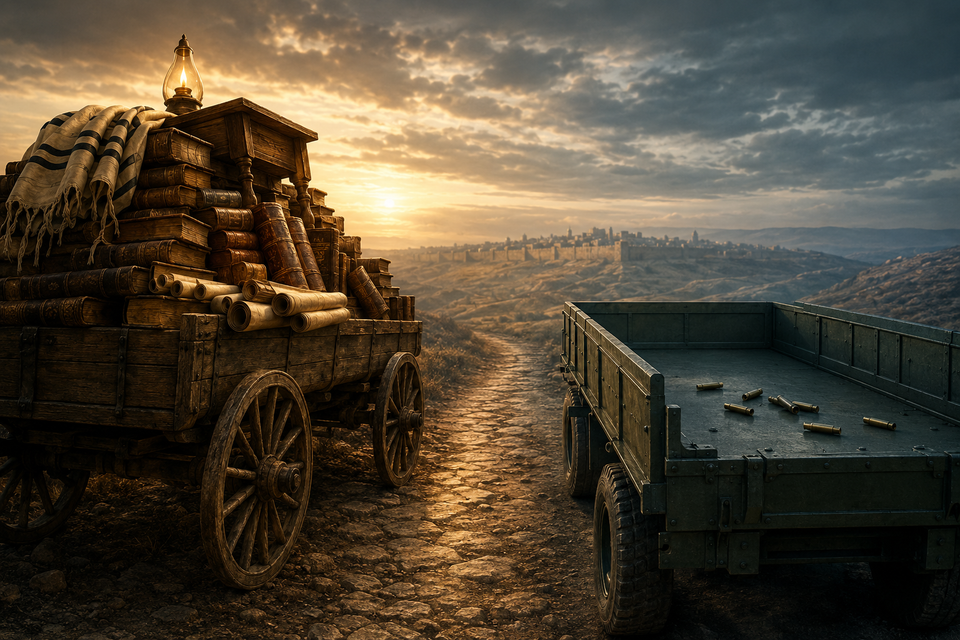
The wagon that is full has not changed. The wagon that is empty has not changed. Only the question being asked has changed — and even that question, when examined honestly, leads back to the same place.
Sources
IDF capacity admissions
- Times of Israel, "IDF sees increase in draft of Haredi troops, but is still far off from goals" (November 14, 2024) — Brig. Gen. Shay Tayeb's testimony to the Knesset Foreign Affairs and Defense Committee that the IDF can only absorb 3,000 additional Haredi soldiers per year despite needing 10,000 new soldiers
- Times of Israel, "Only 1,212 of the 24,000 Haredi men called up in past year have begun enlisting" (May 21, 2025) — additional Tayeb testimony
- Times of Israel, "IDF offers one-time amnesty to thousands of draft dodgers, citing manpower shortage" (August 17, 2025)
Exemption statistics
- Wikipedia, "Exemption from military service in Israel" — citing IDF data: 44.7% Haredim, 46.6% secular, 8.7% Religious Zionist breakdown of exemptions; 32.9% of men and 44.3% of women received exemptions by 2020; 15% of men drop out before completing service
- Conscription in Israel statistics: 69% of Jewish men and 59% of Jewish women drafted as of 2019
- Tablet Magazine, "Refusing Service in Israel Defense Force" (March 2021) — Profile 21 mental health exemption rate at ~12% of all candidates
- Shomrim, "An Industry of Fake Mental Health Exemptions from Army Service is Flourishing" — investigative reporting on Profile 21 abuse
The Chazon Ish – Ben-Gurion meeting (October 20, 1952)
- Yitzchak Navon's recorded account, published in his memoirs and recounted in numerous sources
- World Mizrachi, "The Chazon Ish, Ben-Gurion and Rav Tzvi Yehudah" (March 2023) — full transcribed exchange
- Yeshiva World News, "70 Yrs Ago Today: What Happened At The Historic Meeting Of The Chazon Ish And Ben-Gurion?" (October 2022)
- Jewish Action, "Great Minds of the 20th Century" (Rabbi Aharon Feldman) — additional details from Shlomo Lorincz, who heard the account from the Chazon Ish himself, originally published in Digleinu Vol. 2 (110), Marcheshvan 5718
Chazon Ish in his own halachic writings
- Chazon Ish, Orach Chaim, Hilchos Eiruvin §114 — on milchemet mitzvah obligations
Contemporary Charedi position
- The Jewish Press, "United Torah Judaism Hopes For A Miracle: An Interview with Degel HaTorah's Rabbi Uri Maklev" (January 29, 2020) — direct quote on IDF not needing Charedim and the political nature of the draft debate
Torah sources
- Mishnah Sotah 8:7 — milchemet mitzvah and milchemet reshut
- Rambam, Hilchos Shemittah V'Yovel 13:13 — the tribe of Levi and those consecrated kodesh kodashim
- Shemos 17:11 — Moshe's raised hands at Amalek