
How do Charedim Uplift Israeli Society Through Gemachim?
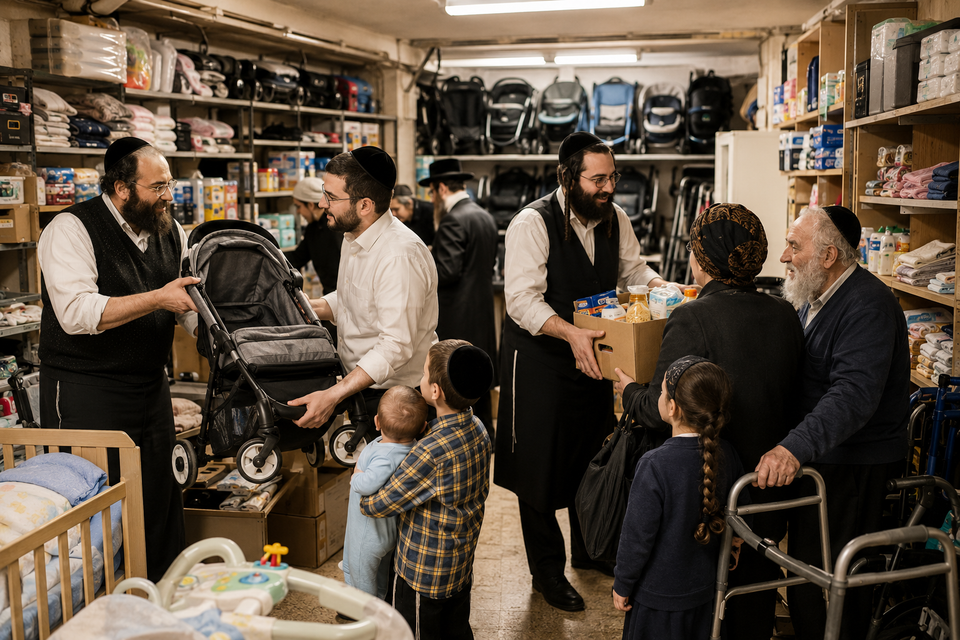
Behind a nondescript door, in a basement closet, on a handwritten flyer taped to a shul corkboard — that is where you find them. Gemachim: thousands of small, volunteer-run free-loan and free-lending funds that quietly carry an entire community through its weddings, illnesses, births, and emergencies, asking nothing in return. The formal Charedi charities and nonprofits are described elsewhere in this series. The gemach is something more elemental than any of them — not an organization at all, but the Torah's economics built straight into the ordinary home.
The word is short for gemilus chasadim, the mitzvah of lovingkindness. A gemach is not a charity that gives things away; it is a fund that lends them — money, equipment, clothing, very nearly anything — without interest, without conditions, and without judgment. Created and sustained by ordinary people for the sole purpose of helping others, the gemach system is, quite literally, an underground economy of kindness, most of it invisible to the world outside, all of it pointing at the same idea: that no Jew should ever have to face a need alone.
I. The Halachic DNA of a Gemach
To understand why the gemach takes the particular form it does — a loan rather than a handout — you have to understand a teaching of Chazal that turns ordinary intuition on its head. "Greater is one who lends than one who gives charity," the Gemara states, "and one who forms a partnership is greater than them all" (Shabbos 63a). Greater than charity? Yes — because the man who receives a loan is not shamed. He has not been reduced to a beggar with his hand out; he has been treated as a capable person passing through a hard stretch, who will repay when he can. The loan preserves the one thing poverty strips away most cruelly: dignity. This is why the Rambam places helping a person become self-sufficient — through a gift, a loan, a partnership, or work — at the very top of his ladder of tzedakah (Hilchos Matnos Aniyim 10:7). The gemach is that highest rung, institutionalized and multiplied a thousandfold.
And it rests on an economic ethic that exists nowhere else. Where the surrounding world runs on interest — on credit cards, banks, and the price of borrowed money — the Torah forbids a Jew to charge his fellow Jew a single agora of ribbis (Vayikra 25:36; Shulchan Aruch, Yoreh Deah 160), and commands him instead to lend freely to those in need ("if you lend money to My people," Shemos 22:24; Rambam, Hilchos Malveh V'Loveh 1:1). Strip interest out of an economy and command free lending into it, and what grows in that soil is the gemach. It is not a charming folk custom. It is the Torah's financial law made flesh.
II. The Scale of the Invisible
No one can count them all, and that is part of the point. By every estimate they run into the thousands across Israel; in cities like Bnei Brak and Jerusalem a single neighborhood may hold dozens. Nearly every shul, yeshiva, and school operates one; nearly every Charedi family belongs to several. Some are registered nonprofits with real overhead; far more are a labeled cardboard box on a shelf, a handwritten ledger in a kitchen drawer, a key left with the neighbor who runs the stroller gemach out of her stairwell.
The financial scale alone is staggering. The interest-free money gemachim are estimated to hold deposits ranging from several billion shekels into the tens of billions — an entire parallel lending economy, operating quietly alongside the banks, built on nothing but trust and Torah, and costing the taxpayer precisely nothing. And that is only the money. The lending of things — which no economist can price — touches even more lives.
III. A Gemach for Almost Everything
The truest way to grasp the system is simply to walk through it. What follows is only a sampling, but it conveys the reach: in a well-established Charedi community there is, quite literally, a gemach for nearly every need a human being can have.
Money. At the heart of it all sit the free-loan gemachim — interest-free loans for a wedding, a medical bill, back rent, tuition, or a sudden emergency, ranging from a few hundred shekels to very large sums, funded by donations, maaser money, and repayments. Alongside them run dedicated hachnasas kallah funds to help marry off poor brides, and emergency cash gemachim for the family that simply cannot make it to the end of the month.
Babies and young children. Strollers, cribs, bassinets, car seats, playpens, baby monitors, breast pumps, and full layettes of newborn clothing — lent out so that no young couple need buy expensive gear they will use for a year. Maternity-clothing gemachim spare an expectant mother an entire wardrobe she will need only for a season.
Weddings and simchas. Gowns for the kallah and for the mothers and the Shabbos kallah; suits and hats for the chosson; tablecloths, centerpieces, vases, candlesticks, and serving platters; the dishes and settings for a sheva brachos; sound systems and simcha decor; even the ornate chair of Eliyahu HaNavi for a bris and the supplies for an upsherin. An entire wedding can be dressed, set, and celebrated almost entirely out of gemachim.
Medical needs. Wheelchairs, crutches, walkers, hospital beds, oxygen concentrators, nebulizers, orthopedic boots and slings, blood-pressure monitors, thermometers — and, in the larger gemachim, rare or pediatric equipment the hospitals themselves do not stock. Where Yad Sarah is the great national lender, thousands of small local medical gemachim fill the gaps at two in the morning.
Household and appliances. Power tools and drills, folding tables and chairs by the dozen, space heaters and fans, air-conditioning units for a heat wave, Shabbos hotplates and urns, and ovens kashered and lent for Pesach — the practical machinery of a large family's life, available the moment something breaks or a Yom Tov approaches.
Food. Pantry gemachim stocked with dry goods and produce, bakery and grocery surplus redirected before it is wasted, hot Shabbos meals, full Yom Tov packages, and discreet emergency groceries delivered quietly to a family in crisis — often by a volunteer who never learns, and never asks, why.
Clothing. Children's clothes and school uniforms, winter coats and boots, shoes, and Shabbos clothing — turning over especially before the school year and the chagim, so that no child stands out for what his family cannot afford.
Medicine. Supervised gemachim that collect unused, in-date medications and first-aid supplies and redistribute them within halacha, under the eye of a pharmacist or knowledgeable askan — sparing waste on one side and expense on the other.
Learning. Sefarim and textbooks, schoolbooks, backpacks, and supplies — so that a child can be fully equipped for the year, or a yungerman can borrow the set he needs for a sugya, without anyone keeping score.
Hospitality and travel. Gemachim that arrange lodging for guests, beds and linens for families who must stay near a hospitalized relative, folding cots and air mattresses, and even suitcases — the infrastructure of hachnasas orchim turned into a standing communal service.
Yom Tov and the seasons. Lulav-and-esrog and sukkah gemachim before Sukkos, menorahs before Chanukah, costumes and the makings of mishloach manos before Purim, Pesach supplies before Pesach — and, when the season turns harsh, the gemach that distributes fans and even air-conditioners during a summer blackout, or heaters in a winter storm.
And then the ones that surprise you. A gemach for house keys and locksmith help. For jumper cables and roadside rescue. For eyeglasses and hearing aids. For sheitels. For phone chargers, children's toys, esrog boxes, and the checking of tefillin and mezuzos. Spend enough time in a Charedi neighborhood and the question stops being "is there a gemach for that?" and becomes "which one, and who has the key?"
IV. Kindness With Halachic Precision and Human Dignity
For all their warmth, gemachim are not run on sentiment alone; they are governed by halacha. The free-loan funds are run with scrupulous care to avoid even a trace of ribbis, frequently under the guidance of a rav or beis din who resolves questions and disputes — and poskim of the first rank, among them Rav Moshe Feinstein and Rav Shlomo Zalman Auerbach, devoted detailed attention to the precise halachos by which a gemach must operate. And running through all of it is an unbending insistence on the borrower's dignity: transactions are kept private, no humiliating questions are asked, and the entire design ensures that a person in need can borrow rather than beg. The gemach guards the heart while it helps the hand.
V. What It Accomplishes
The cumulative effect is enormous and almost entirely uncounted. Gemachim keep families from financial collapse after a simcha or an emergency. They take real pressure off the healthcare system, lending out at no cost the equipment a family would otherwise have to buy or a hospital to provide. They reduce waste on a large scale, circulating the same stroller, gown, or wheelchair through dozens of families across the years. They knit a community tighter, because a gemach is local, personal, and trusted in a way no government office can be. And they do all of it with no taxpayer funding, no bureaucracy, and no overhead beyond a volunteer's time — a vast social safety net that costs the State nothing and relieves it of a great deal.
VI. What It Really Is
But to describe the gemach only in shekels saved and waste reduced is to miss it entirely. The gemach is what kol Yisrael areivim zeh lazeh — every Jew a guarantor for every other (Shevuos 39a) — looks like when an entire society actually lives by it. It is the living proof of what Chazal meant in naming kindness one of the defining marks of a Jew (Yevamos 79a), and of the verse "olam chesed yibaneh," that the world itself is built out of acts of kindness (Tehillim 89:3).
In the Charedi world, no one is meant to be left behind — not because there is a minister of welfare assigned to the task, but because there is a mother with a key to the stroller gemach, a bochur who delivers diapers to a struggling family after dark, and a yungerman who quietly lends a stranger his entire paycheck before Pesach and asks for it back only when it is easy. That is not a charity system. It is brotherhood made practical, repeated ten thousand times a day, out of sight.
It is Torah in action — and the world has truly never seen anything quite like it.
May Klal Yisrael always be known by its chessed, may every giver and every quiet gemach be blessed for the good they do unseen, and may the kindness our people pour out hasten the day of redemption — bimheirah b'yameinu, amen.
Sources
The Torah of lending and kindness
- Shabbos 63a — "greater is one who lends than one who gives charity, and one who forms a partnership is greater than them all" — the loan that preserves the recipient's dignity
- Rambam, Hilchos Matnos Aniyim 10:7 — the highest rung of tzedakah: enabling a person to become self-sufficient through a gift, loan, partnership, or work
- Shemos 22:24 and Rambam, Hilchos Malveh V'Loveh 1:1 — the mitzvah to lend to those in need
- Vayikra 25:36 and Shulchan Aruch, Yoreh Deah 160 — the prohibition of ribbis, the economic foundation on which the free-loan gemach is built
- Avos 1:2 — gemilus chasadim as one of the three pillars on which the world stands; Shevuos 39a — kol Yisrael areivim zeh lazeh; Yevamos 79a — kindness as a defining trait of the Jewish people; Tehillim 89:3 — "olam chesed yibaneh"
- The detailed attention given to the halachos of gemachim and ribbis by poskim including Rav Moshe Feinstein and Rav Shlomo Zalman Auerbach
The scale
- Reporting and economic estimates placing the deposits of Israel's interest-free money gemachim alone in the range of several billion to tens of billions of shekels, with the lending of goods reaching even further
The structural relationship to other articles in this series
- "How Do Charedim Uplift Israeli Society Through Chessed and Nonprofit Work?" — the formal organizations alongside this grassroots network
- "Do Charedim Contribute to Israeli Society in Other Ways Besides Paying Taxes?" — the gemach within the wider picture of contribution
- "Who Benefits More — Charedim or the State?" — the full balance sheet