Is living under a secular Jewish government better or worse than being under a non-Jewish one?
On the surface, the answer seems obvious. Of course it is better to live under Jewish rule than foreign rule — our own brothers, who speak our language, know our customs, and should let us live freely as Torah Jews. But the moment that Jewish leadership turns secular and sets itself against Torah values, the question stops being simple. Because the real measure was never whether a government is Jewish or gentile. It is whether that government protects Torah or wages war on it.
That single distinction reorders everything. A government of fellow Jews that defends Torah life is among the greatest blessings a generation can know. A government of fellow Jews that attacks Torah — in the name of Judaism, in the Hebrew language, under a flag bearing a Magen David — can be more spiritually perilous than any exile our people ever endured. To understand why, you have to understand a truth the Torah world has learned at great cost: that a wound from within hurts, and harms, more than a blow from without.
I. The Pain From Within
A non-Jewish government that restricts us is a hardship we know how to bear. It is openly an external galus; its threat is visible, its lines are clear, and our people have spent two thousand years learning how to stand firm against it while keeping our Torah intact. The Czar and the Kaiser could tax us, conscript us, and confine us — but no one mistook them for the voice of the Torah, and so they could not redefine it.
A secular Jewish government bent against Torah is a different kind of danger entirely, because it does not announce itself as the enemy of Torah. It arrives dressed in the garments of Judaism. It sacralizes secular ideals in the vocabulary of mitzvos; it makes the settling and building of the land into a substitute religion of labor; it rewrites school curricula, funds a culture at war with kedushah, and presses all of it forward in lashon hakodesh and under Jewish symbols, so that a child can grow up believing this is Judaism. A foreign king who forbids Torah leaves it intact in our hearts. A Jewish regime that redefines Torah threatens to hollow it out from the inside. That is the more dangerous war.
II. The Warning of Rav Elchonon Wasserman
This is precisely what Rav Elchonon Wasserman, Hy"d, warned of in the years before the Churban, in his writings on the footsteps of Moshiach. The gravest threat to Torah Jewry, he taught, would not come from the open enemy outside but from within our own people — advanced under the banner of progress and secular nationalism, by those who would tear at the foundations of Torah while wrapped in Jewish clothing. He was drawing on an old current in our mesorah: the teaching that in the generations before Moshiach, the most dangerous adversary of all would rise up from inside, indistinguishable on the outside from the very people whose soul it sought to capture. A threat you cannot see is always harder to guard against than one you can.
III. The Chazon Ish and Ben-Gurion: The Burdened Wagon and the Empty One
The defining encounter of this whole question took place on the 20th of October, 1952, when Prime Minister David Ben-Gurion came to the modest Bnei Brak home of the Chazon Ish. The crisis of the hour was the government's drive to enshrine in law the conscription of young women — a decree the entire Torah world rejected with every fiber of its being, prepared for mesirus nefesh rather than submit to it. Ben-Gurion, unable to move the Torah community without its leaders, came to take the measure of the man whose word that community followed.
What the Chazon Ish told him has echoed ever since. He invoked the Talmudic image of two wagons meeting on a narrow path where only one can pass: by law, the unburdened one must give way to the one bearing the load. We, he explained, are the laden wagon, carrying the weight of three and a half thousand years of Torah and mitzvos; the new secular movement, barely fifty years old, is the empty one — and so it is the secularists who must make way for us, not the reverse. Ben-Gurion pushed back, pointing to the ingathering of exiles, the security of the state, the labor of building a nation, insisting his wagon was hardly empty. And in a letter that December, the Chazon Ish set down his opposition to the decree in writing. But the heart of his message never wavered, and it was never really about politics. It was about neshamos — about the catastrophe of a Jewish government using its power to coerce Jews away from their Creator, in the one land that was given to be filled with kedushah.
IV. The War Is Against the Ideology — Never Against the Jew
Here a vital distinction must be drawn, or everything above will be misread. That same Chazon Ish who fought the secular ideology with such force is the one who taught, in his rulings, that the individual non-observant Jew of our era is not to be treated as the rebellious heretic of earlier generations. He is a tinok shenishba — a child taken captive, raised without ever knowing the Torah that was his birthright — and the harsh historical laws against the heretic simply do not apply to him. He is to be drawn close with love, not pushed away.
This is the line that separates the Torah world's stance from anything resembling hatred. The battle is against an ideology that seeks to redefine Torah and against the coercion that seeks to enforce it — never against secular Jews as people. Those Jews are our brothers, beloved, most of them captives of circumstance who were never given the chance to know what they are missing. We fight the war on Torah with everything we have, and we love every soldier on the other side of it. The two are not in tension; they are the whole of the matter.
V. When a Secular Government Is a Blessing
And precisely because the measure is Torah and not ethnicity, the verdict can fall the other way. A secular Jewish government can be better than a non-Jewish one — when it lets Torah Jews live freely, build their yeshivos, raise their children, and keep halacha without interference. Rav Aharon Kotler, asked whether it was permitted to accept financial support from a state led by secular Jews, ruled that where the money builds Torah and carries no spiritual strings, accepting it is not only permitted but praiseworthy. The principle is perfectly consistent: the question is never who governs, but what they do to Torah. A government that shelters the beis medrash earns our gratitude, whatever the beliefs of the men who run it.
VI. The Tragic Irony
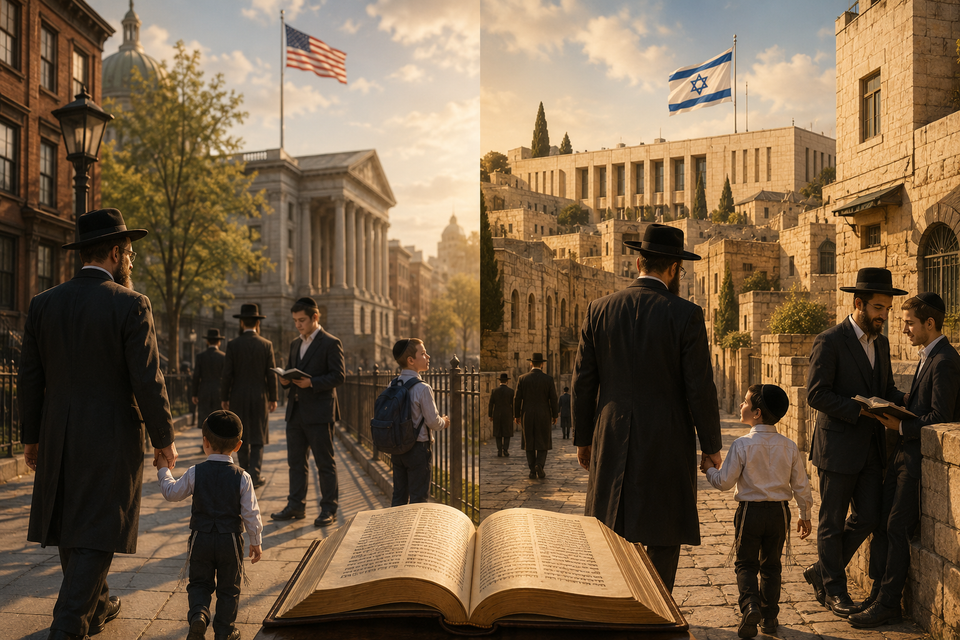
Which leads to one of the bitter ironies of our age. In many ways, Torah Jews today are freer to live as Torah Jews under certain non-Jewish governments than under the secular Jewish one in their own homeland. In America, Charedim learn, teach, open mosdos, and live openly and proudly as Torah Jews with little interference. In Eretz Yisrael, by contrast, secular politicians fight to jail bnei Torah, drain the yeshivos of funding, and force a "core curriculum" designed to dilute Torah chinuch — battles documented at length elsewhere in this series. The danger, it turns out, was never the gentile who tries to stop us from keeping the Torah. It is the fellow Jew who tries to change what the Torah is.
VII. The Range of Daas Torah
The Gedolim have voiced this concern across a spectrum. Rav Elazar Menachem Man Shach returned to it again and again: the deepest danger of secular Zionism was never military but spiritual — the quiet erasure of Torah values from the soul of the nation. At the furthest end stands the Satmar Rebbe, who in his Vayoel Moshe argued from the Three Oaths that secular Jewish sovereignty in Eretz Yisrael is not merely worse than galus but is itself galus — exile wearing its most dangerous disguise, the disguise of redemption. Between these voices lies the broad mainstream of the Torah world, which neither blesses the secular state's ideology nor abandons the field to it, but works within it to protect Torah while refusing to call its war on Torah by any softer name.
VIII. So What Is the Answer?
There is no simple one, and it would be dishonest to pretend otherwise. Living among Jews is always a blessing, and Eretz Yisrael is always our home — no secular government can make it otherwise. But leadership that sets out to destroy Torah, even when it speaks Hebrew and wears a kippah, is more dangerous to the Jewish soul than exile among strangers.
The Charedi world is not ungrateful, and it does not deny the physical gifts of the modern state. It simply measures good and evil by one standard, and only one: what draws us closer to Hashem, and what pulls us away. Where a government protects Torah — even a government far from observance — we rejoice and we thank it. Where a government wages war on Torah, we resist it — not with violence, but with tefillah, with mesirus nefesh, and with absolute clarity about what is at stake. And through all of it we daven for the only government that will ever fully answer the question: that of Melech HaMoshiach, who will restore true Torah rule to this land — not through coercion, but through clarity, through love, and through truth.
May Hashem guard His Torah and His people from every threat, within and without, may every captive heart be drawn home in love, and may we soon see the kingship of Hashem revealed over all the earth — bimheirah b'yameinu, amen.
Sources
The danger from within
- Rav Elchonon Wasserman, Hy"d (Ikvesa d'Meshicha, in Kovetz Maamarim) — that the gravest threat to Torah Jewry in the pre-Moshiach era would arise from within, under the banner of progress and secular nationalism
- The mesorah's teaching regarding the internal spiritual adversary of the generations before Moshiach
The Chazon Ish and the secular state
- The meeting of the Chazon Ish and David Ben-Gurion in Bnei Brak on October 20, 1952, amid the controversy over conscripting women, and the Chazon Ish's parable of the laden and empty wagons (the burdened wagon, bearing millennia of Torah, to which the newcomer must give way), followed by his letter of opposition that December
- The Chazon Ish's ruling (in his commentary on Yoreh Deah) that the non-observant Jew of our time has the status of a tinok shenishba, to be drawn close with love rather than treated as a rebel — the war is against the ideology, never the person
The measure of any government
- Rav Aharon Kotler — that accepting state support which builds Torah, free of spiritual conditions, is permitted and even praiseworthy
- Rav Elazar Menachem Man Shach — that the deepest danger of secular Zionism is spiritual erasure rather than physical threat
- The Satmar Rebbe, Rav Yoel Teitelbaum (Vayoel Moshe, Maamar Shalosh Shevuos) — that secular Jewish sovereignty in Eretz Yisrael is galus in its most dangerous disguise
The structural relationship to other articles in this series
- "What Is the Charedi View of the State's Government Legitimacy?" — the foundation beneath this question
- "Does the State of Israel Try to Force Secular Education in Charedi Schools?" — the war on Torah in its present form
- "What Is the Charedi View on Voting in Israeli Elections?" — how the Torah world acts within a system it does not endorse
- "Is Zionism Working?" — the ideology being measured here