How do Charedim Uplift Israeli Society Through Chessed and Nonprofit Work?
One of the least understood contributions the Charedi world makes to the State of Israel is also one of its largest: a vast, humming network of nonprofits and chessed organizations that quietly carries enormous parts of the country's health, welfare, and emergency systems. These are not PR projects. They are the operating system of Charedi society — built on ahavas Yisrael, gemilus chassadim, and the conviction that every Jew is responsible for every other — and a great deal of what they produce flows straight to Israelis of every kind.
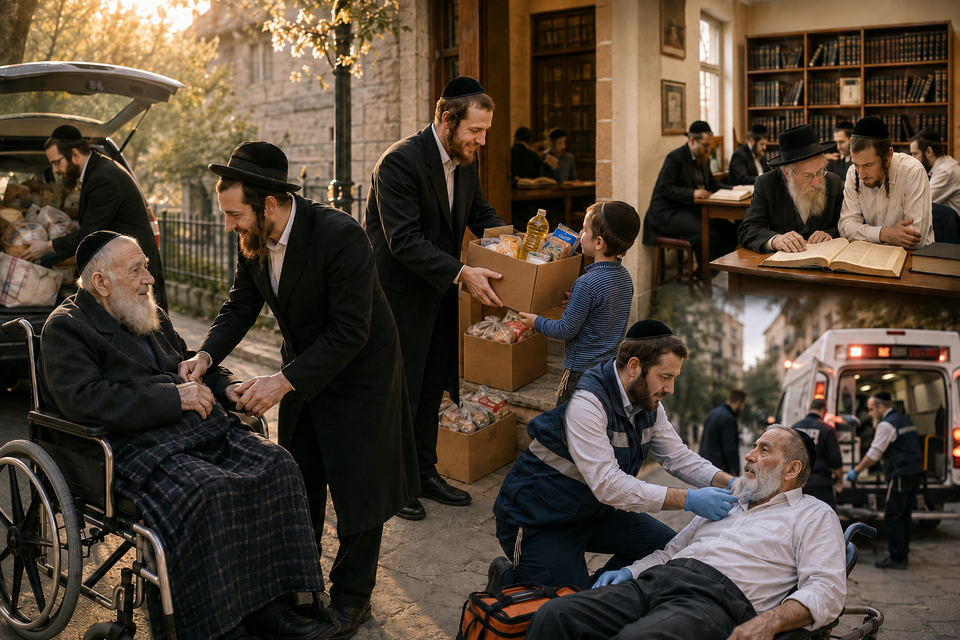
While the public argument stays fixed on army exemptions and budget lines, tens of thousands of Charedi men and women are, at this very moment, saving lives, feeding families, rescuing the vulnerable, and sitting beside the broken-hearted — often anonymously, almost always without pay, and very often on behalf of people who share none of their beliefs. This article maps that world, and ends with a directory of ten of its flagship institutions.
I. The Engine: Why a Torah Community Builds Like This
The chessed network is not an accident of culture; it is the direct output of what the Torah commands. "The world stands on three things," the Mishnah teaches — "on Torah, on avodah, and on gemilus chassadim" (Avos 1:2). Kindness is not an optional extra bolted onto Jewish life; it is one of the three pillars holding the world up. The Gemara goes further, defining the mitzvah of "v'halachta bidrachav" — walking in Hashem's ways — as the obligation to imitate Him: as He clothes the naked, visits the sick, and buries the dead, so must we (Sotah 14a). And binding it all together is the principle that turns private virtue into a national infrastructure: kol Yisrael areivim zeh lazeh — every Jew is a guarantor for every other (Shevuos 39a). When you actually believe that another Jew's hunger, illness, or grief is your responsibility, you do not wait for a ministry to act. You build.
II. The Scale: A Nation of Kindness Within the Nation
The result is staggering in its breadth. At the grassroots sit the gemachim — free-loan and free-lending funds — which exist across Israel in the thousands, a single neighborhood often running dozens. The money gemachim alone are estimated to hold deposits ranging from several billion into the tens of billions of shekels: an entire interest-free lending economy, built on the Torah's prohibition against charging a fellow Jew interest and its command to lend to those in need (Shemos 22:24; Devarim 15:8).
Above the gemachim rises a dense ecosystem of formal nonprofits spanning medicine, mental health, poverty relief, emergency response, education, orphan care, burial, and financial rehabilitation — powered by tens of thousands of volunteers, many giving their time without recognition or recompense. Some are national in scale and serve every Israeli without distinction; others are hyper-local, quietly holding up a single street or kehillah. Together they relieve the State of billions of shekels it would otherwise have to spend on healthcare, welfare, and social services — a subsidy running in the opposite direction from the one the headlines describe.
III. Ten Flagship Charedi Nonprofits — and Their Impact
What follows is a directory of ten of the largest and most consequential, each founded or led by members of the Charedi community, each serving Israelis far beyond it.
1. Ezer Mizion — health and medical support — ezermizion.org Founded by Rav Chananya Chollak, Ezer Mizion operates the largest Jewish bone-marrow donor registry in the world, now numbering more than a million registered donors, and has matched donors to patients to enable life-saving stem-cell transplants across Israel and around the globe. Alongside the registry it runs scores of programs — ambulance and patient transport, medical-equipment loans, respite and therapy services, and support for cancer patients, the elderly, and children with special needs.
2. Yad Sarah — medical equipment lending — yadsarah.org Founded in 1976 by the late Rabbi Uri Lupolianski — who would later become Jerusalem's first Charedi mayor, and who passed away in early 2026 — Yad Sarah grew into the largest volunteer organization in Israel. Through more than 120 branches and some 7,000 volunteers, it lends out wheelchairs, hospital beds, oxygen machines, and medical equipment of every kind, free of charge, to more than half a million people a year — saving the national healthcare system an estimated NIS 5.5 billion (about $1.5 billion) annually.
3. United Hatzalah — emergency medical response — israelrescue.org Founded by Eli Beer, who grew up in Jerusalem's Charedi community, United Hatzalah fields a corps of more than 8,000 volunteer medics who respond to over 2,000 emergencies a day with an average response time under three minutes — and roughly 90 seconds in major cities — using GPS dispatch and a fleet of rapid "ambucycles." It treats every patient free of charge, and serves all Israelis regardless of religion or background.
4. ZAKA — rescue and chesed shel emes — zaka.org.il Emerging from the volunteers who organized after a 1989 bus bombing, ZAKA (Disaster Victim Identification) fields thousands of volunteers — overwhelmingly Charedi — who perform perhaps the most thankless kindness of all: chesed shel emes, the recovery and dignified treatment of the dead after terror attacks, accidents, and disasters, for which no thanks can ever be repaid. Government-recognized and often first on the scene, ZAKA has deployed to international disasters from Haiti to Mumbai.
5. Yad Eliezer — poverty relief — yadeliezer.org.il Founded in 1980 by Rabbi Yaakov and Hadassah Weisel, Yad Eliezer became one of Israel's largest poverty-relief organizations, supporting over 18,000 families a year through monthly food packages, baby formula, widow and orphan support, job training, and a fund that provides full weddings for poor couples — all run with famously low overhead, with the great majority of every shekel reaching families directly.
6. Migdal Ohr — at-risk youth and education — migdalohr.org Founded in 1972 by Rabbi Yitzchak Dovid Grossman — the "Disco Rabbi" of Migdal HaEmek, later an Israel Prize laureate — Migdal Ohr grew into one of Israel's largest welfare-education networks, caring for thousands of orphaned, disadvantaged, and at-risk children across multiple campuses and scores of youth clubs. Its students come from religious and secular homes alike, from native Israelis to immigrant children from Ethiopia, Russia, and beyond.
7. Lev L'Achim — education and outreach — levlachim.org Operating for decades under the leadership of Rav Aharon Leib Shteinman, Lev L'Achim runs a nationwide network of thousands of volunteers devoted to Jewish education and connection — placing children in Torah schools, operating learning centers, mentoring at-risk youth, assisting immigrants, and running helplines — much of it directed toward secular and immigrant families who would otherwise have no Jewish education at all.
8. Zichron Menachem — children with cancer — zichron.org Founded in 1990 by Chaim and Miri Ehrental after the loss of their son Menachem to cancer at fifteen — work for which they later received the Israel Prize — Zichron Menachem supports children with cancer and their families in every major Israeli hospital: a day center, a blood bank, counseling, respite trips, and fully-staffed medical camps, all free of charge, for families of every background.
9. Bayit Lepletot / Girls Town Jerusalem — orphaned and at-risk girls — bl-girlstown.org Founded in 1949 by Rabbi Naftali Rosenfeld, himself a Holocaust survivor, to take in orphaned refugee girls, Bayit Lepletot has cared for thousands of girls over more than seventy years. Today it houses and educates hundreds at a time — orphans, children of terror victims, girls from broken homes — taking full responsibility for each one from childhood through her wedding, turning none away.
10. Chasdei Naomi — food and poverty relief — chasdei-naomi.org For roughly three decades, Chasdei Naomi has been among Israel's largest food-relief organizations, delivering food packages and holiday provisions and supporting the country's neediest — poor families, Holocaust survivors, lone soldiers, and the elderly — across the nation, sustained by donations and a large volunteer base.
And these ten are only the visible peaks. Behind them stand countless smaller organizations — financial-empowerment programs that pull families out of debt toward independence, medical-referral services, simcha and morale projects for the hospitalized, neighborhood chesed funds — and the thousands of gemachim that never appear on any list at all.
IV. Who It All Serves — and Why
Read that directory again and notice what is missing from it: any line that says "for Charedim only." Yad Sarah's wheelchairs, United Hatzalah's medics, Ezer Mizion's bone-marrow matches, ZAKA's volunteers, Migdal Ohr's classrooms — these reach secular Israelis, Dati Leumi Israelis, Arab Israelis, tourists, and non-Jews, without a question asked about who they are. The Charedi chessed network is not a closed circle serving its own. It is one of the most open and far-reaching welfare systems in the country.
And it is powered by something other than politics or public relations. No one builds a bone-marrow registry of a million people, or rises at 2 AM to deliver oxygen to a stranger, or recovers the dead from a bombing, for a tax break or a headline. It is driven by kol Yisrael areivim zeh lazeh — the unshakable conviction that the suffering of any Jew is the responsibility of every Jew — extended outward, as the Torah's chessed always is, to every human being made in the image of Hashem.
V. The Bottom Line
This is the contribution the debate forgets to count. While the country argues over what the Charedi world supposedly takes, that same world is quietly running an enormous share of the nation's chessed — healing the sick, feeding the hungry, raising the orphan, honoring the dead, and rescuing the lost — and handing the results, free of charge, to everyone.
It does this not out of obligation to the State, but out of obligation to something the State cannot legislate: the Torah's command that we carry one another. That is the engine. The organizations above are simply what it looks like when a community takes that command seriously.
May the quiet givers be blessed for all the good they do unseen, may Klal Yisrael always be known among the nations by its chessed, and may the day come when kindness fills the earth as the waters cover the sea — bimheirah b'yameinu, amen.
Sources
The Torah of chessed and areivus
- Avos 1:2 — the world stands on Torah, avodah, and gemilus chassadim
- Sotah 14a — "v'halachta bidrachav," the mitzvah to imitate Hashem's kindness
- Shevuos 39a — kol Yisrael areivim zeh lazeh, every Jew a guarantor for every other
- Tehillim 89:3 — "olam chesed yibaneh," the world is built on kindness
- Shemos 22:24; Devarim 15:8 — the prohibition against interest and the mitzvah to lend, the foundation of the gemach
The organizations (founders, scope, and official websites)
- Ezer Mizion (ezermizion.org); Yad Sarah (yadsarah.org); United Hatzalah (israelrescue.org); ZAKA (zaka.org.il); Yad Eliezer (yadeliezer.org.il); Migdal Ohr (migdalohr.org); Lev L'Achim (levlachim.org); Zichron Menachem (zichron.org); Bayit Lepletot / Girls Town Jerusalem (bl-girlstown.org); Chasdei Naomi (chasdei-naomi.org) — figures drawn from the organizations' own published reporting and reputable coverage
The structural relationship to other articles in this series
- "Do Charedim Contribute to Israeli Society in Other Ways Besides Paying Taxes?" — the broader picture of which this chessed network is one part
- "How Does Torah Learning Benefit Every Jew?" — the spiritual contribution alongside the practical
- "Who Benefits More — Charedim or the State?" — the full balance sheet