
How Do Charedim Feel About Charedi Soldiers Who Do Join the IDF?
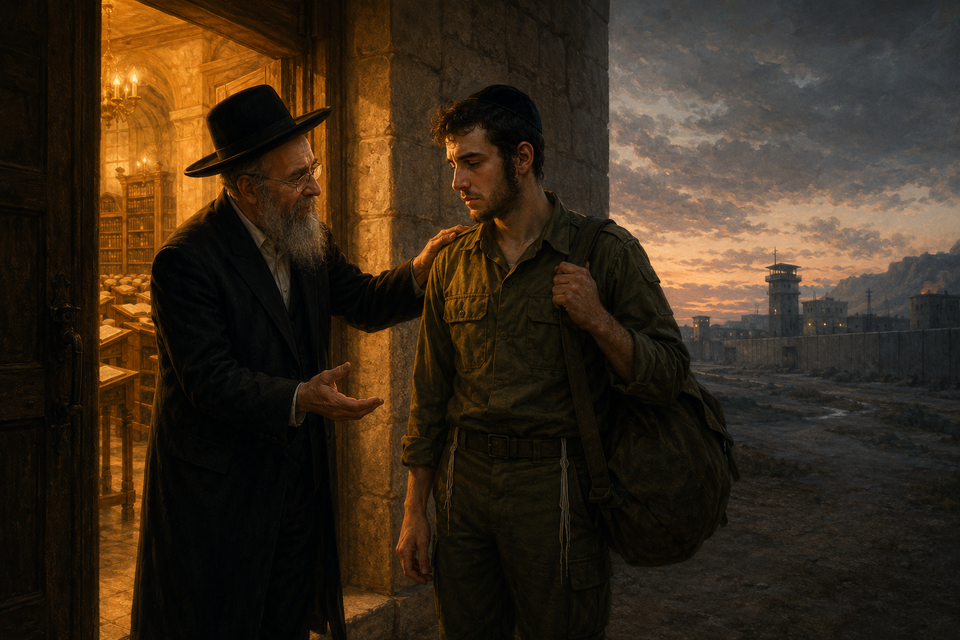
The Charedi world draws a sharp line between the system and the soul. Toward the army as an institution — and never more than now, with yeshiva students under arrest and the entire Torah world under open assault — the response is firm, unbroken resistance, because in this climate every enlistment is seized upon as proof that the Torah world can be broken, and used to tighten the pressure on everyone else. Toward the individual Jew caught in that machinery, the response is the opposite: not condemnation but concern, not rejection but an outstretched hand. We resist the system with all our strength, and we never stop loving the soul.
How does the Charedi world feel about Charedim who end up serving in the IDF?
To answer honestly, one must hold two things at once that are too often collapsed into one: the system, and the soul. Toward the institution of the army — its framework, its goals, its place in the war now being waged against the Torah world — the Charedi response is firm and unyielding opposition, and, as we will explain, that opposition has grown more urgent, not less, in the present moment. But toward the individual Jew who ends up in uniform — often pressured, often confused, often crushed between impossible forces — the response is something entirely different: concern, not condemnation; an outstretched hand, not a closed door. The whole of the Charedi position lives in the space between those two, and we set it out below.
I. The System and the Soul Are Not the Same Thing
The first principle, taught consistently by the Gedolim, is that one must never confuse disagreement with hatred, or opposition to a system with rejection of a person.
A Charedi Jew who ends up in the army is not, in the Torah world's eyes, a rasha or an enemy. He is a fellow Jew — and very often a wounded one: a young man who was pressured, or misled, or financially cornered, or who struggled in learning and lost his footing, or who simply could not withstand forces far larger than himself. Rav Aharon Leib Shteinman gave the authentic Torah reflex when, of a bochur who ended up in the army, he turned the question inward — what did we fail to do for him? where did we fall short? — rather than outward in accusation. That instinct — to respond to a Jew's fall with self-examination and concern rather than condemnation — is the heart of the matter. The fight is with the system that swallowed him; it was never with him.
II. Now, More Than Ever — Why Resistance Has Become Urgent
And yet precisely because we distinguish the system from the soul, we must speak plainly about the system in this hour — because the hour has changed, and the stakes have risen sharply.
The Torah world today is not facing a debate; it is facing an assault. As of this writing, yeshiva students are being arrested — military police have carried out well over a thousand arrest operations against draft "evaders," young men have been detained and jailed, and bochurim have been seized even while leaving the country or, in at least one case, while filing a complaint at a police station. The courts have ordered, and the state has begun to impose, a battery of personal sanctions on individual yeshiva students: the stripping of housing benefits, the cancellation of daycare and childcare subsidies — even for those who work — and the threat of criminal prosecution, alongside moves to punish the very donors who support the yeshivos. This is no longer a policy disagreement about "sharing the burden." It is an open campaign of pressure, arrest, and financial strangulation directed at the Torah world as such — at its yeshivos, its students, and its way of life.
In such an hour, resistance is not stubbornness; it is survival. And here a hard truth must be said clearly, for it is the reason the resolve of the community matters now as never before: every Charedi who is brought to enlist is seized upon by those waging this campaign as proof that the whole Torah world can be broken. Each enlistment is held up as evidence that the exemption was never necessary, that resistance is mere obstinacy, that "see — it can be done" — and is used, immediately, to intensify the pressure on everyone else. In a war of attrition against the Torah world, each defection is not a private matter; it is ammunition handed to those who seek to dismantle the whole. This is precisely why the community's resolve must hold, and hold together: because those pressing the assault are counting on it to crack, and are working to convert every individual who succumbs into a battering ram against the rest.
Let this be heard by the young man who is wavering, and let it be heard as protection, not condemnation: to be brought into the army now is not only a danger to your own ruchniyus — it is to be made, against your own people, into a weapon you never meant to be. The ones pressing you do not want a soldier; they want a symbol — proof to wave before the world that the Torah world has begun to fold. Do not let yourself be turned into that symbol. Stand with your people. The strength of the whole depends on each one holding firm, and never more than now.
III. Firmness Toward the System, Compassion Toward the Soul
These two — fierce resistance to the system and genuine compassion for the individual — are not in tension. They operate on entirely different planes, and the Torah holds both at once.
The resistance is aimed at the system and its campaign of pressure; the compassion is aimed at the soul caught within it. We resist the machinery with all our strength, and we refuse to let that machinery turn us against the Jew it has captured. Indeed, the very framing of the danger — that the system seeks to use the enlisted Charedi as ammunition against his own people — should deepen our compassion for him, not lessen it, for it reveals him to be, very often, the system's victim rather than its agent: a young man maneuvered, pressured, and then exploited by forces that care nothing for him and everything for what his uniform can be made to represent. To resist the system fiercely and to love its victims fully is not a contradiction. It is the only coherent response. Chazal gave us the model in three words — "smol docheh v'yamin mekareves," the left hand pushes away while the right hand draws near (Sotah 47a) — and they were careful to teach that the right hand, the hand that draws close, must always be the stronger of the two. We push the system away with the left; we pull the Jew close with the right — and the right is stronger.
IV. The Hand Extended to the One Who Has Fallen In
So how does the Charedi world actually treat the individual who is already there, in uniform? The Torah ideal is unambiguous: with care, with help, and with an open door — never with rejection.
When Rav Michel Yehuda Lefkowitz was asked whether a young man who had grown up Charedi and ended up in the army should be turned away from the yeshiva upon his return, his answer was immediate: if he still wants to learn, bring him in — and with kavod; the Torah has not left him. That is the authentic response. The mesorah's whole approach to any Jew who has strayed is built on it: "lo yidach mimenu nidach" — that the Almighty contrives that no one be cast away forever (Shmuel II 14:14); and the recognition that a Jew raised and pressured by forces beyond his control is to be understood with the compassion due a tinok shenishba, not the severity due a rebel (Shabbos 68a–b). No Jew is ever beyond return — and the quiet work of kiruv organizations and individuals who arrange chavrusas, shiurim, and a warm place to land for young men in army frameworks is the living expression of that emunah. The hand is always extended; the door is never barred.
This is also why the harshness that some Charedi soldiers report — the sense of being rejected by a community, a yeshiva, even a family — is a failure of the ideal, not the ideal itself. Where such coldness exists, it usually flows not from hatred but from fear: fear that others will follow, fear for the community's Torah values, fear of the spiritual price these young men are paying. The fear is understandable. But fear is not an excuse to wound a fellow Jew, and to push away or shame a young man who has stumbled is to violate the Torah's own standard — the same standard, set out in our article on mocking fellow Jews, that forbids degrading any Jew created in the image of God. The honest position is to name this plainly: rejection of the individual is not the Charedi ideal; it is a falling-short of it, and the answer is to return to the ideal, not to defend the failure.
V. The Closing Position — Resist the System, Love the Soul
So how do Charedim feel about Charedim who join the IDF?
We feel two things at once, and we refuse to surrender either. Toward the system that draws them in — now waging an open campaign of arrests, sanctions, and pressure against the entire Torah world — we feel firm, unbroken opposition, sharpened rather than softened by the present assault; for in this hour every enlistment is converted into a weapon against the whole, and the resolve of the community to stand together has become a matter of survival. We resist, now more than ever, because to fold is to hand our adversaries the proof they are working so hard to manufacture. And toward the individual Jew caught in that machinery — pressured, confused, and so often used — we feel concern, sorrow, and an unbreakable love; we ask what we failed to do for him, we keep the door of the beis medrash open, and we never stop believing in his neshama.
To care. To help. To cry. To guide. To resist the system with all our strength — and never to turn that strength against the soul. That is the Charedi response, and it has not changed, except to grow more urgent: hold the line against the system, and hold the hand of every Jew within it. Because no Jewish soul is ever beyond reach, and no Jew — in uniform or out — is ever, for a single moment, beyond the love of his people or the love of Hashem.
May Hashem strengthen His people to stand firm in this hour, guard every Jewish soul from harm of body and of spirit, and bring us speedily to the day when the Torah world is no longer under siege — bimheirah b'yameinu, amen.
Sources
The system and the soul
- The consistent teaching of the Gedolim that opposition to a system must not be confused with rejection of a person; the documented approach of Rav Aharon Leib Shteinman — responding to a bochur's fall into the army by asking "what did we fail to do for him?" rather than with condemnation — presented as the documented substance of his approach (the original draft's citation to "Pe'er HaDor," which is the biography of the Chazon Ish, is corrected)
Now, more than ever — the present assault
- The current enforcement campaign: the High Court's April 2026 order imposing personal economic sanctions on individual draft evaders — denial of housing benefits, cancellation of daycare and childcare subsidies even for those who work, and criminal proceedings — and the move to end tax benefits for donors to yeshivos; over a thousand military-police arrest operations and the detention and jailing of yeshiva students since the November 2025 ruling; tens of thousands of enlistment orders to a community of which some 80,000 are eligible and have not enlisted (Times of Israel; Jerusalem Post; Israel Democracy Institute, 2025–2026) — the documented backdrop establishing that the present moment is one of open pressure on the Torah world
- The dynamic, openly visible in the public debate, by which each Charedi enlistment is held up by proponents of the draft as proof that the exemption is unjustified and resistance unnecessary — and thereby used to intensify the pressure on the remainder of the community
Firmness and compassion together
- Talmud Bavli, Sotah 47a — "smol docheh v'yamin mekareves" — the left hand pushes away while the right hand draws near, the right being the stronger (developed in "What Is the Charedi Approach to Those Who Go Off the Derech?")
The hand extended to the individual
- The documented approach of Rav Michel Yehuda Lefkowitz — that a young man who served and still wishes to learn must be brought into the yeshiva with kavod, for the Torah has not left him — presented as a documented theme
- Shmuel II 14:14 — "lo yidach mimenu nidach" — the Almighty contrives that no one be cast away forever; and Talmud Bavli, Shabbos 68a–b — the framework of tinok shenishba, the compassion due one shaped by forces beyond his control rather than the severity due a rebel (both developed in "What Is the Charedi Approach to Those Who Go Off the Derech?")
- The quiet work of kiruv and support organizations (such as Lev L'Achim) that arrange chavrusas, shiurim, and connection for young men in army frameworks — presented generally; the article does not endorse the army-enlistment frameworks themselves, consistent with this series' position
Where the ideal is not met
- Vayikra 19:17 — "lo sisna es achicha bilvavecha" — do not hate your brother in your heart; the honest acknowledgment that rejection or harshness toward a returning soldier, where it occurs, flows from fear rather than the Torah ideal, and violates the standard that forbids degrading any fellow Jew (developed in "What Is the Torah's View on Mocking Charedim and the Gedolim?")
The structural relationship to other articles in this series
- "Why Does the Charedi World Frown on 'Charedi' IDF Programs?" and "Is It True That the Secular Establishment Wants to Assimilate Charedim Through the IDF Draft?" — the case against the system
- "Until When Will You Keep Protecting Them?" — the call to protect, not surrender, the struggling bochur
- "What Is the Charedi Approach to Those Who Go Off the Derech?" — the model of firmness toward the path and love toward the person
- "What Is the Torah's View on Mocking Charedim and the Gedolim?" — the prohibition on degrading any fellow Jew