
Do Charedim have Hakaras HaTov for those that do serve?
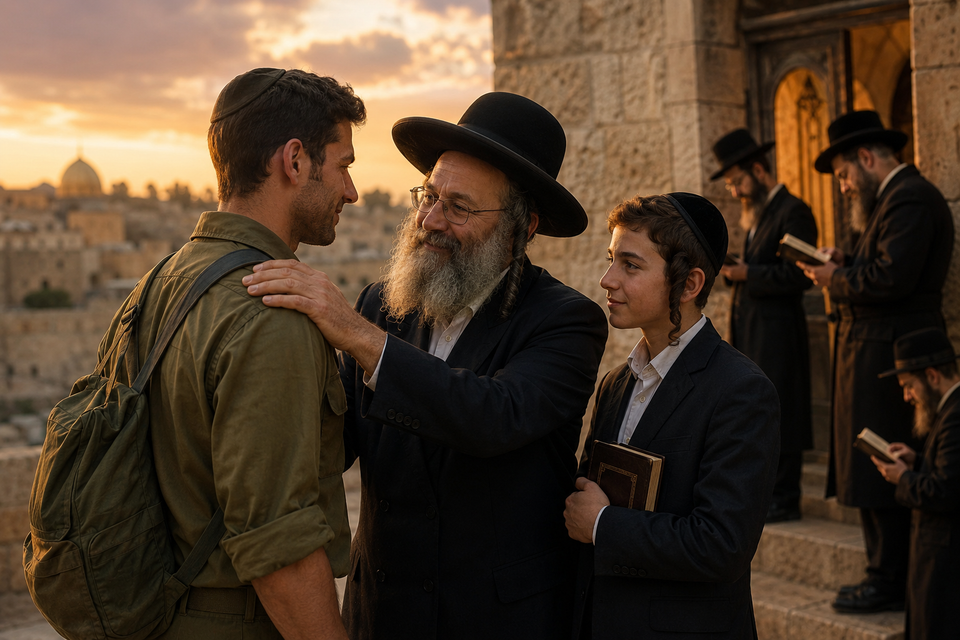
Yes — and the gratitude is real, not grudging. Hakaras hatov is a Torah obligation so fundamental that the Torah teaches it even toward water and dust, and it most certainly extends to a Jew who places his body between his people and their enemies. The thing to understand is that gratitude and disagreement are not opposites: one can oppose conscription and the secular military ideology with full conviction, and at the very same time owe — and feel — deep, sincere appreciation for the individual who serves with mesirus nefesh. To disagree with a system is not to be ungrateful to the person inside it.
Do Charedim have hakaras hatov — genuine gratitude — for those who serve in the IDF to protect Am Yisrael?
Yes. Sincerely, and as a matter of Torah obligation, not mere politeness. The Charedi world has well-known and deep disagreements about conscription, about the secular framework of the army, and about the place of Torah Jews within it — and we have set those out, at length and without softening, across this series. But none of that touches the gratitude owed to the individual who risks his life for the Jewish people. These are two entirely different questions, and the failure to keep them apart is the source of most of the confusion. One can hold, with complete conviction, that the system is wrong, and hold, with equal conviction, that the soldier within it who places his body between his people and their enemies deserves our profound hakaras hatov. We explain how and why below.
I. Hakaras HaTov Is a Torah Obligation — Even Toward Water
Begin with how seriously the Torah takes gratitude, because once that is clear, the rest follows almost on its own. Hakaras hatov is not an optional nicety in the Torah; it is a foundational obligation — and the Torah drives the point home with a startling example.
When the plagues struck Egypt, Moshe Rabbeinu did not bring the first plagues himself. The Nile was struck — turned to blood, and made to swarm with frogs — by Aharon, not Moshe; and so too the dust of the earth, struck to bring the plague of lice, was struck by Aharon. Why not by Moshe? Rashi explains: the river had protected Moshe when he was placed in it as an infant, and the dust had shielded him when he buried the Egyptian in the sand — and therefore it was not fitting that Moshe be the one to strike them (Rashi, Shemos 7:19; 8:12). Pause on what this means. Moshe Rabbeinu was required to show hakaras hatov toward water and dust — inanimate things that neither knew nor cared that they had helped him — simply because he had benefited from them. As Chazal put it: a well from which you have drunk — do not cast a stone into it. If the Torah demands gratitude even toward lifeless water and dust, how much more does it demand gratitude toward a living Jew who knowingly risked his life to protect you.
And the Torah treats ingratitude as a genuine spiritual failing. The song of Haazinu rebukes a people who "forgot God who brought you forth" (Devarim 32:18) — placing ingratitude near the root of spiritual decline. The baalei mussar teach a piercing principle here: one who trains himself to deny the good done to him by people — kfiyas tovah — will, in the end, come to deny the good done to him by Hashem, for the two are the same middah turned in different directions. Gratitude to people is not separate from one's avodas Hashem; it is part of its foundation. This is why the Chazon Ish counted the recognition of good in others among the marks of true human greatness. A Jew who cannot feel hakaras hatov has a flaw at the root of his service of Hashem — and the Torah world knows this and is bound by it as much as by any other part of the Torah.
II. Gratitude Does Not Require Agreement
Here is the distinction on which the entire question turns, and it is a simple one once stated: being grateful to a person is not the same as endorsing his path, and disagreeing with a person's choices is not the same as being ungrateful to him. These are independent. One can do either without the other, and the mature Torah position does both at once.
We know this from ordinary life, where no one finds it puzzling. A father can disagree, deeply, with the path his son has chosen — and love him without reserve, and be grateful for the good in him, and weep for him at night. A rebbi can oppose a decision his talmid has made, and still cherish him, still recognize his virtues, still feel gratitude for what is good in what he does. Disagreement and love, opposition and gratitude, live together comfortably in every healthy relationship — and only in the heated arena of the draft debate does anyone pretend they cannot. The Charedi world's relationship to the soldier is exactly this: we may believe his path is mistaken, and we may oppose the system that placed him where he is, and we still owe him — and feel — real gratitude for the danger he has taken upon himself on our behalf.
To insist otherwise — to claim that the only way to be grateful to a soldier is to endorse conscription, or that any disagreement with the army proves a lack of gratitude — is to confuse two things the Torah keeps carefully apart. Hakaras hatov attaches to the person and to the good he has done; it does not require agreement with the framework he operates in. The Charedi world can say, in the same breath and without contradiction: we oppose this system, and we are grateful to you. That is not a dodge or a hedge. It is precisely how the Torah's obligation of gratitude works — owed to the benefactor for the benefit, independent of whether one would have chosen his road.
III. The Gedolim's Hakaras HaTov
This is not a clever argument constructed after the fact; it is the lived position of the Torah leadership, expressed again and again.
Rav Aharon Leib Shteinman — who opposed the conscription of yeshiva bochurim as firmly as anyone — was known to say of soldiers that they give of themselves for Klal Yisrael, that even though the Torah world does not follow their path, it owes them appreciation. He is reported to have told askanim that just as one must never compromise on Torah, so too one must never speak with disrespect of those who place themselves in danger for the nation. Rav Moshe Feinstein held both halves together with characteristic clarity: that Torah and halacha may never be compromised for the sake of unity, and that, at the very same time, one who protects the Jewish people is owed gratitude — even as we daven for every Jew's return to full Torah life. The Bobover Rebbe, Rav Shlomo Halberstam — no friend of secular Zionist ideology — is remembered for showing honor to a wounded soldier, on the grounds that here was a Jewish neshama who had suffered, and that alone commanded respect. And Chacham Ovadia Yosef had the custom of saying a Mi Shebeirach for the soldiers, giving voice to gratitude to Hashem for those who stood in defense of Jewish lives against terror — for whoever saves a single Jewish life, the Mishnah teaches, is as one who saved a whole world (Sanhedrin 37a).
Notice what unites them. Every one of these Gedolim held firm Charedi positions — on conscription, on the secular state, on the place of Torah — and every one of them, without any sense of contradiction, expressed genuine gratitude and honor toward those who serve. They are the living proof that the two can, and must, be held together.
IV. Expressed the Charedi Way — Quietly
If the gratitude is real, why is it so often invisible to those outside the community? Because the Charedi world expresses its hakaras hatov in its own idiom — and that idiom is not the public rally, the flag, or the slogan.
It is expressed in Tehillim — children and grown men adding kappitlach for soldiers in danger. It is expressed in tears — the genuine grief of homes and yeshivos when a soldier falls. It is expressed in kabbalos — communities taking on extra learning and mitzvos in the merit of those at the front. And it is expressed in quiet chesed — the steady, unpublicized stream of food, support, and tefillah that flows from Charedi neighborhoods toward soldiers and their families, through every war and every wave of terror, with no cameras and no credit sought. This is the native language of Charedi gratitude: not the demonstrative gesture, but the Tehillim said in the dark, the tear wiped quietly, the chesed done without a name attached. To one accustomed to looking for gratitude in public displays, this can look like silence. It is not silence. It is the way a Torah Jew gives thanks — inwardly, before Hashem, and through deeds rather than slogans.
V. The Closing Position
So — do Charedim have hakaras hatov for those who serve?
Yes — real, Torah-mandated, heartfelt gratitude. The obligation of hakaras hatov runs so deep in the Torah that it is owed even to water and dust that once helped a person; it is owed, beyond all question, to a Jew who places his body in danger for his people. And it is owed independently of agreement — for gratitude attaches to the person and the good he has done, not to one's endorsement of the system he serves within. The Charedi world can oppose conscription and the secular military framework with full conviction, and in the very same heart carry deep appreciation for the courage and sacrifice of those who serve. The two are not in tension; the Torah keeps them apart, and the Gedolim held them together.
That this gratitude is expressed quietly — in Tehillim, in tears, in unpublicized chesed — does not make it less real; it makes it the gratitude of a Torah Jew rather than the gratitude of a press release. And where any Jew falls short of it, the failure is his and not the Torah's, whose standard remains, always, hakaras hatov.
Because in the end, whatever our disagreements, a Yiddishe neshama is never a stranger to us — and one who has risked that neshama, and his very body, for the safety of Klal Yisrael has earned a place in our hearts and our tefillos that no disagreement can take away.
May Hashem watch over all who stand in the defense of His people, and return all of Israel together to Him in peace — bimheirah b'yameinu, amen.
Sources
Hakaras hatov is a Torah obligation — even toward water
- Rashi, Shemos 7:19 and 8:12 — Moshe did not strike the Nile (which had protected him as an infant) nor the dust (which had hidden the Egyptian he buried); they were struck by Aharon — hakaras hatov owed even to inanimate water and dust; with the principle "a well from which you have drunk, do not cast a stone into it" (Bamidbar Rabbah; Tanchuma)
- Devarim 32:18 — the rebuke of those who "forgot God who brought you forth" — ingratitude near the root of spiritual decline; the mussar principle that denying the good done by people (kfiyas tovah) leads to denying the good done by Hashem
- The theme (in the name of the Chazon Ish, Emunah U'Bitachon) that recognizing the good in others is a mark of human greatness — presented as a documented theme
Gratitude does not require agreement
- The distinction, fundamental to the Torah's obligation of hakaras hatov, that gratitude attaches to the benefactor for the benefit, independent of agreement with his path or framework — as a father may disagree with a son, or a rebbi with a talmid, while loving and being grateful to him
The Gedolim's hakaras hatov
- The documented positions and conduct of Rav Aharon Leib Shteinman (gratitude owed to those who give of themselves for Klal Yisrael, and the insistence that one never speak with disrespect of those who endanger themselves for the nation), Rav Moshe Feinstein (that Torah may not be compromised for unity, and that one who protects the Jewish people is owed gratitude even as we daven for his return; Igros Moshe — the original draft's citation to Yoreh De'ah 4:38 is presented as his documented position rather than a verified siman), the Bobover Rebbe, Rav Shlomo Halberstam (honor shown to a wounded soldier as a Jewish neshama who had suffered), and Chacham Ovadia Yosef (the custom of a Mi Shebeirach for soldiers; gratitude for those who defend Jewish lives) — all presented as the documented substance of their views and conduct rather than as verified verbatim quotations; the original draft's pastoral quotation attributed to Yechaveh Daas, a work of halachic responsa, is not reproduced as such
- Talmud Bavli, Sanhedrin 37a — "whoever sustains a single Jewish soul is as one who sustained an entire world" — the magnitude of what one who saves Jewish lives accomplishes
Expressed the Charedi way; and where the ideal is not met
- The documented reality of Charedi gratitude expressed through Tehillim, kabbalos, tears, and quiet chesed for soldiers through every war and wave of terror — presented as the documented general phenomenon rather than relying on specific unverifiable accounts; the anonymous vignettes in the original draft are not reproduced as documented events
- The honest acknowledgment that the Torah's standard of hakaras hatov binds the community, so that contempt toward soldiers is a violation of that standard rather than an expression of the Charedi position (consistent with "What Is the Torah's View on Mocking Charedim and the Gedolim?", whose prohibitions on degrading a fellow Jew the Torah applies universally)
The structural relationship to other articles in this series
- "Do Charedim Think Their Lives Are Worth More Than Those Who Serve?" — the closely related charge regarding the value of lives
- "Do We See the Miracles?" and "What Would Happen If No One Fought?" — the Torah's protection of the nation
- "What Is the Torah's View on Mocking Charedim and the Gedolim?" — the universal prohibition on degrading any fellow Jew