
Do Charedim Think Their Lives Are Worth More Than Those Who Serve?
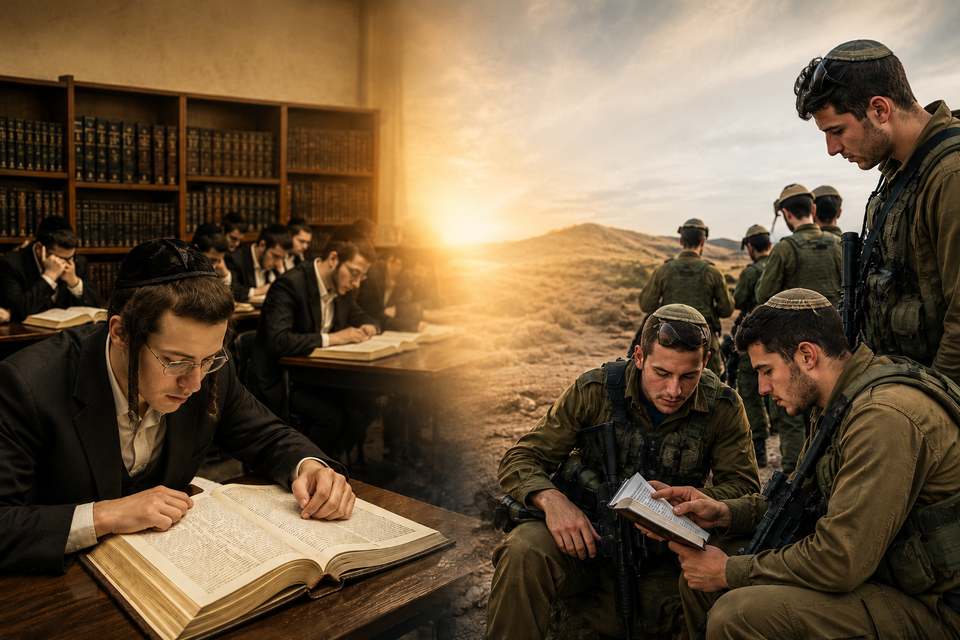
The answer is an unequivocal no — every Jewish life is infinitely precious, and the Charedi world grieves for every fallen soldier as a brother. But the accusation carries a sharper edge worth answering honestly: that by not sharing the physical risk, Charedim must value their own sons' lives more. That charge misreads the Charedi position entirely. The bochur in the beis medrash is not hiding while others die for him; he believes he is part of what protects them — and the difference between him and the soldier is a difference of role, not of worth.
Do Charedim think their own lives — the lives of their sons in the beis medrash — are worth more than the lives of the soldiers who risk everything to defend Am Yisrael?
The answer is no, and it is worth saying it without hedging: absolutely not. There is hardly an accusation more painful, or more false. From a Torah standpoint the matter is not in doubt: every Jewish soul is infinitely precious, the soldier's no less than the scholar's, and the suggestion that the Torah world holds its own blood to be redder than that of those who fall in battle is a profound misreading of everything the Torah teaches and everything the Charedi world believes.
But the accusation deserves more than an indignant denial, because beneath it lies a sharper charge that a mere "of course we value life" does not answer: if you truly valued the soldier's life as your own, the argument runs, you would not let him bear the danger while your sons stay safe. That is the real sting, and it deserves a real response. We give it below — first affirming the value of every Jewish life, then meeting the harder charge head-on.
I. Every Jewish Life Is a Whole World
Begin with the foundation, because it is absolute and admits no exceptions. In the Torah's eyes, every single Jewish life is of infinite, immeasurable worth.
The Mishnah teaches that whoever sustains a single Jewish soul is regarded as though he had sustained an entire world — "kol hamekayem nefesh achas miYisrael, ke'ilu kiyem olam malei" (Sanhedrin 37a). Not a fraction of a world; a whole one. Each Jew is created b'tzelem Elokim, in the image of God — "chaviv adam shenivra b'tzelem" (Avos 3:14) — and bears, in that image, an infinite worth that cannot be ranked, weighed, or compared against another's. Infinity is not greater or lesser than infinity. The life of the soldier and the life of the bochur are each a whole world, each the image of God, each beyond price — and the Torah does not contain the arithmetic by which one such life could be worth "more" than another.
This is why the Torah treats the saving of life as overriding nearly the whole of itself. The mitzvos were given "vachai bahem" — that one shall live by them (Vayikra 18:5) — from which Chazal derive that almost the entire Torah is set aside to save a Jewish life (Yoma 85b). And the Torah commands "lo sa'amod al dam re'echa" — do not stand idly by your brother's blood (Vayikra 19:16). A tradition that suspends its own commandments to preserve a single life, and forbids standing idle while a brother's blood is shed, does not and cannot hold that some Jewish lives are worth more than others. The premise of the accusation is foreign to the Torah at its root.
II. The Charedi World Grieves for Every Soldier
This is not abstract theology; it is lived in Charedi homes and yeshivos, and anyone who claims the Charedi world is indifferent to fallen soldiers has not seen those homes from the inside.
When a siren sounds, when a terror attack strikes, when a soldier falls, the Charedi world weeps. Children add kappitlach of Tehillim; notices go up in shuls to daven for the wounded by name; entire communities take on kabbalos — extra learning, extra tefillah, acceptances upon themselves — to arouse rachamei Shamayim for Jews in danger. Through every war and every wave of terror, Charedi neighborhoods have organized tefillah and chesed for soldiers they never met — davening for them by name, taking on mitzvos in their merit — not because they knew them, but because they knew they were brothers. This is the ordinary, daily texture of Charedi life, far from the cameras, and it is the opposite of indifference.
The Gedolim embodied it. It is told of Rav Shlomo Zalman Auerbach that he would rise to his feet before a wounded soldier, saying that one who gave of his very body for Klal Yisrael is owed honor. Rav Aharon Leib Shteinman was seen to weep after a terror attack, giving voice to the simple Torah truth that a Jew's pain is our pain and a Jew's blood is our blood, whether or not he keeps the mitzvos. And Rav Moshe Feinstein wrote that even Jews far from Torah observance remain our own family — that we are bound to care for them, to daven for them, and to long for their return. (These are presented as the documented substance of their views and conduct.) The grief is not performance. It is the natural response of a heart raised to believe that every Jew is a limb of one's own body — "kol Yisrael areivim zeh bazeh" (Shevuos 39a).
III. The Harder Charge — "You Let Others Die for You"
Now to the real edge of the accusation, the one that a recitation of grief does not by itself answer. The charge is not only "do you value life?" but "if you valued the soldier's life as your own, how can you let him face the bullets while your sons sit safely in the beis medrash? Doesn't that prove you value your own sons' lives more?"
This deserves a direct answer, and the answer is that the charge rests on a premise the Charedi world does not accept: that the bochur in the beis medrash is merely "safe," contributing nothing to the protection of Klal Yisrael, while the soldier alone bears the burden of defending him. That is not how the Torah world understands what is happening. The ben Torah does not believe he is hiding behind the soldier; he believes he is standing beside him — guarding the nation by a different means, one the Torah holds to be no less real. We have set out at length elsewhere the Torah's teaching that the learning of Torah is itself a genuine protection for Klal Yisrael (in our articles on Torah as the protection of the nation, and on what would happen if no one learned); here the point is narrower but decisive. If a Jew sincerely believes — as the Charedi world does — that the Torah being learned in the beis medrash is part of what shields the very soldiers at the front, then his son's place in the yeshiva is not an escape from the shared task of defense. It is his share of it.
Grasp this, and the accusation dissolves. The bochur is not saying "let him risk his life so that mine may be spared." He is saying "he defends Klal Yisrael with his body, and I defend it with my Torah, and both are needed, and neither of us is shielding himself at the other's expense." One may disagree with the premise — one may not believe that Torah protects — but if one wants to understand the Charedi heart honestly, one must see that the bochur does not experience himself as a free rider on the soldier's courage, but as a partner in a shared defense, carrying a different part of the same load. The disagreement is about what protects the nation, not about whose life is worth more. To convert a dispute about the means of protection into an accusation about the comparative value of lives is to misread the Charedi position from the ground up.
IV. A Difference of Role, Not a Hierarchy of Worth
There is a Torah model for exactly this — and it has nothing to do with some Jews' lives being worth more than others.
The tribe of Levi did not go out to war. While the rest of Israel took up arms, Levi was set apart for the service of Hashem — and the Rambam codifies the principle and extends it: one who dedicates himself to stand before Hashem, to serve Him and to know Him, is "sanctified as the holy of holies," and the Torah relieves him of the burdens the rest of the nation carries, so that he may carry a different one (Hilchos Shemittah V'Yovel 13:12–13). Levi's exemption from war was never a statement that a Levi's blood was redder than a soldier's. It was a division of national labor — some to defend the camp with the sword, some to sustain it through the service of Hashem — within a single people whose lives were all equally precious. The Charedi world sees the ben Torah as standing in that same tradition: not a Jew whose life is worth more, but a Jew whose assigned avodah is different.
And this is the answer to the hidden assumption in the accusation — that the only real way to value the nation, and to share its burdens, is to risk one's body for it. The Torah does not accept that the body is the only thing a Jew can give. The one who gives his days and years to Torah is giving something too — and when the Charedi world declines army service, it does so for the hashkafic and halachic reasons we have set out across this series, not because the bochur prizes his own life above the soldier's. A Jew who avoided the army out of simple fear, while believing it was truly his obligation, would indeed be valuing his life too highly. But that is not the Charedi claim and never has been. The Charedi claim is that the bochur's obligation lies elsewhere — in the Torah that he, too, believes defends the nation — and a disagreement about where one's duty lies is not a confession that one's life is worth more.
V. Said With Humility, and With Pain
A final word, and it must be said plainly, because the temptation to win the argument can crowd out something more important. The pain of the bereaved is real, and it is sacred, and nothing in this article is meant to wave it away.
When a mother has buried a son who fell defending the country, and she looks at a yeshiva full of young men his age who did not face what he faced, her anguish is not a "misunderstanding" to be corrected. It is a wound, and it commands our humility. The Charedi world does not answer that anguish by lecturing it. It answers — or should answer — with grief that genuinely shares the loss, with honor for the fallen, with tefillah for the wounded, and with the honest acknowledgment that the gulf of pain between communities is real and must be met with love rather than defensiveness. To explain the Charedi position, as this article does, is not to diminish that pain by a hair. It is possible — it is necessary — to hold both at once: to grieve fully with those who have given the most, and to say clearly that their sacrifice was never a sign that anyone considered their lives worth less.
And so the truth at the center of it all is the simplest one. We are not greater. We are not holier. We do not hold our lives to be worth more — for the Torah has taught us that we may not, that every Jewish life is a whole world, and that "lo sisna es achicha bilvavecha," do not hate your brother in your heart (Vayikra 19:17), binds us to every one of them. We are brothers — grieving the same losses, davening the same tefillos, bound in the same mutual responsibility. Whether a Jew guards Klal Yisrael with a rifle or with a Gemara, with a tank or with Tehillim, he is a limb of the one sacred body that Hashem chose with love — and not one of those limbs is worth a hair more than another.
May Hashem protect all who stand in defense of His people, by whatever means, and may we merit to see the day when no Jewish blood is shed at all — bimheirah b'yameinu, amen.
Sources
Every Jewish life is a whole world
- Talmud Bavli, Sanhedrin 37a — "kol hamekayem nefesh achas miYisrael, ke'ilu kiyem olam malei" — whoever sustains a single Jewish soul is as one who sustained an entire world; the infinite, unrankable worth of every life
- Pirkei Avos 3:14 — "chaviv adam shenivra b'tzelem" — every person beloved, created in the image of God
- Vayikra 18:5 — "vachai bahem" — that one shall live by the mitzvos; with Talmud Bavli, Yoma 85b — the saving of life sets aside nearly the whole Torah
- Vayikra 19:16 — "lo sa'amod al dam re'echa" — do not stand idly by your brother's blood
The Charedi world grieves for every soldier
- Talmud Bavli, Shevuos 39a — "kol Yisrael areivim zeh bazeh" — all Israel are guarantors for one another
- The documented conduct and teachings of the Gedolim: Rav Shlomo Zalman Auerbach (rising before a wounded soldier who gave of his body for Klal Yisrael); Rav Aharon Leib Shteinman (his grief after terror attacks — a Jew's blood is our blood, observant or not); and Rav Moshe Feinstein (that Jews far from observance remain our family, to be cared for and davened for; Igros Moshe — the citation of Choshen Mishpat 2:65 in the original draft is presented as his documented position rather than a verified siman) — all presented as the documented substance of their views and conduct
- The ongoing reality of Charedi tefillah and chesed for soldiers through wars and terror — kappitlach of Tehillim, kabbalos, davening for the wounded by name — presented as the documented general phenomenon rather than relying on a single unverifiable report; the anonymous account in the original draft is not reproduced as a documented event
A difference of role, not a hierarchy of worth
- Rambam, Hilchos Shemittah V'Yovel 13:12–13 — the tribe of Levi set apart from the burdens of the nation (including war) for the service of Hashem, and the extension of the principle to any who so dedicate themselves — a division of national labor, never a claim that some lives are worth more (developed in "Why Is Torah Learning the Top Priority?" and "Who Benefits More: The Charedim or the State?")
- The Charedi understanding that Torah learning is itself a genuine protection of Klal Yisrael — so that the ben Torah is a partner in the nation's defense rather than a free rider upon it (developed in "Do We See the Miracles?" and "What Would Happen If No One Fought?") — and that army service is declined for hashkafic and halachic reasons, not from valuing one's own life above another's
Said with humility
- Vayikra 19:17 — "lo sisna es achicha bilvavecha" — do not hate your brother in your heart; the obligation to meet the pain of the bereaved with grief, honor, and love rather than defensiveness (the citation of Yevamos 65b in the original draft has been removed as not germane to the question)
The structural relationship to other articles in this series
- "Do We See the Miracles?" and "What Would Happen If No One Fought?" — the Torah's protection of the nation, on which the answer to the harder charge rests
- "Who Benefits More: The Charedim or the State?" — the Charedi contribution, material and spiritual
- "Do Charedim Believe They Are the Only Ones With This Task?" — "we are not better, they are not worse"; the equal worth of every Jew faithful to the mesorah