
Do Charedim believe in civil disobedience for Torah causes?
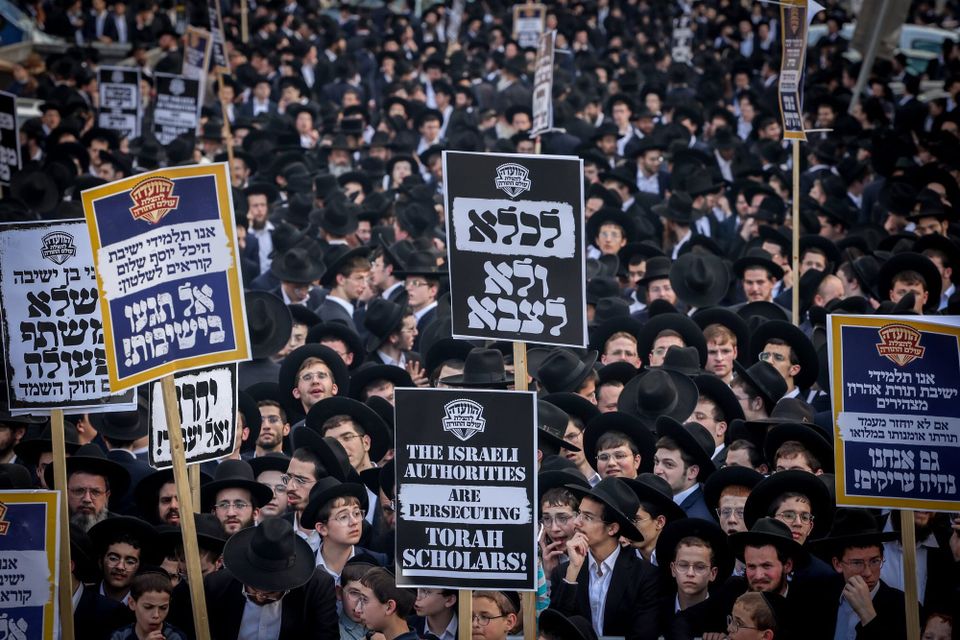
Yes. When the Torah itself comes under threat, Charedim hold that we have not only the right but at times the obligation to resist — and if that resistance must take the form of nonviolent civil disobedience, then so be it. But the claim has to be stated precisely, because it is so easily caricatured. This is not about politics, not about culture wars, not about protest for the thrill of protesting. It is about standing for the eternal truth of the Torah when it is under attack — under the full guidance of daas Torah, within the bounds of halacha, and without a hand raised in violence.
I. When a Command Contradicts Hashem's, We Obey Hashem
The foundation is a single principle: no human authority, however legitimate, can command a Jew to violate the Torah. The Gemara frames it as a question and answers it without hesitation — "the word of the master and the word of the servant, whose word do we heed?" — and when the Master is the Ribbono Shel Olam and the servant is any earthly ruler, the answer is obvious (Sanhedrin 49a). The Rambam draws the line at the very highest authority a Jew could face: even a Jewish king, whose word in its proper sphere carries the force of law, "if he decrees the nullification of a mitzvah, we do not listen to him" (Hilchos Melachim 3:9).
This is the part outsiders miss: it is not rebellion against legitimate authority. It is the recognition that all legitimate authority is itself bounded — that a government's writ runs only as far as the Torah that stands above it allows. A Jew does not get to do "whatever is right in his own eyes" (Devarim 12:8); but neither does a state. Our ultimate loyalty was never pledged to a regime or a movement. It belongs to the One who gives every authority whatever authority it has.
II. The Torah's Own Heroes of Civil Disobedience
This is no modern import dressed in Jewish clothing. The Torah itself honors those who defied unjust decrees for the sake of Heaven — and honors them precisely for the defiance. The very first recorded act of civil disobedience in human history is in the opening chapter of Shemos: the midwives Shifra and Puah, ordered by the most powerful man on earth to murder the Hebrew infants, "feared God and did not do as the king of Egypt had commanded them" (Shemos 1:17) — and the Torah immortalizes their names while Pharaoh's is never given.
The pattern repeats down the generations. Chananyah, Mishael, and Azaryah refused to bow to Nevuchadnetzar's idol though the furnace stood waiting. Daniel kept his window open and went on davening three times a day after the king had outlawed it, knowing the lions' den was the price. Mordechai would not bend his knee to Haman though the whole court bowed around him. In every case the shape is identical: when a decree commands what Hashem forbids, the righteous refuse — openly, peacefully, and ready to bear whatever the refusal costs. Civil disobedience for the sake of Heaven is not the margin of our tradition. It is woven through its spine.
III. The Obligation to Protest
And it can be more than a right; it can be a duty. Chazal teach that whoever is able to protest against wrongdoing and remains silent is held accountable for that wrongdoing himself (Shabbos 54b–55a). When the Torah is being attacked in public, silence is not neutrality — it is a quiet form of consent. To raise one's voice, peacefully and within halacha, is therefore an act of kavod haTorah, and at times of genuine kiddush Hashem. As Rav Aharon Kotler impressed upon his generation, when the very soul of Klal Yisrael is under threat, standing up for it — peacefully, with clarity — is not a lapse from avodas Hashem but a form of it.
IV. The Gedolim Who Guided It
Across the generations the Gedolim have led and sanctioned exactly this kind of resistance — and always, without exception, in its peaceful and disciplined form. Rav Shach called for mass tefillos and for demonstrations when the Torah education of Jewish children was under threat, even as he sharply and repeatedly condemned zealotry and street violence as a betrayal of the very cause they claimed to serve. Rav Yosef Shalom Elyashiv guided protests against rulings that trampled on religious life — the autopsy of the dead, public chillul Shabbos, the coercion of religious schools. Chacham Ovadia Yosef called it a sacred duty to resist attempts to redefine who is a Jew and to secularize the legal foundations of the country. And at the furthest end of the spectrum stood the Satmar Rebbe, whose public demonstrations against Zionism shows that protest can be a legitimate form of spiritual resistance.
V. The Limits — and They Are Absolute
But not every protest is justified, and the conditions on it are strict and non-negotiable. The Torah forbids violence, forbids vandalism, and forbids — above all — anything that desecrates the Name of Hashem. A protest that produces a chillul Hashem, or that hardens the world's contempt for Torah Jews, has defeated its own purpose and must be abandoned or rethought, however righteous the cause behind it. This is where the Chazon Ish's warning becomes decisive. Zeal, he taught, that is not tempered by halacha, by refined middos, and by daas Torah does not build anything — it destroys. Kana'us untethered from yiras Shamayim is not a higher form of devotion; it is a danger.
Two iron rules therefore govern everything. First, it must be nonviolent — full stop. Second, no one acts on his own. Every step is taken under the guidance of the Gedolim, never on private initiative. The freelance zealot who throws a stone, burns a dumpster, or screams at a passerby is not performing a kiddush Hashem; he is performing its exact opposite, and the Torah world does not claim him — it disowns him. Resistance that is real and resistance that is reckless are not two points on one continuum. They are opposites.
VI. What It Has Actually Looked Like
Strip away the caricature and look at the record, and the legitimate model is clear. The sustained campaigns against mass autopsies helped win real legal protection for the dignity of the dead. Peaceful demonstrations preserved the character of Shabbos in religious neighborhoods, where roads close and the city grows quiet for a day. And in our own time, the resistance to the conscription of yeshiva bochurim has taken its truest form in the vast prayer gatherings that have filled the streets of Yerushalayim — hundreds of thousands of Jews assembled not with fists but with Tehillim, the Gedolim calling explicitly and insistently for tefillah, not stones. That is the Charedi model at its purest: the streets filled to overflowing, and filled with prayer.
VII. In Summary
So yes — Charedim believe in civil disobedience when the Torah is genuinely under threat. But never out of anger, and never in pursuit of power. Always for kavod haTorah, always under daas Torah, and always without violence. Our loyalty was never given to any government or any movement; it is held, whole and undivided, by the Ribbono Shel Olam alone.
And on the rare occasions we are forced to rise, we mean to do it as the midwives did — with the fear of Heaven in our hearts, with open hands rather than raised fists, and with a measure of grief that it ever had to come to this at all.
May Hashem guard His Torah from every threat, grant our leaders the wisdom to know when and how to stand, and bring the day when His Name is honored by all — bimheirah b'yameinu, amen.
Sources
The supremacy of Torah over any human command
- Sanhedrin 49a — "the word of the master and the word of the servant, whose word do we heed?" — that Hashem's command overrides any human authority's
- Rambam, Hilchos Melachim 3:9 — even a Jewish king, if he decrees the nullification of a mitzvah, is not to be obeyed
- Devarim 12:8 — that we do not each do "what is right in his own eyes," but follow the law of Hashem
Civil disobedience in Tanach
- Shemos 1:17 — the midwives Shifra and Puah, who "feared God and did not do as the king of Egypt commanded them"
- The refusal of Chananyah, Mishael, and Azaryah (Daniel 3), Daniel at his window (Daniel 6), and Mordechai before Haman (Esther 3)
The duty to protest, and its limits
- Shabbos 54b–55a — that one who can protest wrongdoing and stays silent bears responsibility for it
- The Chazon Ish (Emunah u'Bitachon) — that zeal untempered by halacha, refined character, and daas Torah destroys rather than builds; and the guidance of Rav Aharon Kotler, Rav Shach, Rav Yosef Shalom Elyashiv, and Chacham Ovadia Yosef that such resistance is peaceful, disciplined, and led only by the Gedolim
The structural relationship to other articles in this series
- "The Charedi View on Vandalism" and "The Charedi View on Extremism" — the line between legitimate resistance and its reckless counterfeit
- "Why Do Charedim Always Listen to Their Rabbanim?" — the daas Torah that must guide every step
- "Does the State of Israel Try to Force Secular Education in Charedi Schools?" — one of the threats that has called such resistance forth