
Why does the general public see these extremists on the news so often?
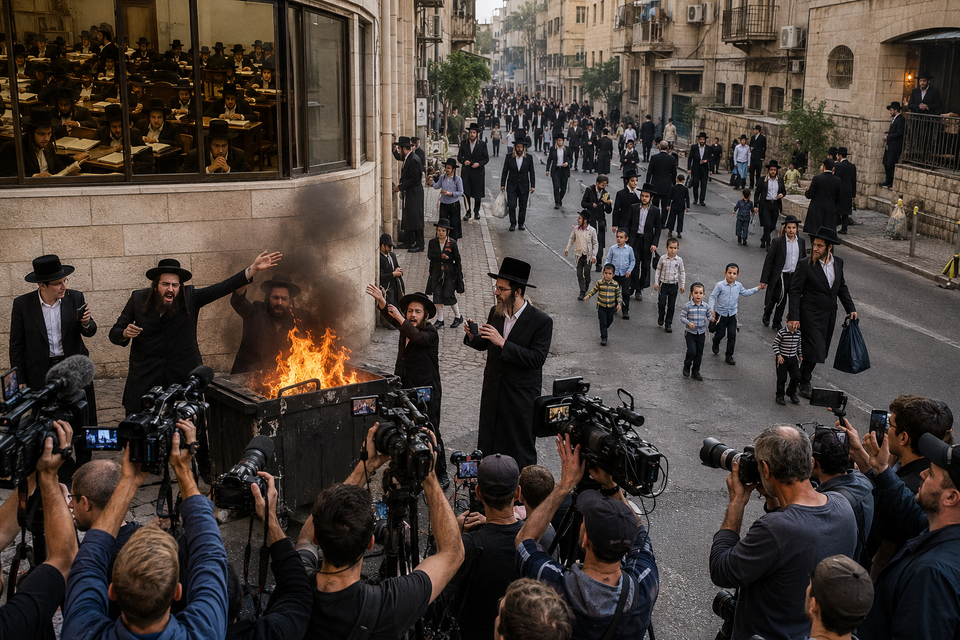
Every few months — sometimes every few days — a clip goes viral. A man in a black hat screaming at a soldier. A knot of boys setting a flag or a dumpster alight. Another protest, another viral moment. To the average Israeli, or to a Jew scrolling through the news abroad, an impression forms almost on its own: so this is the Charedim. This is what they are like. It is an entirely understandable conclusion — it is, after all, what the news keeps showing. And it is very nearly the precise opposite of the truth. Which raises a question worth asking plainly: if the extremists are such a vanishing fraction of the community, why does the public see them on screen so relentlessly?
I. Because Extremism Sells
The first answer is the simplest, and it has nothing to do with Charedim in particular. The news business runs on attention, and nothing seizes attention like conflict, fire, and drama. "If it bleeds, it leads" is an old newsroom adage for a reason. An image of more than a million Charedim doing entirely unremarkable things — learning, working, raising children, running gemachim, sitting at the bedside of the sick — is not a story; it is a Tuesday. A handful of young men torching a bin is a story. The camera does not exactly lie, but it points — and it points, every single time, at the burning bin and never at the quiet street stretching behind it. Multiply that one editorial choice across a thousand outlets and a million phones, and a fringe of a fringe hardens, in the public mind, into the whole.
II. Because It Is Useful to Some
There is a second layer, and it is less innocent. For some — not all, but some — in the media and the broader culture, the Charedi world represents something they actively oppose: a way of life built entirely on Torah that stubbornly refuses to dissolve into secular modernity. And the extremist image is a remarkably useful instrument. If "the Charedim" can be made to look violent, lawless, and irrational, then a great many things become far easier to justify — cutting the funding of Torah institutions, forcing changes onto Charedi schools, narrowing the space for religious life. The burning dumpster stops being merely a story and becomes an argument, and it tends to surface most insistently exactly when those battles are live. This does not make every journalist an ideologue; most are simply chasing the story in front of them. But it does mean the fringe gets amplified, again and again, by people who find it convenient.
III. Because the Majority Is Quiet
And there is a third reason, this one partly of our own making. The Charedi world is not, by temperament or by conviction, a world of press conferences and PR firms. Most Charedim are absorbed in Torah, in work, in family; they believe far more in the quiet, steady avodah of a life lived before Hashem than in public campaigns, and they do not spend their days battling strangers in comment sections. There is real Torah wisdom in that restraint — "a man of understanding stays silent," teaches Mishlei (11:12), and not every provocation deserves to be answered with a brawl. But silence carries a price: it leaves the field open for others to fill in the blank. When the only loud voices wearing a black hat are the ones throwing things, the loud minority gets mistaken for the silent majority — not because it represents that majority, but simply because it is the part that ended up on camera.
IV. What the Gedolim Actually Say
Here is the part the cameras never trouble to capture. The Torah leadership of the Charedi world has been unambiguous that this behavior is wrong — not a public-relations embarrassment to be managed, but a genuine and serious violation of the Torah itself. To scream at a soldier or a policeman, to burn and to vandalize, to drag the contempt of the world down upon Torah Jews — this is chillul Hashem, the desecration of Hashem's Name, which the Torah counts among the very gravest of sins. Rav Chaim Kanievsky made it plain, during the very episodes the cameras most enjoyed, that such conduct is not daas Torah and is not the way of a ben Torah. And the Chazon Ish had set down the principle decades before: zeal that is not governed by halacha and by refined character does not serve Hashem — it destroys (Emunah u'Bitachon). The extremist who claims to act "in the name of the Torah" while causing this kind of harm is not an intensified version of the Charedi mainstream. He is acting against it — and against the very Gedolim whose name he invokes.
V. The Double Standard — and an Honest Limit
A fair word, then, about a double standard. There is an expectation applied to Charedim almost uniquely: that every rav must publicly denounce every individual who misbehaves while wearing a black hat, as though anything short of a fresh condemnation each time were complicity. No one holds the entire Dati Leumi world collectively responsible for every extremist who happens to be a settler. No one demands that every secular public figure personally condemn every protester who curses the Torah. The Charedi world alone is asked to answer, over and over, for the deeds of people it never authorized and openly rejects.
And beneath the double standard lies a simpler truth: the Torah itself has already condemned these actions — clearly, permanently, and without ambiguity. When the law is that plain, one fringe individual's failure to keep it is his failure, not an open question hanging in the air until each rav delivers a fresh verdict on it. Let this be said without the slightest hedge: we reject the behavior entirely. We simply decline to accept that a community of well over a million Jews must apologize, on an endless loop, for a fringe it long ago disowned.
VI. Don't Judge a World by Its Fringe
So when the next clip crosses your screen, remember what the frame has been cropped to leave out. The Torah's own instruction is to judge favorably — b'tzedek tishpot amisecha, to judge your fellow with righteousness (Vayikra 19:15), and as the Mishnah puts it, hevei dan es kol ha'adam l'kaf zechus, to weigh every person on the side of merit (Avos 1:6). That means looking for the truth and the texture behind a headline rather than swallowing the headline whole. The Charedi community is not perfect — no community of human beings is. But it is overwhelmingly peaceful, profoundly devoted, and rooted in thousands of years of a life built on faith, humility, and ahavas Yisrael. Do not let a few burning dumpsters blind you to the steady light of more than a million Jewish neshamos quietly living that life.
VII. In Summary
The public sees the extremists so often not because they are common, but because they are filmable — and because a fringe of a fringe happens to feed both the appetites of an attention economy and, at times, the aims of those who would frankly prefer the Charedi world were smaller and quieter. The reality is the part that never trends: a vast and peaceful community, learning and building and giving, led by a Torah leadership that condemns the violence as forcefully as anyone alive. That is the true picture. It simply does not burn brightly enough to hold a camera.
May Hashem's Name be sanctified through us and never desecrated, may the world come to see Klal Yisrael as it truly is, and may we all merit to judge one another with the favor and truth the Torah asks of us — bimheirah b'yameinu, amen.
Sources
The Torah's rejection of this conduct
- The gravity of chillul Hashem, the desecration of Hashem's Name; the Chazon Ish (Emunah u'Bitachon) — that zeal ungoverned by halacha and refined character destroys rather than serves; and the guidance of Rav Chaim Kanievsky that such conduct is not daas Torah and not the way of a ben Torah
The value of restraint — and judging favorably
- Mishlei 11:12 — that a person of understanding holds his tongue
- Vayikra 19:15 — b'tzedek tishpot amisecha, to judge your fellow with righteousness; Avos 1:6 — hevei dan es kol ha'adam l'kaf zechus, to judge every person on the side of merit
The structural relationship to other articles in this series
- "The Charedi View on Vandalism" and "The Charedi View on Extremism" — the substance of the rejection itself
- "Why Don't Charedi Rabbanim Condemn Extremists Publicly?" — the double standard examined directly
- "The Torah View on Mocking Charedim and Gedolim" — the wider pattern of misrepresentation