Who Is More Dangerous for Israel: Bennett, Lapid, and Lieberman — or Hamas, Hezbollah, and Iran?
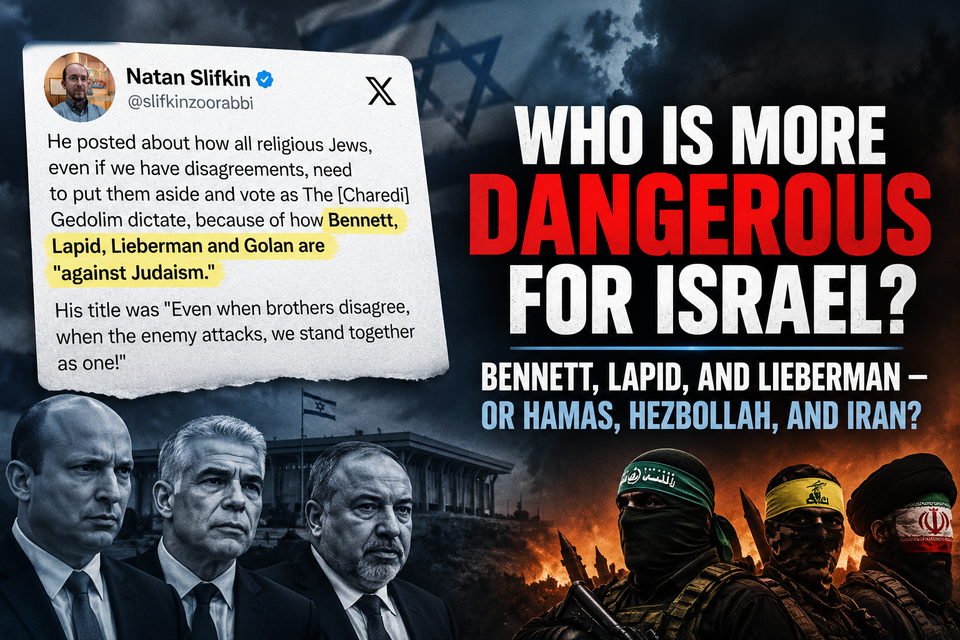
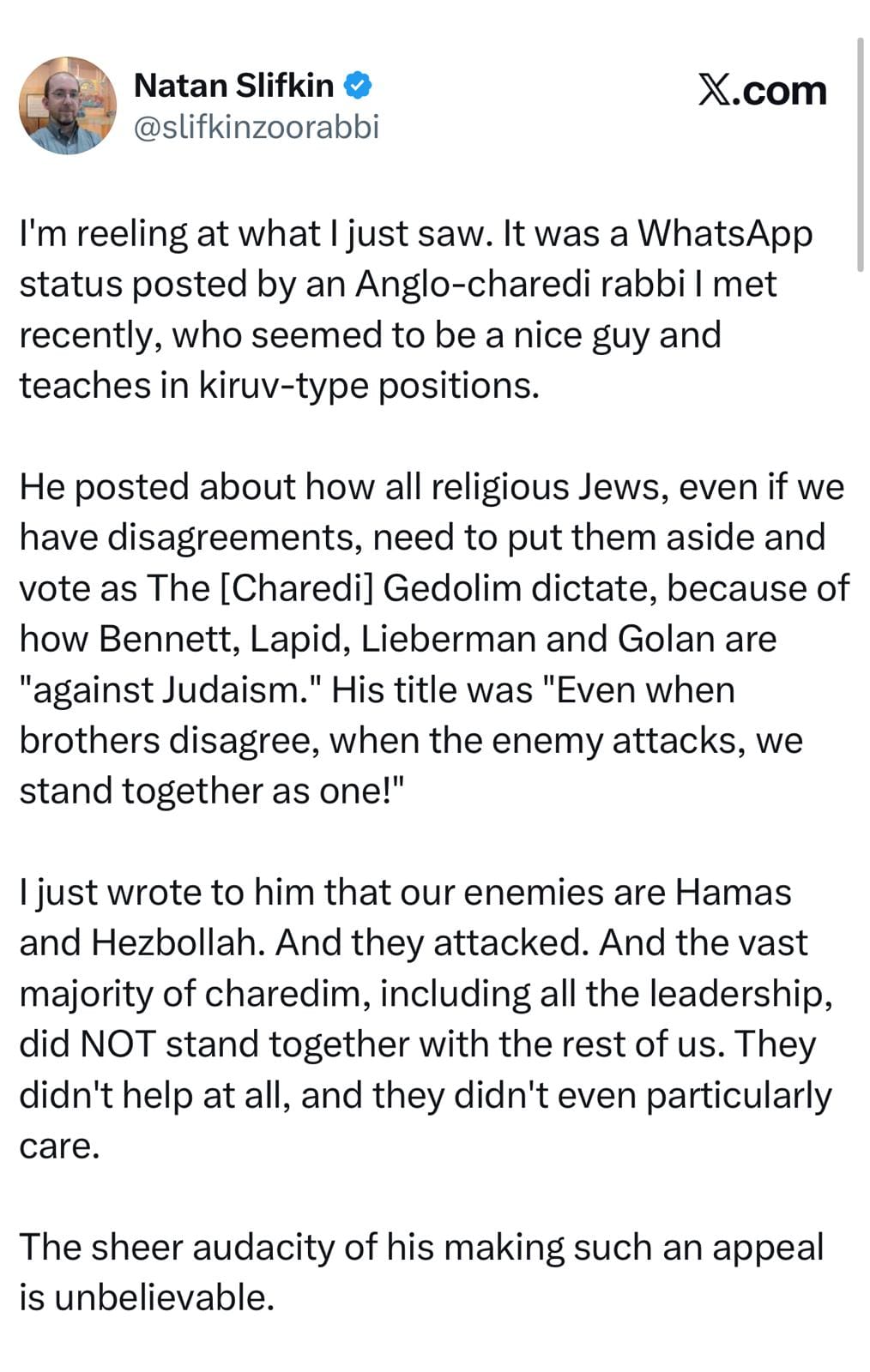
Natan Slifkin is "reeling" at a WhatsApp status from a Charedi rabbi who urged religious Jews to put their disagreements aside and vote as the Gedolim direct, because politicians like Bennett, Lapid, Lieberman, and Golan are "against Judaism." Our enemies, Slifkin answered, are Hamas and Hezbollah — and the audacity of saying otherwise is "unbelievable." We thank him for stating the question so cleanly, because this — not stipends, not seminaries, not any single law — is the bottom-line disagreement between the Charedi world and its critics. It is a disagreement about what actually protects the Land of Israel and the people in it. And it is not a question either side gets to answer by feeling. The Torah answers it, explicitly, in pesukim every Jew — including every secular Jew, including every politician named above — says or is obligated to say twice a day.
I. The Tweet
Natan Slifkin posted this:
The status that so shocked him was a graphic quoting four politicians in their own words on what they intend for Torah Judaism in Israel — and the quotes were not invented. Yair Golan has made separation of religion and state a central plank of his platform, telling the Jerusalem Post this month that Israelis should not have religious authorities dictate "how to marry, how to live, where to travel, or what to wear." Naftali Bennett declared in August that "the door is locked" to the Charedi parties, rejecting even a 3% exemption for the generation's best learners: "There will be no frameworks and no allocations." Yair Lapid, in his one turn holding the treasury, cut the funding of yeshiva students and froze transfers to Charedi mosdos. Avigdor Lieberman used his turn to cancel daycare subsidies for the children of avreichim — a measure aimed, by his own ministry's description, at pressuring the fathers out of the beis medrash.
So the rabbi's premise is simply documented fact: these men have declared, in public, a program against the Olam HaTorah. The only live question is the one Slifkin raises — whether calling that an attack by "the enemy," while Hamas and Hezbollah exist, is moral clarity or audacity.
We are glad to answer. Respectfully, and with sources.
II. First, Clear the Hishtadlus Argument Off the Table
Before anything else, let us remove the argument this is not about, because it is where every version of this debate runs off the rails.
This is not a column about whether Israel needs an army. The question of hishtadlus — what practical effort Hashem requires of us, and who is obligated to provide it — is a real sugya with a real mesorah, and we have addressed it at length elsewhere. Nothing below depends on it. Assume, for the length of this article, whatever position on hishtadlus you like.
The question here is prior to all of that: what is the actual source of the Jewish people's security in its Land? Not the mechanism. The source. Because once that question is answered, the ranking in our title answers itself.
III. The Deal Is Written Down
Am Yisrael is not a nation like other nations, and Eretz Yisrael is not a land like other lands. We were placed here with a mission — to be the people through whom knowledge of Hashem spreads through the world — and we hold the Land on written terms. Every Jew, religious or secular, is party to those terms; the Torah was given to all of Klal Yisrael, not to a sector.
And the terms are not hidden in some obscure midrash. They are in the second paragraph of Shema — the one said twice every single day:
הִשָּׁמְרוּ לָכֶם פֶּן יִפְתֶּה לְבַבְכֶם... וְחָרָה אַף ה' בָּכֶם... וַאֲבַדְתֶּם מְהֵרָה מֵעַל הָאָרֶץ הַטֹּבָה אֲשֶׁר ה' נֹתֵן לָכֶם
"Guard yourselves lest your heart be seduced... and Hashem's anger will flare against you... and you will swiftly be lost from upon the good Land that Hashem gives you." (דברים י"א, ט"ז–י"ז)
They are in Parshas Ki Savo, in the tochacha read aloud in every shul in the world:
וְהָיָה אִם לֹא תִשְׁמַע בְּקוֹל ה' אֱלֹקֶיךָ... וּבָאוּ עָלֶיךָ כָּל הַקְּלָלוֹת הָאֵלֶּה וְהִשִּׂיגוּךָ... יִתֶּנְךָ ה' נִגָּף לִפְנֵי אֹיְבֶיךָ
"And it will be, if you do not listen to the voice of Hashem your G-d... all these curses will come upon you and overtake you... Hashem will cause you to be struck down before your enemies." (דברים כ"ח, ט"ו; כ"ה)
And the Torah says explicitly that the Land itself enforces the terms:
וְלֹא תָקִיא הָאָרֶץ אֶתְכֶם בְּטַמַּאֲכֶם אֹתָהּ כַּאֲשֶׁר קָאָה אֶת הַגּוֹי אֲשֶׁר לִפְנֵיכֶם
"Let the Land not spit you out when you defile it, as it spat out the nation that was before you." (ויקרא י"ח, כ"ח)
Read that last passuk again. The Land of Israel is holy, and it does not keep residents who violate its terms — it did not keep the Canaanim, and the Torah warns it will not make an exception for us. This is not Charedi rhetoric. It is a passuk in Chumash, binding on the authors of every party platform in this election whether they have opened a Chumash since their bar mitzvah or not.
The same contract has a other side, and it is just as explicit:
אִם בְּחֻקֹּתַי תֵּלֵכוּ... וְנָתַתִּי שָׁלוֹם בָּאָרֶץ וּשְׁכַבְתֶּם וְאֵין מַחֲרִיד... וְחֶרֶב לֹא תַעֲבֹר בְּאַרְצְכֶם... וְרָדְפוּ מִכֶּם חֲמִשָּׁה מֵאָה
"If you walk in My statutes... I will grant peace in the Land, and you will lie down with none to make you afraid... and a sword will not pass through your land... five of you will chase a hundred." (ויקרא כ"ו, ג'; ו'–ח')
That is the Torah's own security doctrine, stated as a promise. We did not write it. We are simply the community that still believes it is true.
IV. Who, Then, Are Hamas, Hezbollah, and Iran?
Here is where Slifkin and the Charedi world genuinely part ways — so let us say our side without flinching.
When Hashem sealed the covenant with Avraham Avinu, He told him in advance:
יָדֹעַ תֵּדַע כִּי גֵר יִהְיֶה זַרְעֲךָ בְּאֶרֶץ לֹא לָהֶם וַעֲבָדוּם וְעִנּוּ אֹתָם אַרְבַּע מֵאוֹת שָׁנָה
"Know with certainty that your descendants will be strangers in a land not theirs, and they will enslave them and afflict them four hundred years." (בראשית ט"ו, י"ג)
Mitzrayim was announced centuries before Mitzrayim existed as our oppressor. The slavery had a purpose — the kur habarzel, the iron crucible that forged a family into a nation subservient to Hashem alone — and it had a clock, and when Hashem's accounting was complete (four hundred years from Yitzchak's birth; two hundred and ten in Egypt itself, as Chazal teach on וַיֵּרֶד... רְד"וּ), no empire on earth could hold us one additional day. Pharaoh believed he was the actor in that story. He was the instrument.
And lest anyone think this is a one-time insight about Egypt, the Navi says it about the superpower of his own day, in words that should be famous:
הוֹי אַשּׁוּר שֵׁבֶט אַפִּי וּמַטֶּה הוּא בְיָדָם זַעְמִי
"Woe, Ashur, rod of My anger — the staff in their hand is My fury." (ישעיהו י', ה')
Assyria — the cruelest military machine of the ancient world — is called a stick. A rod does not decide where it lands. And note well: the same perek goes on to promise Ashur's own punishment, because a rod that swings with joy and cruelty is fully guilty for its choices — exactly as the Rambam explains about the Egyptians (הלכות תשובה פ"ו ה"ה), who were punished though the exile was decreed, because no individual Egyptian was forced to be the one holding the whip. So let no one twist our words: Hamas, Hezbollah, and Iran are murderers, guilty in full, and we daven daily for the safety of every Jew they threaten and for the downfall and destruction of all of them. Calling them a rod does not acquit the rod. It identifies the Hand.
That is the Charedi worldview in one line: our enemies are real, and they are not independent. They are the shevet, not the Yad. They have power over us exactly when, and exactly to the degree, that our standing in the covenant gives them an opening — and not a millimeter more. We did not invent this framework to score election points. It is Chumash, Navi, and Rambam, and it is what the Olam HaTorah actually believes on an ordinary Tuesday.
Now the title question is no longer provocative. It is almost mechanical. If the sword is a rod, then the gravest danger to Israel is not the rod. It is whatever weakens the hand of Israel's protection. The rod is the symptom. The severed connection is the disease.
V. Now Apply It
So consider what it means, in this framework, that the Rav wrote what he wrote — about politicians who have not merely said these things, but, each time they held power, already done them.
A politician who promises "no frameworks and no allocations" for Torah learners; a finance minister who cuts the stipends of yeshiva students and freezes the budgets of their mosdos; a finance minister who cancels daycare subsidies specifically to pressure avreichim out of the beis medrash; a platform whose stated principle is peeling halacha out of Jewish public life, piece by piece — marriage, Shabbos, kashrus; and a state that, today, sends the military police to arrest yeshiva bochurim and lock them in prison for the crime of learning Torah — in the Torah's own security doctrine, quoted above in its own words, this is not "domestic policy." This is sawing at the branch the entire country is sitting on. It is weakening the single factor the Torah names as decisive — while the rod hangs on the wall.
That is what the rabbi's WhatsApp status meant, and it is why his title was precise: when that is under attack, brothers who disagree about plenty stand together. Slifkin reads "the enemy" and hears a comparison of persons — as if someone called Lapid is worse than Sinwar, chas v'shalom, man for man. No one said that, and we will not say it: Hamas are monsters; Israeli politicians are misguided brothers, and there is no equivalence between them as human beings. The comparison is not between persons. It is between dangers — between a threat the Torah says cannot touch us when our side of the covenant is whole, and a campaign that works directly on the covenant itself, from inside, with the full power of the state. A rod on the wall and a hand weakening at the wrist are not dangers of the same order. Every passuk quoted above says which one matters more.
And to Slifkin's charge that the Charedi world "didn't help at all and didn't particularly care" — we answer plainly: the Olam HaTorah has been standing its watch the entire time. Its learning did not pause; its Tehillim did not pause; its chessed organizations did not pause. He is free to believe that none of that counts as helping. But that belief is exactly the disagreement, not evidence for his side of it. One cannot assume the Torah's protection is worthless and then cite its "worthlessness" as proof the Charedim did nothing.
One more word, about unity itself, since his correspondent's status was a call for it. The Yerushalmi (פאה א', א') teaches an astonishing thing: the generation of Achav was steeped in avodah zarah, yet they went out to war and won — because there was no machlokes and no slander among them. Unity is itself a shield. Which makes it worth asking gently: between a rabbi pleading "even when brothers disagree, we stand together," and a public campaign, years long, to shame the Torah community, cut off its bread, and jail its sons — which one is the attack on Jewish unity?
VI. They Are Not Even Saving the Money
Here the critics usually retreat to accounting: whatever you believe about zechusim, the state cannot afford to fund your learning. Very well — let us look at the ledger as we read it.
Lapid's cuts did not balance anything; the deficit years rolled on. Lieberman's daycare decree was projected to "incentivize employment"; what it incentivized was a High Court battle and the impoverishment of children. And we cannot help noticing — we wrote about it in "With Friends Like These: International Edition" — that the very season in which the state escalated its war on the Olam HaTorah, arresting bochurim at the airport and raiding their homes, is the season in which its "friends" abroad, twelve countries at a time, discovered new boycotts and bans to impose on it, and proud Jews in foreign governments found their voices against it. We do not claim to run regression analyses on Shamayim, and we would never present hashgacha as a spreadsheet. But a Jew who says Shema twice a day is entitled to notice a pattern the Torah told him to expect: the state cuts the branch, and finds the whole tree shaking. They are not saving a shekel. They are spending down the only account that was keeping the interest at bay.
If these leaders believed the pesukim that Jews across their own country recite twice every day, they would not be cutting the Torah budget. They would triple it and quadruple it — the cheapest defense spending in the country’s history, by the Torah’s own terms — and the promise of ויקרא כ"ו would be theirs to collect on: שלום בארץ, וחרב לא תעבור בארצכם — “peace in the Land... and a sword will not pass through your land.” That is not our forecast; we make none. It is Hashem’s written offer, open as it has always been.
VII. The Answer
So, Natan: no audacity, just Shema.
Hamas, Hezbollah, and Iran are the rod — guilty, murderous, and real, and may Hashem swiftly bring their end. But a rod has no power except the power given it. The politicians who have made careers of attacking the world of Torah — cutting what sustains it, criminalizing its sons, campaigning to unravel the covenant that holds this Land — are not working on the rod. They are working on the Hand's own terms of protection, from inside the house. The Torah states, in pesukim neither of us is free to delete, which of those two is the existential threat.
That is why a Charedi rabbi in a kiruv position told his audience that when this enemy attacks, brothers close ranks. He was not being audacious. He was being literate.
And tomorrow, that literacy becomes a ballot. The Gedolei Yisrael — Rav Dov Landau, Rav Moshe Hillel Hirsch, the Rosh Yeshiva of Mir, the Zakein HaPoskim Rav Nebenzahl — have put their instruction in writing, over their own signatures: vote for the parties that stand under the authority of the Chachamim, Gimmel and Shas, each community as its gedolim direct. Understand what is actually riding on it. This is not a vote about stipends, and it is not a vote about one community’s budgets. By the Torah’s own terms — the terms quoted throughout this article, from pesukim no Jew is free to delete — it is a vote about the shield over every Jew in this Land: the soldier on the border, the family in Ashkelon, the secular Israeli who has never opened these pesukim and is protected by them anyway. Every vote for Gimmel or Shas is a vote to keep the beis medrash full, the covenant held, and the Hand over this nation strong. The safety of the entire nation is at stake, and the Torah told us exactly where that safety comes from. Tomorrow, say so at the ballot box.
May Hashem protect every Jew in Eretz Yisrael and around the world — the soldier on the border and the bochur in the beis medrash, who are brothers whether their leaders remember it or not — may He open the eyes of those who war against His Torah, turn every rod back from His people, and bring us speedily to the day when שלום בארץ is not a promise but the news — bimheirah b'yameinu, amein.
Sources
The exchange
- Natan Slifkin's post (X, October 2026), quoted in full above, describing the WhatsApp status of an Anglo-Charedi rabbi titled "Even when brothers disagree, when the enemy attacks, we stand together as one!" (Note that he edited the original for some reason.)
The politicians' own record
- Ynet, August 6, 2026 — Bennett: "The door is locked to anyone who supports draft evasion"; rejecting even a 3% learners' exemption: "There will be no frameworks and no allocations"
- Jerusalem Post, October 1, 2026 — Yair Golan and The Democrats' platform: separation of religion and state as a central principle; religious authorities should not dictate "how to marry, how to live, where to travel, or what to wear"; state recognition of marriages outside the Rabbanut
- Ynet, January 2014 — Finance Minister Lapid cuts funding for yeshiva students; Jewish Press, February 2014 — Lapid freezes transfers to Charedi institutions
- Globes, 2021 and Times of Israel, 2021 — Finance Minister Lieberman cancels daycare subsidies for children of avreichim; the High Court freezes the decree; JNS, 2021 — the measure's stated aim of pushing yeshiva students into the workforce
The Torah sources
- The second parsha of Shema — דברים י"א, ט"ז–י"ז
- The tochacha of Ki Savo — דברים כ"ח
- The Land spitting out its violators — ויקרא י"ח, כ"ח
- The brachos of Bechukosai and their conditions — ויקרא כ"ו
- The bris bein habesarim, with Rashi there and Rashi on רד"ו for the 400/210 accounting — בראשית ט"ו, י"ג
- Ashur as the rod of Hashem’s anger, and its own punishment later in the perek — ישעיהו י', ה'
- Why the Egyptians were punished though the exile was decreed — רמב"ם הלכות תשובה פ"ו ה"ה
- The generation of Achav, victorious in war in the merit of unity — ירושלמי פאה א', א'