What Is the Charedi View on Yom HaShoah?
The Charedi world was shattered by the Holocaust and mourns its six million kedoshim with everything in it — and yet it does not mark Yom HaShoah the way the state does. The reasons are halachic, they are about how a Jew remembers, and they are about refusing to fold the deepest catastrophe of our history into a political argument. We remember. We simply remember in the language of Torah.
Each year on the 27th of Nissan, Israel observes Yom HaShoah: sirens sound across the country, traffic halts, ceremonies are held, and the nation stands in silence for the six million. For much of the Israeli public, especially the secular world, it is the central day of Holocaust remembrance — and it is often woven together with themes of Jewish strength, defiance, and national pride. The Charedi world was no less devastated by the Holocaust; it lost entire dynasties, yeshivos, and towns, and it carries the memory of the kedoshim in its very bones. And yet it does not observe Yom HaShoah in the way the state does. This is often misunderstood as coldness. It is the opposite. To explain why requires understanding three things: a question of the calendar, a question of how Jews mourn, and a question of what the Holocaust must never be reduced to.
I. A Question of the Calendar
Begin with the date itself, because it is not a small matter. The 27th of Nissan was chosen by the Knesset — by a secular government, without the guidance of the Gedolei Yisrael — and it falls squarely within the month of Nissan. And Nissan, in the Jewish calendar, is not a month of mourning. It is the month of our redemption from Mitzrayim, a month so saturated with joy that the halacha sets aside the ordinary expressions of grief within it.
The codified custom is explicit: throughout Nissan we do not recite tachanun, we do not deliver eulogies, and we do not hold public fasts, because the month is given over to simcha and to the memory of geulah (Shulchan Aruch and Rema, Orach Chaim 429:2). To establish a new fixed day of national mourning inside such a month runs against the grain of the Jewish calendar itself. And this points to something deeper than a scheduling quibble: the forms of Jewish mourning are not ours to invent by decree. Our calendar of grief — its days, its laws, its boundaries — was given to us through the mesorah, not legislated by a parliament. A day of mourning placed in Nissan by political vote, however sincere the impulse behind it, is not how Klal Yisrael has ever marked its sorrows.
II. The Days the Torah Already Gave Us
And here is the point that is so often missed: the Charedi world's reservation about Yom HaShoah is not a reluctance to mourn the Holocaust. It is the conviction that we already possess the proper vessels for that mourning — vessels the mesorah handed us long ago.
There is Tisha B'Av, the day that gathers into itself every great catastrophe of Jewish history, from the destruction of both Batei Mikdash onward; and indeed special kinnos recounting the horrors of the Holocaust have been composed to be recited on it, folding the Shoah into the eternal Jewish day of national grief where it belongs. And there is Asarah B'Teves, which the Chief Rabbinate itself designated as Yom HaKaddish HaKlali — the general day of Kaddish for the countless victims whose date of death, and whose very resting place, will never be known. On these days, mourning is not an innovation fighting against the calendar; it is the calendar doing exactly what Hashem designed it to do. We did not need a new day. We needed only to bring the Holocaust into the days that were already holy.
III. How a Jew Remembers
Beyond the question of when lies the deeper question of how — and here the difference is not about depth of feeling but about the very nature of Jewish remembrance.
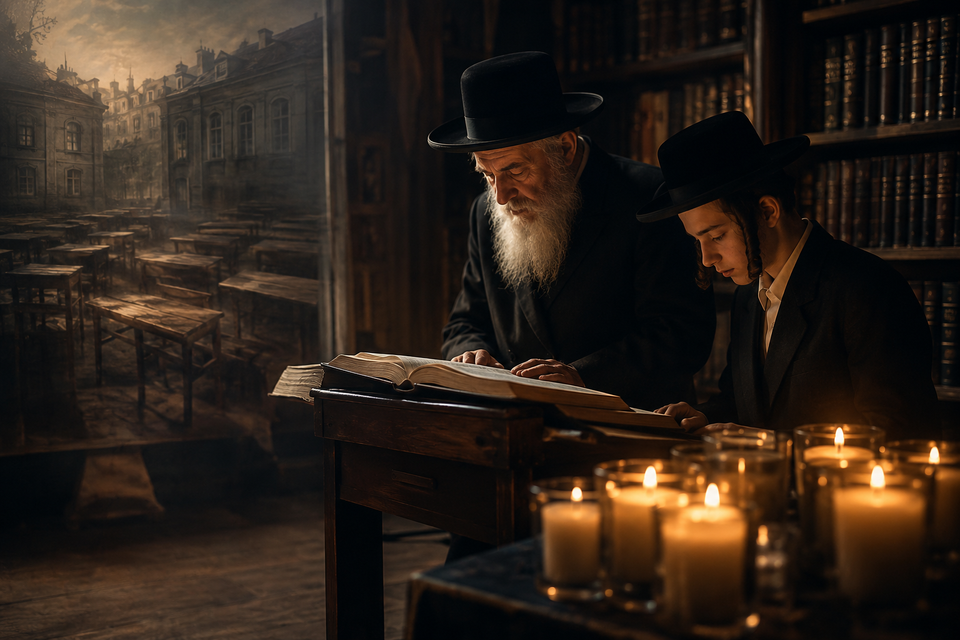
The state's mode of memory is the siren and the moment of silence: the nation stands still, wordless, for two minutes. No one should doubt the sincerity or the sorrow in that silence. But it is worth asking what, in the Torah's understanding, actually reaches a departed neshamah — what genuinely honors and elevates it. And the Jewish answer has never been silence. It is Torah. It is a perek of Tehillim said in a martyr's memory, a Mishnah learned to elevate his soul, a Kaddish d'rabbanan answered with a thundering "yehei shmei rabbah," a child raised in the emunah that the murderers tried to extinguish. These are not passive gestures; they are acts that the mesorah teaches reach upward and lift the neshamah higher. So when a Charedi marks the Holocaust not by standing for a siren but by opening a sefer, it is not a refusal to remember and certainly not a dishonoring of the dead, chas v'shalom. It is remembrance in the one currency the Torah says the dead can actually receive. We honor the kedoshim by doing the very thing they were murdered for refusing to abandon.
IV. What the Holocaust Must Never Be Reduced To
There is one more concern, and it is the gravest. Yom HaShoah, in its common framing, is frequently pressed into the service of a particular message: that the Holocaust happened because the Jews were weak and stateless, and therefore the lesson is that we need an army and a state so that it can never happen again. The Charedi world recoils from this — not because it doubts the value of protecting Jewish life, but because it cannot bear to see the deepest abyss of our history flattened into a political slogan.
To make the Shoah into an argument for statehood is to reduce six million kedoshim to a lesson in geopolitics — to replace emunah with nationalism as the frame through which we understand it. Rav Yitzchak Hutner, in his profound writing on the churban of European Jewry, warned precisely against this distortion: against allowing the catastrophe to be recast as the mere price of political powerlessness, draining it of its spiritual weight and handing it over to ideology. And here we must be exceedingly careful, for the Torah forbids us the arrogance of explanation. "The hidden things belong to Hashem our G-d" (Devarim 29:28). The Torah speaks of times of hester panim, of the Divine face concealed — but it hands no mortal the key to read those times, and the cheshbon of the Shoah is sealed with the Ribbono Shel Olam alone. The Charedi objection to the political framing is therefore not the offer of a rival explanation; it is the refusal to explain at all, and the insistence that what the Holocaust demands of us is not a policy but emunah, teshuvah, and a deeper clinging to Hashem — never a verdict, and never a slogan.
V. We Remember Every Single Day
Perhaps the truest answer to "why don't Charedim observe Yom HaShoah?" is this: because for the Charedi world, Holocaust remembrance was never meant to be the work of a single day in Nissan. It is woven into every day of the year.
Walk through Bnei Brak or Yerushalayim and you will hear the names of the destroyed: yeshivos called Ponevezh, Mir, Slabodka, Kletzk — great Torah citadels of Lita and Poland, reduced to ash and then deliberately rebuilt, brick by brick, so that their names would never be erased from the earth. Sit in a beis midrash and you will find Jews saying Kaddish for relatives who have no graves, continuing the precise mesorah of communities the Nazis tried to wipe from history, raising families steeped in the very Yiddishkeit that was marked for annihilation. This is the most defiant answer a Jew can give to those who sought our end — not hatred, which only ever shrinks the one who carries it, but holiness: the rebuilding of Jewish life, more abundant and more learned than before. Hitler sought a world without Torah Jews. The crowded batei midrash of today are the standing refutation of his dream.
VI. Conclusion: Memory With Mesorah
So the Charedi world does not need a siren to remember. It remembers in its davening, in its learning, in the kehillos it rebuilt and the generations it raises in emunah. Its remembrance is not powered by anger but by achrayus — the responsibility to ensure that the chapter of Jewish history written after the ashes is filled with light.
We mourn every single one of the six million kedoshim with a grief that has no bottom. We simply do it in the way the Torah has always taught us to carry our sorrows — rooted in halacha, shaped by the mesorah, and lifted by the eternity of a Torah that no enemy has ever managed, or will ever manage, to destroy.
May the neshamos of the kedoshim be bound in the bond of eternal life, may Hashem avenge their blood, and may we merit the day when death is swallowed up forever and every tear is wiped from every face — bimheirah b'yameinu, amen.
Sources
The calendar
- Shulchan Aruch and Rema, Orach Chaim 429:2 — the joy of the month of Nissan, in which tachanun, eulogies, and public fasts are set aside — and the principle that the forms and days of Jewish mourning come through the mesorah, not by decree
The days already given to us
- Tisha B'Av — the eternal Jewish day of national catastrophe, into which Holocaust kinnos have been woven
- Asarah B'Teves — designated by the Chief Rabbinate as Yom HaKaddish HaKlali, the general day of Kaddish for victims whose yahrzeit is unknown
How we remember
- The Torah's teaching that the neshamah of the departed is elevated through Torah, Tehillim, Kaddish, and mitzvos performed in its merit — the active remembrance of the beis midrash
What we will not do
- Devarim 29:28 — "the hidden things belong to Hashem our G-d" — the basis for refusing both to reduce the Holocaust to a political lesson and to presume any explanation of it; the cheshbon is sealed with Hashem, the victims were kedoshim, and we offer neither verdict nor slogan, only emunah
A note on attribution
- The documented concerns of Rav Yitzchak Hutner (in his writing on the churban of European Jewry) regarding the reduction of the Holocaust to a lesson in nationalism, and the discomfort of the Chazon Ish (Igros), Rav Shach (Michtavim u'Maamarim), and the Satmar Rav (Vayoel Moshe) with the secular framing of Holocaust remembrance, are presented as their well-documented positions and themes rather than as verified verbatim quotations.
The structural relationship to other articles in this series
- "The Charedi View on the Holocaust" — the fuller treatment, with the same reverence and the same refusal to explain
- "What Is the Charedi View on the Phrase 'Never Again'?" — the rejection of reducing the Shoah to an argument for human power
- "Why Don't Charedim Celebrate Yom Ha'atzmaut?" — another state-established day measured against the mesorah