What Is the Charedi View on the Holocaust?
The Holocaust — the Churban of European Jewry, in Which Six Million Were Murdered, Among Them the Greatest Torah Centers of the Generation — Is a Wound Beyond Human Comprehension. The Charedi Response Holds Two Truths Together. First: We Cannot Pinpoint the Exact Divine Accounting, and to Claim Certainty About a Specific Cause Is an Arrogance. But Second, and Just as Important: This Was Not Random and Not Meaningless. The Torah Itself Forewarned Us — in the Tochacha — Exactly What Follows When Klal Yisrael Abandons the Covenant. Hashem Is Just; There Were Reasons, Even if Their Full Specifics Are Hidden. And the Generations Before the Churban Were, by and Large, a Time of Massive Turning Away From Torah and From Hashem's Ways
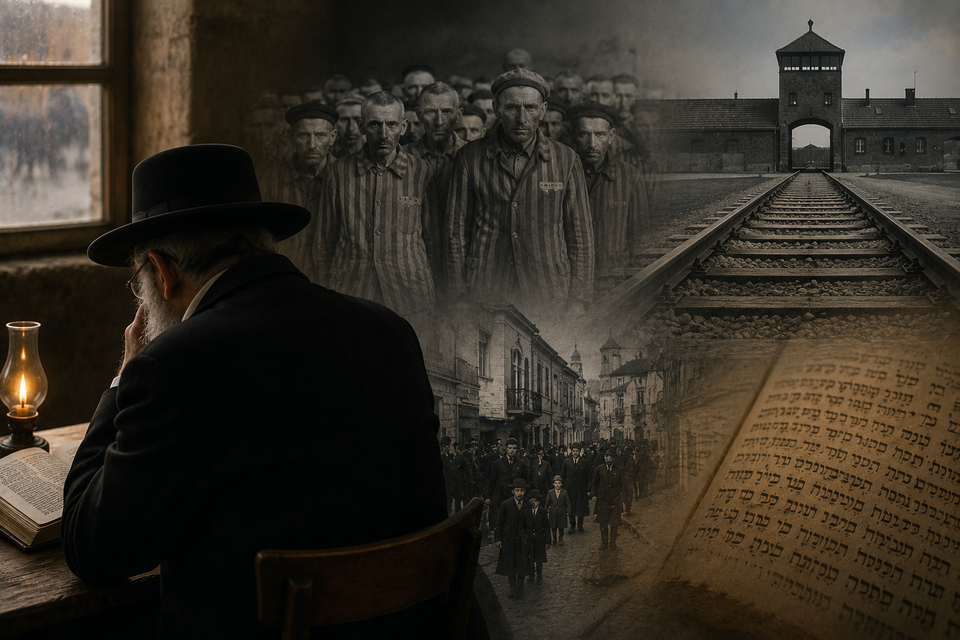
The Holocaust — HaShoah, the Churban Europa — is among the most unfathomable tragedies in all of Jewish history. Six million of our brothers and sisters were murdered. Among them were towering Torah giants, roshei yeshiva and rebbes, entire Chassidic dynasties, the great yeshivos of Lithuania and Poland, ancient kehillos, the elderly and the children. The scope of the destruction is beyond human comprehension, and it left a wound in Klal Yisrael that will not heal until the coming of Moshiach.
How does the Charedi world — with its deep emunah and fidelity to the Torah's mesorah — confront a horror of this magnitude?
The answer holds two truths together, and both must be stated, because emphasizing either one alone distorts the Torah's position. The first truth is humility: we cannot pinpoint the precise Divine accounting, and anyone who claims to know with certainty the specific reason Hashem allowed the Holocaust speaks with an arrogance the Torah does not permit. The second truth is just as essential: the Holocaust was not random, not arbitrary, and not without reason. The Torah itself forewarned us, in the clearest terms, what would befall Klal Yisrael if we abandoned the covenant. Hashem is just, and nothing He does is without purpose. There were reasons — even if their full and exact specifics are hidden from us. And the generations before the churban were, by and large, a time of vast turning away from Torah and from the ways of Hashem.
To hold only the first truth — "we cannot know anything" — is to ignore that the Torah told us in advance. To hold only the second — "we know exactly why" — is to claim a knowledge no human possesses. The authentic Charedi view holds both: there were reasons, rooted in the covenant the Torah describes; and the precise accounting is beyond us. We work through this below.
I. The Torah Forewarned Us — This Was Not Without Reason
The single most important point, and the one most often missed in discussions that reduce the Holocaust to pure mystery, is this: the Torah itself told us, explicitly and in advance, what would follow if Klal Yisrael abandoned the covenant.
Twice the Torah sets out the Tochacha — the rebuke — in terrifying detail. In Bechukosai (Vayikra 26) and again in Ki Savo (Devarim 28), the Torah lays out, with unbearable specificity, the catastrophes that would befall the Jewish people if they turned away from Hashem: the persecutions, the scatterings, the famines, the hunted and the slaughtered, horrors so severe that the Torah itself seems to strain to describe them. These are not the words of later commentators. They are the words of the Torah — Hashem's own forewarning to His people of the consequences of abandoning Him.
This means that the Holocaust, however incomprehensible in its scale and its specifics, cannot be regarded as something the Torah never anticipated or as a rupture with no relationship to the covenant. The Torah established, from the beginning, that the relationship between Klal Yisrael and Hashem is a covenant — and that the abandonment of that covenant carries consequences. The Torah connects the hiding of the Divine Face directly to this abandonment: "And My anger will flare against them on that day, and I will abandon them and hide My face from them… and they will say on that day, 'Is it not because my God is not in my midst that these evils have befallen me?'" (Devarim 31:17). The pasuk itself names the connection between the hidden Face and the turning-away.
And the Torah affirms, as bedrock, that Hashem's justice is perfect: "HaTzur tamim pa'alo… Keil emunah v'ein avel, tzaddik v'yashar Hu" — "The Rock, His work is perfect… a God of faithfulness without injustice, righteous and upright is He" (Devarim 32:4). The navi Amos states the principle directly: "Im tihyeh ra'ah b'ir, va'Hashem lo asah?" — "If calamity befalls a city, has Hashem not brought it about?" (Amos 3:6). Nothing that happens to Klal Yisrael is random or outside Hashem's just providence. When we stand at a graveside and recite tzidduk hadin — the justification of the Divine judgment — we affirm precisely this: that even in the face of death we cannot understand, Hashem's judgment is just.
II. What We Can Say, and What We Cannot
Here the two truths must be held in their proper relationship.
What we can say is the framework the Torah establishes: that the covenant is real, that abandoning it has consequences, that Hashem is just, that there were reasons. What we cannot say — what no human being has the standing to say — is the precise Divine accounting: that this specific sin produced this specific suffering, that this community died for that reason, that we can read the hidden ledger of Heaven and map cause to consequence.
This is the valid core of the caution voiced by the Brisker Rav, Rabbi Yitzchak Zev Soloveitchik zt"l, who opposed the confident assignment of specific causes to the Holocaust. His objection was not to the Torah's covenantal framework — no one denies that. His objection was to the arrogance of precision — to those who would point to a particular sin or a particular group and declare, "this is exactly why six million died." That specific accounting is hidden, and to claim to know it is to presume to read the mind of Hashem and to risk a terrible injustice toward the kedoshim. The proper response to the unknowable specifics is teshuva and yiras Shamayim, not a confident chart of Divine cause and effect.
So the two truths are not in tension; they operate at different levels. At the level of the framework: there were reasons, the Torah forewarned us, Hashem is just. At the level of the exact accounting: we do not know, and we do not presume to. The Charedi world affirms the first with full conviction and approaches the second with full humility. "Hanistaros la'Hashem Elokeinu" — "the hidden things belong to Hashem our God" (Devarim 29:28); but "haniglos lanu u'l'vaneinu" — "the revealed things are for us and our children." The revealed framework is ours to affirm; the hidden specifics are His.
III. The Generation Before the Churban
Within this framework, the Charedi world does not avert its eyes from the spiritual state of the Jewish people in the generations before the Holocaust. By and large, it was a time of massive turning away from Torah and from the ways of Hashem — and this is simply the historical truth.
The eighteenth and nineteenth centuries brought the Haskalah — the so-called Jewish Enlightenment — which championed assimilation, secularism, and the abandonment of Torah observance in the name of "progress" and integration into European culture. Its effect on European Jewry was devastating. Yeshivos emptied; Shabbos observance collapsed across vast segments of the people; whole communities cut their ties to Torah Judaism, embracing Reform, secular nationalism, Bundism, Communism, or simple assimilation. By the early twentieth century, the majority of European and world Jewry had, in varying degrees, left the path of strict Torah observance. This is not a polemical claim; it is a demographic and historical fact about the era.
The Meshech Chochmah — Rabbi Meir Simcha HaKohen of Dvinsk (d. 1926) — captured the spiritual danger of this era in a passage on Bechukosai that has become famous as near-prophetic. He warned of the illusion that a Jew might come to believe "Berlin is Yerushalayim" — that the diaspora had become a permanent home and that Jewish identity could be safely dissolved into the surrounding culture. He warned that such an illusion would not stand: that "a storm wind would arise and uproot" those who forgot their origins and imagined that Berlin had become their Jerusalem. Written before his death in 1926, it named with chilling precision the spiritual currents that defined the era — the conviction that Torah could be abandoned and Jewish identity preserved by assimilation into Europe.
This does not mean — and this must be stated with the greatest care — that any individual who perished "deserved" his death, or that the murdered are to be blamed for their own murder. It means that, at the level of the nation and the era, the Jewish people had, by and large, turned away from the covenant — and that this collective reality is part of how the Torah's framework understands the catastrophe that followed. The distinction between collective covenantal reality and individual desert is essential, and we return to it below.
IV. Rav Avigdor Miller — A Sustained Charedi Treatment
Among the Charedi thinkers who addressed the Holocaust most directly and at greatest length was Rav Avigdor Miller zt"l (1908–2001), who devoted sustained attention to the subject across his writings and shiurim — his defense of Hashem's justice in the face of the Holocaust was later gathered into a full-length work, A Divine Madness: Rabbi Avigdor Miller's Defense of Hashem in the Era of the Holocaust.
Rav Miller's central thesis was that the Holocaust must be understood within the framework of Divine justice — that to call it random, meaningless, or unrelated to the spiritual state of the Jewish people is itself a failure of emunah. He argued, forcefully and without apology, that the era of mass abandonment of Torah — the Haskalah, the great secularizing movements, the assimilation that swept European Jewry, the widespread conviction that the Jew could shed his Torah and remain whole — represented a profound collective turning away from Hashem, and that the catastrophe that followed could not be severed from this reality. In his understanding, when great segments of the Jewish people declared, in effect, that they were Europeans of the "Mosaic persuasion" — that Berlin was Jerusalem — they cut themselves off from the source of their protection, and the Divine shield that had guarded Klal Yisrael was withdrawn, in the manner of hester panim the Torah had forewarned.
Rav Miller never minimized the horror, and never spoke with anything but anguish for the murdered. But he refused what he regarded as the greater danger: the modern instinct to declare the Holocaust inexplicable in principle — to sever it entirely from Divine justice and treat it as a meaningless eruption of evil. To do that, he held, is to deny that Hashem rules the world with justice — to push Hashem out of the most consequential event of the century. His insistence was that emunah requires us to affirm that Hashem is just and that nothing of this magnitude occurs outside His providence and His reasons, even when those reasons, in their full specifics, exceed our understanding. Rav Miller's treatment represents the Charedi conviction at its most unflinching: that we honor neither Hashem nor the truth by pretending the churban had no relationship to the spiritual state of the people the Torah had bound in covenant.
V. The Death of the Tzaddikim — and Why It Does Not Overturn the Framework
A profound question presses here, and the Charedi world does not evade it. If the framework speaks of the nation's turning away, how do we understand that the Holocaust fell most heavily upon the most Torah-true communities in the world? The yeshivos of Lithuania, the Chassidic courts of Poland and Hungary, the ancient observant kehillos of Eastern Europe — the very heart of the Torah world — were the most completely destroyed. Tzaddikim, lamdanim, rebbes, and pure-hearted simple believers perished in their multitudes.
The Torah's framework answers this not by abandoning the covenantal understanding but through a principle Chazal state directly: "keivan sheNitan reshus laMashchis, eino mavchin bein tzaddik l'rasha" — "once permission is given to the destroyer, it does not distinguish between the righteous and the wicked" (Bava Kamma 60a; cf. Rashi on Shemos 12:22). When Divine judgment is unleashed upon a generation — when the protective Face is hidden from the nation as a whole — the calamity does not sort itself neatly by individual desert. The tzaddikim are swept up in the churban of the generation along with all the rest. This is precisely why the suffering of the righteous in a national catastrophe is not evidence that they personally sinned — and why the framework operates at the level of the nation and the era, not the individual soul.
This is the crucial guardrail against the monstrous misreading. The covenantal framework speaks of Klal Yisrael collectively and of the era as a whole. It does not — ever — license the claim that this murdered child, that slaughtered tzaddik, that incinerated kehillah of pious Jews "deserved" their fate. The tzaddikim who died are kedoshim of the highest order, whose deaths al kiddush Hashem are held by the Charedi world in the deepest sanctity, and whose suffering is understood by many as a kapparah borne on behalf of the generation — the righteous suffering with and for their people. To honor them is to refuse to pin their deaths on their own account, while still affirming the Torah's framework that the nation, collectively, stood in a broken covenant.
And the guilt of the murderers is in no way diminished by any of this. That Hashem, in His hidden justice, allowed the churban does not transfer one particle of guilt from the resha'im who perpetrated it. The Torah's principle is that Hashem may use even a wicked nation as the rod of His judgment while that nation remains fully, damnably guilty for the evil it freely chose — as with Ashur and Bavel in the words of the Neviim. The murderers were resha'im of the highest order, fully accountable before Hashem and man for every life they took. The framework of Divine justice and the full culpability of the murderers stand together.
VI. The Voices From Within the Fire
Some of the most piercing words came from those who entered the fire themselves. Rav Elchonon Wasserman Hy"d — Rosh Yeshiva of Baranovich, talmid muvhak of the Chofetz Chaim — was murdered in 1941. According to accounts transmitted by survivors, in his final hours he spoke not with despair but with the language of korbanos: that those about to die should go with thoughts of teshuva, as offerings upon the altar, their hearts turned to Hashem — and that the fire consuming their bodies would be the fire of a sacrifice that would help rebuild the House of Israel.
This is kabbalas hadin at its most exalted — the acceptance of a judgment one cannot fully fathom, not out of resignation but out of a trust in Hashem's justice so complete that it holds even at the threshold of death. Rav Elchonon did not claim to know the precise accounting; but he affirmed, with his last breath, that he stood within Hashem's justice and not outside it. That union of humility about the specifics and total emunah in the framework is the Charedi posture in its purest form.
The Chofetz Chaim zt"l (d. 1933), in his final years, spoke with foreboding of a coming storm and urged spiritual preparation, turning much of his attention to the themes of the pre-messianic era. He did not live to see the Holocaust, but his trembling about the darkening world, and his insistence that only clinging to Torah would carry Klal Yisrael through what was coming, were of a piece with the Torah's covenantal warning.
VII. Not a "Birth-Pang," Not Redeemed by a State
One theological claim about the aftermath the Charedi world firmly rejects: that the founding of the State of Israel was the redemptive answer to the Holocaust — that the Shoah was the "birth-pang" of the State, and that secular sovereignty is the consolation and the meaning of the six million.
Across the spectrum — Rav Aharon Kotler, the Brisker Rav, the Satmar Rav, the Gerrer Rebbe (the Imrei Emes), and others — the Charedi gedolim rejected this. To present a secular state as the redemptive "meaning" of the churban is a double distortion: it claims to know the redemptive purpose of a catastrophe whose specifics are hidden, and it locates that purpose in a secular political achievement rather than in the true geulah the Torah describes. Rav Yitzchak Hutner zt"l, in his Pachad Yitzchak, addressed how this framing distorts the Jewish understanding of galus and geulah — cheapening both the depth of the churban and the meaning of redemption by binding them to a secular national project. The six million are not "redeemed" by a flag. Their redemption, like ours, awaits Moshiach.
VIII. The Response — Rebuilding Through Torah
The deepest Charedi response to the Holocaust is not a theory but a life. In the decades after the churban, the Torah world did not turn to political solutions; it turned to Torah, and it rebuilt. The great yeshivos were reestablished in Eretz Yisrael and America, the Chassidic courts reconstituted from handfuls of survivors, the kollelim built from nothing; entire communities — Bnei Brak, Yerushalayim, Lakewood, Monsey, Gateshead — rose into fortresses of Torah where broken survivors had arrived with little more than their emunah. The world the murderers tried to erase did not merely survive; it grew into the largest Torah world in Jewish history.
The sentiment attributed to Rav Shach zt"l captures it: that the Jewish answer to those who sought to destroy us is not with weapons but with Gemaras — with the voices of children learning Torah. Every new yeshiva, every child learning, every Chassidic court rebuilt, is a refusal to let the fire of Torah be extinguished — and a living act of teshuva, the nation's return to the covenant whose abandonment the Torah had warned against.
IX. The Closing — Mourning With Emunah, Affirming His Justice
What is the Charedi view on the Holocaust?
It is neither "we know exactly why" nor "we can know nothing at all." It is the harder and truer position that holds both: the Torah forewarned us — in the Tochacha, in Hashem's own words — exactly what follows when Klal Yisrael abandons the covenant; Hashem is just, and nothing of this magnitude is random or without reason; and the generations before the churban were, by and large, a time of vast turning away from Torah. These things we affirm with full conviction. And at the same time: the precise Divine accounting — which sin, which measure, which exact reason — is hidden from us, and to claim certainty about it is an arrogance that profanes both Hashem's hidden ways and the sanctity of the kedoshim.
We do not pin the churban on the murdered, for the tzaddikim who perished are kedoshim and the destroyer once loosed does not distinguish; and we do not lift one grain of guilt from the resha'im who chose their evil freely. But we refuse to push Hashem out of His own world. We affirm, as the Torah demands, that He is just, that He forewarned us, and that there were reasons — even as we bow our heads before specifics we were never given to know.
And so we mourn the kedoshim, we affirm the justice of the Judge we cannot fathom, we return to the covenant through Torah and teshuva, and we rebuild — teaching our children that even in the deepest darkness Klal Yisrael has ever known, the fire of Torah was not extinguished, and will never be extinguished, until the day Hashem reveals His hidden Face, wipes away every tear, and the kedoshim rise in techiyas hameisim to see the complete redemption with their own eyes.
Sources
The Torah's forewarning — the covenantal framework
- The Tochacha — Vayikra 26 (Bechukosai) and Devarim 28 (Ki Savo) — the Torah's explicit forewarning of the catastrophic consequences of abandoning the covenant
- Devarim 31:17–18 — "And I will hide My face from them… is it not because my God is not in my midst that these evils have befallen me?" — the pasuk connecting the hidden Face to the turning-away
- Devarim 32:4 — "HaTzur tamim pa'alo… tzaddik v'yashar Hu" — the perfection and justice of Hashem's ways
- Amos 3:6 — "Im tihyeh ra'ah b'ir, va'Hashem lo asah?" — calamity is not random but comes from Hashem
- Devarim 29:28 — "hanistaros la'Hashem Elokeinu, v'haniglos lanu u'l'vaneinu" — the hidden things belong to Hashem; the revealed framework is ours
- The recitation of tzidduk hadin — affirming Divine justice even in the face of incomprehensible death
What we can and cannot say — the proper humility about specifics
- The Brisker Rav (Rabbi Yitzchak Zev Soloveitchik zt"l) — the caution against assigning specific causes; the objection to the arrogance of precision (claiming to map exact sin to exact consequence), distinct from the covenantal framework itself, which is not in dispute
- The two levels: the affirmed framework (there were reasons; Hashem is just; the Torah forewarned) and the hidden specifics (the exact accounting, which we do not presume to know)
The generation before the churban
- The Haskalah and the mass abandonment of Torah observance across European Jewry (Reform, secular nationalism, Bundism, Communism, assimilation); the demographic reality that the majority had left strict observance by the early twentieth century
- The Meshech Chochmah (Rabbi Meir Simcha HaKohen of Dvinsk, d. 1926), on Bechukosai — the near-prophetic warning about the illusion that "Berlin is Yerushalayim" and the storm that would uproot those who forgot their origins
- The essential distinction between collective covenantal reality (the nation's turning away) and individual desert (never to be pinned on any victim)
Rav Avigdor Miller's treatment
- Rav Avigdor Miller zt"l (1908–2001) — his sustained treatment of the Holocaust within the framework of Divine justice; A Divine Madness: Rabbi Avigdor Miller's Defense of Hashem in the Era of the Holocaust (the gathered, book-length presentation of his position), and his broader hashkafah works (Rejoice O Youth, Sing You Righteous)
- His thesis: that to call the Holocaust random or meaningless is itself a failure of emunah; that the pre-war mass abandonment of Torah was a collective turning from Hashem; that the Divine shield was withdrawn in the manner of hester panim the Torah forewarned; and that emunah requires affirming Hashem's justice even where the full specifics exceed our understanding — represented here as his documented thesis rather than verbatim quotation
The death of the tzaddikim — and the guilt of the murderers
- Talmud Bavli, Bava Kamma 60a — "keivan sheNitan reshus laMashchis, eino mavchin bein tzaddik l'rasha" — once the destroyer is given permission, it does not distinguish between righteous and wicked (cf. Rashi on Shemos 12:22); the principle that the righteous are swept up in the churban of the generation, so their suffering is not evidence of individual sin
- The tzaddikim who died al kiddush Hashem as kedoshim, their deaths understood by many as a kapparah for the generation
- The full and undiminished guilt of the murderers — the principle (as with Ashur and Bavel in the Neviim) that Hashem may use a wicked nation as the rod of His judgment while that nation remains fully accountable for the evil it freely chose
The voices from within the fire
- Rav Elchonon Wasserman Hy"d (d. 1941) — the transmitted accounts of his final words: the language of korbanos and teshuva; kabbalas hadin at its most exalted (Kovetz Maamarim and the transmitted accounts)
- The Chofetz Chaim zt"l (Rabbi Yisrael Meir Kagan, d. 1933) — his foreboding of the coming storm and his insistence on clinging to Torah; he died before the Holocaust
Not a "birth-pang," not redeemed by a State
- The rejection across the Charedi spectrum (Rav Aharon Kotler, the Brisker Rav, the Satmar Rav, the Gerrer Rebbe / Imrei Emes, and others) of the theology that the secular State was the redemptive answer to or "meaning" of the Holocaust
- Rav Yitzchak Hutner zt"l, Pachad Yitzchak — the distortion of the understanding of galus and geulah introduced by binding them to a secular national framework
The response — rebuilding through Torah
- The post-Holocaust revival of the Torah world (Bnei Brak, Yerushalayim, Lakewood, Monsey, Gateshead); the growth into the largest Torah world in Jewish history; rebuilding as the nation's act of teshuva and return to the covenant
- The sentiment attributed to Rav Shach zt"l (Michtavim u'Maamarim): that the response to those who sought our destruction is through Torah — the voices of children learning
The structural relationship to other articles in this series
- "What Was the Charedi View of the Founding of the State of Israel?" — the rejection of redemptive theology around the State
- "Yes, We See the Miracles, No the State Is Not the Geulah" — the Source vs. Vessel framework
- "What Do Charedim Believe Will Happen to the State When Moshiach Comes?" — the true geulah the Charedi world awaits