What Do Charedim Think of the Israeli Flag and National Anthem?
For many Jews the blue-and-white flag and HaTikvah stir real and tender feeling — pride, survival, belonging. In Charedi neighborhoods they are met more coolly, and the reason is not mere politics. It is a quiet conviction about what is holy, what is central, and what a Jew is at his very core.
It would be wrong to begin anywhere but with honesty about the feeling. For a great many Jews, the sight of the blue-and-white flag, or the rising notes of HaTikvah, touches something deep — the memory of a people that survived what should have ended it, the pride of having a place in the world after centuries of having none. That emotion is real, and it deserves to be met with respect rather than a sneer. So when those same symbols are received coolly in Charedi neighborhoods, the fair question is why — and the answer is not contempt, and not even, at bottom, politics. It runs deeper than that, into Torah, history, and a particular understanding of what holds a Jew's identity together. Let us take the flag and the anthem each in turn.
I. The Flag: A Secular Emblem in Sacred-Looking Cloth
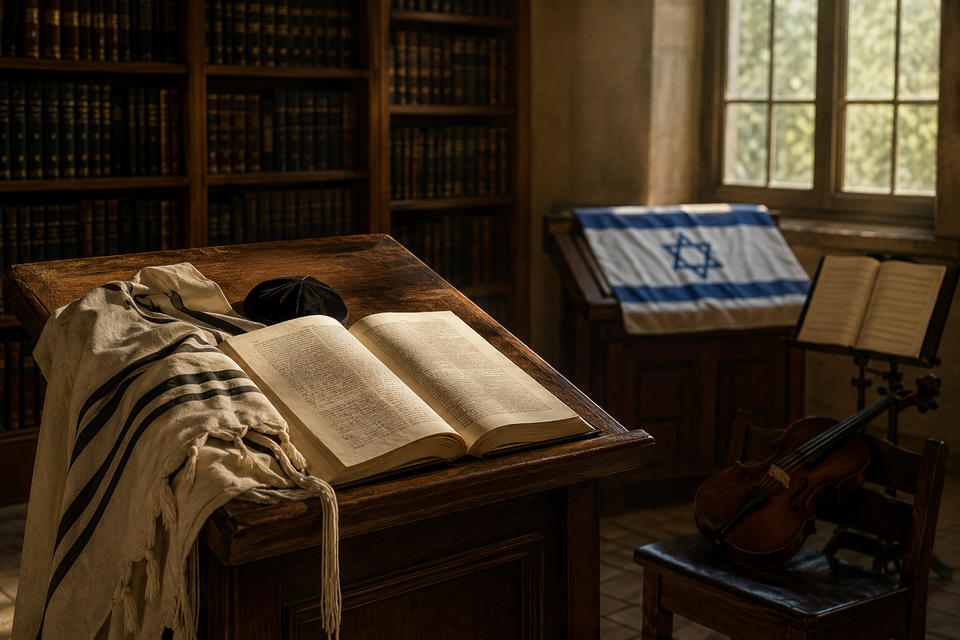
Begin with the flag's own origins, which are not in dispute. It was designed in the late nineteenth century within the secular Zionist movement, its blue stripes and Magen David consciously modeled on the look of a tallis. David Wolffsohn, one of the early Zionist leaders, left a well-known account of the moment the movement needed a banner for its first Congress: casting about for a symbol, he reached for the tallis Jews wrap themselves in to pray, and from that image the flag was born.
It is a striking story — but notice what it is and what it is not. The flag's creators were not fashioning an object of mitzvah or a vessel of avodas Hashem; they were designing a national emblem, the standard of a modern state meant to take its place among the nations of the world. And that aspiration, however understandable after so much suffering, is precisely the one the Torah views with caution. When the Jewish people once asked for a king "like all the nations" (I Shmuel 8:5), the request troubled the navi — not because leadership is wrong, but because the longing to be like the nations is in quiet tension with what Israel was called to be: "a kingdom of priests and a holy nation" (Shemos 19:6), a people defined by being set apart. The flag, whatever its beauty, carried no halachic standing, no sanction of the Gedolim, and no root in the mesorah of what a banner of Klal Yisrael might be (cf. Avos 1:1). It was new, and it was national, and it was secular — and a Torah Jew notices all three.
II. Resemblance Is Not Kedushah
This goes to a principle that lies at the heart of the matter, and it is easy to miss. In the Torah, holiness is not produced by appearances.
A tallis is holy — but not because of how it looks. Its kedushah flows entirely from the mitzvah of tzitzis, from Hashem's command; the cloth is sanctified by the word of the Ribbono Shel Olam, not by its color or its shape. Take that same look — the white field, the blue stripes — and stamp it onto a national flag, and you have not transferred one drop of that holiness, because holiness was never in the look to begin with. Kedushah comes from Hashem's designation, never from symbolism alone. A flag that resembles a tallis is no more sacred than a building shaped like a sefer Torah; the resemblance is architecture, not kedushah. This is why Rav Yosef Chaim Sonnenfeld and the Gedolim of the Old Yishuv in Yerushalayim would not hang the Zionist flag in their institutions, and why figures such as the Chazon Ish, Rav Elchonon Wasserman, and Rav Aharon Kotler regarded it warily — not merely as non-religious cloth, but as the standard of a competing identity, one that might, over time, draw Jews to think of themselves first as citizens of a secular state rather than as ovdei Hashem. Their concern was never the fabric. It was what the fabric was being asked to mean.
III. The Ponevezh Flagpole: A Story Often Misread
No discussion of this would be complete without the most famous Charedi flag story of all — the Ponevezh Yeshiva in Bnei Brak, which raises an Israeli flag each year on Yom HaAtzmaut. It is sometimes offered as proof that the Charedi world quietly came around to the flag after all. The truth is more interesting, and more debated.
The Ponevezher Rav, Rav Yosef Shlomo Kahaneman, was a Torah giant who lost his community and much of his family in the Holocaust and devoted the rest of his life to rebuilding the Torah world from the ashes. The explanations offered for his custom vary, and honesty requires admitting that we cannot read his heart with certainty. But one detail is telling: on that day he raised the flag without reciting Hallel — the unmistakable sign that he was not marking Yom HaAtzmaut as a religious festival or endorsing the ideology behind it. Whatever his precise intent — and accounts differ — it was emphatically not a declaration that the secular state's vision had been sanctified. And in any case, his was a singular, minority practice: the great majority of the Gedolim of his generation did not follow it, precisely out of the concern that external symbols, however reframed, could come to stand in for Torah substance and blur the lines they thought it vital to keep clear.
IV. HaTikvah: A Hope With No Mention of the One We Hope To
Turn now to the anthem, where the question sharpens. HaTikvah, written by Naftali Herz Imber in the spirit of nineteenth-century European national-romanticism, is a moving poem about a two-thousand-year-old yearning to be a free people in our own land. And yet — read it closely — it does not once name Hashem. It speaks of no Torah, no Beis HaMikdash, no Shechinah, no Mashiach, no malchus Beis David. Its hope is real, but it is a national hope, and it stops there.
Set beside it the hope a Jew voices every single day, standing before his Creator: "May our eyes behold Your return to Zion in compassion" — v'sechezenah eineinu b'shuvcha l'Tziyon b'rachamim. That is the tikvah of the mesorah, and it is a different order of longing entirely: not the founding of a state, but the return of the Shechinah; not independence, but the rebuilding of the Beis HaMikdash and the ingathering of all Israel under the kingship of Hashem and the throne of David. The two hopes are not equal, and to a Charedi ear, exchanging the second for the first — singing of an unnamed "hope" where one might instead beg for the return of the Divine Presence — feels like trading an eternal yearning for a temporary one. It is not that HaTikvah says something false. It is that it leaves unsaid the only One who could ever fulfill it.
V. This Is Not Hatred
Let none of this be mistaken for coldness toward Eretz Yisrael or toward fellow Jews. It is nothing of the kind. Charedim love the Land with their whole hearts — every stone of Yerushalayim, every mitzvah bound to its soil, every Jew who walks its streets. The reticence toward the flag and the anthem is not the rejection of the Land or its people; it is a refusal to let secular national symbols become the measure of Jewish identity or the content of Jewish hope.
Underneath it lies a conviction as old as David HaMelech: "These call upon chariots and these upon horses, but we invoke the Name of Hashem our G-d" (Tehillim 20:8). A people whose security and whose destiny rest in Hashem does not locate its deepest pride in a banner or a melody, however stirring — not out of disdain for those who do, but out of loyalty to a hope it believes will outlast every flag ever raised. That is why many Charedim do not salute the flag, do not sing HaTikvah, and stay back from official state ceremonies: not from hostility, but from a quiet determination to keep their first allegiance fixed where the mesorah fixed it.
VI. The Cloth, the Song, and the Soul
So what do Charedim think of the flag and the anthem? Not that they are hateful — but that they are not, and cannot be, the core of who a Jew is. A flag, in itself, is cloth that a generation agreed to honor; an anthem, in itself, is a poem set to music. Whatever meaning a people pours into them, that meaning is assigned, not intrinsic — and it is not the foundation a Jew stands on.
Torah is. Torah is the soul of the Jewish people — its guide, its glory, and its truth in every generation — and it was for the sake of the Torah, not a state, that we were made a people at all. "For the children of Israel are servants to Me" (Vayikra 25:55): a Jew is, first and before anything else, an eved Hashem, bound to the mesorah of Har Sinai. And so the Charedi heart yearns not, in the end, for a flag flying over a parliament, but for the day when every Jew will stand united under the Kingship of Hashem, in the full Geulah Sheleimah — a hope no anthem has yet learned to sing.
May we see it with our own eyes, b'shuvcha l'Tziyon b'rachamim — bimheirah b'yameinu, amen.
Sources
A people set apart, not "like the nations"
- I Shmuel 8:5 — the request for a king "like all the nations" and why it troubled the navi
- Shemos 19:6 — "a kingdom of priests and a holy nation" — Israel defined by being set apart
- Avos 1:1 — the mesorah; a banner of Klal Yisrael has no root in the transmitted tradition
Holiness is not appearance
- The principle that the kedushah of a tallis flows from the mitzvah of tzitzis — Hashem's command — and not from its look; resemblance transfers no holiness, because kedushah comes from Divine designation alone
The authentic hope
- "V'sechezenah eineinu b'shuvcha l'Tziyon b'rachamim" (the Shemoneh Esrei) — "may our eyes behold Your return to Zion in compassion" — the daily Jewish hope for the Shechinah, the Beis HaMikdash, and malchus Beis David, set against an anthem that names none of them
Trust, and identity
- Tehillim 20:8 — "these call upon chariots and these upon horses, but we invoke the Name of Hashem our G-d"
- Vayikra 25:55 — "for the children of Israel are servants to Me" — the Jew as eved Hashem before all else
On the Ponevezh flag custom
- The practice of Rav Yosef Shlomo Kahaneman, the Ponevezher Rav, of raising the flag on Yom HaAtzmaut without Hallel — a singular, much-discussed, and variously explained minority custom that the majority of the Gedolim did not adopt; surveyed in Jonathan Rosenblum's "Reclaiming the Flag" (Mishpacha, 2016), among other accounts
On HaTikvah's origins
- The poem of Naftali Herz Imber, in the idiom of nineteenth-century European national-romanticism — a national hope that makes no mention of Hashem, Torah, the Mikdash, or Mashiach
A note on attribution
- The documented opposition of Rav Yosef Chaim Sonnenfeld (Salmas Chaim), the Chazon Ish, Rav Elchonon Wasserman (Ikvesa d'Meshicha / Kovetz Maamarim), Rav Aharon Kotler, and Rav Shach (Michtavim u'Maamarim) to the elevation of secular national symbols is presented as their well-documented positions rather than as verified verbatim quotations.
The structural relationship to other articles in this series
- "The Charedi View on Ripping Down Israeli Flags" — why opposing the flag's meaning never permits damaging it
- "What Is the Torah View on Nationalism?" — peoplehood through Torah versus secular nationhood
- "Why Don't Charedim Celebrate Yom Ha'atzmaut?" and "Why Charedim Oppose Hallel on Yom Ha'atzmaut" — the surrounding questions
- "Why Is Mesorah Such an Integral Part of Judaism?" — the standard by which a symbol's claim is weighed