
"Side by Side, Not Apart": What the Chief of Staff Just Told Us About the Draft
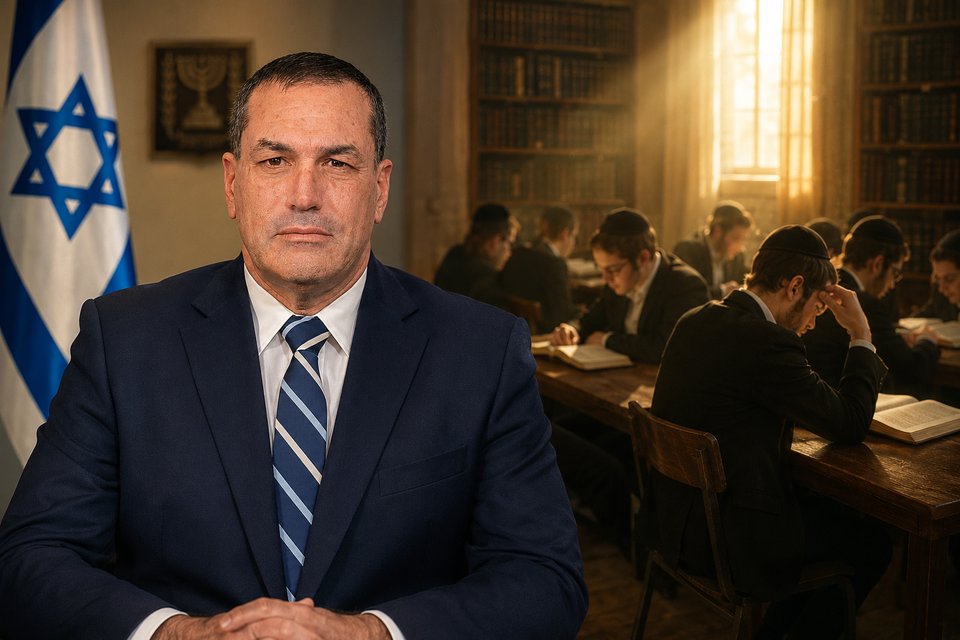
The coalition crisis grabbed the headlines this week. But the most honest words spoken about Charedi service came from a quieter room — and every Jew who cares about this fight should read them carefully. The Chief of Staff has now said, in his own words, what the draft is actually about.
I. The Crisis on the Surface
The headline was political. A deal, of sorts, was reached: Prime Minister Netanyahu and the Charedi parties circling one another over the draft, with elections set for October 20 held out against the promise of legislation. Shas chairman Rabbi Aryeh Deri and United Torah Judaism chairman Rabbi Moshe Gafni delivered the Gedolim's demand plainly — advance the Basic Law on Torah study and the law halting the arrests of bnei yeshiva this week, or watch the Knesset dissolve. The Prime Minister, as ever, promised movement.
We have learned by now what those promises tend to be worth. But the more important statement of the week was not made by any politician negotiating his survival. It was made by the man who actually runs the army — and unlike the politicians, he told the truth.
II. If You Truly Need Soldiers, Look Elsewhere
The Chief of Staff arrived with a familiar message: the army, he said, is short thousands of combat soldiers and needs every soldier it can get. We will treat that claim briefly — because it is not the heart of what he said this week, and because we do not entirely believe it to begin with. The very same government now warning that the nation cannot survive without drafting yeshiva students is pouring hundreds of billions of shekels into a drone-and-AI military, the technological "Super Sparta" the Prime Minister himself promises will make raw numbers matter less, not more.
But grant the shortage for the sake of argument. If the State genuinely needs more soldiers, the honest place to look is among those who actually believe in it: the secular Israelis who evade the draft and never appear when they are called, and the entire Arab sector — nearly a fifth of the country — that the draft does not touch at all. Let the people who built this State, and who hold it to be the answer, fill its ranks first. And let no one pretend the Charedim are sitting idle while others carry the weight. They are carrying a weight of their own — the limud haTorah that, in the mesorah we will never apologize for, is what truly guards this nation. We are not the obvious place to find soldiers. We are simply the place they have chosen to look.
And that is the entire giveaway — because the choice was never really about soldiers at all. The Charedi refusal turns on no number; it is a matter of principle, and the principle is plain: a yarei Shamayim cannot serve in this army as a Jew. Which is precisely what the Chief of Staff, in the rest of that very same meeting, went on to prove — in his own words.
III. "Without Compromise" — The Message Sent to the Religious Zionists
The heart of the meeting was not the Charedim at all. It was the crisis over women in combat. Dozens of hesder yeshivos — Religious Zionist institutions whose students serve, and serve devotedly, filling the combat units in numbers far above their share of the population — had declared that they would no longer send their talmidim to the Armored Corps, after the High Court ordered the integration of women into tank units. These are not men who refuse to serve. These are the army's own.
And to them, on a matter touching the core of their religious conviction, the Chief of Staff's answer was unbending. The expansion of women into combat roles, he said, is "of immense operational importance, and the IDF will continue to act to expand it." His phrase for how it would be done: without compromise.
We say what follows with genuine respect for our Dati Leumi brothers, with whom we differ on a great deal but whose mesirus nefesh is real and whose sons bleed on the front lines: look closely at the answer they received. To the very community that fills the army's combat ranks, that has built its entire hashkafah around serving, the response on a question of deep religious principle was without compromise. And if that is the answer handed to the ones who serve — what answer does anyone seriously imagine is waiting for the Charedi world, which does not?
IV. What the "Joint Service Order" Actually Says
Then Zamir named the mechanism, and in naming it, he said the quiet part out loud.
The framework governing all of this is the Joint Service Order — the IDF's standing order regulating how men and women, and how different populations, serve together. Listen to how the Chief of Staff himself described its very purpose. It is, he said, one of the foundations for "integrating a wide variety of populations in service" — "allowing this service side by side, not at the expense of each other," while preserving the dignity of all. And he pledged to "continue strengthening the implementation of this order" — once again — without compromise.
Side by side. Together. That is not a hostile characterization invented by a critic. That is the stated, official, foundational principle of the order, in the Chief of Staff's own mouth: the deliberate mixing of populations into shared service.
Now hold that against what the Charedi world actually requires. The Charedi condition for any service was never a few adjustments at the margins. It is a fully insulated framework — no mixing, the kedushas hamachaneh intact, the bnei yeshiva sealed off entirely from precisely the integration this order exists to create. The two cannot be reconciled, and the Chief of Staff has now confirmed it for us in his own words. The army's foundational order is built on the opposite principle from the one the Charedi world cannot live without. The promise of a sealed, separate Charedi track is not contradicted by some hostile politician on the evening news. It is contradicted by the Chief of Staff calmly describing his own army's order.
V. This Is Not Theoretical
If anyone imagines this is an abstract argument about orders and policies, consider what surfaced from Lebanon just days ago. The wives of soldiers in an armored battalion published a photograph taken inside their own husbands' quarters: a female soldier bedded down among the men, the foot of her cot quite literally touching theirs. And the commander of that battalion is himself a religious man.
One of the wives put into words what the photograph could not. She sends her husband to fight, she wrote, and trusts him completely — but he is now forced to sleep in a single room, head-to-toe, beside a woman. Where are the elected officials? Where is the Chief Military Rabbi? The group that took up the cause — Soldiers' Wives for the Kedusha of the Camp, itself part of a Religious Zionist organization — was blunter still: the army's senior leadership, they charged, has been overrun by the courts and by ideological pressure, and the mixing in the field has reached intolerable extremes.
The Torah commands, "v'haya machanecha kadosh" — your camp shall be holy — so that Hashem "see nothing unseemly among you, and turn away from behind you" (Devarim 23:15). The kedushas hamachaneh is not a stringency invented by the squeamish; it is a condition the Torah itself places on the very Divine Presence that is meant to march alongside an army of Jews. And here is the part that should stop every honest reader cold: these are not the protests of Charedim who refuse to serve. They are the cries of the wives of religious soldiers who do serve — watching the system make it impossible for their husbands to serve as Jews. As one of their statements put it with devastating simplicity: it is unfathomable to speak of drafting the Charedi community while the religious soldiers already inside the army cannot serve in accordance with halacha.
That single sentence is the whole argument — and it is delivered by the people with the most standing in the world to deliver it.
VI. The Accommodations That Prove the Rule
It is true that the army has built tracks meant to accommodate religious soldiers — the "Magen" and "Herev" frameworks, with their gender-segregated teams. But notice what even the most segregated of them quietly concedes: women still serve on the same base, in other roles. The separation is partial. It is provisional. It is an accommodation extended at the army's discretion — and an accommodation extended at the army's discretion is an accommodation revocable at the army's discretion.
A separation granted "without compromise" to the very integration it sits inside is not a guarantee. It is a temporary courtesy, lodged within a framework explicitly designed to pull in the opposite direction. And the hesder rabbis are learning exactly this, right now, in real time, over the tank corps — watching a previous accommodation quietly redrawn the moment it collided with the army's true commitment. The lesson is not hidden in some classified file. It is being broadcast on the news this week.
VII. So What Is This Really About?
Set the pieces side by side. The army says it needs more soldiers. It does not aim its enforcement at the largest pools of non-service in the country; it aims it at the yeshivos. It will not bend "without compromise" even for the Religious Zionists who do serve. And its foundational order is built — by the Chief of Staff's own description — on mixing populations together, not on keeping them apart.
A genuine manpower problem searches for soldiers wherever they happen to be. What we are watching does not search wherever they happen to be. It searches, with a consistency too perfect to be accidental, in a single direction — toward the one community in this country whose entire way of life is organized around not being dissolved into everyone else. We have said it before, and this week the Chief of Staff confirmed it without meaning to: this was never, at the bottom of it, about filling a manpower gap at all. It is about who gets to decide what a Jew in this land is permitted to remain.
VIII. The Answer That Does Not Change
So the Charedi answer is the answer it has always been — and it is not spoken in anger. With genuine respect for every soldier, with gratitude for every sacrifice, and without a trace of resentment toward the young men caught inside a system far larger than any of them: the bnei yeshiva will not trade the kedushah of their world for a place "side by side" in a framework built to dissolve it. Not because we do not love this nation — but precisely because we do. The Torah is the thing that keeps it a nation at all.
And the One who has carried Klal Yisrael through pressures incomparably greater than a manpower shortage and a Knesset vote has not, at any point, handed that task over to a Chief of Staff. So we will do what we have always done. We will keep learning. We will keep davening. And we will keep our world whole.
Sources
- The statements of IDF Chief of Staff Lt. Gen. Eyal Zamir to Religious Zionist rabbis (June 2026) on the manpower shortage, the expansion of women in combat "without compromise," and the Joint Service Order as the foundation for "integrating a wide variety of populations... side by side" — as reported across Israeli media
- The Chief of Staff's claim of a shortage of "thousands" of combat soldiers — set against the government's own massive, multi-hundred-billion-shekel investment in a drone, AI, robotics, and autonomous-systems military, and the Prime Minister's stated vision of a technological "Super Sparta" built to substitute technology for sheer manpower
- The far more obvious places to find soldiers, were soldiers truly the goal: the secular Israelis who evade the draft, the surge in mental-health exemptions that forced the army to tighten its criteria, the conscripts who do not complete their service, the reserves the Chief of Staff has warned could "collapse," and the entire Arab sector — nearly a fifth of the country — that the draft does not reach at all
- The photograph of mixed sleeping arrangements in an armored battalion's quarters in Lebanon (June 2026), and the response of the Soldiers' Wives for the Kedusha of the Camp — as reported by Arutz Sheva and others; Devarim 23:15 — v'haya machanecha kadosh, the Torah's command that the camp be holy
- The April 2026 High Court ruling ordering the integration of women into Armored Corps roles by the November 2026 draft, and the hesder yeshivos' resulting boycott; the IDF's "Magen" and "Herev" service tracks (2026) for the accommodation of Charedi soldiers
The structural relationship to other articles in this series
- "The Secular Establishment Wants to Assimilate the Charedim Through the Draft" — the deeper aim this episode exposes
- "How Torah Learning Protects Klal Yisrael" — the national role the Charedi world is already carrying
- "Why Charedim Frown on Charedi IDF Programs" — the insulation question, examined directly
- "Do Charedim Have Hakaras Hatov for Those Who Serve?" — the respect that underlies even this disagreement