Is Unity Possible Without Agreement on Zionism or Army Service?
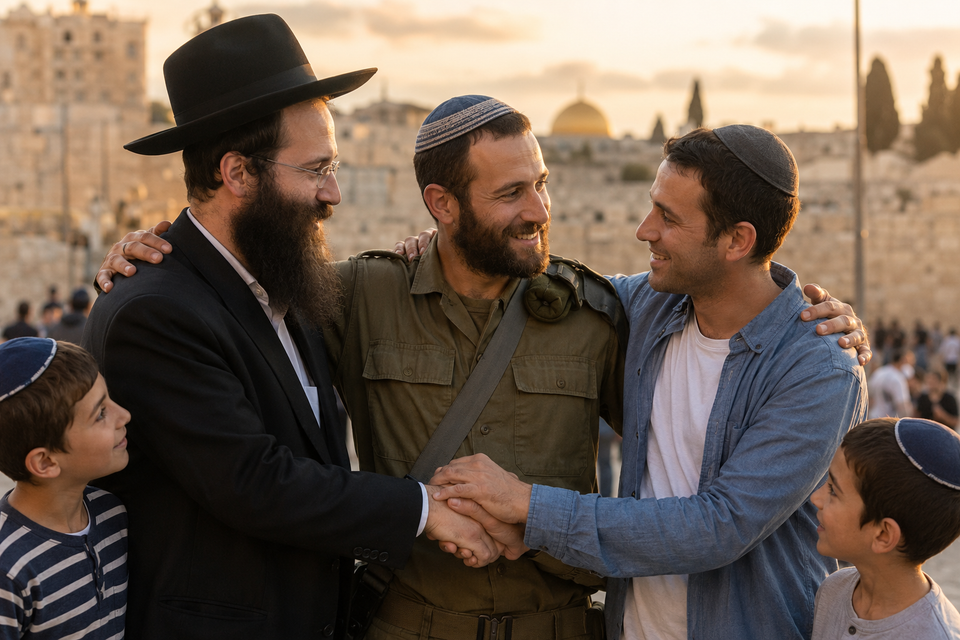
The answer is an emphatic yes — because real unity was never the same thing as uniformity. Klal Yisrael has been a nation of difference from the very beginning: twelve shevatim, each with its own banner, its own portion, its own path in avodas Hashem, and yet one people encamped around one Mishkan. The Charedi world believes deeply in the possibility — and the necessity — of Jewish unity even across our sharpest disagreements, Zionism and the draft among them. But it has to be the real thing: a unity rooted in Torah and in truth, not one bought with slogans or paid for by the surrender of principle.
I. Ahavas Yisrael Was Never Conditional on Agreement
The Torah's command is unadorned: v'ahavta l'reiacha kamocha, love your fellow as yourself (Vayikra 19:18) — a mitzvah Rabbi Akiva called the great principle of the entire Torah. Notice what it does not say. It does not say love your fellow if he shares your hashkafah, or votes as you vote, or sees the State as you see it. It says love your fellow — every fellow — full stop. And it can demand that unconditionally because the love is anchored not in agreement but in essence: every Jew, whatever his views, carries a chelek Eloka mimaal, a spark of the Divine, and that spark does not flicker because we argue. Rav Aharon Kotler — a man no one could accuse of softness on Torah principle — taught that genuine ahavas Yisrael rests precisely on that shared essence and not on shared opinions. A Jew whose views we hold to be mistaken, even dangerous, is still our brother, and is still owed our love.
II. Disagreement Is Not Disrespect
One of the quiet tragedies of recent decades is how easily ideological disagreement — above all about the State — has been allowed to curdle into sinah, into outright contempt. That is not the Torah's way, and it never was. The Torah teaches us to honor every human being as a bearer of the Divine image: chaviv adam shenivra b'tzelem — beloved is the human being, for he was created in the image of God (Avos 3:14). If every person, simply for being a person, is owed honor, how much more a fellow Jew — even one far from Torah, even one standing on the opposite side of a bitter argument from us. You can believe with total conviction that another Jew is profoundly wrong, and still owe him your respect. These two things do not pull against each other. Holding them together is the avodah.
III. The Model: Twelve Tribes Around One Center
Look at how the Torah itself draws a picture of unity. Twelve tribes, twelve banners, twelve genuinely distinct characters and paths — arranged not in a single undifferentiated mass but as a camp, each in its place, around one shared center. The unity was never located in their sameness; it was located in what stood at the middle of them all. The Torah goes further still and makes room for disagreement itself: a machlokes she'hi l'shem Shamayim, a dispute for the sake of Heaven, "is destined to endure" (Avos 5:17) — not as a breakdown of unity but, when it is conducted honestly and for Heaven's sake, as a sign of a living Torah nation thinking hard about how to serve its Creator. The disagreements between the Charedi world and other Jews, insofar as they are sincere arguments about how best to be faithful to Hashem, need not fracture the nation. What fractures a nation is never the disagreement itself. It is the hatred we allow to ride on top of it.
IV. Gedolim Who Held Both at Once
The very greatest of our leaders showed that the two can be held together — unbending on Torah, and at the same time overflowing with love for every Jew. Rav Shlomo Zalman Auerbach was legendary for the kavod he extended to every single person who came before him — secular doctors, professors, soldiers — never once endorsing an ideology he rejected, and never once withholding the warmth he believed every fellow Jew was owed. Chacham Ovadia Yosef reached across the entire breadth of the Jewish people, in kiruv and in care, while never bending a hair's breadth on halacha. Rav Michel Yehuda Lefkowitz was known for a gentleness and humility that simply would not permit any Jew to be treated as anything less than beloved, however sharply one might disagree with him. Their message was a single, consistent one: stand for the Torah, do not bend — and never, for one moment, forget the holiness alive in every Jew. Even the most fervent opponents of Zionism among the Gedolim were careful to insist that their opposition was to an ideology, never to a single Jew who held it.
V. Why This Unity Matters Most of All Right Now
The warning of our own history could not be sharper. The second Beis HaMikdash was built and served by a generation that learned Torah and kept the mitzvos — and it was destroyed anyway, our Sages teach, because of sinas chinam, baseless hatred among Jews (Yoma 9b). It was not idolatry that brought it down; it was Jews who could not bear one another. The lesson writes itself: if hatred between Jews is what destroyed the Mikdash, then love between Jews is what will help rebuild it. And in truth we are bound to one another whether we choose it or not — kol Yisrael areivim zeh bazeh, every Jew is a guarantor for every other (Shevuos 39a). The areivus does not read the fine print. It does not say "all the Charedim," or "all the religious Zionists," or "all the secular," or "only those who agree." It says all of Israel.
VI. What Honest Unity Is — and What It Isn't
It is worth being precise, because cheap unity does no one any good. Honest achdus does not mean pretending the disagreements are trivial or that they do not matter — they are real, some of them are serious, and this publication argues its side of them without flinching. It does not mean blurring away every difference, or trading a Torah principle for the warm glow of a shared slogan. What it means is something harder and truer: that across every one of those disagreements, we still love every Jew, still feel ourselves responsible for every Jew, still daven for every Jew, still run to help every Jew in danger, and still labor side by side with every Jew wherever the Torah allows it. Conviction and love are not competitors for the same space in the heart. The Charedi world intends to hold both — and to hold both fiercely.
VII. In Summary
So is unity possible without agreement on Zionism or the army? Yes — and not the thin, brittle unity of people who simply happen to agree, but the deep unity of a single nation that knows it is one even in the middle of its arguments. We will not pretend the differences away, and we will not soften the Torah to purchase a moment's peace. But we will love every Jew, as the Torah commands us to; we will carry every Jew, as the areivus binds us to; and we will wait together — every shevet and every kind among us — for the day when the masks fall away and the whole nation stands as one before Hashem.
That is the unity the Torah demands. Not "all who agree with us." All of Israel.
May Hashem plant true ahavas Yisrael in every Jewish heart, may baseless hatred vanish from among us, and may the achdus of Klal Yisrael hasten the rebuilding of the Beis HaMikdash — bimheirah b'yameinu, amen.
Sources
The command to love every Jew
- Vayikra 19:18 — v'ahavta l'reiacha kamocha, and Rabbi Akiva's teaching that it is the great principle of the Torah; the concept of every Jew as a chelek Eloka mimaal, a spark of the Divine
- Avos 3:14 — chaviv adam shenivra b'tzelem, the honor owed every human being as a bearer of the Divine image
Unity that holds room for disagreement
- Avos 5:17 — that a dispute for the sake of Heaven is destined to endure; the model of the twelve shevatim, each with its own banner, encamped around one center
- Yoma 9b — that the second Beis HaMikdash was destroyed through sinas chinam, baseless hatred among Torah-keeping Jews
- Shevuos 39a — kol Yisrael areivim zeh bazeh, that all of Israel are responsible for one another
Gedolim who embodied it
- Rav Shlomo Zalman Auerbach, Chacham Ovadia Yosef, and Rav Michel Yehuda Lefkowitz — who stood unbending on Torah while extending genuine kavod and love to every Jew
The structural relationship to other articles in this series
- "Sinas Chinam and Ahavas Yisrael" and "Why Is Unity So Important in Torah Judaism?" — the foundations of this question
- "Does Unity Mean We Must Compromise on Truth?" — the honest limit that keeps achdus from becoming surrender
- "How Have Gedolim Built Bridges Without Compromising Torah?" — the living models of holding both at once