
Is Noam Sohlberg Really So Innocent?
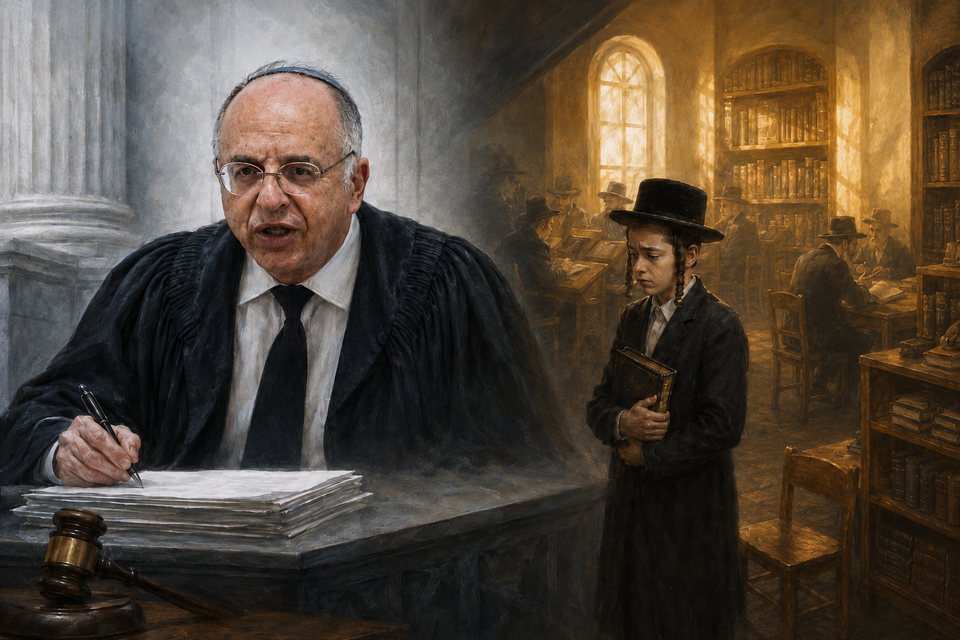
A religious judge, the court he serves, and the lives being quietly broken behind the headlines.
President of the Supreme Court, Justice Noam Sohlberg, at the High Court hearing on draft enforcement. To the police representative, Deputy Commissioner Meirav Wagner, he presses: can she commit that the police will function "also in the residential areas of Charedi population centers — and not just minimal, random actions?" His verdict on what he has read: a feeling of "total dereliction" in what the police is doing.
Let us say it once, clearly, and then let us never return to it.
The mob that descended on Justice Noam Sohlberg's home and smashed its windows did wrong. There is no heter for it, no posek who permits it, no Torah that sanctions it. It was ugly, it was forbidden, and it was itself a chillul Hashem. We condemn it without reservation and without an asterisk.
There. It is said. Now turn the page — because the glass on his lawn is the smallest desecration in this story, and the largest one is still sitting on the bench, in a kippah, signing orders.
The bigger chillul Hashem
Here is what the eulogists-for-the-living will not tell you while they polish Sohlberg's halo this week.
A chillul Hashem is not measured by how much noise it makes or how good the photograph is. A broken window is loud, visible, and over by morning. But when a man who wears a kippah, who knows what a yeshiva is, who has tasted the daled amos of halacha, sits at the head of the highest secular court in the land and uses it to brand the study of Torah a crime — that is a desecration on a scale no rock through a window could ever reach. One shames the Name in a single street for a single night. The other does it in the name of the State, in the language of "justice," with the signature of a religious Jew at the bottom of the page, in front of the entire nation, indefinitely.
That is the real story. And Noam Sohlberg is not a bystander to it. He is its author.
He is responsible for what he signed
Strip away the sympathy of the moment and look at the record, because the record is not in dispute.
Sitting as Deputy President of the Supreme Court, Sohlberg has led — there is no gentler verb — the drive to force the State to hunt down ben Torah after ben Torah. His panel ruled that the police were violating the court's own orders by refusing to arrest Charedim, and demanded the failure be fixed at once. He swept aside the police excuses, writing that budget and manpower shortages are "no peg on which to hang every dereliction." He told them to stop fearing disturbances and to walk into the heart of Charedi neighborhoods. He demanded the civilian police actively partner with the military police to pull yeshiva students out of their batei midrash and into cells.
And he wrapped the whole campaign in the robes of righteousness, declaring that the State cannot abide a reality where "whoever is mightier prevails" and "the sinner profits." Read those words slowly and let them indict their author. In the vocabulary of this court, the sinner is the boy over a Gemara. The crime is learning. That is the moral universe Sohlberg has lent his name and his religious face to — and a religious face is exactly what makes the lie persuasive. See, the State says, even a frum judge agrees. He is the hechsher on the whole enterprise. There is no role more damaging he could have chosen.
Destroying lives, by signature
This is where "he is destroying lives" stops being rhetoric and becomes a ledger.
Under the pressure of this same bench, the sanctions aimed at the families of learners include stripping yeshiva funding from any student marked an "evader"; cancelling the subsidized daycare and after-school care their young children rely on — identified, by the court's own assessment, as the single most effective weapon in the arsenal; revoking their National Insurance discounts; and tightening the screws on housing and transportation benefits.
Read that again and let it land. The most "effective" instrument this court could devise was not aimed at a tank or a general. It was aimed at a toddler's daycare. The declared strategy is to make the existence of a Torah family financially unlivable until the father breaks and hands over his son. That is not the law brushing against a citizen by accident. That is a machine, designed and ordered from the bench, to grind a community down at its own kitchen table — and the man at the head of the panel knew exactly what he was building.
A pane of glass is replaced by morning. A young man branded a criminal for opening a sefer, a family stripped of the subsidies that kept its children fed and schooled — those are not repaired by a glazier. There are two kinds of destruction in this story. One was committed by a mob and is being called violence by everyone. The other was committed by a court, carries Sohlberg's signature, and is being called justice. Only one of them is permanent.
A religious man on a throne that is not ours
And now the line everyone offers as a character witness: but he's religious. He wears a kippah. He keeps Shabbos. He learns.
We do not doubt it. And it does not soften the indictment — it sharpens it.
A wholly secular judge, raised on secular values, applying a secular code against the Torah world, is at least acting in character; he knows no other framework and answers to no higher one. But a man who knows what a yeshiva is, who understands in his bones what it means to a Jewish family to have a son in learning — and who then places that knowledge in the service of the machine dismantling it — has made a choice no secularist could make. He has taken everything his Yiddishkeit should have taught him and turned it into a credential for the prosecution.
Because the throne he sits on is not a Jewish throne. The Supreme Court of the State of Israel is not the Sanhedrin. It does not derive its authority from Sinai; it does not judge by the Torah; and on this very question it has set itself in open war against the daas Torah of nearly the entire gedolei hador. An institution that arrogates to itself the right to override the Torah — that re-labels the learning of Torah as "evasion" and the learner as a "sinner" — is, in the plainest meaning of the words, a chillul Hashem in robes. A religious man does not redeem such a court by sitting on it. The court drags him down into its desecration, and he goes willingly, gavel in hand.
A kippah is not a hechsher on a ruling. It never was. The only question that matters is what flows from the pen beneath it — and what has flowed from Sohlberg's pen is a war on Torah with a religious signature.
In fairness — and it changes nothing
Their strongest case deserves to be stated, not strawmanned.
They will say the law binds everyone, and a nation at war, burying its sons week after week, cannot exempt one community from its own defense forever. They will say Sohlberg is, by the standards of that court, among the friendlier voices the religious world has — a justice of restraint, not an activist crusader. They will say he is enforcing a law the Knesset failed to replace, not inventing a vendetta, and that the equal-burden question — mi yelech — is a real and painful wound, not a fiction.
Grant all of it. It still answers nothing. A man can enforce a law and still be the author of a cruelty. He can be the "moderate" on the bench and still sign the order that targets a child's daycare. "I was only applying the law" is the oldest sentence in the ledger of those who did terrible things by the book — and it has never once absolved the hand that signed.
The throne that is coming
There was a throne in Yerushalayim once, and there will be again — a throne of David beneath a rebuilt Beis HaMikdash, where judgment flows from the Torah and not against it. That is the only court whose authority we are bound to. Measured against it, every gavel this State brings down on a ben Torah is not a sign of its strength but of how far it still stands from the Jewish destiny it claims to embody.
The current arrangement is not the destination. It was never meant to be. And no robe, however religious the man inside it, will hold back what Hashem has already begun.
So — is Noam Sohlberg really so innocent? He is a religious Jew who chose a throne that is not ours, and from it he is signing the slow unmaking of the Torah world and calling it justice. Wronged this week, yes. Innocent? Not for a moment.
Sources
The hearing and the rulings
- Calcalist — Sohlberg on the "feeling of total dereliction" in police activity against evaders (April 12, 2026)
- Maariv — "Sohlberg lost his patience": the High Court move bypassing the government; criticism of police avoidance "from fear of disturbances" (April 26, 2026)
- Calcalist — High Court finds police are violating the court's enforcement ruling (March 1, 2026)
- Kikar HaShabbat — the Sohlberg quotes that made him a target; police avoidance of detaining evaders "during chance encounters" (June 2026)
- Srugim — the panel's "whoever is mightier prevails" / "the sinner profits" language; the 3-week sanctions deadline (April 26, 2026)
The sanctions ("destroying lives")
- Calcalist — the benefits the court flagged: housing, transportation, subsidized daycare (April 12, 2026)
- Calcalist — existing sanctions: yeshiva-budget revocation, daycare-discount removal (noted as most effective), National Insurance discounts (April 12, 2026)
The riot and its aftermath
- Haaretz — dozens attempt to break into Sohlberg's home; his wife's reaction (June 3, 2026)
- JDN — police detain 65 participants in the protest outside the home (June 2026)
- Israel Hayom / Kan — Netanyahu's condemnation; police detentions (June 2026)
- Haaretz — Supreme Court President Yitzhak Amit's letter calling the violence an attack on the justice system (June 4, 2026)
Communal/political response
- Arutz Sheva — Degel HaTorah chairman MK Moshe Gafni's statement on the rulings against Torah learners (April 26, 2026)