How Have Chareidi Gedolim Built Bridges Without Compromising Torah?
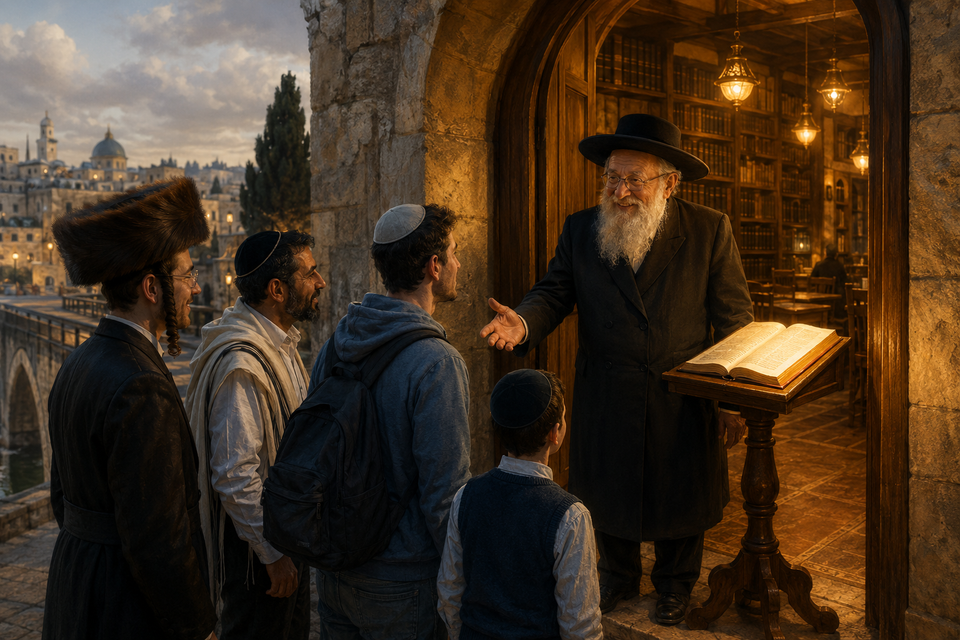
The Charedi world has never held that standing for Torah means standing against people. Its Gedolim built real bridges to Jews far from Torah — and built them not in slogans but in institutions: Lev L'Achim, Shuvu, the great Sephardi return. Yet they built without bending. Their model was Aharon HaKohen, who drew people close with love; and their line was firm: kiruv rechokim is not kiruv aveiros.
There is a caricature of the Charedi world as a fortress with its drawbridge up — suspicious of every Jew outside its walls, interested in condemnation rather than connection. It is worth answering that caricature not with protest but with evidence, because the actual record of the Gedolim tells the opposite story. They taught, by their lives, how to hold two things at once that the world insists must be separated: an unbending loyalty to Torah, and an overflowing love for every Jew — including, especially, the Jew who has never tasted it. They understood a principle that organizes the whole approach: the Jew far from Torah is not our enemy. He is our mission.
I. The Torah's Own Model: Aharon HaKohen
Before naming any modern figure, name the template they were all working from — because "bridge-building with love" is not a modern innovation but a Torah ideal with a face.
Hillel teaches in Pirkei Avos (1:12): "Be among the disciples of Aharon — loving peace and pursuing peace, loving people and drawing them close to Torah" — oheiv es habrios u'mekarvan laTorah. Note the precise order of the words, for the whole method lives in it. One does not drag people to Torah and hope love follows; one loves them — genuinely, first — and through that love draws them close. Aharon HaKohen was beloved by the entire nation, Chazal tell us, precisely because every Jew felt his warmth, and that warmth was itself what moved them toward teshuvah. This is the Charedi model of kiruv in a single mishnah: the bridge is built of real ahavas habrios, and Torah is what waits, undiluted, at the other end of it. Every Gadol named below was, in his own way, a talmid of Aharon.
II. The Jew Far From Torah Is Our Mission, Not Our Enemy
But how can one feel genuine love — not strategic politeness, but love — for a Jew who rejects the very Torah one has given one's life to? Here Chazal supply the lens that makes it possible, and it changes everything.
The Gemara and the Rambam establish the category of the tinok shenishba — the Jewish child taken captive and raised among the nations, who never knew Torah and cannot be blamed for not keeping it (Shabbos 68a–b; Rambam, Hilchos Mamrim 3:3). The Rambam rules that such a Jew, and those raised in his world, are to be brought back with peaceful means and drawn close with bonds of love until they return — not condemned for an ignorance that was never their fault. Most Jews far from Torah today, the Torah world has long understood, fall under exactly this compassion: they did not reject a Torah they knew; they were never given it. That single insight dissolves the supposed contradiction. One can love such a Jew wholly and without reservation — because there is nothing to hold against him — while holding the Torah itself entirely firm.
And the balance has a name in Chazal: "l'olam tehei smol docheh v'yamin mekareves" — "let the left hand push away while the right draws near" (Sotah 47a). The weaker hand may, when it must, hold a line; but the dominant hand, the stronger one, is always the one extended in welcome. Standards and love are not rivals in this model. They are two hands of one embrace.
III. Bridges Built Not in Words, but in Institutions
The truest proof that the Gedolim meant this is not anything they said but what they built — vast enterprises of outreach, raised with their blessing and often their initiative, that have drawn hundreds of thousands of Jews back toward their heritage.
When Rav Yosef Shalom Elyashiv — austere, exacting, the posek hador, a man not given to public movements — lent his backing to Lev L'Achim, the sprawling Israeli kiruv network that knocks on doors and opens Torah classes across the country, he was making a statement louder than any quotation: that reaching the distant Jew was not a sideline but a duty of the first order. When Rav Avrohom Pam, Rosh Yeshiva of Torah Vodaas and a byword for ahavas Yisrael, looked at the wave of immigrant children pouring out of the collapsing Soviet Union with no Jewish education awaiting them, he founded Shuvu — an entire school system built to catch a generation before it was lost. And in the Sephardi world, Chacham Ovadia Yosef devoted the towering energy of his life to l'hachzir atarah l'yoshnah, restoring the crown to its former glory — building, through Shas and its El HaMaayan educational network, one of the largest teshuvah movements in modern Jewish history, returning vast numbers of Sephardi Jews to the proud Torah of their grandfathers.
Nor were these the work of "outreach professionals" alone. Rav Shimshon Dovid Pincus, as rav of Ofakim, poured himself into reaching ordinary, unaffiliated Israelis, and through his seforim and his fire inspired countless baalei teshuvah. The Bobover Rebbe, Rav Shlomo Halberstam, rebuilt a Chassidus from the ashes of the Holocaust and deliberately opened its yeshiva's doors to youth from homes with little Torah, wagering that joy and sincerity would do what severity never could. These are not anecdotes. They are institutions, with buildings and budgets and tens of thousands of alumni — the bridge-building of the Gedolim made concrete, and still standing.
IV. Warmth Without Surrender — Even From the Fiercest
It is sometimes assumed that the Gedolim most uncompromising in ideology must have been cold toward the individuals on the other side of it. The record says the reverse: the firmest of them often distinguished most carefully between the battle of ideas and the human being in front of them.
The Satmar Rav waged the most total ideological war against secularism and Zionism the modern Torah world has known — and was, at the same time, famous in his own circles for an immense personal chesed, and for a refusal to push away the individual Jew who stood before him, whatever banner that Jew carried. His walls were high, but they were walls around ideas, not around people. The Steipler Gaon, for all his unworldly immersion in learning, never tired of speaking of the pintele Yid — the indestructible spark in every Jewish soul — and saw in every Jew, however distant, a baal teshuvah waiting to happen. Rav Shlomo Zalman Auerbach was beloved across all of Yerushalayim, secular and religious alike, for a kindness he extended to every single person — without ever, for one moment, softening a halacha to earn it. They proved that one need not choose between conviction and warmth. The conviction was for the Torah; the warmth was for the Jew; and the two never had to be traded against each other.
V. The Line They Would Not Cross
And yet — this is the other half of the truth, and it is what separates the Charedi model from mere sentiment — there was always a line. The love was real, and the love was bounded. Kiruv rechokim, drawing the distant close, never meant kiruv aveiros, drawing transgression close.
Rav Moshe Feinstein, whose teshuvos breathe care and whose manner was famously gentle, nonetheless ruled firmly that one may not join religious bodies that placed Orthodox rabbanim alongside Reform and Conservative clergy as equals — not out of hatred for any Jew, but because lending Torah's authority to a platform that treated its denial as legitimate would betray the Torah itself. The principle running through all of it is the one the Gedolim never compromised: you do not bring a Jew close by lowering the Torah to meet him; you raise him toward the Torah where it stands. To dilute halacha in the name of unity is not, in this view, a kindness at all — it is to offer the searching Jew a counterfeit, and to rob him of the very thing he came for. Real love wants for the other the truth, not a flattering imitation of it. That is why the warmth of these Gedolim drew people upward rather than merely making them comfortable where they were.
VI. The Legacy: Two Loves That Need Each Other
So how did the Charedi Gedolim build bridges without compromising Torah? By refusing the false choice the question almost smuggles in — the assumption that one must pick between loving Jews and loving Torah.
Their legacy is the insistence that ahavas Yisrael and ahavas haTorah are not in tension but in partnership — that love which forgets the Torah is not really love, and Torah held without love is not fully the Torah either. They reached out, with everything they had, in the way of Aharon — loving people and drawing them close. And they reached out holding the Torah perfectly steady, because they understood that the Torah, undiluted, was precisely the gift they were trying to give. True achdus, they taught, is built not on shared slogans but on shared truth — on a Klal Yisrael whose heart beats in rhythm with its own Torah.
May we be worthy heirs of that legacy — loving every Jew as a brother, holding the Torah without compromise, and drawing all of Klal Yisrael close to its Father in Heaven — bimheirah b'yameinu, amen.
Sources
The Torah's model of bridge-building
- Pirkei Avos 1:12 — Hillel's teaching to be of the disciples of Aharon, "loving peace and pursuing peace, loving people and drawing them close to Torah" (oheiv es habrios u'mekarvan laTorah) — the order of the words placing love first
Loving the distant Jew — the lens of the tinok shenishba
- Shabbos 68a–b and Rambam, Hilchos Mamrim 3:3 — the category of the tinok shenishba, and the ruling to bring such Jews back with peaceful means and bonds of love rather than condemnation (developed in our articles "The Charedi Approach to Kiruv" and "The Charedi View on Those Who Go Off the Derech")
- Sotah 47a — "let the left hand push away while the right draws near" — the balance of firmness and welcome, the dominant hand always the one extended
- Vayikra 19:18 — "v'ahavta l're'acha kamocha"
Bridges built in deeds (documented)
- Lev L'Achim — the Israeli kiruv network backed by Rav Yosef Shalom Elyashiv and other Gedolim
- Shuvu — the school network founded by Rav Avrohom Pam to provide Torah education for the children of immigrants from the former Soviet Union
- Shas and its El HaMaayan network, and the broader Sephardi teshuvah movement of l'hachzir atarah l'yoshnah, led by Chacham Ovadia Yosef
- The outreach of Rav Shimshon Dovid Pincus as rav of Ofakim; the post-Holocaust rebuilding of Bobov by Rav Shlomo Halberstam, welcoming youth from homes with little Torah — all presented as documented life-work rather than through quoted speech
Warmth alongside firmness
- The documented personal chesed of the Satmar Rav toward individual Jews despite his uncompromising ideological stance; the Steipler Gaon's theme of the pintele Yid; the universally attested kindness of Rav Shlomo Zalman Auerbach — presented as their well-attested approache
The structural relationship to other articles in this series
- "The Charedi Approach to Kiruv" — the method of outreach in depth
- "The Charedi View on Those Who Go Off the Derech" — smol docheh v'yamin mekareves applied
- "Sinas Chinam and Ahavas Yisrael" — the love that underlies it all
- "The Charedi View on Recognizing Reform and Conservative Judaism" — where the line is drawn, and why