
Betrayed... Again!
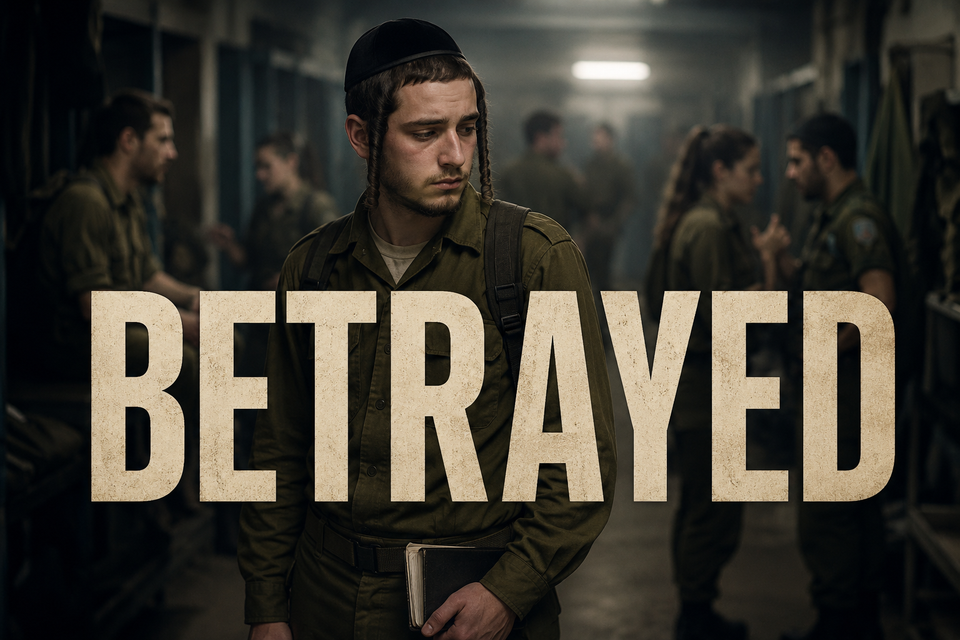
They did everything the state asked of them. They enlisted voluntarily, into the army's own Charedi track — some severing ties with their parents, knowing their shidduch prospects might never recover. They trained, they served, they went into Gaza. And then the army dissolved their company by memo, dropped them into a mixed unit where music plays on Shabbos and kitchen duty comes with female soldiers, and told them that refusal means discipline. "We feel betrayed," they told Ynet. Of course they do. They were. And every Charedi young man weighing the recruiters' promises must read their story to the end — because it is not an accident, it is not an exception, and the gedolim saw it coming from the very first brochure.
I. What Was Done to the Soldiers of Tomer
The facts, as the soldiers themselves told Ynet and as reported across the Israeli and Charedi press. The Tomer Company was the Charedi track within the Givati Brigade — no improvised experiment, but a framework established back in 2014, marketed for over a decade as the proven model: guaranteed tefillah times, Torah study, mehadrin standards, an environment built for the Charedi soldier. These young men enlisted in November 2024 on the strength of exactly those commitments.
Several weeks ago, the company was disbanded, and its remaining soldiers were folded into a regular company now serving in Gaza. Their testimony of what followed should be read slowly. Events that are not gender-separated. Music played and meat served during the Nine Days. Music on Shabbos, filmed and posted to social media, at their outpost in Gaza. Kitchen shifts assigned alongside female soldiers; duty alongside female paramedics. And when they raise their concerns? "We're told to refuse the assignment and face disciplinary action. So we end up working with them, even though that isn't appropriate for a Chareidi soldier." They appealed to their commanders. To the brigade rabbinate. To the IDF's own Chareidi Directorate — the office that exists for precisely this. "We've spoken to everyone we can. Nobody takes us seriously. As far as they're concerned, Tomer has been closed, and that's the end of it." The commanders, they said, told them plainly: the army would stop recruiting Charedim to the company, because it had no future.
II. Hear the Price They Paid — And Grieve With Them
Before a word of analysis, let us do what the army would not: take these soldiers seriously, and honor what this cost them. Listen again to the one sentence that should haunt every reader: "People burned bridges with the communities they came from. Many severed ties with their parents and families, knowing that even future marriage prospects could be damaged... They sacrificed their past and their future to contribute to the country, and now no one seems to care."
These are not our enemies, and we will not spend one syllable of scorn on them. They are Jewish boys — many of them, by their own account, boys already carrying heavy burdens — who were made a solemn promise by the State of Israel, who paid for that promise with their families, their communities, and their futures, and who then watched the state pocket their sacrifice and cancel the terms. Whatever we hold about the path they chose, our hearts go out to them without reservation. The betrayal is real, the pain is real, and the shame belongs entirely to the institution that spent their trust and discarded them in the middle of a war.
III. The Prediction That Came True — To the Letter
But now the analysis, because their story is not new. It is the fulfillment, almost clause by clause, of warnings issued in public, by name, before it happened.
It was Rabbi Yigal Levinstein — a Religious Zionist rosh mechina, no Charedi polemicist — who warned his own students this very season not to trust the army's assurances of "separate teams," because, he said, after the training course, fighters are folded into joint operational companies where men and women serve together as a matter of routine. Read that warning, and then read the Tomer soldiers: "During training they took care of everything, and then once we reached the battalion everything changed." It is the same sentence. It was Rabbi Ohad Tirosh, rosh yeshiva of the Eli hesder yeshiva, who testified from twenty years on the inside that the army drafted its own religious-accommodation ordinance and then deliberately never implemented it — "I don't believe a single word." It is the pattern we named when the hesder yeshivos boycotted the Armored Corps and the soldiers' wives published the photograph from Lebanon: Separation is promised. Separation dissolves. Tomer is not a deviation from the system. Tomer is the system, photographed at the moment the promise reaches its expiration date — which is always, precisely, the moment after you can no longer take your sacrifice back.
And savor, if you can, the army's official explanation: recruitment to Tomer was ended "as part of changes intended to improve Chareidi enlistment frameworks and better preserve the religious lifestyle of participants." They closed the Charedi framework in order to "improve" the Charedi frameworks. They dissolved the protected company in order to better preserve the religious lifestyle of the soldiers now doing kitchen duty with female paramedics. This is not an explanation. It is a confession wearing a press release. Bear in mind: mere months ago the army was still placing fresh Charedi recruits into this very company, vowing in its announcements to maintain their religious lifestyle "throughout their service." Throughout their service lasted until the next staffing memo.
IV. There Is No Address — That Is the Lesson
Absorb the deepest fact in the soldiers' account: they exhausted every channel the system built for them. The commanders. The brigade rabbinate. The Chareidi Directorate — the dedicated office whose entire mandate is the Charedi soldier. All of them shrugged. When the apparatus created specifically to guarantee your Yiddishkeit tells you the file is closed, you have learned the truth about every guarantee: there is no address, because the guarantees were never load-bearing. They were recruitment materials. The moment institutional convenience points the other way — a company under strength, a staffing table to balance — the "iron-clad framework" is a line item, and your neshamah is an administrative adjustment "in coordination with commanders."
This, and exactly this, is why the gedolim have said no — not to this or that detail, but to the entire premise. Rabbi Dunner and MK Davidson and every earnest voice like them ask why our leadership will not simply negotiate "better frameworks, stronger guarantees, enforceable standards." Here is the answer, in the mouths of Charedi soldiers standing at an outpost in Gaza: the guarantees were negotiated. The framework existed for eleven years. The standards were promised in writing, cycle after cycle. And it was all revocable by memo, mid-service, mid-war, with disciplinary action waiting for whoever objected. The gedolim did not lack information about the army's frameworks. They possessed twenty-five years of it. Eizehu chacham? Ha'ro'eh es ha'nolad — who is wise? The one who sees what is being born (Tamid 32a). The boys who trusted the brochures are begging the Chareidi Directorate to return their phone calls. The boys who listened to the gedolim are in the beis medrash tonight. That is what daas Torah is — not stubbornness, but sight.
V. The Warning — Read It Before You Sign
So let this be said as plainly as it can be said, to every Charedi young man being courted by a recruiter, a brochure, a stipend, or a "new and improved" track: the soldiers of Tomer are not a cautionary footnote. They are your future, written in advance. The promise you are being offered has an expiration date, and it expires at the precise moment you have burned the bridges you cannot rebuild — when your family is estranged, your shidduch is complicated, your community is behind you, and your leverage is gone. Then you will discover what they discovered: that the framework can be dissolved by people who will never meet you, that objecting is a disciplinary offense, and that the office established to protect you considers your case closed.
The institution is not on our side. We say this without hatred — the individual Jews within it include many decent men, and some, as we have documented, are ashamed of what they are ordered to do. But the institution, as such, has now demonstrated across every framework it ever offered — the ordinance never implemented, the hesder guarantees dissolved, the tefillin denied in its prisons, the Chashmonaim pipeline strangled, and now Tomer disbanded — that its commitments to a Torah Jew's neshamah are instruments, kept while useful and voided when not. Against an institution like that, there is exactly one protection, and it is the one the Torah gave us: al pi haTorah asher yorucha — the gedolim, whose word does not expire, whose guarantee is not a press release, and who have told us, with one voice, not to hand over our sons. Tomer is what listening to the recruiters looks like. The beis medrash is what listening to the gedolim looks like. Choose.
VI. And to the Soldiers of Tomer Themselves
One final word, and it is for you — the betrayed soldiers of this story — because you may well read this. You will hear no "we told you so" from us at your expense; your pain is not our vindication to enjoy, and the ones who owe you an apology sit in the Kirya, not in Bnei Brak. Know only this: the community you feared had closed its doors to you has a door that never closes. The beis medrash receives every Jew, always — and a Jew who was deceived is owed a welcome, not a lecture. Come home whenever you are ready. You will find that the one framework in Jewish life that has never once dissolved its terms, in three thousand years, is waiting exactly where your fathers left it.
May Hashem guard these soldiers and every Jewish soldier in body and in soul, comfort them for the trust that was broken, bring them and all of us home to the tents of Torah, and protect our sons from every promise made to be revoked — bimheirah b'yameinu, amen.
Sources
The testimony
- The Ynet report (via Yeshiva World News and Matzav) on the disbanding of the Tomer Company, the Charedi track in the Givati Brigade: the soldiers' accounts of non-separated events, music and meat during the Nine Days, Shabbos music filmed at their Gaza outpost, kitchen and medical duty alongside female soldiers, the instruction to refuse and face discipline, and the exhausted appeals to commanders, the brigade rabbinate, and the IDF Chareidi Directorate; the IDF's statement that recruitment ended "as part of changes intended to improve Chareidi enlistment frameworks"
- The Tomer Company's establishment in 2014 as a flagship Charedi framework (per the Netzach organization's own materials), and the IDF's draft-cycle announcements assigning new Charedi recruits to Tomer while pledging to maintain "their religious lifestyle throughout their service"
The warnings fulfilled
- Rabbi Yigal Levinstein's warning that "separate teams" assurances dissolve after training into joint operational companies; Rabbi Ohad Tirosh's testimony that the Joint Service Ordinance was drafted and deliberately never implemented; the Lebanon mixed-quarters photograph and the hesder boycott of the Armored Corps; the confirmed denials of tefillin to Charedi detainees; Tamid 32a — eizehu chacham, ha'ro'eh es ha'nolad; Devarim 17:11 — al pi haTorah asher yorucha
The structural relationship to other articles in this series
- "If This Is How They Treat the Soldiers Who Serve Them Best" — the pattern: separation promised, separation dissolved
- "Why Charedim Frown on Charedi IDF Programs" — the position, before Tomer proved it
- "How Charedim Feel About Charedi Soldiers" — the compassion these soldiers deserve, and receive
- "Not Even for a Minute" and "There Is No Greater Lie" — the witnesses the system refuses to hear
- "Why Do Charedim Listen to Their Rabbanim?" — the one guarantee that does not expire