
Are Yeshiva Bachurim Really Being Jailed for Learning Torah?
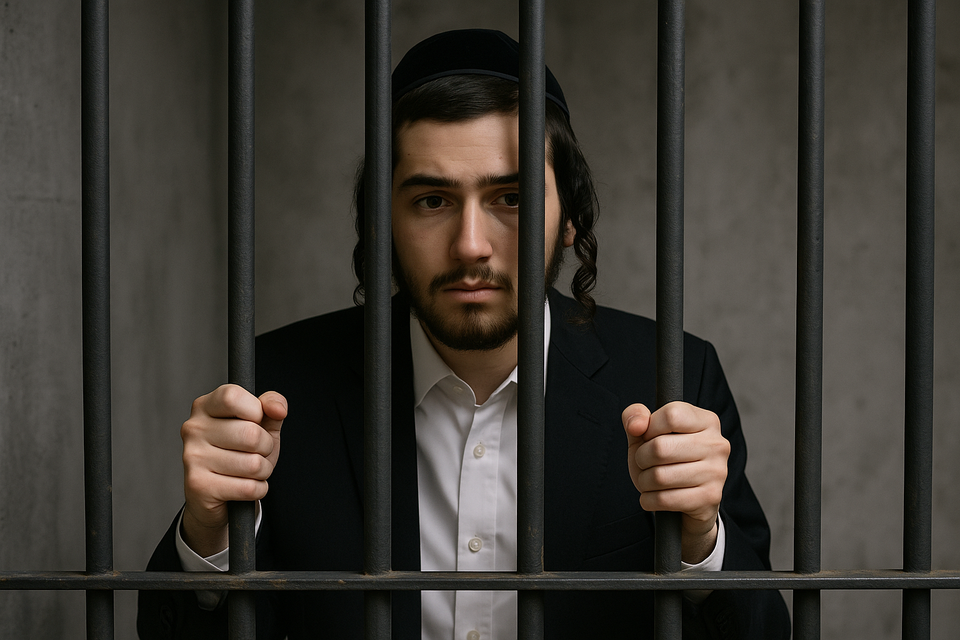
Let's Be Very Clear. Yes. They Are. And No Amount of Legal Vocabulary Changes What Is Actually Happening.
The question is being asked more and more, in the press, in private conversations, in courtrooms, and across the broader Jewish world. Defenders of the current policy work hard to deny the framing: "No one is being jailed for learning Torah. They are being arrested for evading military service. The two are completely different."
We are going to answer this question with the directness it deserves. Yes, yeshiva bachurim are being arrested and jailed by the State of Israel because they are learning Torah. The legal vocabulary the State uses to disguise this fact does not change what is actually happening on the ground. And every Jew who believes in the Torah — and every honest observer outside it — needs to understand exactly what is occurring, why the State's framing is a semantic cover for the underlying truth, and why the Charedi response has been, and will continue to be, peaceful, principled, and unyielding.
We work through it below.
I. The Documented Reality
This is not theoretical. The arrests are happening, with documented cases, in real time.
April 27, 2026. Military Police arrest a yeshiva bochur at his home in the Gilo neighborhood of Jerusalem in the early hours of the morning. He is transferred to military prison. Yeshiva World News reports the arrest follows the Supreme Court's Sunday ruling, with Justice Sohlberg slamming the police for "a complete avoidance" of exercising arrest authority — explicitly designed language to force escalation.
This week. Kol B'Ramah, reported by Yeshiva World News, broke the story that the Israel Police and Military Police are preparing a large-scale, coordinated operation in central Israel — targeting Charedi cities specifically — to arrest "every draft evader identified in the central region… with no exceptions." The senior source in the Police Operations Division confirmed this on the record.
Highway 10, the same week. Plainclothes detectives stop vehicles at the Yigal Alon Boulevard roundabout in Beit Shemesh, blocking traffic, checking specifically whether any Haredi passengers are draft evaders. Detectives in unmarked cars stopping ordinary Charedi families on a public road — to determine whether a Torah student is in the vehicle.
August 2025. Two yeshiva student brothers are arrested in their Tel Aviv home in a nighttime joint police-military raid. Their detention is extended by a military court. The Charedi press runs the headline: "The State of Israel has declared open war against Bnei Torah."
Throughout 2024–2026. Israel Police arrest hundreds of yeshiva students at protests. Officers are injured. Vehicles are smashed. Each round produces the next round. Internal IDF memos leaked to Haaretz document approximately 71,000 evaders, of whom roughly 50 percent are Charedi.
The compliance data the State publishes itself. In the 2024–2025 draft cycle, the IDF summoned 24,000 Charedim. 1,539 reported. That is 6.4 percent compliance under maximum legal pressure — and the State's response to this 6.4 percent figure is not to question the framework producing it but to escalate enforcement.
This is the documented reality. Boys are being taken from their homes, transferred to military prisons, detained, prosecuted, and sanctioned. The mass-arrest operation announced for next week will expand this dramatically. The question "Are yeshiva bachurim being jailed?" is no longer a question. It is a description.
II. The Semantic Cover-Up: "It's About the Draft, Not the Torah"
Defenders of the State's policy offer a consistent rebuttal: "They are not being jailed for learning Torah. They are being jailed for draft evasion. Those are completely different."
This sounds reasonable until you examine what the words are actually doing.
The Israeli draft law, in its current form after the Supreme Court rulings of 2024 and 2026, contains no exemption for full-time Torah study. The previous Tal Law, which provided a structured exemption for bnei yeshivos hesedrim hu omanuto (those whose Torah is their occupation), was struck down. The replacement framework offers no equivalent. Under current Israeli law, the act of choosing to learn Torah full-time rather than enlist is, by legal definition, the criminal act of draft evasion.
This is the trick. The State has constructed a legal framework in which the act of learning Torah full-time is the act of draft evasion, then claims it is "only" punishing draft evasion. But the underlying behavior the State is criminalizing — the only behavior that produces the legal violation — is the choice to remain in the beis medrash.
Apply the test in any other context. If a state passes a law requiring Jews to work on Shabbos, then arrests Jews for "labor-law violations" because they refuse to work on Shabbos, is the state arresting Jews for Shabbos observance or for "violating labor law"? The legal vocabulary says the latter. The substance says the former. The substance is what matters.
A boy is sitting in Mir, in Slabodka, in Ponevezh, in Lakewood-affiliated yeshivos in Bnei Brak and Yerushalayim. He is doing what Jewish boys have done in those institutions for two centuries, in continuity with what Jewish boys have done in yeshivos for two thousand years, in continuity with what Jewish boys have done since "vehagisa bo yomam valayla" was commanded at Sinai. The State sends a Military Police unit to his home at four in the morning, drags him from his bed, and transfers him to a military prison. Whatever the charge sheet says, he is being jailed because he was learning Torah and refused to stop. The State's vocabulary does not change the underlying reality.
III. The Question of Authority: Whose Law?
There is a deeper question lurking under this dispute, and the article you are reading exists to name it directly. The State's defenders speak as if "the law" obviously means Israeli civil law as legislated by the Knesset and adjudicated by the Supreme Court. The Charedi position has, for seventy-eight years, refused to grant that premise.
For the Torah-observant Jew, the law — the meta-system within which all other systems must operate — is the Torah given at Sinai, transmitted through the chain of mesorah codified in Avos 1:1, governed by the halachic process Devarim 17:8–11 establishes, and applied through the rulings of the recognized Torah authorities of the generation. The Torah does not have to conform to the State's law. The State's law must conform to the Torah. This is not arrogance, not extremism, not chauvinism. It is the foundational structure of Jewish religious life, in continuity with how Jews have understood the relationship between Torah and surrounding legal frameworks for three thousand years.
The Rambam codifies this with full sharpness in Hilchos Sanhedrin 26:7, ruling on the prohibition of arkaos: even when a gentile court's law would reach the same conclusion the Torah would reach, a Jew may not extract his verdict from that court — because the legitimacy of a ruling depends on the authority structure that produced it, not only on its content. The Rambam goes further: one who litigates before such courts is "as though he reviled and blasphemed and raised his hand against the Torah of Moshe Rabbeinu."
Apply this in reverse. A legal system that has constituted itself as an alternative to the Torah's authority cannot then invoke Torah obligations against the Torah-loyal community. The State of Israel has, for seventy-eight years, legislated in ways the Torah does not authorize — chillul Shabbos as a public reality, marriages the Torah does not recognize, jurisprudence that explicitly displaces halacha. The State has set itself up as a standing alternative to Torah authority. And then, on this single question of conscription, it discovers that the bnei yeshivos are bound by its law.
The Charedi answer is the answer the Torah-faithful have given to every regime that ever tried this move: we answer to the Ribbono Shel Olam, not to your decrees. That is not rebellion. That is faithfulness to the only legal framework that, for the Torah Jew, has actual binding authority.
IV. The Historical Pattern: Every Previous Regime That Tried This Failed
The accusation of jailing Jews for learning Torah is not abstract historical reference. It is a specific historical pattern. Every regime that has ever attempted it has failed. The historical record is unbroken across three thousand years:
- Antiochus IV (167 BCE) — banned Torah study and bris milah. Result: Chashmonaim revolt, Greek defeat, Torah preserved, Chanukah.
- Hadrian (132 CE) — banned Torah study and ordained ten gedolim executed for teaching it. Result: hidden yeshivos at Yavneh and beyond, Mishnah completed, Torah preserved.
- The Inquisition (1391–1492) — forced conversions, executions, expulsions. Result: secret communities, the Sephardic mesorah preserved, the Inquisition eventually collapsed.
- Czar Nicholas I (1827–1856) — the Cantonist Decrees. 70,000–84,000 Jewish boys conscripted at ages 8–25 for 25-year terms with active conversion attempts. Result: hidden boys, pidyon shevuyim networks, the decrees abrogated within thirty years.
- The Russian Government (1892). Demanded the Volozhin Yeshiva add secular curriculum and government-approved teachers. The Netziv and Rav Chaim Brisker chose to close the flagship yeshiva of Lithuania rather than comply. The Brisker mesorah continued.
- The Soviet Union (1917–1991). Banned Jewish religious education, closed yeshivos, persecuted observant Jews for seventy years. Result: underground Torah learning, secret seforim distribution, Soviet collapse, the largest baal teshuva movement in modern Jewish history.
The State of Israel, in pursuing this trajectory, is not the exception. It is the latest instance. The historical record is so consistent that one would expect even secular policymakers to recognize the pattern. They do not, because, as the Rambam writes in Hilchos Taaniyos 1:3, the secular framework systematically classifies historical pattern as mikreh — chance — and refuses to read the structural lesson. The lesson is there nonetheless. Every regime that has tried this has failed. This one will too.
V. The Sha'as Ha'Shemad Question
Here is the most serious halachic dimension, and it must be addressed carefully.
The Rambam in Hilchos Yesodei HaTorah perek 5 codifies the categories of yei'hareg v'al ya'avor — the cases in which a Jew is obligated to give up his life rather than violate Torah. Three cases are absolute and apply at all times: avodah zarah, gilui arayos, and shefichus damim. But the Rambam adds a critical fourth category, sha'as ha'shemad — a time of decreed religious persecution. In such a time, even minor mitzvos require the standard of yei'hareg v'al ya'avor. The threshold is whether the persecution is directed at the practice of mitzvos as such, even when the specific mitzvah at issue is not one of the three universal cases.
Has the current Israeli enforcement framework reached the threshold of sha'as ha'shemad?
The mainstream Charedi gedolim have not, to this point, declared a formal sha'as ha'shemad. The framework is not being applied with the lethal intent of the Cantonist Decrees or the Inquisition. The intent is coercive, not annihilative. But the structural marker the Rambam identifies — the targeting of the practice of a mitzvah, specifically because it is the practice of that mitzvah — is now visibly present in Israeli policy. When the State systematically pursues full-time Torah learners, as full-time Torah learners, for the act of being full-time Torah learners, it is operating in the structural shadow of sha'as ha'shemad even if it has not yet reached the lethal extremity.
This is why the documented position of every contemporary Charedi gadol on this question has been so sharp. Rabbi Dov Landau shlita's "under no circumstances should anyone report to the recruitment offices" — the absoluteness of "under no circumstances" — reflects this halachic framing. Rabbi Moshe Hillel Hirsch shlita's "if yeshiva students who received orders are arrested, I will come to support them in prison" — the open declaration of willingness to be jailed — reflects this halachic framing. The gedolim are treating this not as a routine policy dispute but as a halachic situation requiring mesirus nefesh — the deliberate willingness to suffer rather than capitulate.
VI. The Mesirus Nefesh Response — Documented in Real Time
The Charedi response, anchored in the documented rulings of the gedolei haposkim, has been remarkably consistent across the past two years.
Rabbi Dov Landau shlita, leader of the Lithuanian Charedi stream, in his September 2024 published statement (VIN News):
"Judicial authorities have declared war against the Torah world and are forcing the army to issue draft orders to yeshiva students. We publicly declare that under no circumstances should anyone report to the recruitment offices, and we stand with these yeshiva students and their families during this trial. We are with you, heroes of valor."
And following the April 2026 Supreme Court ruling (Yeshiva World News):
"Bnei yeshivos will not go to the army under any circumstances, neither by coercion nor willingly."
Rabbi Moshe Hillel Hirsch shlita, in his September 2024 published statement (VIN News):
"If yeshiva students who received orders are arrested, I will come to support them in prison."
Rabbi Dov Lando shlita, in the signed letter of the November 2024 emergency gathering of dozens of Lithuanian Charedi yeshiva deans (Israel National News):
"Anyone who, G-d forbid, joins these tracks or similar, should know that beyond the personal tragedy that he brings upon himself and his household, others may, G-d forbid, be drawn after him, and his sin would be great to bear."
These are not isolated declarations. They are the documented unified position of the contemporary gedolei haposkim, articulated in writing, in mainstream Israeli media, in real time, for any reader to verify. The position is: bnei yeshivos must not report. If they are arrested, they will be supported in prison. The community will absorb the cost, peacefully, without yielding on the underlying principle.
This is mesirus nefesh — the deliberate, halachically-grounded willingness to suffer rather than transgress. It is the same posture Jews have taken under every persecutory regime in three thousand years. It is what is happening right now, in Israel, today, by Charedi gedolim with names, in writing, on the record.
VII. The Chillul Hashem: Israel as the Only State Jailing Jews for Learning Torah
Pause and consider what the State's trajectory implies for its international standing.
In America, no Jew is jailed for sitting and learning Torah. In England, no Jew is jailed for sitting and learning Torah. In France, in Australia, in Argentina, in every country where Jews live freely — no Jew is jailed for the act of dedicating his life to Torah study. In every country in the modern world.
The State of Israel, in pursuing the current trajectory to its conclusion, will become the first country in the modern world to jail Jews specifically because they are learning Torah. This is not hyperbole. It is the documented direction of the current policy, on the current trajectory, with the current escalation.
The Gemara in Yoma 86a teaches the gravity of chillul Hashem — public desecration of Hashem's Name. The Rambam codifies that chillul Hashem committed by Torah-observant institutions is the most severe form. But what is the chillul Hashem of the Jewish state that founded itself as a refuge from Jewish persecution becoming the only state in the world that persecutes Jews for learning Torah?
This is not a Charedi rhetorical question. It is a precise theological description of the trajectory. The world will see this. American Jewish communities are already seeing it. The Diaspora Charedi communities that fund the yeshivos in Eretz Yisrael are already drawing the parallel. Every secular Jew with a moral conscience, in any country, will eventually be asked to explain how the Jewish state arrived at the position of being the only modern state to do what no other modern state does to its own Jews.
The Gemara in Shabbos 119b teaches that Yerushalayim was destroyed specifically because they disgraced the Torah scholars within it. The verse the Gemara cites — "they mocked the messengers of Hashem, disdained His words, taunted His prophets, until there was no remedy" (Divrei HaYamim II 36:16) — is a chillingly accurate description of contemporary Israeli political discourse against the Charedi community. The wound the Gemara warns of — ein marpei, no remedy — is the wound a Jewish state inflicts on itself when it pursues this trajectory.
VIII. Peaceful Non-Compliance, Not Insurrection
This must be said with full clarity, because the framing in the press deliberately obscures it:
The Charedi position is peaceful non-compliance, not violent rebellion.
The gedolim have not called for insurrection. They have not called for the overthrow of the State. They have not called for violence against police or soldiers. They have called for bnei yeshivos to continue learning Torah, and for the community to peacefully absorb whatever consequences the State chooses to inflict.
Yes, there have been protest crowds that occasionally turned violent. The gedolim have generally condemned these incidents. The mainstream Charedi position is structural non-cooperation, not aggression. If a boy is arrested, he is supported in prison. If sanctions are imposed, the community absorbs them and builds alternative infrastructure. If police come to a home, the family submits to the arrest. The position is the position of every Torah-faithful community that has ever faced coercive pressure from a hostile authority: continue learning Torah, refuse to comply, accept the consequences, trust in Hashem, do not raise weapons.
This is the framework of Rabbi Akiva continuing to teach Torah under Hadrian's prohibition, of the Marranos teaching their children Torah under the Inquisition, of the cantonist boys hiding in attics, of the underground yeshivos of Stalin's Russia. None of those communities took up arms. All of them continued to learn. The State that tried to stop them eventually collapsed or relented. The Torah continued.
IX. Yes. They Are. And We Will Continue.
So to the question that opened this article: Are yeshiva bachurim really being jailed for learning Torah?
Yes. The documented arrests of April 2026, the planned mass operation of this week, the Highway 10 detentions, the September 2025 Tel Aviv nighttime raid, the hundreds of protest arrests — these are real. The legal framework that constructs full-time Torah learning as the criminal act of "draft evasion" is in force. The Police Operations Division has been instructed to arrest "every draft evader identified in the central region… with no exceptions."
No semantic cover changes this. The State may call it draft evasion. The substance is that a boy sitting in a beis medrash, learning Torah, is being taken from his home and transferred to a military prison because he was learning Torah and refused to stop.
The historical pattern is unbroken. Every regime that tried this has failed. The Greeks failed. The Romans failed. The Inquisition failed. The Czars failed. The Soviets failed. The current trajectory will fail also.
The Charedi response is documented, peaceful, and unyielding. The gedolim — Rabbi Dov Landau, Rabbi Moshe Hillel Hirsch, Rabbi Dov Lando, the assembled Lithuanian Roshei Yeshiva of November 2024 — have ruled that bnei yeshivos must not report under any circumstances and that the community will absorb the cost.
The chillul Hashem is enormous. A Jewish state on track to become the only modern state to jail Jews for the act of learning Torah is, by the Gemara's own framework, wounding itself in a place that conventional remedies cannot heal.
We stand with the bachurim. We stand with the gedolim. We stand with the Torah being learned in every beis medrash across Eretz Yisrael, in continuity with the chain of mesorah from Sinai. We say it without apology, without hesitation, without softening:
Yes — Jews are being jailed in the Jewish state for the act of learning Torah. We will continue to learn. We will not betray our mesorah. We will not bend to the State's framework. We will absorb the cost the State chooses to inflict. And we will be standing — bnei Torah in their batei midrash, mothers raising the next generation, the chain of mesorah unbroken — long after the framework that picked this fight has joined the historical list of the regimes that picked it before, and lost.
Torah lo ta'azov osanu — the Torah will not abandon us. And we will not abandon her.
Bimheirah b'yameinu, amen.
Sources
Verified contemporary arrests and enforcement
- Yeshiva World News, "CHAOS ON THE STREETS? Israel Police To Carry Out Mass Arrests Of Bnei Torah In Chareidi Cities" — citing Kol B'Ramah, Police Operations Division source quoted on the record
- Beit Shemesh News — Highway 10 / Yigal Alon Boulevard roundabout incident
- Yeshiva World News, "ARRESTS RESUME: Military Police Arrest Yeshiva Bochur" (April 27, 2026) — Gilo arrest with Justice Sohlberg's quoted statement
- VIN News, "Chareidi Leaders Unite, Declare 'War' Over Military Arrest Of Yeshiva Students" (August 7, 2025) — Tel Aviv nighttime raid
- Yeshiva World News, "Arrests Of Bnei Torah? Police Demand 6 Border Police Battalions"
- Yeshiva World News, "Israeli Police Blocking Army Arrests Of Bnei Torah In Chareidi Neighborhoods, Internal Memo Shows" — Haaretz leaked memo, 71,000 evader figure with 80% Charedi share
- Times of Israel (August 2025) — IDF data: 24,000 Charedim summoned in 2024-2025 cycle, 1,539 reported (6.4% compliance)
Verified contemporary gadol statements
- Rabbi Dov Landau shlita — VIN News (September 2024); Yeshiva World News (April 2026)
- Rabbi Moshe Hillel Hirsch shlita — VIN News (September 2024)
- Rabbi Dov Lando shlita — Israel National News (November 2024 emergency gathering letter)
Primary halachic sources
- Rambam, Mishneh Torah, Hilchos Yesodei HaTorah perek 5 — yei'hareg v'al ya'avor and sha'as ha'shemad
- Rambam, Mishneh Torah, Hilchos Talmud Torah 6:10 — Talmidei chachamim exempt from anaga (conscription) because the Torah protects them
- Rambam, Mishneh Torah, Hilchos Sanhedrin 26:7 — the arkaos prohibition; legitimacy of a ruling depends on authority structure
- Rambam, Mishneh Torah, Hilchos Taaniyos 1:3 — prohibition of attributing national calamity to mikreh
- Talmud Bavli, Shabbos 119b — Yerushalayim destroyed because they disgraced the Torah scholars within it; ein marpei
- Divrei HaYamim II 36:16 — the verse cited by the Gemara
- Talmud Bavli, Yoma 86a — chillul Hashem
- Talmud Bavli, Sotah 21a — Torah magna u'matzla
- Yehoshua 1:8 — "v'hagisa bo yomam valayla"
- Mishnah, Avos 1:1 — the chain of mesorah from Sinai
- Devarim 17:8–11 — lo tasur and the obligation to follow the Torah authorities of the generation
The historical pattern
- Documented record of Antiochus IV (167 BCE), Hadrian (132 CE), the Spanish Inquisition (1391–1492), the Cantonist Decrees of Czar Nicholas I (1827–1856), the Volozhin Yeshiva closure (1892), and Soviet suppression of Jewish religious life (1917–1991) — see Tsar Nicholas I and the Jews (Stanislawski, JPS 1983), Adina Ofek's "Cantonists" (Modern Judaism 13:3), and extensive academic literature on each period
Israel's international standing context
- International Court of Justice — South Africa v. Israel proceedings (2024 provisional measures)
- International Criminal Court — arrest warrants for Israeli officials (November 2024)