
Are We Allowed to Go Up on Any Parts of Har HaBayis Before Moshiach Comes?
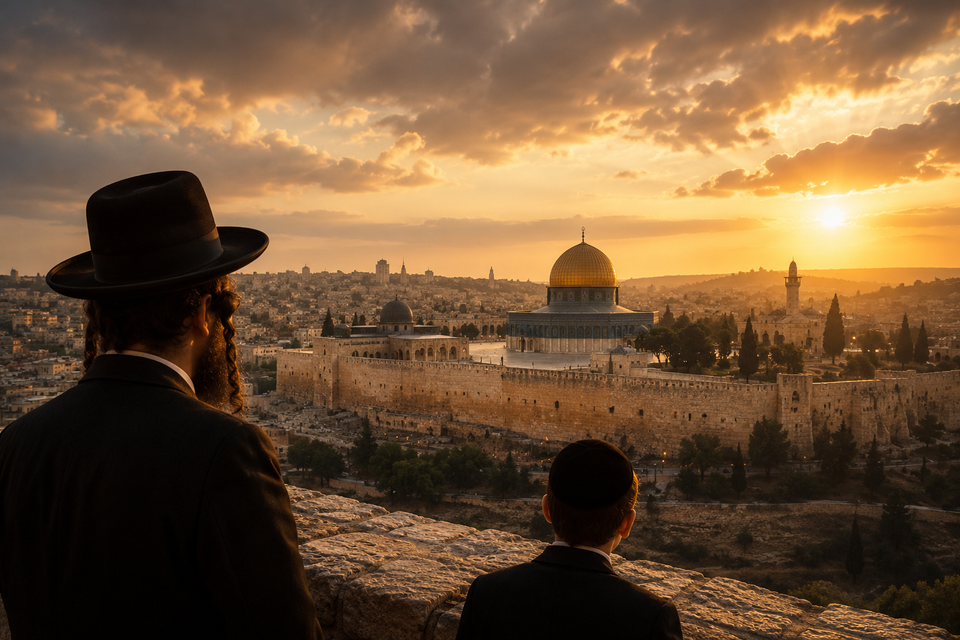
Few questions in our day are as charged as this one. The Charedi answer — and the answer of the overwhelming majority of poskim across every sector of Torah Jewry, together with the official Chief Rabbinate of Israel — is no: we do not ascend Har HaBayis, or any part of it, until the coming of Moshiach restores the purity and the clarity that entering it requires. And it is essential to understand that this "no" is not spoken out of distance from the holiest place on earth. It is spoken out of the deepest reverence for it. The restraint itself is the avodah. But the question is more subtle than it first appears, and it deserves to be answered with precision.
I. The Subtlety the Question Turns On
It is tempting to put it simply: we are all tamei meis today — ritually impure through contact with death, since we lack the ashes of the Parah Adumah to purify ourselves — and so the entire Mount is closed to us. But that is not quite the halacha, and honesty requires the finer point. The Mount is not a single undifferentiated zone of holiness; it has graded levels of kedushah (Keilim 1:8). A person who is tamei meis is barred from the inner sanctified region — the Machaneh Shechinah, the area of the Azarah and inward — but is not, by the strict letter of the law, barred from the outermost areas of the Har; the Rambam states plainly that even a corpse itself may be brought into that lower-sanctified outer area (Hilchos Beis HaBechirah 7:15).
So the real question is not the blunt "is all of it forbidden?" It is sharper than that: can a person safely ascend to the permitted outer portions while reliably staying clear of the forbidden inner ones? And it is precisely there — not in a blanket claim of impurity — that the Charedi answer of "no" actually rests.
II. The Heart of It: Safek Kareis
Here is the core. The penalty for entering the inner sanctified zone in a state of tumas meis is kareis — spiritual excision, among the very gravest punishments the Torah knows (Bamidbar 19:13; the tamei is sent out from the Machaneh Shechinah, Bamidbar 5:2). And we do not know — with anything like the certainty a penalty of that magnitude demands — exactly where the lines fall: where the permitted outer area ends and the kareis-bearing inner zone begins. The precise location of the Mikdash, the Azaros, and their boundaries is a matter of reconstruction and dispute among scholars and poskim, not of settled, demonstrable fact.
In halacha, a safek — a genuine doubt — in a matter of kareis is treated with the very utmost stringency. When the cost of a single wrong step is excision from one's people, "almost certainly fine" is simply not a standard a Jew is permitted to gamble on. This is exactly the reasoning of the poskim of the generation, Rav Chaim Kanievsky among them: precisely because we cannot establish the boundaries with certainty, the only responsible course is to keep away from the entire area.
III. The Purity We Cannot Fully Achieve
Set the boundaries aside, and a second obstacle remains: purity itself. Those outer areas that a tamei meis may technically enter are still closed to a person bearing other forms of tumah — and reaching the required state demands immersion and a degree of halachic care that most people ascending neither fully understand nor reliably maintain. Add to that the near-certainty that, in any crowd, someone will drift past the safe line into the forbidden zone, and the conclusion the Gedolim drew becomes almost self-evident: the responsible ruling for the tzibbur as a whole is to refrain entirely, rather than to open a door through which some will inevitably walk straight into kareis. It is the same logic by which Chazal at times restricted even the permitted in order to safeguard against the forbidden — when the stakes are this high, a fence is not stringency for its own sake. It is mercy.
IV. The Sanctity That Never Lapsed
There is a foundation beneath all of this that must be stated, because some assume the entire prohibition was buried in the rubble of the Churban. It was not. The Rambam rules that the original sanctification of the Mikdash and of Yerushalayim sanctified them "for their time and for all time to come" — and he explains why: that kedushah flows from the Shechinah, and the presence of the Shechinah is never nullified (Hilchos Beis HaBechirah 6:14–16). The walls fell; the holiness did not. (The Ra'avad raises a question as to whether the penalty of kareis still applies after the destruction — but the halacha follows the Rambam, and certainly leans to stringency where a matter of kareis is even possibly at stake.) The Mikdash lies in ruins, and its sanctity stands wholly intact. That is the very reason the caution remains in full force today.
V. The Breadth of the Ruling
This is not the stringency of one circle or one community. The Chief Rabbinate of Israel has declared the prohibition repeatedly and without qualification, and the great poskim of the last century — across the Litvish, Chassidish, and Sephardi worlds alike, from the Chazon Ish and Rav Moshe Feinstein to Rav Elyashiv, Rav Shlomo Zalman Auerbach, the Steipler, Rav Shach, and Chacham Ovadia Yosef — ruled with one voice: do not ascend, until we are granted the Parah Adumah, a Sanhedrin, and the rebuilt Mikdash in the days of Moshiach. On a question where the downside is excision of the soul, the mesorah does not chase the lenient edge of a dispute. It steps back.
VI. And Not for the Sake of Sovereignty
There is a final dimension, and in our own day it has grown unavoidable. A great many of those who ascend now do so to make a statement — to assert sovereignty, to plant a flag, to answer the Islamization of the site with a visible Jewish presence. The numbers have climbed steeply; tens of thousands ascend in a single year; ministers go up before the cameras on days chosen for their symbolism. One can understand the national passion that drives it. But the Charedi world says, quietly and without flinching, that kavod Shamayim can never be made subordinate to a political message. The holiest place on earth is not a stage on which to perform sovereignty, and to gamble with kareis — and to inflame the nations of the world — for the sake of a statement is not a sanctification of Hashem's Name but the opposite of one.
There is even an irony here worth naming plainly: much of the drive to ascend is bound up with the very sanctification of nationalism that the Torah world has always questioned — the impulse to treat national assertion itself as a religious act. But Har HaBayis does not need us to claim it. It is ours already, and it always will be. What it asks of us is not that we conquer it with our feet, but that we revere it with our restraint.
And there is a graver danger still than the spiritual one. These provocative ascents — the ministers, the flags, the cameras — predictably inflame our enemies, who seize on them as a pretext for incitement, for calls to violence, and at times for actual bloodshed. Let it be said with total clarity where the blame for that violence lies: entirely with those who choose to commit it. Our enemies seek to harm Jews regardless of what any Jew does, and their hatred is their own crime and never our fault. But precisely because Jewish life hangs in the balance, the Torah's response is sober and unsentimental. Pikuach nefesh — the saving of a single Jewish life — sets aside almost the whole of the Torah; there are few values it does not outweigh. And it follows directly that we do not go looking to create situations of danger, and do not place Jewish lives in the path of foreseeable violence, for the sake of a political gesture. Our enemies need no excuse to spill Jewish blood — but the Torah does not permit us to hand them one for the price of a photograph. To gamble with Jewish lives in order to plant a flag is not strength. It is a misreading of everything the Torah holds most precious.
VII. In Summary
So — may we ascend any part of Har HaBayis before Moshiach comes? The Charedi answer, and the answer of the great consensus of poskim, is that we wait. We wait with awe, with fear, and with a yearning that aches. We keep off the Mount not because we feel distant from it or indifferent to it, but for the opposite reason entirely: because we love it far too much to risk its honor, or our own neshamos, on a doubt. The day is coming — with the Parah Adumah, the Sanhedrin, the Mikdash, and Moshiach — when we will ascend it again in purity and in overflowing joy. Until that day, the most eloquent thing a Jew can do at Har HaBayis is to stand at its edge, and long for it with his whole heart.
May Hashem return His Shechinah to Zion, rebuild the Beis HaMikdash, and bring us all to ascend His holy mountain in purity and in joy — bimheirah b'yameinu, amen.
Sources
The prohibition and its severity
- Bamidbar 5:2 — the sending of the tamei out of the camp, the tamei meis from the Machaneh Shechinah; Bamidbar 19:13 — the penalty of kareis for entering the Mikdash in a state of impurity
- Keilim 1:8 — the graded levels of sanctity of the Mount; Rambam, Hilchos Beis HaBechirah 7:15 — that a tamei meis is barred from the inner sanctified region but not from the outermost area
Why the prohibition holds in practice
- The principle that a safek in a matter of kareis is treated with the utmost stringency, given that the precise boundaries of the sanctified areas are not known with certainty
- Rambam, Hilchos Beis HaBechirah 6:14–16 — that the sanctification of the Mikdash and Yerushalayim is eternal, because it flows from the Shechinah, which is never nullified (with the dissenting question of the Ra'avad)
The ruling of the poskim
- The repeated declarations of the Chief Rabbinate of Israel and the consistent prohibition of the poskim across all sectors — the Chazon Ish, Rav Moshe Feinstein, Rav Elyashiv, Rav Shlomo Zalman Auerbach, the Steipler, Rav Shach, and Chacham Ovadia Yosef
The structural relationship to other articles in this series
- "How Does the Dati Leumi World View Nationalism?" — the impulse that drives much of the modern ascent movement
- "What Happens to the State When Moshiach Comes?" — the future in which Har HaBayis is restored to us
- "Do Charedim Value Living in Eretz Yisrael?" — reverence for the land and its holiest place