
Why Don’t Charedim View the State of Israel as the “Reishit Tzmichat Geulateinu”?
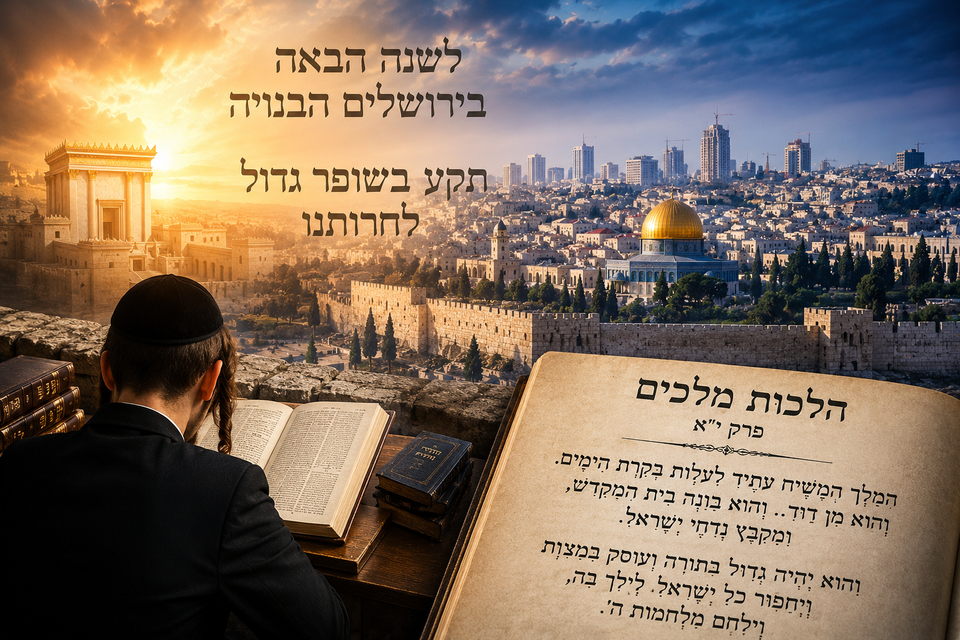
The phrase is beautiful and the longing behind it is real — yet the Charedi world cannot apply it to the State, and not out of cynicism. Redemption, in the Torah's own description, carries unmistakable marks: a Davidic king steeped in Torah, the Beis HaMikdash rebuilt, the exiles gathered, the world filled with the knowledge of Hashem. A secular state meets none of them — and a redemption led by a movement that defined itself against Torah is a contradiction in its very terms.
Of all the phrases that divide the Religious Zionist and Charedi worlds, few are as moving — or as loaded — as four words recited in the Prayer for the State and sung with feeling on Yom HaAtzmaut: "reishit tzmichat geulateinu," "the beginning of the flowering of our redemption." They carry an electric hope: that the founding of a Jewish state in 1948, after two thousand years of exile, was the opening scene of the Geulah the Nevi'im foretold.
The Charedi world does not say these words. And it is important to understand why, because the reason is so often misread. It is not that Charedim are cynical, or unmoved by Jewish history, or indifferent to redemption. The opposite is true: they ache for the Geulah, daven for it three times a day, and mention it in nearly every bentching and every Shemoneh Esrei. The disagreement is not over whether to long for redemption. It is over what redemption is — and whether what we are looking at is in fact its beginning.
I. First, What Is the Geulah?
You cannot judge whether something is the "beginning of the redemption" until you know what the redemption is supposed to look like. And here the Torah is not vague.
The Rambam, in his great codification of these halachos, lays out the picture with precision (Hilchos Melachim 11:1): the Melech HaMoshiach will arise and restore the kingdom of David to its former glory, build the Beis HaMikdash, and gather in the dispersed of Israel. He goes further, giving an actual test (11:4): a king from the House of David, immersed in Torah and engaged in mitzvos like David his ancestor, who compels all Israel to walk in the Torah's path and fights the wars of Hashem — such a man is the presumptive Moshiach; and if he succeeds, rebuilds the Mikdash on its site, and gathers the exiles, he is the definite Moshiach. The era he inaugurates, the Rambam continues (Hilchos Melachim 12), is one in which Israel is freed from subjugation to the nations and the whole world is filled with the knowledge of Hashem — "for the earth shall be filled with the knowledge of Hashem as the waters cover the sea" (Yeshayahu 11:9). It is the day of which the navi says, "Behold, this is our God, for whom we hoped, and He has saved us" (Yeshayahu 25:9) — a day of open, undeniable recognition of the Divine.
Notice what is at the center of every one of these descriptions. Not a flag, not a parliament, not an army — but Hashem, His Torah, His Mikdash, and His people returning fully to Him. The Geulah, in the Torah's own telling, is a spiritual transformation that the whole world cannot fail to see. That is the measuring rod. The question is simply whether the modern State lies along it.
II. The State Meets None of the Marks
Hold the State up against that blueprint honestly, and the answer is plain — not as an insult, but as a matter of fact.
There is no Moshiach — no king of the House of David, immersed in Torah, leading the nation back to Hashem. There is no Beis HaMikdash — the Har HaBayis stands without it, the place of the Shechinah's return still bare. The Shechinah has not returned, no korbanos are offered, no kohen serves at the mizbe'ach. The ingathering is partial and secular, not the Torah-centered return of kibutz galuyos the Rambam describes. And Torah has not been restored to public life — the State's law is not the Torah's law, and its public square is not governed by halacha. By the Rambam's own checklist, not a single criterion has been met. One may find the State's existence remarkable, even moving; but the markers of the Geulah are specific, and they are absent. To attach the word "redemption" to a reality that displays none of redemption's defining signs is, the Charedi world holds, to empty the word of its meaning.
III. The Deepest Problem: A Redemption That Runs Against Torah
But the Charedi reservation goes deeper than a checklist, to something that cuts to the heart of the matter. The Geulah is, above all, the triumph of Torah in the world — and a movement that defined itself against Torah cannot be the vehicle of Torah's triumph.
Return to the Rambam's portrait of Moshiach: a king "hogeh baTorah v'osek b'mitzvos," who "yachof kol Yisrael leilech bah" — who brings all of Israel to walk in the way of the Torah. The redemption's leader restores Torah observance; that is the very definition of his role. Now set beside that the stated vision of the State's founders and ideologues, who in many cases were avowed secularists, who spoke openly of forging a "new Jew" cut loose from the Torah life of his ancestors, and who marginalized — sometimes scorned — the religious world and its values. Herein lies the contradiction the Charedi mind cannot get past: a redemption whose Torah-defined purpose is to bring all Israel back to Hashem cannot meaningfully begin through a project conceived, in significant part, to lead them away. This is not to question the sincerity or the sacrifice of those who built the State; it is to say that the engine of the Geulah cannot be an ideology built to replace the very thing the Geulah exists to restore. To call such a beginning "the flowering of our redemption" is, for the Charedi world, a confusion at the root.
IV. "But What About the Miracles?"
Here a powerful objection arises, and it deserves a full and honest answer rather than a brush-off. Were there not miracles? The survival against the odds in 1948 and after, the ingathering of millions, the flourishing of Torah on this soil — is the hand of Hashem not visible in all of it?
It is — and the Charedi world says so without hesitation. Hashem watches over His people in Eretz Yisrael; there have been open kindnesses and rescues that only a blind eye could miss. But here is the quiet, crucial distinction: hashgacha is not the same as Geulah, and a miracle is not a proof of redemption. Hashem performed staggering miracles throughout the long galus — the survival of Soviet Jewry under decades of crushing persecution, the rebirth of a shattered Torah world on the shores of America, the sudden collapse of an empire that had warred against religion. Every one of these was the unmistakable hand of Heaven. Yet no one calls them the beginning of the Geulah, because they plainly were not. They were chesed, protection, Divine mercy in exile — and that is precisely how the Charedi world reads the miracles of Eretz Yisrael as well: as the loving care of a Father for His children in galus, not as the trumpet of Moshiach. To see Hashem's hand is emunah. To declare that hand to be the Geulah is a leap the criteria do not support. (We develop this distinction at length in our article "Do We See the Miracles?")
V. The Gedolim Who Would Not Say the Words
This is no novel position, invented to spoil a celebration. The Torah leadership of the last century was remarkably consistent in declining to crown the State with the language of redemption.
Rav Elchonon Wasserman, Hy"d, in Ikvesa D'Meshicha, warned sharply against false messianism and the premature declaration of redemption — most of all when such declarations issued from those who had set themselves against the Torah; the pre-Messianic era, he taught, would be a time of spiritual testing, not a secular triumph mistaken for salvation. The Satmar Rav devoted whole works, above all Vayoel Moshe, to demonstrating from Gemara, Rishonim, and halacha that labeling the State the beginning of the Geulah is not only mistaken but spiritually perilous. The Chazon Ish, wary to his core of secular Zionism, rejected the idea that political events could be dressed in the language of Geulah while meeting none of the spiritual conditions Chazal had set. The Brisker Rav stood among the most uncompromising of all in refusing the redemptive framing of the State. And Rav Shach — who led Lithuanian Jewry for a generation — was perhaps the most outspoken of the moderate Gedolim on precisely this point, insisting again and again that the "beginning of the flowering of redemption" was a theology the Torah world could not accept, and that no such pronouncement could be made while the actual signs of Geulah were nowhere in evidence. (We do not invoke here the Religious Zionist thinkers who read these events the other way; our purpose is to explain the Charedi position, not to relitigate every name.)
Across Chassidic and Litvish lines, through temperaments mild and fierce, the verdict was one: gratitude for Hashem's kindness, yes — but the word "Geulah," not yet.
VI. So What Does the Charedi World Believe We Are Living Through?
If not the Geulah, then what? The Charedi answer is neither dismissive nor despairing — it is, in fact, full of hope, only of a more patient kind.
Charedim believe we live in an extraordinary moment. They see Hashem's mercy and His miracles; they are grateful beyond words to live in Eretz Yisrael, to learn its Torah, to raise families in its holiness; they recognize the genuine goods of this hour — the freedom to fill the Land with yeshivos, the gathering of Jews from the four corners of the earth. They simply decline to call it by the wrong name. What they call it instead is galus with light — an exile illuminated by unusual kindness; or preparation — a stage that may yet be the soil from which the true Geulah grows; or Divine opportunity — a window in which to build Torah on a scale the exile rarely allowed. These are not small things. They are reasons for profound gratitude. But they are the antechamber, not the palace — and the Charedi world insists on knowing the difference, lest it mistake the waiting room for the destination.
VII. Hope With Humility
So why don't Charedim say "reishit tzmichat geulateinu"? Not because they have abandoned the dream of redemption, but because they hold it too sacred to attach to anything that does not yet bear its marks.
The real Geulah, they believe, will be unmistakable. It will not require a declaration from a Knesset or a phrase in a prayer to make it so; it will announce itself — in a Davidic king who turns all Israel back to Hashem, in a rebuilt Mikdash, in a Shechinah returned, in a world flooded with the knowledge of its Creator. It will come not through politics but through teshuvah, Torah, and Moshiach. And so the Charedi world goes on doing the only thing that has ever actually hastened it: building Torah, filling Eretz Yisrael with kedushah, raising generations who live for Hashem — and waiting, with hope and with humility, not for a date on a calendar, but for the sound of the shofar shel Moshiach.
May we be worthy to hear it soon, and to see the true flowering of our redemption with our own eyes — bimheirah b'yameinu, amen.
Sources
What the Geulah is — the criteria
- Rambam, Hilchos Melachim 11:1 — the Melech HaMoshiach restores the Davidic kingdom, builds the Beis HaMikdash, and gathers the dispersed of Israel
- Rambam, Hilchos Melachim 11:4 — the test of the presumptive and the definite Moshiach: a Davidic king immersed in Torah and mitzvos who brings all Israel to walk in the Torah's path, rebuilds the Mikdash, and gathers the exiles
- Rambam, Hilchos Melachim 12:1–5 — the Messianic era: the end of subjugation to the nations and a world filled with the knowledge of Hashem
- Yeshayahu 11:9 — "for the earth shall be filled with the knowledge of Hashem as the waters cover the sea"; Yeshayahu 25:9 — "Behold, this is our God, for whom we hoped, and He has saved us" — the open, universal recognition of Hashem at the redemption
The contradiction at the root
- The Rambam's Moshiach restores Torah observance (11:4), set against the avowedly secular vision of much of the State's founding leadership and its aspiration to a "new Jew" — the basis for the Charedi claim that a movement defined against Torah cannot be the vehicle of Torah's redemptive triumph
Miracles are not redemption
- The distinction between hashgacha (Divine providence, abundant in galus — e.g., the survival of Soviet Jewry, the rebirth of Torah in America, the fall of Communism) and Geulah (the redemption with its specific criteria) — developed in our article "Do We See the Miracles?"
The Gedolim who declined the redemptive framing
- Rav Elchonon Wasserman Hy"d, Ikvesa D'Meshicha — against false messianism and premature declarations of redemption (addressing the ideology; he was murdered in 1941, before the State)
- The Satmar Rav, Vayoel Moshe — the sustained halachic and hashkafic case against calling the State the beginning of the Geulah
- The Chazon Ish (Igros) and the Brisker Rav — their documented rejection of dressing political events in the language of Geulah absent the spiritual conditions set by Chazal (presented as their well-attested positions)
- Rav Shach — his documented and repeated opposition to the "reishit tzmichat geulah" / athchalta d'geulah theology, insisting no such declaration may be made while the signs of Geulah are absent
A note on attribution and framing
- The Gedolim above are cited for their well-documented positions; recorded statements are presented as their established views rather than as verified verbatim quotations. The working draft's grouping of the Chasam Sofer (who passed in 1839) among those who opposed calling the modern State the beginning of redemption has been set aside as anachronistic; the case is rested on authorities who addressed the question itself. Consistent with this series, the Religious Zionist thinkers who read these events as the dawn of redemption are not engaged here by name; the purpose is to explain the Charedi position rather than to adjudicate every figure.
The structural relationship to other articles in this series
- "Do We See the Miracles?" — hashgacha in Eretz Yisrael, and why it is not proof of Geulah
- "What Will Happen to the State When Moshiach Comes?" — the Charedi picture of the redemption and the State's place in it
- "Don't Bet on a Horse That's Meant to Lose" and "The Charedi View of the Founding of the State" — the deeper reservations about the Zionist project
- "Why Don't Charedim Celebrate Yom HaAtzmaut?" and "Why Do Charedim Oppose Hallel on Yom HaAtzmaut?" — the liturgical expression of this same disagreement