
Why Does the Charedi World Frown on “Charedi” IDF Programs?
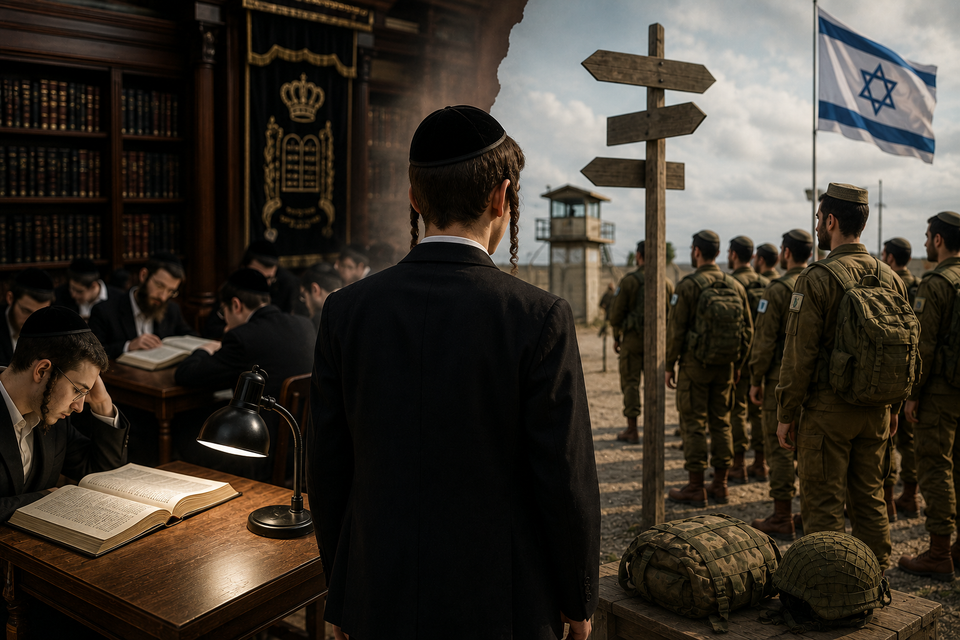
Programs Like Netzach Yehuda (Nachal Charedi) Were Marketed as a Compromise — Kosher Food, Davening Times, Separation From Women. But the Mainstream Charedi World Has Never Accepted Them as a Path for Bnei Torah, and the One Narrow Exception Ever Entertained — a Rescue Framework for Boys Already Lost to Shabbos — Has Now Been Closed. The Principled Reasons Are Permanent: the Priority of Torah, the Question of Whether a Jew Answers to Torah or to Military Command, the Erosion of Every Protection, and the Fear of a Wedge Against the Whole Torah World. And in the Present Moment, the Answer Is Absolute: While the State Wages a Campaign of Arrests, Sanctions, and Coercion Against the Torah Community, No One Enlists — in Any Framework — Until the War Against Us Stops. And Even Then, Every One of the Other Issues Remains
At first glance, programs like Netzach Yehuda (Nachal Charedi) or Shachar look like reasonable compromises. They offer separate frameworks for religious soldiers, with kosher food, set times for davening, limited interaction with women, and rabbinic involvement. So why has the mainstream Charedi world never accepted them as a legitimate path for its sons — and why, in the present moment, has the answer become absolute?
Two things must be said, and they work together. The first is principled and permanent: the Charedi world's reasons for keeping its young men out of these frameworks are rooted in the deepest matters of Torah — the priority of learning, the question of who a Jew ultimately answers to, the integrity of the Torah community. The second is the matter of the hour: the State of Israel is, at this moment, waging an open campaign against the Torah world — arresting bnei Torah for learning, issuing tens of thousands of draft orders, stripping families of basic support — and in such a moment the question of enlistment is not a fine balance to be weighed but a line that no one crosses. While they wage war against us, no one joins them. And when that war finally ceases, every one of the principled reasons still stands.
We will not reduce this to a slogan, and we will be precise about the history — including the truth about what was and was not approved, and by whom — because precision is what the truth requires and what the critics least expect. We work through it honestly below.
I. First, the Starting Point — Torah Learning Is the Priority
Any discussion of Charedi army service has to begin where the Charedi worldview begins: with the supremacy of Torah learning. As we have developed at length in our articles on why Torah learning is the top priority and on full-time Torah learning, the Charedi world holds — on the authority of the entire mesorah — that Talmud Torah k'neged kulam, the study of Torah is equal to all the mitzvos (Peah 1:1), and that the full-time learning of Torah is both the highest calling of a Jew and, in the Charedi understanding, the truest protection of Klal Yisrael.
This means the question of army service, for the Charedi world, is principally a question about those who are not engaged in full-time Torah learning. For the ben Torah immersed in his learning, the Charedi position is that his learning is his contribution and his calling, and that it should not be interrupted. The debate about "Charedi" army programs is therefore largely a debate about what should happen with the boys who are not, in fact, sitting and learning full-time — and it is precisely for those boys that the army programs were designed.
II. An Honest History — and the Truth About Rav Shteinman
Here accuracy requires precision, because the history is regularly distorted in both directions. Netzach Yehuda — the Nachal Charedi — was not an organic Charedi initiative blessed by the gedolim as a path for bnei Torah. It was established in 1999, beginning with about thirty soldiers, as a battalion of the IDF's Kfir Brigade, through the efforts of certain individuals who sought to create a framework for Charedi boys who had already left yeshiva life — and the precise extent of rabbinic involvement has been the subject of careful clarification ever since.
The claim most often made — and most often abused — concerns Rav Aharon Leib Shteinman zt"l. It is sometimes said flatly that "Rav Shteinman supported Nachal Charedi." This is misleading, and the record must be stated exactly. What appears to be true is narrow: that when the original idea was first brought before him, framed specifically as a rescue framework for boys who were already mechallelei Shabbos and entangled in severe aveiros — boys already entirely outside yeshiva life, whom their fathers were desperate to save — Rav Shteinman did not voice opposition to that limited proposal. Some of the founders later described this as a kind of silent, conditional non-opposition rather than any endorsement.
But Rav Shteinman never gave a broad public endorsement, and he later rejected — sharply — the attempt to stretch his position. When it was claimed that he had supported Nachal Charedi as an option for bochurim merely "weak in learning or in yiras Shamayim," he repudiated the claim directly, stating that such a thing "does not enter the mind at all." One of the founders, Rav David Bloch, later confirmed the point without ambiguity: that Rav Shteinman viewed the framework only as a last-resort solution for mechallelei Shabbos and chayavei kareisos — "as a solution, not as an ideal" — and added plainly, "We never said Rav Shteinman gave a haskamah." It is further documented that both Rav Shteinman and Rav Yosef Shalom Elyashiv zt"l avoided any public support for the program or its founders.
So the honest picture is this: at most, certain rabbanim gave quiet, conditional, narrowly-bounded non-opposition to a framework intended only to rescue boys already lost to Shabbos and in grave spiritual danger — and even that was never an endorsement, never a haskamah, and was explicitly never extended to ordinary bochurim or even to "weaker" learners. To cite this history as rabbinic approval of Charedi enlistment is to invert it. The narrow rescue exception, hedged and later sharply qualified, is the opposite of a general license — and the trajectory of Charedi psak since then, as we will see, has moved decisively toward closing even that narrow door.
III. The Concern That Governs Everything — Who Does a Jew Answer To?
The deepest principled concern is hashkafic, and it is real regardless of how well any particular program runs. A Torah Jew lives under the authority of Hashem, as expressed through halacha and the guidance of his rabbanim. The Torah commands "lo sasur min hadavar asher yagidu lecha yamin u'smol" — do not deviate from what they instruct you, right or left (Devarim 17:11) — establishing that the Jew's ultimate authority is Torah and those who transmit it.
The military, by its nature, operates on a different principle: the soldier is bound by the chain of command. In the army, orders are followed; the commander is the final authority; the soldier cannot, in the moment, say "I must ask my rav." This is not a flaw in the army — it is how any army must function. But it stands in real tension with the Torah Jew's framework, in which the final authority is never a human commander but always Hashem and His Torah. The concern is structural: an environment built on absolute submission to military command is, by its nature, an environment in which the Jew's submission to Torah authority is, at minimum, complicated — and at moments may be directly challenged.
This is the principled core beneath all the practical concerns. It is not about whether the food is kosher; it is about whose word is final. For a worldview built on "lo sasur" — on the ultimacy of Torah authority — placing a young man in a total institution whose organizing principle is "yes, sir" is a genuine hashkafic difficulty, independent of any specific program's quality.
IV. The Pikuach Nefesh Dimension — When Life and Death Are Decided by Politics
There is a dimension to this that goes beyond the spiritual, and it must be stated without flinching: the danger is not only to the soul. It is to the body. It is pikuach nefesh in the most literal sense.
In the Torah, the preservation of life is among the highest values there is. Pikuach nefesh overrides almost the entire Torah — "v'chai bahem", "and you shall live by them" (Vayikra 18:5), which Chazal expound (Yoma 85b) to mean "and not die by them" — that the mitzvos were given for life, and that the saving of a single Jewish life takes precedence over nearly everything, for "whoever saves a single soul of Israel, it is as though he saved an entire world" (Sanhedrin 37a). In a Torah framework, the calculus that governs whether a Jew lives or dies is the Torah's own calculus: the supreme, near-absolute value of the Jewish life itself.
That is not the calculus that governs the modern army. The IDF, like every state military, makes its life-and-death decisions within a web of considerations that have nothing to do with the Torah's valuation of a Jewish life: political pressure, diplomatic calculation, the management of international opinion, and rules of engagement shaped as much by how an operation will look to the world as by how it will protect the soldier carrying it out. Decisions about whether to strike, when to hold back, what risks a soldier must absorb so that the operation does not draw condemnation abroad — these are made, in significant part, on grounds of politics and world opinion, not on the Torah's principle that a Jewish life is a world.
And the cost of this has been borne in blood. When soldiers are sent into danger, or held back from acting, or made to absorb risk, because of how the world will react rather than because of what best protects their lives — and when beautiful young Jewish neshamos are lost as a result — that is not an abstraction. It is the most concrete pikuach nefesh question there is. The army has, by the nature of what it is, again and again placed the physical lives of its soldiers into a calculus weighted by political and diplomatic concern, and Jewish lives have been spent in the gap between that calculus and the Torah's. The grief over this is real and widely felt — far beyond the Charedi world — by every family that has asked whether restraint imposed for the sake of world opinion cost a son his life.
This transforms the question entirely. To place a Charedi boy into this system is not merely to risk his soul in a spiritually corrosive environment — it is to place his very life under the authority of a command structure whose life-and-death decisions are governed by politics rather than by the Torah's supreme valuation of that life. It is pikuach nefesh twice over: the spiritual danger to the neshamah, and the physical danger to the body, both surrendered to a calculus that is not the Torah's. A father who keeps his son in the beis medrash is not only guarding his son's ruchniyus. In a real and terrible sense, he may also be guarding his life — keeping him out of a system that has shown, repeatedly, that it will weigh that life against considerations the Torah would never permit to outweigh it.
For a worldview in which a single Jewish life is an entire world, the knowledge that the army subordinates such lives to political and diplomatic calculation is not a secondary concern. It is among the gravest concerns of all — and it is a pikuach nefesh argument in the fullest, most literal meaning of the words.
V. Broken Promises — The Documented Record
A second concern, and a major driver of the hardening Charedi position, is that the protected framework that was promised has been systematically broken — and this is not speculation. It is documented, on the record, often in the words of the very people who built these programs.
Begin with one of the founders himself. Rabbi Yoel Schwartz, among those who established Nachal Charedi, issued a public warning that the IDF was violating its promises to Charedi soldiers — and his words were blunt: "It's worse than you can possibly imagine. They do not keep their word." He described a Charedi naval unit that worked with the submarines, established on the condition of gender separation — and recounted that the IDF did not honor the conditions and brought women into the unit, so that the unit was closed immediately. When a founder of the Charedi army framework says publicly that the army does not keep its word, that is not anti-army propaganda. It is testimony from the inside.
The erosion was structural, not incidental. An investigation by the Hakol HaYehudi website documented that over the years the IDF progressively took control of Netzach Yehuda's policies away from the rabbanim — to the point that by 2022, new policy documents re-outlining the framework showed that the rabbanim had been excluded from the decision-making process and stripped of their authority entirely. The very feature that was supposed to make the framework "Charedi" — that it operated under rabbinic guidance — was removed by the army itself. A framework whose religious protections depend on rabbinic authority, from which the rabbinic authority has been stripped, is "Charedi" in name only.
And the breaking of promises continues into the present, with documented cases of Charedi soldiers being forced into environments that directly violate the Torah. In a case reported in late 2025, ten Charedi soldiers — from the Charedi Tomer and Netzach Yehuda battalions, officially under the Charedi Administration and repeatedly promised protection from inappropriate environments — were quietly placed into mixed-gender units. The pattern was the same in each case: the moment a soldier's medical profile dropped, or he hit some administrative hurdle, the IDF discarded him into a mixed unit like any other soldier, as though the promises had never been made. Their requests for transfer to appropriate units were not delayed or reconsidered — they were rejected outright. As the report put it, this was not a glitch or an accident but a policy: spoken quietly, enforced firmly.
These are not isolated grievances. They form a documented pattern, attested by founders, by investigative reporting, and by ongoing cases: protections promised and not kept; rabbinic authority negotiated and then stripped; gender separation guaranteed and then violated; soldiers forced, against explicit promises, into environments that breach the most basic standards of tznius they were assured would be protected. The lesson the Charedi world has drawn is straightforward and hard to argue with: the army's promises to the Torah community cannot be relied upon, because the army's institutional priorities are military and national, not religious — and when those priorities collide with the promises, the promises lose. A deal whose terms are repeatedly broken is not a framework one can entrust one's sons to.
Supporters of these programs argue that for many soldiers the frameworks have nonetheless served them well, and we have noted honestly that individual experiences vary. But the documented record of broken promises is not a matter of opinion — it is on the record, from the founders themselves and from the army's own policy documents, and it is precisely why the Charedi world no longer trusts the assurances that accompany each new "Charedi" track.
VI. The Concern About the Spiritual Environment
Related to this is the concern the Charedi world voices most often: the spiritual environment of the army and its effect on young men.
The argument is that the army is a secular total institution, and that immersing a young man in it — even in a "Charedi" unit — exposes him to influences that the Charedi world regards as spiritually corrosive: a culture distant from yiras Shamayim, pressure on the standards of tznius and observance, and the sheer force of an environment whose values are not Torah values. The concern is that the environment shapes the person — that a young man placed for an extended period in a world organized around different values will, in many cases, be changed by it.
Here honesty is essential, and it is where the publication's commitment to truth matters most. The actual outcomes are genuinely contested. There are Charedi families who report that their sons emerged from Nachal Charedi with their observance intact or strengthened — "frum, if not frummer." There are others who tell painful stories of sons who drifted from observance during or after their service. Both kinds of stories are real, and it would be dishonest to present only one. The Charedi leadership's concern is not that every soldier is harmed — manifestly, many are not — but that the risk to a young man's spiritual life is real and significant, and that this risk, multiplied across many boys, is one the Torah world is not willing to accept lightly. The concern is a concern about risk and environment, stated as such — not a claim that every boy who serves is destroyed, which would be both false and unfair to the many who serve and remain committed.
To illustrate the kind of trajectory the Charedi world worries about — and we offer this explicitly as a composite illustration, not as a specific real individual's story — consider the pattern that worried parents describe: a boy who struggles to sit and learn, for whom a "Charedi" army framework is proposed as a solution; who enters sincerely, keeping his standards at first; but who is gradually worn down by the surrounding culture — the jokes, the music, the relaxed atmosphere — until the fire he came in with has dimmed, and who needs years afterward to find his way back. This pattern is real enough to worry about, even though it is not every boy's story — and it is the pattern the Charedi concern about environment is pointing at.
VII. The Communal Concern — A Voluntary Framework as a Wedge
A further concern operates at the level of the entire community rather than the individual soldier, and it has become especially acute in the current climate. The Charedi leadership fears that frameworks presented as voluntary options for non-learners will be used as a wedge to coerce the entire Torah world.
The logic is this: once it is established that Charedim can serve in a "Charedi" framework, the argument is made — "they can do it, so why can't all of them?" — and the voluntary framework for the few becomes the lever for compelling the many, including the full-time learners whose learning the Charedi world regards as essential and non-negotiable. The concern is that any normalization of Charedi enlistment endangers the protected status of the Torah world as a whole. This is why even some who might tolerate a genuinely protected framework for individual non-learners resist its expansion: not because the individual case is necessarily catastrophic, but because of what it is feared to enable at the level of the klal.
VIII. The Current Crisis — When the State Wages War on the Torah World, No One Enlists
Everything above describes the principled, long-standing concerns. But the present moment is not a time for weighing fine balances, because the present moment is one of open assault on the Torah world — and in such a moment the answer is not complicated at all.
The facts are stark. In June 2024 the Israeli Supreme Court ruled that there was no longer any legal basis for the exemption of yeshiva students; an expanded panel hardened this in late 2025; and through 2025 and into 2026 the state moved from theory to force. Tens of thousands of draft orders — some 80,000 — were issued to yeshiva students. The courts ordered criminal enforcement and demanded financial sanctions: the stripping of housing benefits, daycare subsidies, and basic support from families whose sons learn Torah. Bnei Torah have been arrested and thrown into prison for the act of sitting and learning. The full apparatus of the state has been turned against the Torah community — its yeshivos, its families, its young men — branding those who devote their lives to Torah as criminals.
Let this be said plainly and without softening: when the state is conducting a campaign of coercion, arrest, and economic strangulation against the Torah world, the question of whether to enlist — in any framework, "Charedi" or otherwise — is closed. No one enlists now. To walk into the army's frameworks while the state is wielding prison and sanctions to break the Torah community is not a personal religious decision to be weighed boy by boy; it is to cross the lines of a battle in the very moment the other side has declared war on your world. It rewards the coercion, it legitimizes the assault, and it betrays the very Bnei Torah sitting in prison for refusing to yield. Whatever debates may once have been had about rescue frameworks for individual lost boys, they are suspended entirely now. While the persecution continues, the door is shut — for everyone.
This is precisely the ruling that the Zakein HaPoskim, HaGaon HaRav Avigdor Nebenzahl shlit"a — Rosh Yeshivas Netiv Aryeh and Rav of the Old City of Yerushalayim — issued in the face of the arrests, breaking a public silence he had maintained for decades. Rav Nebenzahl, who for years had deflected the question by insisting simply that "a Chareidi bochur must sit and learn — how can it be that a Chareidi bochur isn't learning?!", declared, with uncharacteristic sharpness, that he wished to strengthen the precious Bnei Torah thrown into prison for fulfilling their true obligation to learn and refusing to enlist — and then ruled that even a Chareidi bochur who is, unfortunately, not learning Torah must not be tempted to enlist in the army, not even in frameworks established for Chareidim, as the Gedolei Yisrael have already instructed.
This is the decisive point, and it closes the narrow door entirely. The one exception that was ever entertained — the rescue framework for the boy who is "not learning anyway" — is precisely the case Rav Nebenzahl now rules out. Even that boy must not enlist. In a moment when the state has turned conscription into a weapon against the Torah world, the Zakein HaPoskim has ruled that there is no longer any category of Chareidi bochur for whom enlistment is permitted — not the learner, and not even the one who has fallen from learning. For a posek who had spent decades avoiding public pronouncement, the very fact that he spoke underscores how grave the assault has become. When the dean of the poskim breaks his silence to say "no one, under any circumstances," the matter is decided.
IX. And Even When the Persecution Ends — The Issues Remain
Let no one imagine that the closing of the door is only about the present crisis, such that when the coercion stops, the frameworks become acceptable. The current assault makes enlistment unthinkable now; but even in calmer times, every one of the principled issues laid out above remains in full force.
When the war against the Torah world finally ceases — may it be soon — the Charedi world will still hold that the full-time learner must not be removed from his learning, which is the protection of Klal Yisrael; that a Jew's ultimate authority is Torah and not military command; that the army environment poses a real and serious spiritual danger to the young soul; that the protected frameworks have, in practice, been eroded and cannot be relied upon; and that any normalization of enlistment becomes a wedge against the entire Torah world. The persecution closes the door absolutely and immediately. The principled concerns keep it closed even after the persecution ends. The two operate together: today, no one enlists because the state is at war with the Torah community; and always, the deep reasons of Torah priority, authority, environment, and communal integrity stand on their own.
X. What the Charedi World Proposes Instead
The Charedi position is not simply negative. For the boy who is not going to learn full-time, the Charedi world does not say "do nothing." It increasingly emphasizes the development of frameworks for parnasah — vocational training, professional education, and employment within or alongside the Torah community — that allow a young man to support a family and contribute to society without entering the army environment its leadership regards as spiritually hazardous. And it insists, above all, on the protection of the full-time learners: that those genuinely immersed in Torah should be left to their learning, which the Charedi world regards not as evasion but as the most essential contribution any Jew can make to the survival of Klal Yisrael.
The deeper Charedi argument is that the framing of the question is itself mistaken. The goal, in this view, is not to build better army units but to build better yeshivos, better paths to honest livelihood for those not suited to full-time learning, and — most of all — better understanding among all Jews of the unique role that Torah learners play. The Charedi world holds that its yeshivos are not avoiding the defense of Israel but providing it (a claim developed in our articles on Torah learning as the protection of Klal Yisrael), and that the truest service it can render the Jewish people is to guard, uncompromised, the Torah that it believes sustains them.
XI. The Closing Position
Why does the Charedi world frown on "Charedi" IDF programs?
Not, in truth, "frown" — refuse. And not because the matter is finely balanced. The one narrow exception ever entertained — a rescue framework for boys already lost to Shabbos, never a haskamah and never for ordinary or even "weaker" bochurim — has now been closed by the poskim themselves. Rav Nebenzahl has ruled that even the bochur who is not learning must not enlist, in any framework. The door that was once held open the width of a crack, for the most desperate rescue cases alone, has been shut.
The principled reasons are permanent: that the full-time learner must never be torn from the learning that is the protection of Klal Yisrael; that a Jew's ultimate authority is Torah and not the military chain of command ("lo sasur"); that the army environment poses a real and serious danger to the young soul; that the so-called protections have been eroded and cannot be trusted; and that any normalization of enlistment is a wedge against the entire Torah world.
And the reason of the hour is absolute: the state is, right now, waging a campaign of arrests, sanctions, and coercion against the Torah community — and while that war continues, no Jew should walk into its frameworks. To enlist now is to reward the persecution, to legitimize the assault, and to abandon the Bnei Torah sitting in prison for the "crime" of learning Torah. First the war against the Torah world must stop. Only then could the conversation even begin again — and even then, every one of the permanent reasons would still stand.
The Charedi world says this not from weakness but from strength — the strength to say no to a world that does not answer to Hashem, and the strength to guard, uncompromised and unbought, the Torah it believes sustains the Jewish people. The disagreement is real, and painful, and unresolved. But it is not a matter of cowardice or ingratitude, and it is not the caricature the critics paint. It is the considered, sharpening conviction of the gedolei haTorah: that in a time of open assault on the Torah world, the Torah world closes ranks and closes the door — and that its highest service to Klal Yisrael, now as always, is to hold fast to the Torah that is its life.
Sources
The priority of Torah learning (the starting point)
- Mishnah, Peah 1:1 — "v'talmud Torah k'neged kulam" — the study of Torah is equal to all the mitzvos (developed in "Why Is Torah Learning the Top Priority?" and "What Is the Charedi View on Full-Time Torah Learning?")
- The Charedi understanding of full-time Torah learning as the truest protection of Klal Yisrael (developed in the articles on Torah learning as protection)
The history of Netzach Yehuda / Nachal Charedi — stated precisely
- Netzach Yehuda (Nachal Charedi) established in 1999, beginning with approximately 30 soldiers, as a battalion of the IDF's Kfir Brigade, as a framework for Charedi boys who had already left yeshiva life
- The truth about Rav Aharon Leib Shteinman zt"l: the claim that "Rav Shteinman supported Nachal Charedi" is misleading. At most, when the idea was first presented narrowly as a rescue framework for boys who were already mechallelei Shabbos and entangled in severe aveiros, he did not voice opposition (described by some founders as silent, conditional non-opposition). He never gave a public endorsement or haskamah; he later sharply rejected the claim that he had supported the framework for bochurim merely "weak in learning or yiras Shamayim," stating that such a thing "does not enter the mind at all." Founder Rav David Bloch confirmed that Rav Shteinman viewed it only as a last-resort solution for mechallelei Shabbos and chayavei kareisos, "as a solution, not as an ideal," and stated "we never said Rav Shteinman gave a haskamah." Both Rav Shteinman and Rav Yosef Shalom Elyashiv zt"l avoided public support for the program (as documented in the Charedi press, including B'Chadrei Chareidim and reporting in Israel Hayom and Arutz 7)
- The narrow, hedged, later-qualified rescue exception is the opposite of a general license, and citing it as rabbinic approval of Charedi enlistment inverts the record
The hashkafic concern — Torah authority vs. military command
- Devarim 17:11 — "lo sasur min hadavar asher yagidu lecha yamin u'smol" — the ultimacy of Torah authority and the guidance of the chachamim; the structural tension with an institution organized around the military chain of command
- Note: the citation in the original draft of "Sanhedrin 49a" for the principle of leadership accountability (the "kupah shel sheratzim" passage) is inaccurate — that passage is in Yoma 22b, and its meaning (that a leader should carry a humbling flaw in his lineage) does not support the point for which it was cited; it has been removed
The pikuach nefesh dimension — physical life and death
- Vayikra 18:5 — "v'chai bahem" — "and you shall live by them"; Talmud Bavli, Yoma 85b — "v'chai bahem, v'lo she'yamus bahem" — the mitzvos were given for life; the supremacy of pikuach nefesh
- Talmud Bavli, Sanhedrin 37a — whoever saves a single Jewish soul is as one who saved an entire world
- The argument that the IDF, as a state military, makes life-and-death decisions within a framework of political, diplomatic, and international-opinion considerations — rules of engagement and operational restraint shaped by how an action will be received abroad — rather than by the Torah's supreme valuation of the Jewish life; and that Jewish soldiers' lives have been lost in the gap between that calculus and the Torah's. The tension between operational restraint adopted for political and international reasons and the safety of soldiers is debated across Israeli society, well beyond the Charedi world; presented here as the Charedi pikuach-nefesh argument
Broken promises — the documented record
- Rabbi Yoel Schwartz, a founder of Nachal Charedi, publicly warning that the IDF violated its promises to Charedi soldiers — "It's worse than you can possibly imagine. They do not keep their word" — including his account of a Charedi naval unit closed after the IDF brought women into it in violation of the agreed conditions (Arutz Sheva)
- The Hakol HaYehudi investigation documenting that the IDF progressively took control of Netzach Yehuda's policies from the rabbanim, until by 2022 new policy documents showed the rabbanim excluded from decision-making and stripped of their authority
- The reported case (late 2025) of ten Charedi soldiers from the Charedi Tomer and Netzach Yehuda battalions placed into mixed-gender units in violation of repeated promises, with transfer requests rejected outright (as reported on Charedim.com)
- Supporters of the programs argue that many soldiers are nonetheless well served; the documented record of broken promises is, however, on the record from founders and from the army's own policy documents
The spiritual-environment concern
- The honestly contested nature of the outcomes: reports from Charedi families of sons emerging with observance intact or strengthened, alongside accounts of spiritual decline; the concern stated as one of risk and environment, not a claim that every soldier is harmed
- The illustrative narrative is offered explicitly as a composite, not as a specific real individual's account
The communal/coercion concern and the current crisis
- The fear that a voluntary framework for non-learners becomes a wedge to coerce the full-time learners and the Torah world as a whole
- The current legal crisis: the Israeli Supreme Court's June 2024 ruling that there was no longer a legal basis for the blanket exemption of yeshiva students; the expanded-panel ruling of late 2025; the issuance of tens of thousands of draft orders (some 80,000) with very low rates of enlistment; the court-ordered criminal enforcement and financial sanctions (conditioning benefits such as housing programs and daycare subsidies on enlistment) in 2026; the arrests and imprisonment of yeshiva bochurim; and the mass Charedi protests against conscription
- The psak of HaGaon HaRav Avigdor Nebenzahl shlit"a (Zakein HaPoskim, Rosh Yeshivas Netiv Aryeh, Rav of the Old City of Yerushalayim), issued in the face of the arrests (reported September 2025): that even a Chareidi bochur who is not learning Torah must not be tempted to enlist in the army, not even in frameworks established for Chareidim, as the Gedolei Yisrael have already instructed — breaking decades of public silence to strengthen the Bnei Torah imprisoned for learning and refusing to enlist (as published on Charedim.com and reported in B'Chadrei Chareidim)
- The framing of the present position as absolute while the coercion campaign continues: no enlistment in any framework until the assault on the Torah world ends — and the principled concerns remaining in force even thereafter
What the Charedi world proposes instead
- The emphasis on vocational training, professional education, and employment frameworks for those not suited to full-time learning (a path promoted in place of army service)
- The protection of full-time learners; the conviction that Torah learning is itself the truest defense of Klal Yisrael
The named authorities cited in the original draft (noted for accuracy)
- The original draft attributed specific quotations to Rav Aharon Leib Shteinman, Rav Dovid Soloveitchik, Rav Michel Yehuda Lefkowitz, Rav Shmuel Wosner, Rav Chaim Kanievsky, the Gerrer Rebbe, and Chacham Ovadia Yosef. Several of these could not be verified to the cited sources as worded (and, as noted, the anti-army position attributed to Rav Shteinman is contradicted by his documented support for the founding of Netzach Yehuda). The documented positions — the priority of full-time learning, the wariness of the army environment, and the concern for the integrity of the Torah world — are presented here as frameworks, without reliance on unverified verbatim quotations; the popular attribution of pastoral quotations to halachic responsa works such as Yabia Omer follows a pattern this series has consistently corrected
The structural relationship to other articles in this series
- "Why Is Torah Learning the Top Priority?" and "What Is the Charedi View on Full-Time Torah Learning?" — the foundation of the Charedi position
- "What Would Happen If No One Fought?" and the articles on Torah learning as the protection of Klal Yisrael — the Charedi understanding of its own contribution to Jewish survival
- "What Is the Charedi Approach to Political Participation?" — the broader relationship to the institutions of the State