
Why do Charedim oppose state-run conversions or giyur through the army?
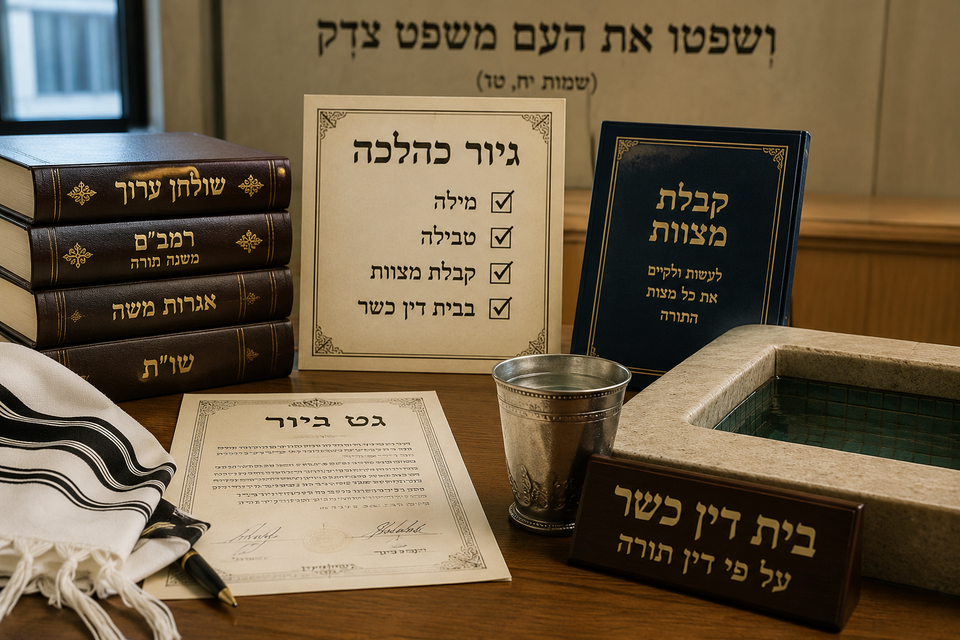
Conversion to Judaism — giyur — is not a symbolic gesture, a social statement, or a route to citizenship. It is entry into an eternal, binding covenant with Hashem: the very same covenant that was sealed at Har Sinai. And like any covenant, it has sacred and non-negotiable terms. The Charedi world's refusal to recognize state-run conversions — and especially conversions processed through the army — is not rooted in politics or in animosity toward a single soul. It is rooted in fidelity to the halacha, to the mesorah, and to the standards Hashem Himself fixed at Sinai. And, as we will see, it is rooted just as deeply in genuine love for the convert.
I. What Halacha Actually Requires
A kosher giyur has clear and ancient requirements. For a man, milah, circumcision; for everyone, tevilah, immersion in a kosher mikveh; and, at the very heart of it, kabbalas mitzvos — the sincere acceptance of the mitzvos of the Torah — all of it carried out before a kosher beis din of three observant Jews bound to halacha (Yevamos 46–47; Shulchan Aruch, Yoreh De'ah 268).
And the kabbalas mitzvos is not a formality to be waved through. The Gemara teaches that a prospective convert who is prepared to accept the entire Torah except for a single detail is not to be accepted at all (Bechoros 30b), and the Rambam codifies that the convert takes upon himself the whole of the mitzvos, holding nothing back (Hilchos Issurei Biah 13–14). A "conversion" in which the person never accepted, and never had any intention of keeping, the mitzvos is missing the one ingredient that makes a giyur a giyur in the first place. Everything else can be in perfect order — the mikveh, the paperwork, the ceremony — and without genuine kabbalas mitzvos it is a beautiful ritual around an empty center.
II. Why the Process, Not Just the Paperwork
But a giyur is more than a checklist of acts; it must flow through the mesorah — the living tradition handed down, unbroken, from Sinai to this very day. This is precisely why the beis din matters so much. It is not a bureaucratic panel rubber-stamping an application; it is the bearer of that tradition, and its members must themselves be committed to the very Torah they are asking the convert to take on. A conversion severed from the mesorah is not merely a procedural irregularity. It is spiritually hollow — an attempt to bring a soul into a covenant through a door the covenant does not actually have.
Rav Moshe Feinstein wrote on this at length, and without softening it: to convert a person who has no intention of keeping the mitzvos is not an act of kindness at all. It is a deception — a stumbling block laid before the convert himself, and before the whole of Klal Yisrael.
III. Where State and Army Conversions Fall Short
Against that standard, the Charedi concern with state-run conversion comes into focus. Too often these conversions are processed by batei din whose dayanim are not themselves fully observant, or who are working under political pressure to produce numbers — and people emerge declared "Jewish" who never accepted Shabbos, never accepted kashrus, never accepted taharas hamishpachah or the binding authority of halacha in any form. The army conversions raise the concern in its sharpest form of all: conducted at scale, on compressed timelines, inside an environment that is in many ways the opposite of a Torah life — and, painfully, often followed almost at once by a return to fully secular living.
This last point is not said to disparage anyone. It is said because it exposes the failure of the process itself: a system that ushers a person through the motions of conversion without ever transmitting the commitment that conversion requires has not been kind to that person. It has handed him a status the halacha may never have granted him. The leading poskim of the last generation, Rav Elyashiv and Rav Chaim Kanievsky among them, were unwavering on the underlying principle: where there is no genuine kabbalas mitzvos, there is simply no giyur — and no room to pretend otherwise, however much we might wish to.
IV. Why the Strictness Is Actually Mercy
Someone will ask, and fairly: why be so exacting? Would it not be kinder, more welcoming, more inclusive, to open the doors wider? But here is the heart of it — in this case the strictness is the kindness, and the leniency is the cruelty. Everything turns on what is actually at stake for the human being involved.
If a person is declared Jewish who is not, in halacha, Jewish, the declaration does not make him Jewish. It only hides the truth from him. His marriage to a Jew may be, in halacha, no marriage at all. His children may not be Jewish, and may carry that unresolved question into a future they never chose and cannot easily undo. A status handed out generously, to be welcoming, can become a generation later a quiet and irreversible tragedy. The Torah commands us to love the ger (Devarim 10:19) — and real love does not press into a person's hands a document that will one day betray him and his descendants. To insist on a real giyur is, at bottom, a refusal to set the convert up to fall.
V. The Convert the Torah Treasures
And let there be no confusion whatsoever about how the Torah regards the sincere ger. It loves him — openly, repeatedly, and without the slightest reservation. We are commanded not merely to tolerate the convert but to love him as we love ourselves (Vayikra 19:34), and the great ones of every generation have done exactly that.
When Ovadiah, a convert, wrote to the Rambam unsure whether he — a ger — was permitted to say in his tefillos "the God of our fathers," the Rambam answered him with overwhelming warmth: yes, you may say it, and you must, for Avraham Avinu is your father too. You who have come of your own free will under the wings of the Shechinah, the Rambam told him, are no less a child of Avraham than any Jew born into the nation. And the Torah means this at the very deepest level imaginable: the royal line of Israel itself — the line of David HaMelech, and of Moshiach who will descend from him — flows through Rus, a woman born a Moabite who chose, with her whole heart, to become a Jew. There is no higher honor the Torah could possibly pay a sincere convert than to route the kingship and the redemption of all Israel directly through one. When a ger comes k'halacha, al pi mesorah, the Charedi world receives him not grudgingly but with open arms — as a full and beloved Jew, with dignity, with warmth, and with real admiration for the journey he has made.
VI. The Bottom Line
So it comes down to this. Giyur is not defined by a government, and it cannot be. A secular court cannot declare a person Jewish; a military program cannot override Har Sinai; and no quantity of political pressure can alter a mesorah that has guarded Klal Yisrael, intact, for more than three thousand years. If the State genuinely wished to honor the Torah, it would align its conversion system with halacha and place it in the hands of batei din rooted in halacha and yiras Shamayim. Until it does, the Charedi world cannot recognize these conversions — not out of coldness, and not out of any desire to shut anyone out, but out of fidelity to the truth, and out of love for the very people that a false recognition would, in the end, fail most of all.
VII. Final Words
Am Yisrael is a holy nation, not merely a nationality, and becoming a Jew is not joining a club — it is entering a covenant that was sealed in fire at Har Sinai and has never once been reopened on easier terms. To guard that covenant is not extremism. It is loyalty — to Hashem, to the mesorah, and not least to the convert himself, whose place among us, when it is real, is real forever.
May we always have the warmth to welcome every sincere soul who comes home, the wisdom to keep the gate true, and the merit to see all of Klal Yisrael united in the service of Hashem.
Sources
The requirements of giyur
- Yevamos 46–47 — the process of receiving a convert and the requirements of milah, tevilah, and acceptance before a beis din; Shulchan Aruch, Yoreh De'ah 268 — the laws of conversion; Bechoros 30b — that a convert who withholds even a single detail of the Torah is not accepted; Rambam, Hilchos Issurei Biah 13–14 — the acceptance of the mitzvos as the heart of the conversion
- The documented positions of Rav Moshe Feinstein (Igros Moshe, Yoreh De'ah), Rav Yosef Shalom Elyashiv, and Rav Chaim Kanievsky — that a conversion lacking genuine kabbalas mitzvos is no conversion at all
The love of the ger
- Devarim 10:19 and Vayikra 19:34 — the mitzvah to love the convert as oneself; the Rambam's letter to Ovadiah the Ger — that the sincere convert is a full child of Avraham Avinu; Rus the Moabite, from whom descend David HaMelech and Moshiach — the royal line of Israel flowing through a sincere convert
The structural relationship to other articles in this series
- "The Charedi View on Recognition of Reform and Conservative Movements" — the same question of halachic authority over Jewish status
- "Why Is Mesorah Integral to Judaism?" — the tradition a true giyur must flow through
- "The Charedi Approach to Kiruv" — the love for every Jew, and every sincere soul drawing near, that underlies it all