
Why Do Charedim Oppose Saying Hallel on Yom HaAtzmaut?
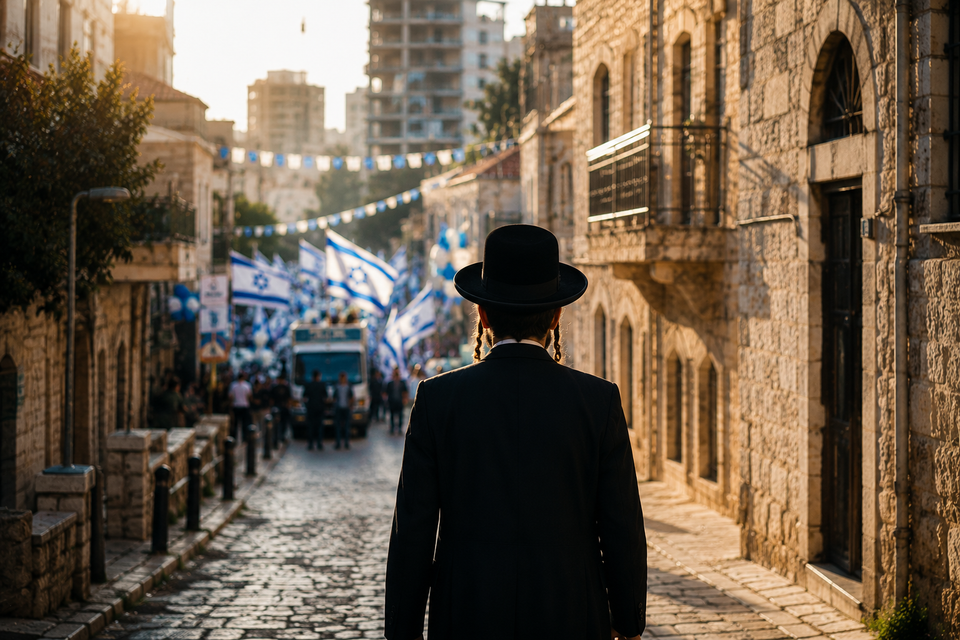
In the Religious Zionist World, Hallel — Sometimes With a Bracha — Is the Defining Religious Practice of Yom HaAtzmaut. Across the Charedi World, Hallel Is Not Said. The Reason Is Not a Lack of Gratitude; It Is Halacha. Hallel Is Not Recited for Every Good Event but Only for a Day That Meets Specific Conditions the Gemara Lays Out — a Day Established by Recognized Authority, Commemorating a Complete Salvation. The Gemara Itself Teaches That Even a Recognized Miracle Producing Only a Partial Salvation — Where "We Are Still Servants of Achashverosh" — Does Not Warrant Hallel. And Reciting Hallel With a Bracha When the Obligation Is in Doubt Risks Taking Hashem's Name in Vain
In many Religious Zionist communities, Yom HaAtzmaut is marked in shul with a special davening, and its centerpiece — and its most debated feature — is the recitation of Hallel, sometimes with a bracha, as an expression of thanks to Hashem for the establishment of the State.
Across the Charedi world, Hallel is not said on Yom HaAtzmaut — not in the yeshivos, not in the batei medrash, not in the shuls. And the reason is not coldness or a lack of gratitude. It is, first and foremost, a question of halacha: Hallel is not a general expression of thanks that may be offered for any good event. It is a specific halachic obligation, attached to specific days, under specific conditions that the Gemara lays out — and the founding of the State does not meet them.
I. When Does Halacha Require Hallel?
Hallel — the recitation of Tehillim 113–118 in praise of Hashem — feels like a natural way to thank Hashem for any good thing. But in halacha, Hallel is not an open-ended expression of gratitude. It is a defined obligation attached to particular days, and the Gemara is precise about which days qualify and why.
The central sugya is in Arachin (10a–b), where the Gemara works through why Hallel is said on some days and not others — why the full Hallel is recited on all of Sukkos but only the first day of Pesach, why not on Rosh Chodesh as a full obligation, why not on Rosh Hashanah and Yom Kippur, and — most importantly for our question — why not on Purim. In the course of this analysis, the Gemara reveals the conditions a day must meet to warrant Hallel.
Several conditions emerge. The day must be a mo'ed — an established, designated day. It must commemorate a genuine deliverance. And — the condition most relevant here — the deliverance must be a complete salvation. This last point is established by one of the most striking passages in the sugya, regarding Purim.
II. The Decisive Principle — "We Are Still Servants of Achashverosh"
The Gemara asks an obvious question: Purim commemorates a genuine, miraculous salvation — the deliverance of the entire Jewish people from Haman's decree of total annihilation. Chanukah, which commemorates its miracle, warrants Hallel. Why, then, is Hallel not said on Purim?
The Gemara (Arachin 10b; Megillah 14a) gives several answers, and one of them is decisive for our question. Rava teaches:
"Bishlama hasam: 'Hallelu avdei Hashem' — v'lo avdei Pharaoh. Ela hacha: 'Hallelu avdei Hashem' — v'lo avdei Achashverosh? Akati avdei Achashverosh anan."
"It is understandable that Hallel is said for the Exodus, for [afterward] we could say 'Praise, O servants of Hashem' — and no longer servants of Pharaoh. But here [on Purim] — can we say 'Praise, O servants of Hashem' and not servants of Achashverosh? We are still servants of Achashverosh!"
This is a profound and decisive teaching. Purim commemorates a real miracle and a real salvation — and yet Hallel is not said, because the salvation was incomplete. After Purim, the Jews were saved from destruction, but they remained subjects of Achashverosh, still in exile, still under foreign rule, the structures of their vulnerability still in place. A salvation that leaves the Jewish people "still servants of Achashverosh" — still in exile, still short of true redemption — does not warrant Hallel, no matter how genuine the miracle that produced it.
The relevance to Yom HaAtzmaut is direct and, for the Charedi world, conclusive. Even granting, for the sake of argument, everything the most enthusiastic supporter claims — that the founding of the State was a miracle, a deliverance, a turning point — it would still, at the very most, be a partial salvation of exactly the "servants of Achashverosh" kind. The Jewish people, after 1948, remain in exile. There is no Beis HaMikdash. There is no Sanhedrin. There is no Malchus Beis David. The Shechinah has not returned to Tzion. We are, in the precise sense of Rava's teaching, "still servants of Achashverosh" — still short of the complete redemption that alone would warrant the Hallel of a new mo'ed. If the salvation of Purim — deliverance from total annihilation — did not warrant Hallel because it was incomplete, then the founding of a secular state, which leaves us at least as far from complete redemption, certainly does not.
This is the halachic heart of the matter, and it operates even if one grants the State every spiritual significance its supporters claim. The Gemara's own standard for Hallel is a complete salvation — and by that standard, the founding of the State does not qualify.
III. Who Has the Authority to Establish a Day of Hallel?
Beyond the question of whether the event qualifies lies the question of authority: even a qualifying salvation requires that the day be established as a Hallel-day by appropriate authority — and that authority is not available today.
The days of Hallel were established by recognized Torah authority. The Hallel of the festivals is min haTorah. The Hallel of Chanukah was established by the Sages of that generation — the recognized Torah leadership, operating in the era when the Sanhedrin functioned and prophecy or its echoes were still present (Shabbos 21b; Rambam, Hilchos Chanukah 3:6, which records that the Sages of that generation established these days). The establishment of a new obligatory observance — and especially one carrying a bracha — is among the weightiest acts in halacha, requiring the authority of a recognized beis din of the highest order, accepted by Klal Yisrael (Rambam, Hilchos Mamrim 1–2).
Today, in the absence of a Sanhedrin and without the recognized authority such an enactment requires, there is no halachic mechanism by which a new day of Hallel — certainly one with a bracha — could be established. This is not a matter of one community's preference against another's; it is a structural feature of how binding observances are created in halacha. The Chief Rabbinate's institution of Hallel on Yom HaAtzmaut, whatever its intent, did not and could not supply the authority that the establishment of a new Hallel-day requires. The authority to add a day of Hallel to the calendar of Klal Yisrael is simply not something that exists in our time.
This connects to a broader halachic caution about the fixed structure of tefillah. The Gemara (Berachos 33b) records Rabbi Chanina's rebuke of one who multiplied praises of Hashem beyond the established formula — teaching that the matbe'a shel tefillah, the fixed coinage of prayer established by the Sages, is not to be added to lightly, even with good intentions and sincere praise. One does not enhance the davening by inserting into it observances the recognized authorities never established.
IV. Hallel With a Bracha — The Problem of a Bracha in Vain
The problem becomes acute when Hallel is recited with a bracha — "asher kideshanu b'mitzvosav v'tzivanu likro es haHallel" — as some in the Religious Zionist world do.
A bracha contains Hashem's Name and the formula of His Kingship. To recite a bracha when one is not obligated to is a bracha l'vatalah — a blessing in vain — which the poskim treat with the utmost gravity, connected to the prohibition against taking Hashem's Name in vain. Precisely because of this gravity, halacha establishes the principle of safek berachos l'hakel: when there is doubt as to whether a bracha is required, one refrains from saying it, erring on the side of not risking Hashem's Name in vain (Shulchan Aruch, Orach Chaim 215:4 and the foundational principle throughout).
Apply this to Hallel on Yom HaAtzmaut. The obligation to say Hallel on that day is, at the very best, a matter of serious dispute — and in the view of most of the Torah world, there is no such obligation at all. The event does not meet the Gemara's criteria; the day was not established by recognized authority; the bulk of Klal Yisrael does not recite it. When the very existence of the obligation is in such doubt, reciting a bracha over it runs directly into safek berachos l'hakel: one does not recite Hashem's Name in a bracha whose obligation is, at minimum, gravely in doubt. This is not a stringency; it is the straightforward application of one of the foundational rules of berachos.
Tellingly, even within the Religious Zionist world that does mark the day with Hallel, the practice is deeply divided precisely on this point — many recite Hallel without a bracha specifically out of this concern, recognizing that a bracha over a disputed obligation is halachically perilous. The division within the very world that says Hallel is itself evidence of how serious the safek bracha problem is.
V. The Range of Halachic Positions — Stated Accurately
It is worth setting out the actual range of positions accurately, because it is often misrepresented — and because the truth is more telling than the caricature.
The Charedi world — Lithuanian, Chassidic, and Sephardic — does not say Hallel on Yom HaAtzmaut at all. The recognized poskim of the Charedi world held that the day does not meet the halachic criteria for Hallel and that there is no authority to establish it as a Hallel-day. The Chazon Ish and the Lithuanian gedolei haposkim who followed him guarded the boundaries of the fixed halacha against the introduction of a new Hallel-obligation; the consistent Charedi ruling is that reciting Hallel on Yom HaAtzmaut — and certainly with a bracha — is not warranted.
The Sephardic world, under Chacham Ovadia Yosef zt"l, ruled firmly against reciting Hallel with a bracha on Yom HaAtzmaut, on the grounds of the safek bracha concern and the failure of the day to meet the criteria for an obligatory Hallel — a particularly significant ruling, since Chacham Ovadia was a figure of considerable engagement with the State and its institutions, yet held the halacha firm on this question.
Even within the Religious Zionist world, the practice is far from uniform. While many Religious Zionist communities recite Hallel — reflecting their theological view of the State's establishment as a redemptive event — there has been ongoing dispute over whether to say it with a bracha or without, with a great many reciting it without a bracha precisely out of the safek bracha concern described above. The fact that the world most inclined to celebrate the day is itself divided over the bracha is the strongest possible evidence that the halachic concern is real and not merely ideological.
VI. Is This a Lack of Gratitude? No.
The objection naturally arises: if Charedim are grateful to Hashem — and they say they are — why not express that gratitude through Hallel? The answer goes to the heart of what halachic Judaism is.
Gratitude is a cornerstone of Torah life. Charedim thank Hashem constantly — for life, for safety, for Torah, for the ability to live in Eretz Yisrael. But in halacha, the forms through which we serve and thank Hashem are themselves defined by halacha. We do not invent new obligatory observances to match our emotions, however sincere. We say Hallel when the halacha establishes that Hallel is said — not when national feeling, however genuine, moves us to. To add a bracha because of national excitement would be to make our own feelings the source of halachic obligation, which is precisely what halacha does not permit.
This is not a diminishment of gratitude; it is the discipline of expressing gratitude in the way Hashem's Torah prescribes rather than in ways we design for ourselves. The Charedi world expresses its hakaras hatov to Hashem abundantly — through Tehillim, through Torah learning, through tefillah, through living a life of Torah and mitzvos. That is gratitude in the currency the Torah recognizes. What it declines to do is manufacture a new Hallel-obligation, with a bracha invoking Hashem's Name, for a day that does not meet the Torah's own criteria — because that would not be a greater expression of gratitude but a departure from the halacha through which gratitude is properly expressed.
VII. The Closing Position
Why do Charedim oppose saying Hallel on Yom HaAtzmaut?
Because Hallel is not a general thanksgiving but a specific halachic obligation, and the founding of the State does not meet its conditions. The Gemara's own standard requires a complete salvation — and the Gemara teaches that even Purim, commemorating deliverance from annihilation, does not warrant Hallel because afterward "we are still servants of Achashverosh." After 1948, in exile still, without Beis HaMikdash, Sanhedrin, or Malchus Beis David, we remain — in the precise halachic sense — still servants of Achashverosh. The salvation, whatever good it contained, is not the complete redemption that Hallel as a new mo'ed would require.
Because there is no authority in our time to establish a new day of Hallel — that requires a recognized beis din of the highest order, accepted by Klal Yisrael, which does not exist in the absence of the Sanhedrin.
And because reciting Hallel with a bracha over a gravely disputed obligation runs directly into safek berachos l'hakel — the rule that protects against a bracha in vain and the taking of Hashem's Name in vain — a concern so real that even the Religious Zionist world that says Hallel is divided over the bracha.
This is not coldness, and it is not ingratitude. It is reverence — loyalty to the halacha received across the generations, and refusal to bend the fixed forms of avodas Hashem to match even the most powerful national feeling. The Charedi world thanks Hashem every day, hopes for the geulah in every tefillah, and waits — patiently and with longing — for the day when all of Klal Yisrael will say Hallel together, with a bracha, for a salvation that is finally complete: in a rebuilt Yerushalayim, with the Beis HaMikdash standing, when we are servants of Hashem alone and of no Achashverosh at all.
That will be the Hallel that halacha not only permits but commands — and the Charedi world awaits it with all its heart.
Sources
The criteria for Hallel
- Talmud Bavli, Arachin 10a–b — the central sugya analyzing why Hallel is recited on some days and not others (the festivals, Rosh Chodesh, Rosh Hashanah, Yom Kippur, Purim), revealing the conditions a day must meet to warrant Hallel
- Talmud Bavli, Pesachim 117a — the Neviim instituted that Israel recite Hallel upon redemption from troubles
- Rambam, Mishneh Torah, Hilchos Chanukah 3:6 — the days on which Hallel is recited; that Hallel was not established on Purim because the reading of the Megillah serves in its place
The decisive principle — partial salvation does not warrant Hallel
- Talmud Bavli, Megillah 14a; Arachin 10b — Rava's teaching: "Can we say 'Praise, O servants of Hashem' and not servants of Achashverosh? We are still servants of Achashverosh!" — a genuine, miraculous, but incomplete salvation (Purim) does not warrant Hallel
- The application: after 1948, Klal Yisrael remains in exile, without Beis HaMikdash, Sanhedrin, or Malchus Beis David — "still servants of Achashverosh" in the precise sense of the Gemara — so even granting the State every claimed significance, it is at most a partial salvation that does not meet the Gemara's standard for Hallel
The authority to establish a day of Hallel
- Talmud Bavli, Shabbos 21b — Chanukah established by the Sages of that generation
- Rambam, Mishneh Torah, Hilchos Mamrim 1–2 — the authority of the beis din hagadol (Sanhedrin) required for binding enactments
- The absence of a Sanhedrin and of the recognized authority required to establish a new obligatory Hallel-day in our time
- Talmud Bavli, Berachos 33b — Rabbi Chanina's rebuke of one who added to the fixed praises of Hashem; the principle of guarding the matbe'a shel tefillah (the fixed formula of prayer) against unauthorized addition
Hallel with a bracha — the safek bracha problem
- Shulchan Aruch, Orach Chaim 215:4 and the foundational principle of safek berachos l'hakel — when the obligation to recite a bracha is in doubt, one refrains, to avoid a bracha l'vatalah (a blessing in vain) and the taking of Hashem's Name in vain
- The application: the obligation to recite Hallel on Yom HaAtzmaut is, at best, gravely disputed, so reciting it with a bracha runs into safek berachos l'hakel
- The division within the Religious Zionist world over reciting Hallel with or without a bracha — itself evidence of the seriousness of the concern
The range of positions (stated accurately)
- The Charedi world (Lithuanian, Chassidic, Sephardic) — no Hallel on Yom HaAtzmaut; the day does not meet the halachic criteria and there is no authority to establish it
- Chacham Ovadia Yosef zt"l — the documented ruling against reciting Hallel with a bracha on Yom HaAtzmaut, on the grounds of the safek bracha concern and the failure to meet the criteria (notable from a figure engaged with the State)
- The Religious Zionist world — divided practice, with many reciting Hallel without a bracha out of the safek bracha concern
- Note on accuracy: popular treatments often attach specific quotations and citations to individual gedolim that cannot be reliably verified, and in some cases attribute positions to the wrong figures (for example, conflating works of similar names by different authors). The documented positions are stated here without reliance on unverified quotations; the argument rests on the primary sources
Gratitude expressed through halacha
- The principle that the forms of serving and thanking Hashem are themselves defined by halacha; gratitude is not a license to create new obligatory observances
- The Charedi expression of hakaras hatov through Tehillim, Torah learning, tefillah, and a life of mitzvos
The structural relationship to other articles in this series
- "Why Don't Charedim Celebrate Yom HaAtzmaut?" — the broader treatment of which this is the companion
- "Do Charedim Pray for the State?" — the parallel question of liturgical innovation and the authority to compose tefillah
- "Yes, We See the Miracles, No the State Is Not the Geulah" — the Source vs. Vessel framework and the incompleteness of any pre-messianic salvation
- "What Do Charedim Believe Will Happen to the State When Moshiach Comes?" — the complete redemption that Hallel will one day mark