
When the World Trembles, a Jew Looks Only Upward
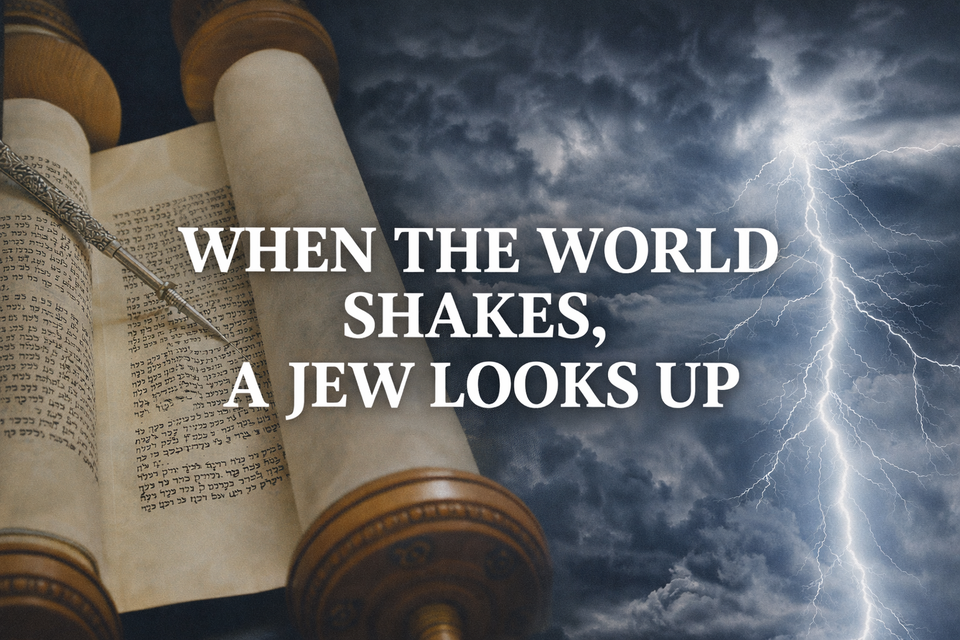
From Purim to Pesach, the message of Chazal is clear: do not place your faith in armies, politics, or nationalism. Our strength has always come from one place alone — the Ribbono Shel Olam.
Picture a Jew sitting at his table on erev Shabbos.
The Purim costumes are folded away. The mishloach manos plates have been cleared. The noise of the day before has settled into something quieter. He opens the news. Headlines scroll past — Iran, Arabia, missiles, threats, escalation. The map of the Middle East glows on the screen like a wound. He turns it off. He opens a sefer.
And there — in words written over a thousand years ago — he reads something that stops his breath.
The Midrash That Will Not Let You Sleep
The Pesikta Rabbati (36:1), cited also in Yalkut Shimoni (Nach 499), describes the period that precedes the revelation of Melech HaMashiach. It does not speak in vague, abstract terms. It is precise. It is almost unsettling in its specificity.
The Midrash says: the kings of the nations will begin provoking one another. It names Persia — Paras — as a central force of tension. It describes the Arab nations watching, anxious, uncertain. It says the entire world will feel the trembling.
And it says that even Klal Yisrael — even we — will feel afraid.
But then come the words that Chazal preserved across the generations, waiting, it seems, to be read in a moment exactly like this one:
"בניי אל תתייראו — My children, do not fear. The time of your redemption has arrived."
We are not prophets. We do not point at a news ticker and declare: this is the moment. But we are allowed — we are obligated — to notice when the language of Chazal begins to sound less like ancient history and more like this morning's headlines.
And when that happens, the question is not: what will the nations do?
The question is: what will we do?
Purim Has Passed. The Process Has Begun.
The Bnei Yissaschar teaches something that reframes everything about the days we are now in.
The downfall of Amalek does not end on Purim. It begins on Purim — and continues, building, intensifying, until Erev Pesach, the 14th of Nisan, as the Raaya Meheimna (Zohar III 249a) makes clear.
Purim was not a conclusion. Purim was an opening.
The simcha, the Megillah, the seudah — they were not the destination. They were the ignition. We are now inside the process that Purim began. The weeks between Purim and Pesach are not an empty corridor. They are charged with momentum, building toward the geulah of Nisan.
And that changes everything about how we experience these days.
The journey from Parshas Zachor through Purim to Pesach is not a calendar coincidence. It is a carefully designed spiritual path — a path that Hashem built into the fabric of time so that His people would have the tools to walk through exactly this kind of darkness.
Zachor — Remember. Before any victory, before any simcha, we are commanded to remember. Remember who Amalek is. Remember what he represents: the force of safek — doubt. The force that cools Jewish hearts and whispers: nothing means anything. History is chaos. You are alone.
Amalek does not need an army. Amalek needs only to make you feel small. Amalek attacks — as the pasuk tells us — when Jews are tired and scattered and do not fear Hashem. Not in battle. In the spirit.
That is why Zachor comes first.
Before Purim, before Pesach, before redemption — remember who is trying to make you forget who you are.
Then came Purim — which we just lived.
In the Megillah, Hashem's name does not appear once. Not once. And yet His hand moved through every line — through the king's sleepless night, through Esther's courage, through the precise reversal of Haman's decree. The message is not subtle: even when Hashem seems hidden, He is writing every word.
That is the emunah of Purim — not emunah for easy times, but emunah for times when the sky seems empty and the news seems to belong to the nations and the future seems to be decided in palaces far from any beit midrash.
We read that Megillah yesterday. Its message is still in the air.
And then comes Pesach, toward which all of this builds:
"בניסן נגאלו ובניסן עתידין להיגאל — In Nisan we were redeemed, and in Nisan we will be redeemed again." (Rosh Hashanah 11a)
Not a memory. A promise. Written into the month itself.
The Danger of Talking Like the Nations
In times of war and uncertainty, there is a temptation that is subtle and seductive.
It sounds reasonable. It sounds brave. It sounds like pride.
Jews begin to use the language of the nations — words like military power, political strength, deterrence, national pride. And within those words hides a quiet heresy: the idea that our survival depends on us.
The Torah will not let this stand.
The walls of Yericho did not fall because of a superior siege strategy. Yam Suf did not split because of a fleet of ships. Purim did not end in salvation because the Jews had better generals than Haman.
Every rescue in our history has had one Author.
Listen to the words of David HaMelech, who was a warrior, who did lead armies, who understood battle better than almost any figure in Tanach — and who still wrote:
"אם ה׳ לא ישמור עיר שוא שקד שומר — If Hashem does not guard the city, the watchman guards in vain." (Tehillim 127:1)
The watchman is still there. The soldiers still go out. The effort is still made. But David — the king, the general, the fighter — knew that the protection was never his to provide.
Our people have survived things that no military strategy could explain. We have outlasted empires. We have walked out of places that no nation walks out of. We have buried our enemies and continued making Shabbos.
Not because we were powerful.
Because He is.
What a Jew Does When the World Shakes
History has seen this before.
The Jews of Persia faced an existential decree. They did not have an army. They had no political allies. They had Mordechai standing firm at the gate and Esther preparing to enter the palace — and three days of fasting and tefillah that rose from an entire nation.
And the decree was reversed.
This is not primitive faith. This is the most sophisticated understanding of how history actually works — an understanding that the nations, for all their armies and intelligence agencies and geopolitical calculations, simply do not possess.
A Jew knows who runs the world.
So when the headlines grow louder, a Jew does not grow louder. He grows deeper.
When the nations panic, a Jew does not panic. He opens a sefer. He daven with more kavana. He gives more tzedakah. He learns more Torah — because the learning of Torah in a beit midrash is not an escape from history. It is the engine of history.
The zechus of Torah is not a nice supplement to geopolitical strategy. It is the real protection of Klal Yisrael. Always has been. Always will be.
Teshuvah. Tefillah. Tzedakah.
These are not consolation prizes for people who have no power.
These are the weapons that have kept us alive for three thousand years while the nations who threatened us became museum exhibits.
The Ground Shakes — Because Something Is Shifting
The Midrash does not describe the trembling of the world before geulah as a catastrophe.
It describes it as a birth.
The world does not shake because it is collapsing. It shakes because something enormous is trying to emerge. Chazal do not tell us to look at the trembling with terror. They tell us to look through it — to see the hand that is shaking it.
For the nations, shaking means collapse.
For a Jew, shaking can mean that Hashem is moving the pieces.
The first geulah came with tremendous pain. But Chazal teach that the final redemption will not leave behind the shadow of exile. It will be complete, whole, permanent — geulah shleimah.
We do not know the day. We are not meant to. But we are meant to be ready. And readiness, for a Jew, does not mean stockpiling or strategizing. It means being the kind of person that a redeemed world requires — a person of emunah, of Torah, of genuine bitachon.
Purim Is Behind Us. Pesach Is Ahead. Walk Forward.
Because you know how this story ends.
Amalek roared in the desert — and fell. Haman rose to the heights of power — and fell. Pharaoh defied heaven itself — and the sea swallowed him.
Persia may rise. Nations may rage. Headlines may scream.
But the Ribbono Shel Olam is writing every line of this story, and He told us the ending long ago:
"בניי אל תתייראו — My children, do not fear." "עת גאולתכם הגיעה — The time of your redemption has arrived."
Purim carried us this far. Now we carry Purim's emunah forward — through these weeks, toward the Seder table, toward Nisan, toward the promise that is written into the month itself.
The costumes are put away. The gragger is back in the closet.
But the simcha of a people who know they are loved — that does not get folded away.
Let the nations read the news.
We just read the Megillah. And we know: the story that ends with redemption always begins when everything looks darkest.
Sources
- Pesikta Rabbati 36:1 / Yalkut Shimoni Nach 499
- Raaya Meheimna, Zohar III 249a
- Bnei Yissaschar, Ma'amarei Chodesh Adar, Ma'amar 4
- Rosh Hashanah 11a
- Tehillim 127:1