When Did the Idea of Kollelim Start?
Is the Kollel System a Modern Invention or an Unbroken Chain From Sinai to Today?
The Documented Historical Continuity of Full-Time Torah Learning Across Three Thousand Years — Anchored in Verified Halachic Sources and Documented Jewish History, Showing That the Contemporary Charedi Kollel System Is Not a Modern Innovation But the Direct Continuation of a Tradition That Began at Har Sinai and Has Continued Without Interruption Through Every Generation Since
The critique is heard often in the contemporary discourse, sometimes from secular voices and sometimes from those who should know better. "The mass kollel system is a modern invention. There was no full-time learning class in the historical Jewish people. The Charedi community has manufactured a tradition that didn't exist."
It is one of the most consistently repeated claims in the contemporary debate. It is also historically false at every level — Tanach, Talmud, Rishonim, Acharonim, and the documented institutional record of the past two centuries.
The reality is that there has never been a generation of Klal Yisrael, from Har Sinai to today, without a substantial class of Jews devoted to full-time Torah learning supported by the broader community. The specific institutional forms have evolved — the Beis HaMikdash framework, the Levi'im and Kohanim, the Anshei Knesses HaGedolah, the Tana'im, the Amora'im, the Geonim, the great Rishonic academies, the European yeshivos of the 18th-19th centuries, the post-Holocaust rebuilding — but the underlying structure has been continuous. Full-time Torah learning, supported by communal infrastructure, has been the spine of Jewish national life across three thousand years.
We document the chain below.
I. The Sinai Foundation — Na'aseh V'Nishma and the Beginning of Am HaTorah
The Jewish nation's foundational moment was the acceptance of the Torah at Har Sinai. Shemos 24:7 records the people's declaration:
"Vayikach sefer ha'bris vayikra b'aznei ha'am, vayomru: kol asher diber Hashem na'aseh v'nishma."
"And he took the Book of the Covenant and read it in the ears of the people, and they said: 'All that Hashem has spoken, we shall do and we shall hear.'"
The Gemara in Shabbos 88a develops the profound theological significance of this declaration: Klal Yisrael accepted the doing (na'aseh) before the hearing (nishma) — committing to perform the mitzvos before knowing their content. This is the moment that constituted Klal Yisrael as Am HaTorah — a nation whose essential identity is defined by its relationship to Torah.
From that moment forward, the structure of Jewish national life required a class of people whose primary occupation was the preservation, transmission, and continued study of the Torah. The Torah itself codifies this:
Devarim 33:10 — Moshe Rabbeinu's farewell brachos to Shevet Levi:
"Yoru mishpatecha l'Yaakov v'soras'cha l'Yisrael — yasimu ketorah b'apecha v'kalil al mizbachecha."
"They shall teach Your laws to Yaakov and Your Torah to Israel; they shall place ketores before You and burnt offerings on Your altar."
The Torah explicitly assigns to one tribe — Levi — the dual role of teaching Torah to Klal Yisrael and serving in the Mikdash. The Levi'im did not receive an agricultural portion in Eretz Yisrael (Bamidbar 18:20–24, Devarim 18:1–2) precisely so they could dedicate themselves to this role full-time. Their material support came from the rest of the nation — the terumos, the maaseros, the offerings. This is the foundational structural model of full-time avodas Hashem supported by communal infrastructure.
The Torah's own framework is therefore explicit. A class of Jews dedicated to full-time avodas Hashem — including Torah teaching and Torah study — is built into the original structure of the Jewish nation from its inception.
II. The Shevet Levi Framework — Extended to All Jews
The Rambam, in one of the most quoted passages of Mishneh Torah, codifies the structural framework that the Charedi kollel system rests on:
Rambam, Hilchos Shemittah V'Yovel 13:13:
"V'lo Shevet Levi bilvad ela kol ish v'ish mi'kol ba'ei ha'olam asher nadvah rucho oso v'hevino madao l'hivades la'amod lifnei Hashem l'sharso u'l'avdo l'de'ah es Hashem, v'halach yashar k'mo she'asahu ha'Elokim, u'farak mei'al tzavaro ol ha'cheshbonos ha'rabim asher bikshu bnei ha'adam — harei zeh nitkadesh kodesh kodashim, v'yihyeh Hashem chelko v'nachalaso l'olam u'l'olmei olamim, v'yizkeh lo ba'olam hazeh davar ha'maspik lo k'mo she'zachah l'Kohanim l'Levi'im."
"And not the tribe of Levi alone, but any individual whose spirit moves him and whose intelligence gives him to set himself apart to stand before Hashem, to serve Him and minister to Him and to know Hashem… behold, this person has been consecrated as the Holy of Holies, and Hashem will be his portion and inheritance forever and ever, and will provide for him in this world sufficient material needs, just as He provided for the Kohanim and the Levi'im."
This Rambam — anchored in the structural framework of Shevet Levi — establishes that the Levi'im model is not a one-tribe institution but a structural category of Jewish national life. Any individual who undertakes the parallel commitment — full-time service of Hashem through Torah and avodah — enters the same structural framework, with the same communal support relationship.
This is the halachic foundation of the contemporary kollel. It is not a Charedi novelty. It is the Rambam's explicit codification of a Torah-rooted structural category — kodesh kodashim extended beyond the tribe of Levi — that has been part of normative halacha for eight centuries.
III. The Tana'im and Amora'im — Documented Full-Time Torah Scholarship
The Talmudic period produced the most documented evidence of full-time Torah scholarship supported by communal infrastructure that pre-modern Jewish history offers. The Tana'im (1st–3rd centuries CE) and Amora'im (3rd–6th centuries CE) operated in academies — yeshivos — where full-time learning was the central activity.
The Beis HaVa'ad / Yeshiva of Yavneh under Rabban Yochanan ben Zakkai (1st century CE), established after the destruction of the Beis HaMikdash, was an institution of full-time Torah learning.
The Yeshiva of Lod under Rabbi Eliezer ben Hyrcanus and Rabbi Tarfon — the upper chamber of Nit'za's house in Lod is referenced in the famous Kiddushin 40b sugya where Rabbi Tarfon and the elders debated the question of Talmud or maaseh.
The Yeshiva of Bnei Brak under Rabbi Akiva — the institution where the foundational sugyos of the Mishnah were developed. The Pesach Haggadah's record of the seder in Bnei Brak with the great Tana'im learning all night is documentation of the operative framework.
The Yeshivos of Sura and Pumbedisa in Bavel — the Yeshivos Gedolos that operated continuously for the entire Amoraic period and into the Geonic period (3rd century CE through approximately 1040 CE). Sura, founded by Rav (Rabbi Abba Aricha) in 219 CE, and Pumbedisa, traditionally associated with Rabbi Yehuda bar Yechezkel, were full-time Torah learning institutions where thousands of students learned with senior scholars year-round. The Yarchei Kallah twice-yearly assemblies brought tens of thousands of additional Jews to these institutions for intensive study periods.
The framework of communal support is explicitly documented in the Gemara. Bava Basra 8a records that Torah scholars are exempt from various forms of communal taxation, and the verse cited (Ezra 7:24) records the historical exemption of Torah scholars from royal taxation in the Persian period. The framework of communal support of full-time Torah scholars was assumed by Chazal as the operative reality.
The Talmud itself records the centrality of Torah learning to Jewish national life in famous formulations. Pe'ah 1:1, recited daily in birchos hashachar: "V'talmud Torah k'neged kulam" — "And the study of Torah equals them all." Kiddushin 40b: "Talmud gadol she'ha'talmud meivi liydei ma'aseh" — "Study is greater, for it leads to action." Shabbos 119b: the world is sustained by "hevel pihem shel tinokos shel beis rabban" — "the breath of schoolchildren learning Torah." Sotah 21a: "Torah magna u'matzla" — "Torah protects and saves."
These are not Charedi rhetorical flourishes. They are the Talmud's own articulation of how Klal Yisrael's national life operates: with Torah learning, particularly the full-time Torah learning of dedicated scholars and bnei yeshiva, as the structural mechanism by which national survival, protection, and continuity are generated.
IV. The Geonim and Rishonim — The Yeshiva System Codified
The Geonic period (approximately 589–1040 CE) continued the Babylonian yeshiva system in formal continuity with the Amoraic period. The Gaonim — the heads of Sura and Pumbedisa — were the operative halachic authorities of world Jewry, supported by the entire diaspora through the Reshus HaGalus (the Exilarchate) and through direct contributions from communities worldwide. This was institutional, organized, communally-supported full-time Torah learning at a scale that would not be matched again until the modern era.
The Rishonic period (approximately 11th–15th centuries) developed the framework further. The great yeshivos of:
The Rif's academy (Rabbi Yitzchak Alfasi, 1013–1103) in Fez and later Lucena Rashi's yeshiva in Troyes (11th century) The Ba'alei Tosafos academies across northern France and the Rhineland (12th–13th centuries) The Rambam's academy in Fostat, Egypt (12th century) The Ramban's yeshiva in Gerona (13th century) The Rashba's academy in Barcelona (13th century) The Rosh's yeshiva in Toledo (13th–14th centuries)
All operated as full-time Torah learning institutions, all supported by their broader communities, all producing the Rishonic literature that constitutes the foundational halachic and Talmudic commentary of the Jewish people.
The halachic codification of communal support followed naturally. The Rema, Yoreh Deah 246:21 — the Ashkenazic codification, written by Rabbi Moshe Isserles in 16th-century Krakow — explicitly permits Torah scholars to be supported by the community:
"It is permitted to a Torah scholar to make stipulations with the community that they will support him so that he can engage in Torah study, and the community is obligated to do so, and many of the greatest of Israel did so."
The Rema's explicit acknowledgment — "many of the greatest of Israel did so" — references the historical practice that had been continuous for centuries before his codification.
V. The Volozhin Revolution and the Modern European Yeshiva System
The institutional form most directly ancestral to the contemporary kollel was developed in the early 19th century by Rabbi Chaim of Volozhin (1749–1821), the foremost talmid of the Vilna Gaon. Yeshivas Etz Chaim in Volozhin, founded in 1803, established the model that defined modern Lithuanian Torah education: an institutional yeshiva with a dedicated student body, structured curriculum, professional rebbeim, and full-time learning as the central activity.
Volozhin's significance cannot be overstated. Within decades, it had become the central Torah institution of Lithuanian Jewry, producing the generation of poskim and roshei yeshiva who would lead the European Charedi world through the late 19th and early 20th centuries.
The model spread:
- Yeshiva of Mir (founded 1815) — became one of the largest Lithuanian yeshivos
- Yeshiva of Slabodka (founded 1882) — under the Alter of Slabodka (Rabbi Nosson Tzvi Finkel), developed the mussar movement integration with full-time learning
- Yeshiva of Telshe (founded 1875)
- Yeshiva of Radin under the Chofetz Chaim
- Yeshiva of Lomza, Kletzk, Baranowitz, Kamenetz, Kobrin, and dozens of others across Lithuania, Poland, and the broader Eastern European Jewish heartland
The institutional infrastructure was vast. By the early 20th century, tens of thousands of bachurim were learning full-time in Lithuanian yeshivos, supported by the broader Jewish community through philanthropic networks coordinated by figures like Rabbi Chaim Ozer Grodzinski (the Achiezer) and the Chofetz Chaim through the Vaad HaYeshivos.
The Kollel Perushim in Yerushalayim — established in the early 1800s by talmidim of the Vilna Gaon — pioneered the institutional kollel model specifically for married Torah scholars supported to continue full-time learning. The kollel format would become foundational to the post-Holocaust rebuilding.
VI. The Holocaust Catastrophe and the Post-War Rebuilding
The Holocaust destroyed the European Torah world. The yeshivos of Volozhin, Mir, Slabodka, Telshe, Radin, Lomza, Kletzk, and dozens of others were physically destroyed. The vast majority of the Roshei Yeshiva, the bachurim, and the lay supporters were murdered. The infrastructure that had sustained tens of thousands of full-time Torah learners across Eastern Europe was annihilated in five years.
And yet — within a single decade of the war's end — the rebuilding had begun on a scale that ultimately exceeded what had been destroyed.
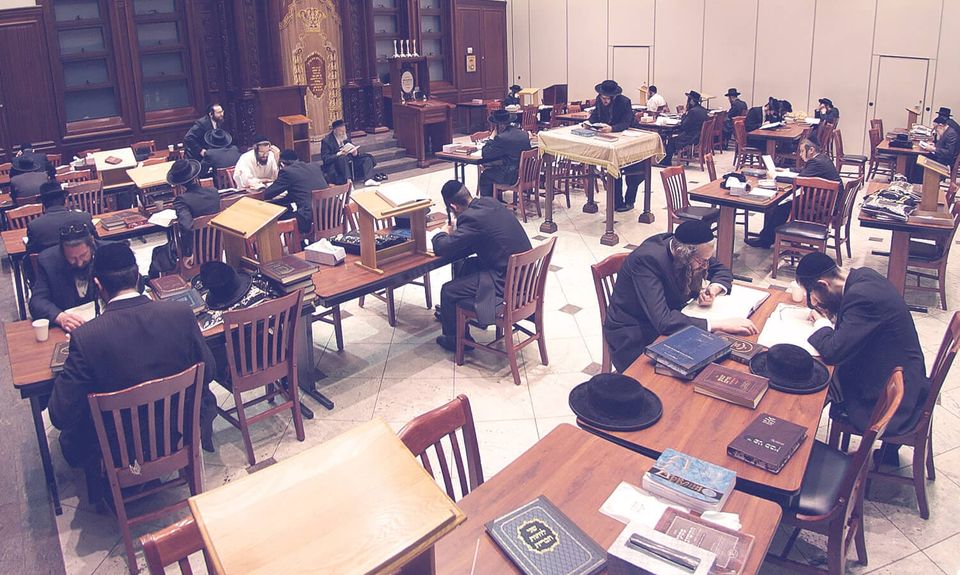
The Mir Yeshiva — which had famously escaped to Shanghai during the war via the Curaçao visas and the Trans-Siberian Railway — was re-established in Yerushalayim, where it operates today as the largest yeshiva in Jewish history, with approximately eight thousand talmidim.
Lakewood — Beth Medrash Govoha — was founded in 1943 in New Jersey by Rabbi Aharon Kotler zt"l (1891–1962). Kotler had been one of the leading European Roshei Yeshiva (Kletzk) and arrived in the United States with a revolutionary vision: the establishment of the European-style full-time learning yeshiva on American soil, with the explicit purpose of rebuilding the institutional Torah world that Europe had lost. Today, Beth Medrash Govoha and its affiliates encompass tens of thousands of full-time learners across Lakewood and dozens of community kollelim worldwide.
The Brisker Yeshiva in Yerushalayim was established by the Brisker Rav (Rabbi Yitzchak Zev Soloveitchik zt"l) — the son of Rav Chaim Brisker and inheritor of the Brisker Lomdus methodology — after his escape from Brisk to Eretz Yisrael in 1941.
The Hungarian and Polish Chassidic dynasties — Satmar, Belz, Ger, Vizhnitz, Bobov, Klausenberg, and dozens of others — were reconstituted by their surviving Rebbes in Brooklyn, Bnei Brak, Yerushalayim, and other centers. Each established its own network of yeshivos and kollelim.
The Sephardic yeshiva world — Porat Yosef, Yeshivat HaNegev, Kisei Rachamim, the Shas-affiliated network — developed in parallel, building institutional infrastructure for Sephardic full-time learning that had not previously existed at this scale.
The post-Holocaust rebuilding was, by every empirical measure, the largest sustained reconstruction of Torah-learning infrastructure in Jewish history. From the ruins of the European Torah world, within seventy-five years, the contemporary Charedi world has built a Torah-learning infrastructure that exceeds the entire pre-war European period in scale, geographic reach, and institutional depth.
VII. The Contemporary Reality — Scale and Documented Numbers
The contemporary Charedi full-time learning population is not a small or marginal phenomenon. The documented numbers:
- Mir Yerushalayim: approximately 8,000 talmidim (largest single yeshiva in Jewish history)
- Beth Medrash Govoha (Lakewood): approximately 6,500 talmidim
- Ponevezh (Bnei Brak): approximately 2,500 talmidim
- Slabodka, Brisk, Or Elchanan, and major Lithuanian yeshivos in Eretz Yisrael: collectively tens of thousands of talmidim
- Chassidic yeshivos and kollelim across Satmar, Belz, Ger, Vizhnitz, Bobov, Chabad, and other dynasties: collectively over 100,000 full-time learners
- Sephardic yeshivos under the Shas-affiliated network and the various Sephardic communities: tens of thousands more
The aggregate global Charedi full-time learning population is, by conservative estimate, over 200,000 men. This is the largest sustained population of full-time Torah learners in Jewish history. The Geonic period of Sura and Pumbedisa had perhaps tens of thousands; the pre-Holocaust Lithuanian system had perhaps fifty thousand; the contemporary Charedi system has multiplied this by approximately six.
VIII. The "Modern Invention" Critique Addressed
We now return to the critique with which this article opened. Is the contemporary kollel system a modern invention?
The honest answer requires distinguishing two questions:
Is full-time communally-supported Torah learning a historical Jewish tradition? Yes, categorically and demonstrably, going back to Sinai through the Levi'im framework, the Tana'im and Amora'im, the Geonim, the Rishonim, and the European yeshivos. The framework is not modern.
Is the specific institutional form of the contemporary mass kollel — married avreichim learning full-time at scale, supported by a combination of communal funds, philanthropy, and State subsidies — a development of the post-Holocaust era? Yes, in this specific institutional configuration. But the institutional form is a development within the tradition, not a departure from it. The Kollel Perushim of early-1800s Yerushalayim and the Volozhin model of the same period were the seeds; the post-Holocaust generation grew the institutional form to historically unprecedented scale because the historical situation required it.
The honest critic should grant the first point and acknowledge the second carefully. Yes, the scale of the contemporary kollel is historically unprecedented. No, the framework of full-time supported Torah learning is not. The Charedi world has, in effect, scaled up an ancient tradition to the level that the post-Holocaust reconstruction required — and the resulting institutional infrastructure has produced the largest, deepest, most rigorously committed Torah-learning population in Jewish history.
The post-Holocaust scale is not a problem to apologize for. It is the appropriate response to the catastrophe that destroyed the European Torah world. The institutional question facing the post-war Charedi world was straightforward: should the rebuilding aim to restore what was lost, or to build on a scale that would ensure the chain could not be broken again? The gedolim of the post-war generation — Rav Aharon Kotler, the Chazon Ish, the Brisker Rav, the Satmar Rebbe, the Klausenberger Rebbe, and others — chose the second option. And the result is what the contemporary Charedi world is — including its kollel system.
IX. The Closing Position
The kollel system is not a modern Charedi invention. It is the post-Holocaust institutional form of a tradition that has been continuous from Sinai to today.
From the Levi'im supported by the maaseros of their brothers, to the Tana'im of the Yavneh and Bnei Brak academies, to the Amora'im of Sura and Pumbedita, to the Geonim sustained by the Exilarchate and the diaspora, to the Rishonim in their academies across Spain, France, the Rhineland, North Africa, and Eretz Yisrael, to the Vilna Gaon's school and the Volozhin revolution, to the great Lithuanian yeshivos that produced the pre-Holocaust gedolim, to the post-war rebuilding in Yerushalayim, Bnei Brak, and Lakewood — the chain has been unbroken for three thousand years.
The specific institutional form has evolved. The Levi'im framework gave way to the Bavli yeshiva system, which gave way to the Geonic period, which gave way to the Rishonic academies, which gave way to the Lithuanian yeshiva system, which gave way to the contemporary global kollel infrastructure. At every stage, the underlying structure is the same: a class of Jews dedicated to full-time Torah learning, supported by the broader community, generating the merit and the institutional continuity by which Klal Yisrael's national life has been sustained.
To call this a "modern invention" is to misread the documented historical record at the most fundamental level. It is the institutional embodiment of one of the oldest, most consistent, most explicitly Torah-rooted structures of Jewish national life. The contemporary Charedi community has inherited this tradition, scaled it up after the Holocaust catastrophe required massive rebuilding, and continues to operate it as the structural backbone of Klal Yisrael's continued spiritual life.
The chain that was forged at Sinai has not been broken. The contemporary Charedi world is its current link. And the kollel system — far from being a modern invention — is the institutional form through which the chain continues to function in our generation, on its way to the geulah and the final restoration of Torah authority in Eretz Yisrael bimheirah b'yameinu, amen.
Sources
The Sinai foundation
- Shemos 24:7 — "Na'aseh v'nishma" — Klal Yisrael's foundational acceptance of Torah
- Shemos 19:6 — "V'atem tihyu li mamleches kohanim v'goy kadosh" — the structural designation of the nation
- Talmud Bavli, Shabbos 88a — Chazal's analysis of the na'aseh v'nishma declaration
The Shevet Levi framework
- Bamidbar 18:20–24 — the Levi'im's lack of agricultural inheritance
- Devarim 10:9 — "al kein lo haya l'Levi chelek v'nachalah im echav, Hashem hu nachalaso"
- Devarim 18:1–2 — the Kohanim and Levi'im's portion structure
- Devarim 33:8–11 — Moshe's brachos to Shevet Levi
- Rambam, Mishneh Torah, Hilchos Shemittah V'Yovel 13:12–13 — the kodesh kodashim category extended to all Jews
- Rambam, Mishneh Torah, Hilchos Talmud Torah 1:8 — the universal obligation of Talmud Torah
- Rambam, Mishneh Torah, Hilchos Talmud Torah 1:10 — the lifelong duration of the obligation
The Tana'im and Amora'im
- Mishnah, Pe'ah 1:1 — "V'talmud Torah k'neged kulam"
- Talmud Bavli, Kiddushin 40b — "Gadol talmud she'ha'talmud meivi liydei ma'aseh" — Rabbi Tarfon vs. Rabbi Akiva
- Talmud Bavli, Shabbos 119b — "hevel pihem shel tinokos shel beis rabban"
- Talmud Bavli, Sotah 21a — "Torah magna u'matzla"
- Talmud Bavli, Berachos 64a — "Talmidei chachamim marbim shalom"
- Talmud Bavli, Bava Basra 7b–8a — "Rabbanan lo tzrichi netiruta" — Torah scholars don't require protection; the framework of Torah scholar exemptions
- Talmud Bavli, Sanhedrin 17b — "talmidei chachamim hadar es ha'ir"
- The institutional record of the Bavli yeshivos at Sura (founded 219 CE by Rav) and Pumbedita
- The Yarchei Kallah twice-yearly intensive learning periods documented across the Bavli
The Geonic and Rishonic periods
- The historical record of Sura and Pumbedita continuing through approximately 1040 CE
- The Reshus HaGalus (Exilarchate) supporting the Geonic academies
- The Rif's academy in Fez and Lucena (11th century)
- Rashi's yeshiva in Troyes (11th century)
- The Ba'alei Tosafos academies across northern France and the Rhineland (12th–13th centuries)
- The Rambam's academy in Fostat (12th century)
- The Ramban's and Rashba's academies in Spain (13th century)
- The Rosh's yeshiva in Toledo (13th–14th centuries)
The halachic codification
- Shulchan Aruch, Yoreh Deah 246 — the framework of Torah study obligation
- Rema, Yoreh Deah 246:21 — explicit permission for Torah scholars to be communally supported
- Aruch HaShulchan, Yoreh Deah 246:40–42 — late-19th-century codification
- Kesef Mishneh on Rambam, Hilchos Talmud Torah 3:10 — the explanation of how the halacha was decided
- Igros Moshe, Yoreh Deah 2:116 — Rav Moshe Feinstein zt"l's ruling permitting kollel student support
The Yissachar-Zevulun framework
- Bereishis 49:13–15 — Yaakov's brachos
- Devarim 33:18–19 — Moshe's brachos
- Bereishis Rabbah and Tanchuma development of the partnership paradigm
The Volozhin revolution and the modern European yeshiva system
- Rabbi Chaim of Volozhin (1749–1821) — founder of Yeshivas Etz Chaim (1803)
- The Vilna Gaon (1720–1797) — the methodological foundation
- The Kollel Perushim in Yerushalayim, established in the early 1800s by talmidim of the Gra
- The institutional histories of Volozhin, Mir, Slabodka, Telshe, Radin, Lomza, Kletzk, Baranowitz, Kamenetz, Kobrin
- The Vaad HaYeshivos under Rabbi Chaim Ozer Grodzinski (the Achiezer) and the Chofetz Chaim
The post-Holocaust rebuilding
- Rav Aharon Kotler zt"l (1891–1962) — founder of Beth Medrash Govoha, Lakewood (1943); previously Rosh Yeshiva of Kletzk
- The Brisker Rav — Rabbi Yitzchak Zev Soloveitchik zt"l — establishment of the Brisker Yeshiva in Yerushalayim after his 1941 escape
- The Mir Yeshiva's Shanghai escape via the Curaçao visas and Trans-Siberian Railway
- The Klausenberger Rebbe — Rabbi Yekusiel Yehuda Halberstam zt"l — the Holocaust-survivor Rebbe who rebuilt Klausenberg in America and later Eretz Yisrael
- Chacham Ovadia Yosef zt"l — the foundational figure of the post-war Sephardic Charedi revival
- The Satmar Rebbe — Rabbi Yoel Teitelbaum zt"l — the post-war Satmar institutional rebuilding
Contemporary Charedi institutional scale
- Mir Yerushalayim — approximately 8,000 talmidim
- Beth Medrash Govoha (Lakewood) — approximately 6,500 talmidim
- Ponevezh (Bnei Brak) — approximately 2,500 talmidim
- The aggregate global Charedi full-time learning population: conservatively over 300,000 men
The structural relationship to other articles in this series
- "What's the Charedi View on Full-Time Torah Learning vs. Working?" — the halachic case for the kollel system
- "Why Charedim Accept State Funding" — the financial infrastructure
- "What Would Happen if No One Fought in the Wars?" — the Torah-as-protection framework
- The Source vs. Vessel framework — the broader theological architecture