
What’s the Charedi View on Full-Time Torah Learning vs. Working?
The Central Ideological Question of the Series — Answered With Full Halachic Honesty, the Documented Mainstream Mesorah, and an Acknowledgment of the Rambam's Strict View That the Charedi World Does Not Hide From
This is, in many ways, the central question that underlies every other question in this series. Why don't Charedim serve in the army? Because they're learning Torah full-time. Why are Charedim asking for State funding? To support full-time Torah learning. Why is the Charedi community structured the way it is? Because it's organized around full-time Torah learning as a communal institution.
Everything turns on this question: what is the Charedi position on full-time Torah learning versus working — and is that position halachically defensible?
The answer requires honesty about several things: about the Torah's hierarchy of values, about a famous and challenging passage in the Rambam that appears to oppose the Charedi position, about how the halacha was actually decided across the major Acharonim, and about the practical Charedi framework that emerges from the resulting ruling. We work through all of it below.
I. The Torah's Hierarchy: V'Talmud Torah K'Neged Kulam
Begin with the foundational source. The Mishnah in Pe'ah 1:1 — recited every morning in birchos hashachar by every observant Jew — lists mitzvos "she'adam ochel peiroseihem ba'olam hazeh v'ha'keren kayemes lo l'olam ha'ba" — "whose fruits a person enjoys in this world while the principal remains for him in the world to come": honoring parents, acts of chesed, peacemaking, visiting the sick, hachnasas orchim, ne'uri kallah, halvayas hameis… and then ends with the punchline:
"V'talmud Torah k'neged kulam."
"And the study of Torah is equal to all of them."
This is the Mishnah's own hierarchy. Torah study is placed in a category by itself — not just one mitzvah among others, but the mitzvah whose value equals the combined value of every other major mitzvah of mercy and chesed. This is not Charedi rhetoric. This is the Mishnah, codified in Massechta Pe'ah, recited daily by every observant Jew in every shul in the world.
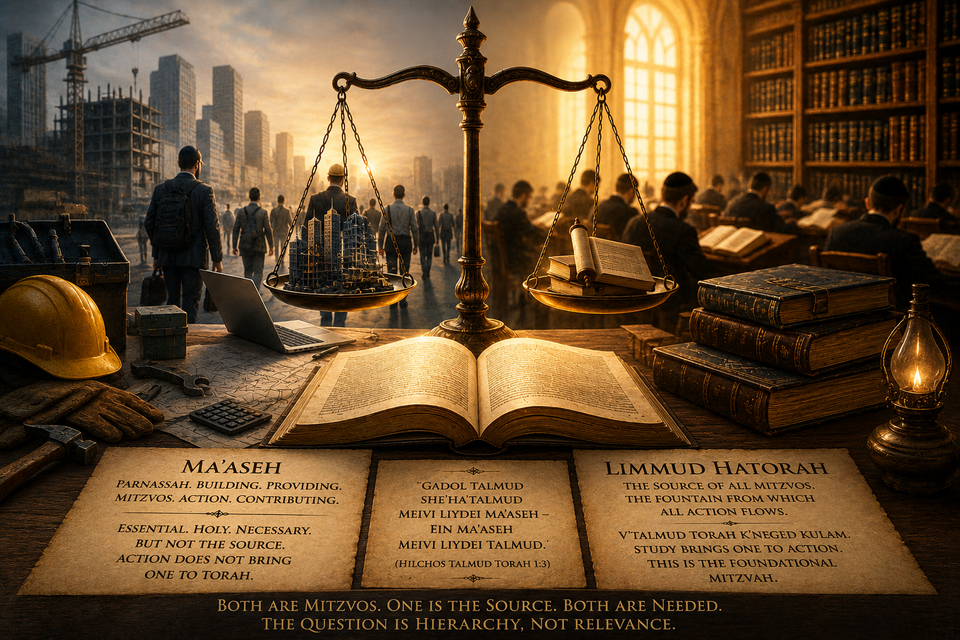
The Talmud in Kiddushin 40b records the famous Rabbinic debate. Rabbi Tarfon and the Elders, in the upper chamber of Nit'za's house in Lod, asked the question that has framed the entire subsequent Jewish discussion: "Talmud gadol o ma'aseh gadol?" — "Is study greater or is action greater?" Rabbi Tarfon said action. Rabbi Akiva said study. The conclusion of the assembled Rabbis was:
"Gadol talmud she'ha'talmud meivi liydei ma'aseh."
"Study is greater, because study brings one to action."
The Rambam in Hilchos Talmud Torah 1:3, codifying this Gemara, adds a sharpening: "Gadol talmud Torah she'ha'talmud meivi liydei ma'aseh, ein ma'aseh meivi liydei talmud" — "Torah study is greater, because study brings one to action; action does not bring one to study." The Rambam's addition is significant. The relationship is asymmetric. Torah study produces action. Action does not produce Torah study. The two are not interchangeable goods; they are sequentially related, with Torah study as the foundational input from which all other mitzvah-fulfillment flows.
These are the Torah's own framings. Torah study occupies a structural position that no other mitzvah occupies. It is the source from which action flows; it is equal in value to all other major mitzvos combined; it is the foundational mechanism by which the rest of the Jewish religious life is generated.
II. The Hard Question: The Rambam in Hilchos Talmud Torah 3:10
Now we must address, with full honesty, the most challenging halachic source in the entire discussion.
The Rambam, in Hilchos Talmud Torah 3:10, writes one of the most strongly-worded statements in all of Mishneh Torah:
"Anyone who decides to engage in Torah and not work, and to be supported from tzedaka — this person has desecrated Hashem's name, shamed the Torah, extinguished the light of religion, brought evil upon himself, and removed his life from the world to come. For it is forbidden to derive material benefit from words of Torah in this world. The Sages said: 'Anyone who derives benefit from words of Torah removes his life from the world.'"
The Rambam continues, in 3:11, with the famous citation of the Tanna who "loved his work" (the Tanna Hillel and Shamai are referenced as patterns), and concludes:
"Most of the great Sages of Israel were chopping wood, drawing water, and watering gardens, dealing in iron and being blacksmiths, and they did not ask anything from the community."
This is the Rambam. The strict, plain reading of this passage would seem to overturn the entire Charedi kollel framework. It is the single most important source the critics of the Charedi system rely on, and the honest Charedi response begins by acknowledging that the Rambam said what he said. The Charedi mesorah does not pretend this passage doesn't exist.
The question is how the halacha was decided. Because — and this is the crucial point — the Rambam's strict view was not accepted as the operative halacha by the major Acharonim who came after him. The position they took, codified in the Shulchan Aruch and the major halachic compendia, is documented and verifiable.
III. How the Halacha Was Actually Decided
The Kesef Mishneh — Rabbi Yosef Karo's commentary on the Rambam, written by the same Rabbi Yosef Karo who authored the Shulchan Aruch and the Beis Yosef — addresses the Rambam's strict position directly. The Kesef Mishneh on Hilchos Talmud Torah 3:10 explains:
"It seems that the prevailing custom in all the lands of Israel is that the rabbis of communities have a salary set for them from the community. And even though there is a basis for what the Rambam wrote, since the alternative would be that Torah would be forgotten, the established custom is correct. For if the rabbi had to support himself by manual labor, he would not be able to teach Torah at all."
The Kesef Mishneh's framework is structural and unambiguous: the Rambam's strict view, if applied literally in the contemporary period, would produce the disappearance of Torah, because there would be no class of full-time Torah teachers to maintain the chain of transmission. Therefore, the established halachic custom — which Rabbi Yosef Karo treats as authoritative — permits the support of Torah teachers and scholars from communal funds. This is not a leniency despite the Rambam; it is the proper application of halachic process to the Rambam's framework given the actual conditions of the post-Talmudic Jewish world.
The Rema in Yoreh Deah 246:21 codifies the permissive ruling as standard halacha:
"It is permitted to a Torah scholar to make stipulations with the community that they will support him so that he can engage in Torah study… and many of the greatest of Israel did so."
The Aruch HaShulchan, Yoreh Deah 246:40-42, Rabbi Yechiel Michel Epstein's late-19th-century compendium that is treated as authoritative across Lithuanian and Hungarian Charedi communities, codifies the Rema's position in elaborate detail and treats it as the binding halachic standard.
Rav Moshe Feinstein zt"l, in Igros Moshe Yoreh Deah 2:116, rules definitively: it is "certainly fine" for kollel students to take payment. Rav Moshe anchors his ruling on the chain we have outlined, and adds the additional principle of eis la'asos l'Hashem — that the spiritual condition of the generation requires the kollel framework to maintain Torah greatness.
This is the operative halacha. The Rambam said what he said in Hilchos Talmud Torah 3:10. The Kesef Mishneh explained how the halacha was decided. The Rema codified the permissive ruling. The Aruch HaShulchan and Igros Moshe ratified it. The mainstream halachic ruling — across the central halachic codifiers of the past five centuries — is that Torah scholars may be supported by the community for their full-time learning. The Charedi kollel system rests on this codified halacha, not on a Charedi sociological invention.
IV. The Rambam's Deeper Framework: Hilchos Shemittah V'Yovel 13:13
The Rambam himself, in another section of Mishneh Torah, provides the structural foundation that resolves the apparent tension. In Hilchos Shemittah V'Yovel 13:13 — a source we have referenced across this series — the Rambam codifies:
"And not the tribe of Levi alone, but every single individual whose spirit moves him and whose intelligence gives him to set himself apart to stand before Hashem, to serve Him and minister to Him and to know Hashem… behold, this person has been consecrated as the Holy of Holies, and Hashem will be his portion and his inheritance forever and ever, and will provide for him sufficient material needs in this world, just as He provided for the Kohanim and the Levi'im."
The Rambam here creates an explicit structural category: those who set themselves apart for the full-time service of Hashem are in the same structural position as the Levi'im in the period of the Mishkan and Beis HaMikdash. The Levi'im did not receive a portion in the Land. They did not engage in agricultural production. They received terumos and maaseros — the structural communal support that allowed them to dedicate themselves entirely to the service of Hashem. The Rambam in this passage extends that framework explicitly beyond the tribe of Levi to any individual who makes the parallel commitment.
This is the deeper Rambam, and it is the structural foundation of the Charedi kollel system. The Levi'im model is not a marginal halachic provision. It is a core Torah category — codified in Bamidbar, expanded by Moshe Rabbeinu, applied across the entire history of the Beis HaMikdash period — and the Rambam codifies its extension to anyone who undertakes the structural commitment to full-time service of Hashem.
The apparent tension between Hilchos Talmud Torah 3:10 and Hilchos Shemittah V'Yovel 13:13 is resolved by the major Acharonim by reading the strict passage as the general default — apprenticeship-style learning that should normally accompany work — and the structural passage as the exception for those who genuinely qualify — those whose entire spiritual orientation is toward full-time service of Hashem in the manner of the Levi'im. The Charedi kollel system structures itself around the latter category, while acknowledging the former as the general framework.
V. The Yissachar-Zevulun Framework
Beyond the halachic codification, the Torah itself provides the model of structured partnership between those who learn and those who work. In Bereishis 49 and Devarim 33, the brachos of Yaakov Avinu and Moshe Rabbeinu to the tribes of Yissachar and Zevulun establish the foundational paradigm.
Devarim 33:18: "Semach Zevulun b'tzeisecha, v'Yissachar b'oholecha" — "Rejoice, Zevulun, in your going out; and Yissachar, in your tents."
The Midrash on this pasuk, developed across the Rabbah and Tanchuma literature, articulates the partnership: Zevulun the merchant, sailing the seas, supporting his brother Yissachar's full-time Torah study in the tents (the beis medrash); both tribes blessed together, with both functions integrated into the single national life of Klal Yisrael. The Yissachar-Zevulun model is not a sociological hypothesis but a Torah-blessed framework, treated by the major halachic authorities as the paradigm of how a Jewish community is supposed to sustain its full-time learners.
The Vilna Gaon's school explicitly embraced this framework. The Lithuanian yeshiva system that built itself on the Gra's mesorah was structured around the principle that the community supports its full-time learners, and that both supporters and learners share in the merit of the Torah being learned. The contemporary Charedi kollel system is the institutional embodiment of the Yissachar-Zevulun paradigm, operating in the form the major Acharonim codified.
VI. Why the Charedi World Treasures Full-Time Learning
Now we can articulate the affirmative case. The Charedi world treasures and structurally supports full-time Torah learning because:
Torah study is identified by Chazal as equivalent in value to all other major mitzvos combined. This is Pe'ah 1:1, recited daily. No other Jewish religious activity occupies the same structural position.
Torah study is the mechanism by which Klal Yisrael's national survival operates. This is Sotah 21a (Torah magna u'matzla), Shabbos 119b (hevel pihem shel tinokos shel beis rabban), and the foundational understanding of how Hashem protects His people through the merit of Torah being learned.
Full-time learners exist in a structural category the Torah recognizes — the kodesh kodashim category of the Levi'im, extended beyond the tribe of Levi by the Rambam in Hilchos Shemittah V'Yovel 13:13. Their support by the broader community is not charity. It is the halachically prescribed structural relationship between the working and learning components of Jewish national life.
The Yissachar-Zevulun paradigm — the Torah's own model — establishes the framework of partnership between those who work and those who learn. Both share in the merit of the Torah being learned. Both are essential to the national life of Klal Yisrael.
The chain of mesorah — the transmission of Torah from Sinai through every generation — requires a class of full-time scholars in each generation. Without that class, the chain would break. The Kesef Mishneh explicitly made this point: the Rambam's strict view, if applied in the contemporary period, would produce the disappearance of Torah.
The contemporary Charedi yeshiva system has produced — across post-Holocaust Eretz Yisrael, America, and beyond — the largest, deepest, most rigorously committed Torah-learning infrastructure in Jewish history. Mir Yerushalayim has eight thousand talmidim. Lakewood and its affiliates have tens of thousands. The Chabad institutions, the Chassidic courts, the Sephardic yeshivos, the Lithuanian yeshivos — collectively, contemporary Torah Jewry sustains a quantity and quality of Torah learning that exceeds the entire pre-Holocaust period. This is the documented achievement of the system the original Rambam in 3:10 would seem to have opposed and the operative halacha permitted.
VII. Documented Gadol Positions on the Kollel System
The contemporary Charedi gedolei haposkim have, with unanimity, treated the kollel system as the operative framework of Charedi communal life:
The Chazon Ish (Rabbi Avraham Yeshaya Karelitz zt"l), in Emunah u'Bitachon and across his teshuvos, structured the post-Holocaust Lithuanian Charedi rebuilding around the principle that full-time Torah learning is the highest avodas Hashem and that the community's first obligation is to support those who undertake it. His documented October 1952 meeting with David Ben-Gurion — "In the merit of our Torah study, they live, work, and are protected. Torah is the tree of life, the elixir of life" — is the foundational articulation of the Charedi position to the secular leadership of the State.
Rav Aharon Kotler zt"l, founder of Beth Medrash Govoha in Lakewood, built the American Lithuanian yeshiva system around the same principle. His writings in Mishnas Rabbi Aharon articulate the centrality of full-time Torah learning to the rebuilding of Klal Yisrael after the Holocaust.
Rav Elazar Menachem Man Shach zt"l, in Michtavim u'Maamarim and across his recorded ma'amarim, defended the kollel system as the structural backbone of the Lithuanian Charedi mesorah.
Rav Yosef Shalom Elyashiv zt"l, in his rulings collected in Kovetz Teshuvos and elsewhere, treated the support of Torah scholars as a structural communal obligation.
The Sephardic poskim, including Chacham Ovadia Yosef zt"l in Yabia Omer and Chacham Ben Zion Abba Shaul zt"l in Or LeTzion, codified the same framework for the Sephardic Charedi communities they led.
The framework is uniform across every Charedi stream of the modern era. The mainstream halachic-mesoretic position is that full-time Torah learning, supported by the community, is the highest spiritual achievement available to a Jewish man and the structural mechanism by which Klal Yisrael maintains its national survival.
VIII. What If You Can't Learn Full-Time?
The honest Charedi position has always acknowledged that not every Jew is able to learn full-time, and that the framework for those who must work is well-established in halacha.
The Rambam in Hilchos Talmud Torah 1:8 codifies that every Jew, regardless of economic circumstances, is obligated in Talmud Torah: "Every man of Israel is obligated in Talmud Torah, whether poor or rich, whether healthy or suffering, whether young or in his old age… until the day of his death."
The Rambam in 1:10 elaborates: "Until when must a man learn Torah? Until the day of his death." The obligation is lifelong. The form may shift — full-time learning for those who can, daily sedarim for those who work — but the underlying commitment to Torah study as the defining structure of the Jewish day does not change.
The mainstream Charedi framework for those who cannot learn full-time is:
Daily sedarim — fixed times for Torah study every morning and evening. Every working Charedi maintains daily Torah learning. Many learn before Shacharis, attend a shiur between Mincha and Maariv, learn with a chavrusa in the evening. The day is structured around Torah even when the primary professional commitment is elsewhere.
Continued connection to a beis medrash and a Rosh Yeshiva. Working Charedim retain active relationships with their original yeshivos, support them financially, send their children there, and continue to identify primarily as bnei Torah even when their professional lives operate in secular industries.
The Yissachar-Zevulun partnership. The working Charedi supports the full-time learner, financially and structurally, and shares — through the established halachic framework — in the merit of the Torah the learner produces.
The home as the secondary beis medrash. Charedi homes are structured around Torah — daily birchos hashachar, shacharis, shema, daily daf yomi or other limudim, Shabbos table divrei Torah, sons attending yeshiva, daughters learning in Bais Yaakov. The structure of Charedi family life ensures that Torah remains the operating framework of the home even when the father works full-time.
IX. The Honest Acknowledgment of Costs
The Charedi system has costs. The Charedi mesorah does not pretend otherwise:
Economic strain. Large families on modest incomes, supported partially by community funds and partially by working spouses, often produce significant financial pressure. The Charedi community has built extensive gemach infrastructure, mutual aid networks, and communal support systems to address this, but the strain is real.
The diversity of capacities. Not every Charedi man is suited to full-time learning at the highest level. The historical Charedi system was clearer about this — recognizing that most working Charedi men in pre-war Eastern Europe were workers and merchants who learned daily but did not learn full-time. The contemporary system, building everyone toward kollel as the default, has sometimes asked of individuals what their individual aptitudes did not match. Internal Charedi discussion on this question has been intensifying over the past two decades.
The relationship with secular employment. As Charedim have increasingly entered the workforce — male labor force participation rising from 36% in 2003 to 55-57% by 2022 — the question of how to integrate Torah learning with professional life has produced new institutional responses (Lev Academic Center, the Kemach Foundation, the Adina Bar-Shalom institutions). The work is ongoing.
Different streams have different emphases. The Satmar position is more uncompromising about exclusive full-time learning. The Lithuanian-American position (Lakewood, Telshe) has historically been more accommodating of working baalei batim. The Sephardic communities have historically maintained a more balanced approach. The Charedi world is not monolithic on the specific institutional form.
X. The Closing Synthesis
The Charedi view on full-time Torah learning versus working is, then, not a single simple proposition. It is a framework with multiple levels:
The Torah's hierarchy — talmud Torah k'neged kulam — places Torah study in a structural category equivalent to all other major mitzvos combined.
The Talmudic resolution — talmud gadol she'ha'talmud meivi liydei ma'aseh — establishes that Torah study is greater because it generates the entire framework of mitzvah action.
The halachic codification — through the Kesef Mishneh, Rema, Aruch HaShulchan, and Igros Moshe — permits and indeed requires the communal support of full-time Torah learners.
The structural foundation — the Rambam in Hilchos Shemittah V'Yovel 13:13 — places those who set themselves apart for full-time service of Hashem in the kodesh kodashim category, with material support flowing from the broader community.
The Yissachar-Zevulun paradigm — the Torah's own partnership model — establishes the framework by which the working and learning components of Klal Yisrael are integrated into a single national life.
The lifelong obligation — Rambam Hilchos Talmud Torah 1:8 and 1:10 — applies to every Jew, in every condition, until the day of his death.
The Rambam's strict view in 3:10 — acknowledged honestly, addressed by the Kesef Mishneh, ruled against by the operative halacha — represents the general default in conditions where Torah is not at risk of being forgotten, and was set aside by the major Acharonim in conditions where the chain of transmission required the full-time learners the Rambam's strict view would have eliminated.
The contemporary Charedi system — with its kollelim, its yeshivos, its full-time learners and its working supporters, its rebbeim and its talmidim, its mothers raising the next generation and its fathers split between beis medrash and parnasa — is the institutional expression of this halachic framework. It is anchored in primary sources. It has produced the largest and deepest Torah-learning infrastructure in Jewish history. It is not a deviation from the Rambam. It is the operative halacha as the Rambam's own halachic process resolved itself across the major Acharonim.
As the Mishnah in Pirkei Avos 6:1 closes the masechta: "Anyone who engages in Torah for its own sake merits many things; and not only that, but the entire world is justified for his sake."
That is the position the Charedi world has held for two centuries. That is the position the documented halacha — across the central codifiers of the post-Rambam era — supports. That is the framework we will continue to live by, build with, and transmit to the next generation, bimheirah b'yameinu, until the geulah comes and the entire world fills with the knowledge of Hashem as a deep ocean fills with its waters (Rambam, Hilchos Melachim 12:5).
Bimheirah b'yameinu, amen.
Sources
Foundational Torah hierarchy
- Mishnah, Pe'ah 1:1 — "V'talmud Torah k'neged kulam" (recited daily in birchos hashachar)
- Talmud Bavli, Kiddushin 40b — Rabbi Tarfon vs. Rabbi Akiva: "Gadol talmud she'ha'talmud meivi liydei ma'aseh"
- Rambam, Mishneh Torah, Hilchos Talmud Torah 1:3 — "Talmud Torah is greater because study brings to action; action does not bring to study"
The Rambam's strict view and the halachic resolution
- Rambam, Mishneh Torah, Hilchos Talmud Torah 3:10 — the strict statement against being supported by tzedaka for Torah study (cited honestly)
- Rambam, Hilchos Talmud Torah 3:11 — the praise of sages who worked
- Kesef Mishneh on Hilchos Talmud Torah 3:10 — Rabbi Yosef Karo's analysis: the Rambam's strict view was not accepted as operative halacha because Torah would be forgotten
- Rema, Yoreh Deah 246:21 — explicit permission for Torah scholars to be supported by the community
- Aruch HaShulchan, Yoreh Deah 246:40–42 — Rabbi Yechiel Michel Epstein's codification
- Igros Moshe, Yoreh Deah 2:116, Rav Moshe Feinstein zt"l — definitive ruling permitting kollel student support
The structural Torah framework
- Rambam, Mishneh Torah, Hilchos Shemittah V'Yovel 13:13 — the kodesh kodashim category extending beyond Levi to any individual setting himself apart for full-time service of Hashem
- Rambam, Mishneh Torah, Hilchos Talmud Torah 1:8 and 1:10 — universal obligation in Talmud Torah; lifelong duration
The Yissachar-Zevulun paradigm
- Bereishis 49:13–15 — Yaakov's brachos to Zevulun and Yissachar
- Devarim 33:18–19 — Moshe's brachos: "Semach Zevulun b'tzeisecha, v'Yissachar b'oholecha"
- Midrash Bereishis Rabbah, Tanchuma, and related sources developing the partnership paradigm
Tanach and Mishnah closing
- Mishnah, Pirkei Avos 6:1 — the baraisa on Torah for its own sake
- Mishnah, Pirkei Avos 2:2 — "Yafeh Talmud Torah im derech eretz" (Rabban Gamliel)
Documented Charedi gadol positions
- Emunah u'Bitachon, Chazon Ish (Rabbi Avraham Yeshaya Karelitz zt"l)
- Kovetz Igros, Chazon Ish, Vol. 1, p. 97
- The Chazon Ish – Ben-Gurion meeting (October 1952) as recorded by Yitzchak Navon
- Mishnas Rabbi Aharon, Rav Aharon Kotler zt"l
- Michtavim u'Maamarim, Rabbi Elazar Menachem Man Shach zt"l, Vol. 1
- Kovetz Teshuvos, Rabbi Yosef Shalom Elyashiv zt"l
- Yabia Omer, Chacham Ovadia Yosef zt"l
- Or LeTzion, Chacham Ben Zion Abba Shaul zt"l
The structural protection mechanism
- Talmud Bavli, Sotah 21a — Torah magna u'matzla
- Talmud Bavli, Shabbos 119b — hevel pihem shel tinokos shel beis rabban
- Talmud Bavli, Berachos 64a — Talmidei chachamim marbim shalom ba'olam
Contemporary Charedi economic reality
- Israel Central Bureau of Statistics — Charedi male labor force participation 36% (2003) → 55-57% (2022)
- Lev Academic Center / Machon Lev, Adina Bar-Shalom institutions, Kemach Foundation — Charedi vocational training programs
The closing vision
- Rambam, Mishneh Torah, Hilchos Melachim 12:5 — the world filled with the knowledge of Hashem as deep waters fill the sea