What Is the Charedi View on Voting in Israeli Elections?
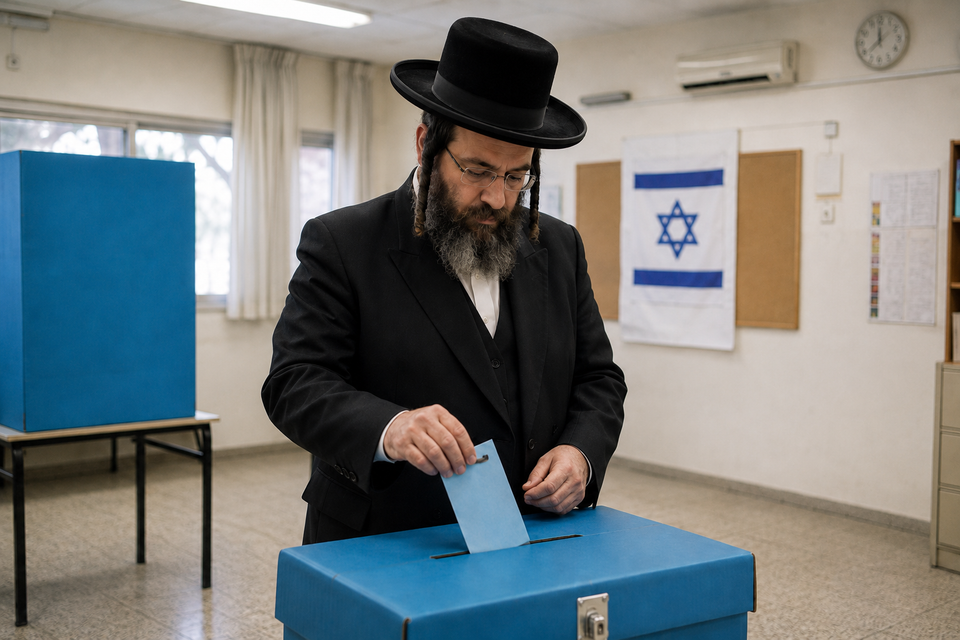
On the surface it looks like a contradiction. The Charedi world objects, openly and consistently, to the ideology on which the secular State was built — and then turns out to vote in some of the highest, most disciplined numbers in the country. The contradiction dissolves the moment one grasps a single distinction the Gedolim have drawn for seventy years: there is a world of difference between participating in a system and endorsing it. Charedim do not vote to bless the State. They vote to protect the Torah from it.
A Jew can walk into a polling station the way he walks into any arena he does not control — not to celebrate it, but to defend what is precious inside it. That is what the Charedi vote is: not a declaration of faith in the State, but an act of hishtadlus to shield yeshivos, chinuch, Shabbos, and the Torah way of life from those who would legislate against them.
I. Protection, Not Endorsement
The Gedolei Yisrael have never left this ambiguous. Rav Elazar Menachem Man Shach — who founded Degel HaTorah precisely to organize the Torah community's voice at the ballot box — taught plainly that participation in elections is not an expression of confidence in the system, but a means of preventing those hostile to Torah from seizing control over Torah life. The Steipler Gaon framed it as an obligation rooted not in any recognition of the government as ideal, but in the duty to safeguard the mosdos haTorah and the children who fill them.
The stakes are not abstract, and that is the point. Every seat in the Knesset translates, sooner or later, into a decision about whether yeshivos are funded or starved, whether bnei Torah are conscripted or left to learn, whether Shabbos is protected in the public square, whether kashrus and family purity retain their legal standing, whether a Charedi child's chinuch remains in his parents' hands. To abstain from that contest is not to keep clean hands. It is to hand the outcome to those who wish the Torah world ill.
II. A Chiyuv, Even a Matter of Pikuach Nefesh
This is why the Gedolim have spoken of voting not as a civic nicety but as a chiyuv — and, in the language of poskim such as Rav Shmuel Wosner, as a matter approaching pikuach nefesh in its own right. The reasoning is straightforward once the danger is taken seriously: legislation hostile to Torah threatens the spiritual life of Klal Yisrael, and in our own day it has come to threaten the material survival of the yeshiva world as well, as budgets are cut and bnei Torah are pursued. A threat to the soul of the nation, and increasingly to the body of its Torah institutions, is not a thing one meets with a shrug.
That is the engine behind the famous discipline of the Charedi vote — the near-universal turnout that astonishes outside observers. It is not enthusiasm for politics. It is the response of a community that has been taught to regard the ballot as a wall standing between its children and harm, and a kol korei from its Gedolim before an election as a call to defend that wall.
III. Voting by Daas Torah, Not Personal Politics
Here the Charedi approach diverges most sharply from the surrounding political culture, and the difference is essential to understanding it. For most citizens, a vote is an act of individual self-expression — a personal verdict on candidates and policies. In the Torah world it is something else entirely: an act of communal protection, guided by daas Torah rather than private preference.
The Gedolim, through the Moetzes and their public directives, weigh which path best shields the Torah community, and the voter follows that guidance — often setting aside whatever personal opinion he might otherwise have held. This is not the suppression of conscience; it is its elevation. The individual subordinates his private political instincts to the collective good of Klal Yisrael as those most steeped in Torah understand it. The result is the bloc — a community voting as one — and it is precisely that unity that gives a numerically small population the weight to defend itself at all. A scattered vote protects nothing; a directed one protects everything.
IV. An Ancient Practice in a Modern Form
None of this is an innovation forced on the Torah world by the modern state. It is the newest expression of one of the oldest instincts in Jewish history: the practice of shtadlanus. Throughout the long galus, Jews lived under governments they did not build, could not endorse, and often had every reason to fear — and in every one of them they worked within the system to protect the kehillah. Yosef rose in the court of Mitzrayim; Mordechai and Esther operated inside the palace of Achashverosh; in every European town the shtadlan stood before the king, the duke, or the czar, pleading the cause of his community and using whatever leverage the system afforded to shield Jewish life.
Not one of them mistook his access for approval. The shtadlan who interceded with a hostile crown was not endorsing the crown; he was protecting Jews from it. Voting in Israeli elections is that same avodah in modern dress — using the instruments the system provides to guard Torah within it, exactly as our ancestors did for two thousand years before there was a Knesset to vote for.
V. Reluctant Participation, Never Legitimization
The care taken at the founding of the State shows just how sharply the Gedolim distinguished defense from endorsement. In those early years, Rav Aharon Kotler was deeply opposed to the Torah community joining the government as a full partner, fearing it would be read as a stamp of legitimacy on a state born of an ideology that sought to replace Torah identity with a secular national one. Yet on the question of voting and running for the Knesset, he urged participation — for the protection it bought. The logic he is remembered for is the logic of necessity: just as a person may cross even a minefield when it is the only path to saving a life, so the Torah community enters even a flawed system when the alternative is to leave its own survival undefended. Rav Yosef Shalom Elyashiv held the same line: participation as an act of protection, so that the Torah community would not be harmed by those who neither share nor understand its way of life.
That distinction was built into the very conduct of Charedi politics. For decades the Torah parties were careful to take partial roles in government rather than full ones — accepting deputy positions and chairmanships while declining the full ministerial seats that would have signaled ownership of the secular state's enterprise. The message was deliberate: we are here to guard our own, not to share in the celebration of a project we do not believe in. One can sit in the room to protect one's children without ever rising to toast the host.
VI. Hishtadlus, Not Misplaced Trust
Underneath all of this lies the basic Torah architecture of hishtadlus and bitachon. The Charedi Jew believes with complete faith that the Ribbono Shel Olam alone runs the world and decides every outcome — and the same Torah that teaches him this commands him to act responsibly within the natural order all the same. He locks his door though Hashem is the true Guardian of the city; he buys insurance and visits a doctor without for a moment doubting Who heals and Who provides. Voting is hishtadlus of exactly this kind, carried into the political realm. The ballot is not where a Torah Jew places his trust — that rests in Hashem, never in princes or parties. It is simply the effort the situation demands, offered up with the knowledge that the result, as always, is in Hands far higher than the Central Elections Committee.
VII. Those Who Do Not Vote — and Why It Is Still Principled
Honesty requires acknowledging that not all of the Torah world votes. Significant segments — much of the Eidah HaChareidis, the Satmar community in the tradition of the Vayoel Moshe, and Neturei Karta — abstain entirely, holding that even casting a ballot implies a measure of recognition for a state whose very legitimacy they cannot affirm. Theirs is not apathy; it is a position arrived at by the same reverence for Torah's supremacy, applied to a different conclusion. They judge that the message of non-recognition matters more than the protection the vote secures, and they hold to it consistently.
For the great majority of the Gedolim, however — the line running from the Chazon Ish through Rav Shach, the Steipler, Rav Elyashiv, and Rav Aharon Leib Shteinman — the calculation came out the other way. In an age when the gezeiros against Torah arrive not as decrees of kings but as bills, budgets, and court rulings, they held that to walk away from the ballot box is to abandon the battlefield while the battle rages — and that surrender, when the survival of Torah life is at stake, is not an option a Jew is permitted. We fight this generation's gezeiros with ballots rather than bullets, because ballots are the weapons this generation's war is fought with.
VIII. From the Ballot Box to the Beis Medrash
So the Charedi response to the modern state is not the retreat its critics imagine. It is a deliberate, disciplined, rabbinically-guided engagement — showing up, in force, not because the system is holy but because the Torah is, and the Torah needs defending in whatever arena it is threatened.
Charedi voting is not an embrace of the State. It is the defense of a community's right to go on living a life of Torah within the boundaries of halacha. It is not, and has never been, a statement of belief in Medinas Yisrael. It is a statement of loyalty to the Torah of Sinai — and of resistance to anyone who would use the machinery of the state to chip away at it. The vote is cast in the morning so that the learning can go on undisturbed in the afternoon; the road from the ballot box leads, as it always has, straight back to the beis medrash.
May the Torah community always merit leaders who guide it with wisdom, may its voice protect its yeshivos and its children, and may we soon see the day when the only sovereignty over Klal Yisrael is the sovereignty of Heaven — bimheirah b'yameinu, amen.
Sources
The Torah framework
- Hishtadlus and bitachon — the obligation to act responsibly within the natural order while placing all trust in Hashem (the principle behind locking a door, seeking a doctor, and acting in the political world)
- Shtadlanus through the generations — Yosef in Mitzrayim, Mordechai and Esther in Shushan, and the communal shtadlanim of galus, who worked within hostile governments to protect Klal Yisrael without endorsing them
The positions of the Gedolim on voting
- Rav Elazar Menachem Man Shach — founder of Degel HaTorah; that voting protects Torah life from those hostile to it and is not an expression of faith in the system
- The Steipler Gaon, Rav Yaakov Yisrael Kanievsky — the obligation to vote to safeguard the mosdos haTorah and Jewish children, not as recognition of the government
- Rav Shmuel Wosner — voting as a chiyuv approaching the level of pikuach nefesh, given the danger of anti-Torah legislation
- Rav Aharon Kotler — opposition to joining the government as a full partner, alongside support for voting and running for the protection it secures
- Rav Yosef Shalom Elyashiv — participation as an act of protection for the Torah community
- Rav Aharon Leib Shteinman and the Chazon Ish — the consistent guidance of the Torah community to participate in elections as a defense against the gezeiros of the age
The principled abstainers
- The Eidah HaChareidis, the Satmar tradition of the Vayoel Moshe, and Neturei Karta — who decline to vote on the grounds that it implies recognition of the State
The structural relationship to other articles in this series
- "The Charedi Approach to Political Participation" — the broader posture this voting expresses
- "What Is the Charedi View of the State's Government Legitimacy?" — why participation is never endorsement
- "Do Charedim Pray for the State?" — the same distinction between protecting fellow Jews and affirming the state's ideology
- "Is Zionism One of the Seventy Faces of Torah?" — the ideology the Charedi vote declines to bless