
What is the Charedi view of the Israeli Supreme Court?
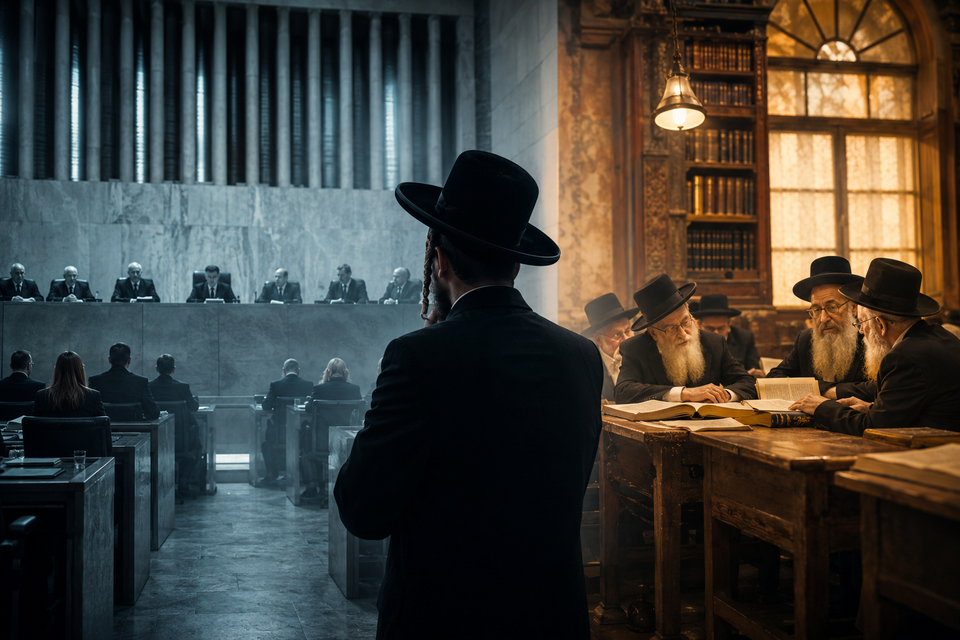
To the Charedi world, the Israeli Supreme Court is not simply a legal institution. It is a spiritual battleground. Where much of the country sees the highest expression of democracy and justice, Charedim see a system built on values foreign to the Torah — and, with growing frequency, set in open conflict with it. We revere justice; it is one of the pillars on which the Mishnah says the world itself stands. But the Torah teaches that true justice can flow from only one source — Hashem's law — and never from a man-made system that installs itself in the Torah's place.
I. Justice Belongs to God
The deepest objection has nothing to do with any single ruling. It concerns the nature of justice itself. In the Torah's understanding, a judge does not hand down his justice; he administers God's. "Do not fear any man," Moshe charges the judges, "ki hamishpat lElokim hu — for the judgment is God's" (Devarim 1:17). When a beis din convenes to render a true judgment, our Sages teach, the Shechinah itself rests among them; the judge sits not as the author of the law but as the representative of the One who gave it. Law, in this conception, is not a human artifact to be engineered toward whatever a society happens to prize in a given decade. It is the revealed will of the Creator, tzedek tzedek tirdof — a justice we are commanded to pursue precisely because it is His and not ours (Devarim 16:18–20).
Measured against that, a court that derives its law from British common law and the evolving values of Western liberalism, rather than from Sinai, is not — from the Torah's vantage — a more enlightened form of justice. It is a departure from the only place real justice was ever anchored. The disagreement, at its root, is not about which rulings are wise. It is about whether justice belongs to God or to man.
II. The Halacha: A Jew Does Not Go to Secular Courts
This is not a mood; it is codified law. The Shulchan Aruch rules that a Jew who brings his fellow before a secular court instead of a beis din has committed something grave — in the language of the halacha, it is as though he has raised his hand against the Torah of Moshe Rabbeinu (Choshen Mishpat 26:1), for the Torah itself directs that disputes be brought "before them" — before the Torah's own judges — and not before others. And here is the part that reveals what is really at stake: the prohibition stands even if the secular court would rule precisely as the Torah would. The objection was never merely to a wrong outcome. It is to the authority. To choose a man-made tribunal over Hashem's is to declare, in the act itself, that His law is optional — and that, in the eyes of the poskim, is why turning to the state's secular courts in place of a beis din remains forbidden.
III. A System That Sits in Judgment Over the Torah
Layer the institution's actual character over the halacha, and the grief sharpens. Over recent decades the Israeli Supreme Court built itself into one of the most powerful and activist high courts in the democratic world — expanding its reach until it could strike down laws passed by the elected Knesset and reshape Israeli society according to a liberal, Western worldview, often over the objections of the public's own representatives. Across many domains, from the public character of Shabbos to the question of who is a Jew, it has placed that worldview above the values of the Torah. And increasingly, it has trained that vast power on the Torah world itself — sitting in judgment over the yeshivos, over Torah chinuch, and over the very way of life the Torah commands, confident that it knows better.
IV. The Clearest Case: The War on the Yeshivos
Nowhere is this clearer than in the draft. For decades, the arrangement that allowed yeshiva students to remain immersed in their learning was a settled feature of Israeli life. The Court has repeatedly ruled those exemptions unconstitutional — and in June 2024, a nine-justice panel ruled that, with no valid exemption framework left in law, the state must conscript yeshiva students under the ordinary draft law and cut the funding of the yeshivos whose students did not serve, stripping something on the order of half a billion shekels a year from Torah institutions. Since then the Court has pressed without let-up — through 2025 and into 2026 ordering that state benefits be revoked from those who refuse to enlist, demanding criminal enforcement, and hauling the government before it for failing to comply.
Set the politics aside for a moment and see it from within. A secular court, applying secular law, has set itself the task of emptying the batei medrash — has ruled, in effect, that the learning of Torah, which the Charedi world holds to be the very purpose for which the Jewish people exists, must yield to the court's own conception of equality, and has moved to enforce that judgment against the Torah's own students with the machinery of the state. To the Charedi world this is not the impartial rule of law. It is a court elevating its values above the Torah, and then wielding them against it.
V. Not Hatred — Grief
It is essential to name the emotion correctly, because it is so easily mistaken for something uglier. What the Charedi world feels here is not hatred of the men and women on the bench, and not contempt for justice. It is grief — the particular grief of watching justice itself cut loose from its source. The Chazon Ish understood that secular law, however logical it may appear on its surface, quietly uproots the soul of the Torah, because it lays claim to the name of justice while removing the Torah from the picture entirely. Rav Shach taught that a court which judges by its own values rather than by the Torah becomes, in the end, not a wellspring of justice but a source of chillul Hashem. Rav Elyashiv guided the Torah world's response to rulings that trampled on religious life, and the Steipler held that there can be no true partnership between the Torah and a system that sets itself against it. But in none of this is the quarrel with the individuals. It is with the system that has displaced the Torah — and for the judges themselves, as for every Jew, we daven.
VI. What Charedim Do Instead — and What Justice Should Be
In their own lives, Charedim live the alternative. When disputes arise — monetary, communal, between families — they bring them to a beis din, not to the secular courts. A Torah court is not merely a mechanism for producing a verdict; it binds the conflict to a higher truth, judging by Hashem's law with the awareness that the Shechinah is present in the room. Only where the other party refuses to come to a beis din may one turn, with rabbinic permission and under defined conditions, to the secular court — and then only to protect against injustice, never as a first choice.
And it points toward a vision of what justice was always meant to be: judges who are talmidei chachamim rather than political appointees; law drawn from Sinai rather than from the latest turn of Western thought; a justice that is not only law but emes, rachamim, and yiras Shamayim woven together. It is the Rambam's portrait of the Sanhedrin seated in the Lishkas HaGazis, rendering judgment according to the Torah given to Moshe Rabbeinu — justice administered by those who tremble before the One in whose name they judge.
VII. In Summary
The Charedi view of the Israeli Supreme Court is, in the end, not political hatred but spiritual grief: grief over a system that has removed Hashem from the law, from its values, and from the very definition of justice — and that has turned the justice it kept against the Torah and the students who give their lives to it. To the Charedi world, justice without Hashem is not a thinner or lesser justice. It is not justice at all.
And so we wait, and we daven, for the day when the Torah will once again be the light by which Eretz Yisrael is judged — restored not by force and not through political domination, but through the return of hearts to the truth of Hashem's will.
May He restore our judges as in former days and our counselors as at the beginning, and reign over us, He alone, in kindness and mercy, with justice and with righteousness — bimheirah b'yameinu, amen.
Sources
Justice as Hashem's
- Devarim 1:17 — ki hamishpat lElokim hu, "the judgment is God's"; Devarim 16:18–20 — the command to appoint judges and pursue righteous justice; and the teaching of Chazal that the Shechinah rests among judges who render a true judgment
- Avos — din, justice, as one of the pillars on which the world stands
The halacha of secular courts
- Shulchan Aruch, Choshen Mishpat 26:1 — the prohibition against bringing a case before secular courts in place of a beis din, rooted in the Torah's command that disputes be brought "before them," the Torah's own judges — binding even where the secular court would rule identically
- Rambam, Hilchos Sanhedrin — the Sanhedrin in the Lishkas HaGazis, judging according to the Torah given to Moshe Rabbeinu
The positions of the Gedolim
- The Chazon Ish, Rav Elazar Menachem Man Shach, Rav Yosef Shalom Elyashiv, and the Steipler Gaon — that secular law uproots the Torah even when it appears reasonable, that a court judging by its own values rather than the Torah becomes a source of chillul Hashem, and that there can be no partnership between the Torah and a system arrayed against it
The structural relationship to other articles in this series
- "The Charedi Draft Debate" and "Does the State of Israel Try to Force Secular Education in Charedi Schools?" — the rulings in which this conflict is most concretely felt
- "What Is the Torah View on Democracy?" and "Do Charedim Support a Halachic State?" — the broader question of law and authority
- "Dina D'Malchusa Dina: The Torah View" — where the law of the land binds, and where it does not